
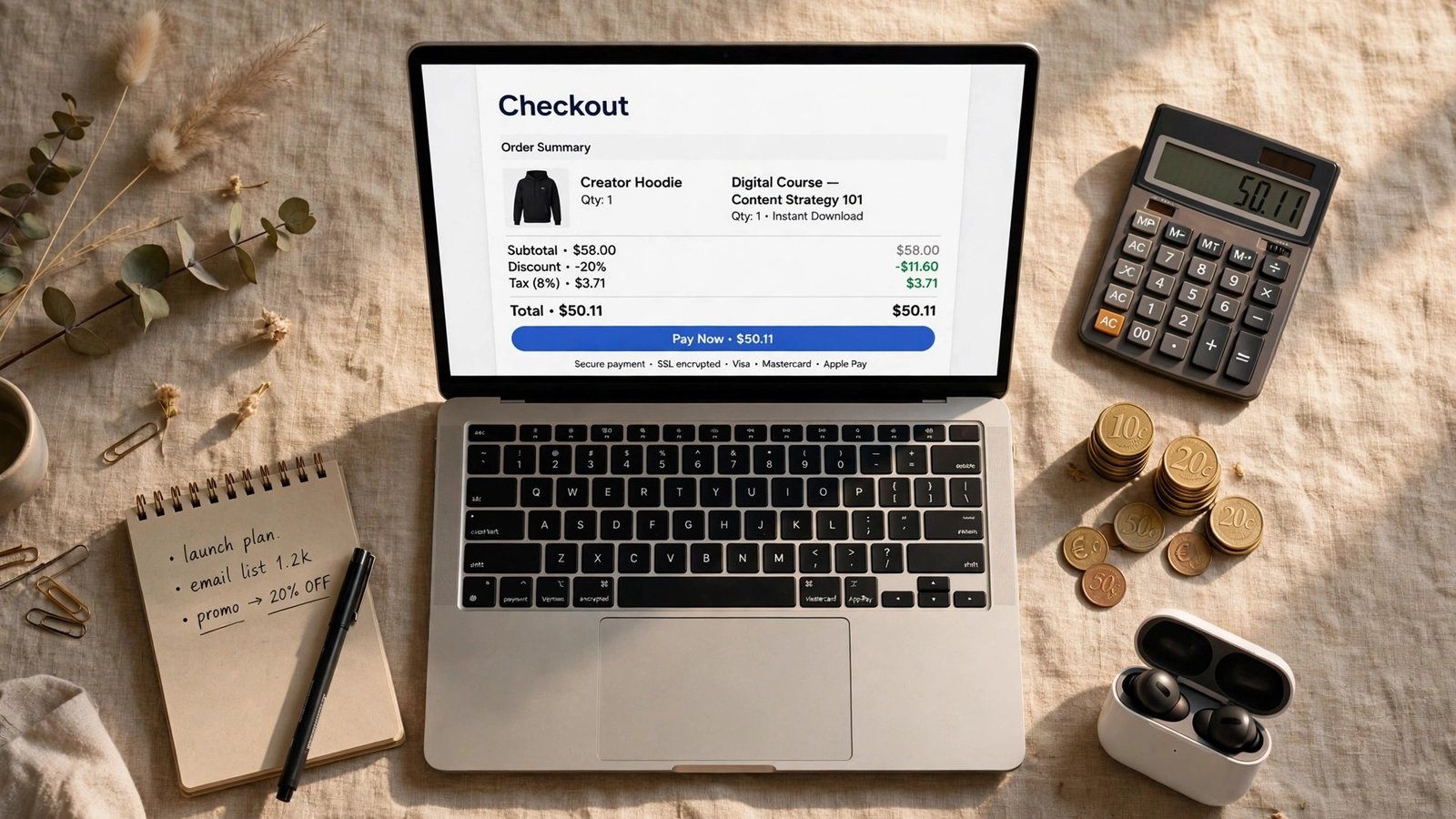
Lemon Squeezy charges 5% + 50¢ on every sale in 2026, with no monthly fee. That headline is honest — and it is also incomplete. If your buyer is outside the US, you pay another 1.5%. If they pay with PayPal, you pay another 1.5%. If it is a subscription payment, you pay another 0.5%. Stack those together and a $50 international subscription renewal costs you $4.00, not $3.00. That is 8% before you count anything else.
Lemon Squeezy publishes the surcharges in its fees documentation — the problem is that most sellers only read the pricing page, which says international sales “may encounter small additional fees” and leaves it at that. Price a $29 ebook or a $9-a-month membership on the 5% number alone, and your margins will come in lower than your spreadsheet promised.
Below: the full fee stack, worked examples at $9.99, $29, and $99, what the 5% buys you as a merchant of record, comparisons with Paddle, Gumroad, Stripe, and Creem, and what Stripe Managed Payments means for whether you should stay or move. Every competitor figure is a published rate, checked October 2026. Rates can change, so check your own account’s fee page before you reprice a catalog.
The Real Fee Stack: 5% + 50¢ Is the Floor, Not the Ceiling
Here is the whole stack, in one place:
| Fee | Rate |
|---|---|
| Base fee (every transaction) | 5% + $0.50 |
| Buyer outside the US | +1.5% |
| PayPal payment | +1.5% |
| Subscription / recurring payment | +0.5% |
| Affiliate-referred order (merchant side) | +3% |
| Payment recovered via abandoned-cart email | +5% |
| Affiliate payout | +2% |
Two details catch almost everyone out. First, the percentage is calculated on the total order value including tax: a German buyer paying $29 plus $5.51 of VAT is charged on $34.51, not $29. Second, the surcharges stack. A US buyer paying by card for a one-time product is the cheapest possible sale; almost any other combination costs more. The common stacks:
- US card, one-time: 5% + 50¢
- International card, one-time: 6.5% + 50¢
- US PayPal, one-time: 6.5% + 50¢
- International card, subscription: 7% + 50¢
- International PayPal, subscription: 8% + 50¢
That last line is the worst common case, and it is not an edge case. If you sell a membership or SaaS product globally and many customers pay with PayPal, a real chunk of your renewals will land at 8% + 50¢ — $4.50 in fees on a $50 renewal, $1.50 more than the headline rate suggests, every single month.
Worked Examples: What You Actually Keep at $9.99, $29, and $99
The table below uses the listed price before tax. In real life, tax is added on top and the fee is charged on the tax-inclusive total, so your real fee on an international sale will be a little higher.
| Price | US card (5% + 50¢) | International card (6.5% + 50¢) | International PayPal (8% + 50¢) |
|---|---|---|---|
| $9.99 | $1.00 fee, keep $8.99 | $1.15 fee, keep $8.84 | $1.30 fee, keep $8.69 |
| $29 | $1.95 fee, keep $27.05 | $2.39 fee, keep $26.61 | $2.82 fee, keep $26.18 |
| $99 | $5.45 fee, keep $93.55 | $6.94 fee, keep $92.06 | $8.42 fee, keep $90.58 |
The cheap-product problem
At $9.99, the 50¢ flat fee alone is 5% of the price, so a plain US card sale already costs 10%, and an international PayPal sale costs 13%. A $5 sale costs $0.75 on a US card — 15% — before surcharges. Lemon Squeezy is not built for very cheap products. At $99, the pattern flips: the 50¢ fee is half a percent, and the percentage dominates. The higher your price, the closer your real rate gets to the headline.
The $29 Germany example, with tax included
Take that $29 ebook sold to a buyer in Germany by card. The buyer pays $29 plus German VAT — about $5.51 at 19% — for a total of $34.51. Lemon Squeezy charges 6.5% on $34.51 ($2.24) plus 50¢, for a total fee of $2.74. Paddle charges its flat 5% + 50¢ on the same total: $1.73 + $0.50 = $2.23. Same headline rate, same sale, 51¢ difference — entirely because of the international surcharge.
The $50 test
A $50 one-time sale to a US buyer paying by card costs $3.00 in fees (5% is $2.50, plus 50¢). You keep $47.00 — a clean 6% effective rate. The same $50, as an international subscription renewal, costs $4.00: 5% + 1.5% international + 0.5% subscription = 7% ($3.50) plus 50¢. You keep $46.00. Same product, same price, a dollar less — $12 a year if that customer renews monthly. A $12 sale nets $10.90 after the $1.10 fee, a 9.2% effective rate on a plain US card sale, before any surcharge.
The Fees Beyond Checkout
Three more charges sit further down the funnel. Affiliate-referred orders cost an extra 3% on top of the normal fee — and you still pay the affiliate their commission, so factor both into your commission rate. Payments recovered through abandoned-cart emails cost an extra 5%; a recovered sale at a higher fee still beats a lost sale, but do not count recovered revenue at your normal margin. Affiliate payouts cost an extra 2%, easy to miss because it lands when money goes out. Model your real funnel, not just your checkout page.
Getting Paid: Payouts, Minimums, and the 13-Day Hold
Payouts to a US bank account are free. Payouts to a non-US bank cost 1%. PayPal payouts cost $0.50 for a US account, or 3% (capped at $30) for an international one. There is a $50 minimum payout balance, and payouts go out on the 1st and 15th of the month. Sales are held for about 13 days before they become eligible for payout — normal for a merchant of record, since it covers the chargeback window — but it means your cash flow lags your sales by roughly two weeks. Plan launches and ad spend around that lag.
What the 5% Actually Buys: Merchant of Record, Explained
Lemon Squeezy is a merchant of record. When a customer buys from your store, Lemon Squeezy is the legal seller, not you. The receipt says Lemon Squeezy. It collects sales tax and VAT around the world and remits it, handles chargebacks, screens for fraud, and deals with the payment networks. You get what is left after fees, and you never touch the tax filings.
Compare that with plain Stripe at 2.9% + 30¢. On Stripe, you are the seller: you collect and remit sales tax in every state and country where you owe it, handle chargebacks yourself, and stay compliant with rules that change constantly. Stripe Tax helps with the calculation, but it costs extra, and the legal responsibility stays with you.
So the honest question is not “is 5% more than 2.9%?” It obviously is. The question is what it would cost you — in money, time, and risk — to be your own merchant of record. For a solo creator selling a $49 course to buyers in 30 countries, that is usually a lot more than the 2.1 points you save. For a larger business with an accountant and a mostly-US customer base, the answer can flip. The 5% also buys the storefront, checkout, license-key delivery, and subscription billing in one place. You are paying to not run a payments and tax department.
Lemon Squeezy vs Paddle vs Gumroad vs Stripe
All competitor figures below are published rates, checked October 2026.
| Platform | Headline fee | International surcharge | PayPal surcharge | Subscription surcharge | Merchant of record? |
|---|---|---|---|---|---|
| Lemon Squeezy | 5% + 50¢ | +1.5% | +1.5% | +0.5% | Yes |
| Paddle | 5% + 50¢ | None listed | None listed | None listed | Yes |
| Gumroad (direct) | 10% + 50¢ + 2.9% + 30¢ processing | Included | Included | Included | Yes |
| Gumroad Discover | 30% flat | Included | Included | Included | Yes |
| Stripe (direct) | 2.9% + 30¢ | Extra, varies | N/A | None | No — you handle tax |
| Creem | 3.9% + 40¢ | Not listed separately | Not listed separately | Not listed separately | Yes |
Paddle is the closest comparison, and the one that stings. Same 5% + 50¢ headline, also a merchant of record, also handles global tax — but Paddle lists no international or PayPal surcharge. On US sales, the two cost exactly the same. On international sales, Paddle wins by the surcharge, and if most of your buyers are outside the US, that gap adds up fast. For context on what Stripe itself charges as a baseline, see our PayPal vs Stripe fees breakdown for freelancers.
Gumroad is the expensive outlier for direct sales: 10% + 50¢ plus card processing of 2.9% + 30¢, about 13% effective. Its Discover marketplace, where Gumroad itself promotes your product, is a flat 30%. Gumroad can still make sense if its marketplace brings you buyers you would not reach otherwise, but as a plain checkout for your own audience, it is the priciest option here. For a fuller breakdown, see our Gumroad fees guide.
Stripe direct is the cheapest headline rate and the most work. At 2.9% + 30¢, a $50 sale costs $1.75, and you keep $48.25 — $1.25 more than Lemon Squeezy’s US card outcome. But you keep the tax job, the chargeback job, and the compliance risk. Creem, at 3.9% + 40¢ as a merchant of record, undercuts Lemon Squeezy by more than a point and lists no separate international surcharge. It is newer and smaller, so its feature set and track record are thinner, but on price alone it is the most direct challenge to Lemon Squeezy’s 5%.
What $10,000 a month actually costs
Take a seller doing $10,000 a month — 200 sales at $50 each, 60% of buyers international. Using published rates, checked October 2026: Lemon Squeezy costs about $690 (base fees of $600, plus the 1.5% international surcharge on $6,000 of international sales, which is $90). Paddle costs $600: same base, no international surcharge listed. Gumroad costs about $1,450 including processing. Same revenue, same customers, an $850-a-month gap between Gumroad and Paddle — $10,200 a year. At real volume, the platform choice is a five-figure decision.
Stripe Managed Payments: The Replacement, and the Stay-or-Move Decision
The biggest question hanging over Lemon Squeezy in 2026 is not the fee stack. It is Stripe. Stripe acquired Lemon Squeezy in July 2024. In January 2026, co-founder and CEO JR Farr wrote that the team had spent the past year building Stripe Managed Payments — Stripe’s own merchant-of-record product — and that the goal was an easy migration path for Lemon Squeezy users. He was candid that this work had meant slower support and fewer updates for Lemon Squeezy itself. Stripe Managed Payments became generally available on April 22, 2026, priced at 3.5% on top of standard Stripe processing fees, in 35+ business locations (one source says 37).
Read that pricing carefully: it is not a 3.5% flat fee. A US card sale costs roughly 3.5% + 2.9% + 30¢ — about 6.4% + 30¢ — more than Lemon Squeezy’s 5% + 50¢ headline on a US sale. The pitch is not that it is cheaper. It is Stripe’s own merchant-of-record product, on Stripe’s infrastructure, with Stripe’s support and roadmap behind it, while Lemon Squeezy’s own development has visibly slowed.
So: stay on Lemon Squeezy if your store works, your customers are mostly in the US, and you do not need new features. A working store that pays you on time is worth more than a migration that saves a fraction of a percent. Plan a move to Stripe Managed Payments if you are deep in Stripe’s ecosystem or your international surcharges are heavy — but check the supported-locations list first, because sellers in countries not on it cannot migrate at all (Indonesia is one reported example). Move to Paddle if your buyers are mostly international and you want the same merchant-of-record cover without the surcharges. Move to Creem if price is your top priority and you have tested its checkout with a small product first. Move to Stripe direct if you have real volume, a mostly-US audience, and an accountant or the willingness to handle tax yourself.
Migration is not always the project sellers fear. DaisyUI moved off Lemon Squeezy by hand in a few hours, according to a note in a Creem case study — reported, not tested by us. The expensive part is moving active subscriptions without breaking renewals, and re-issuing license keys if your product uses them. Test that path with a handful of customers before you move the rest.
You can read Lemon Squeezy’s own numbers on its pricing page, and Stripe’s side on the Stripe Managed Payments page. Read the fees documentation, not just the marketing page — that is where the surcharges live.
Who Should Still Use Lemon Squeezy
Lemon Squeezy is still a good fit for a specific seller: digital products priced at $20 or more, buyers mostly in the US, global tax handled without thinking about it, and a simple, settled storefront over squeezing the last half-percent of margin. A $49 course sold mostly to US buyers costs $2.95 a sale, you keep $46.05, and you never file a VAT return. That is a fair trade.
Think twice if you sell $5–$9 products, if most of your buyers are international and pay with PayPal, if you run a subscription with heavy international renewals, or if affiliates drive a large share of your sales. In each case, the surcharges stack against you, and Paddle or Creem will leave measurably more in your pocket. Run your last three months of sales through the stack — your actual country mix, PayPal share, and subscription share — and let your own numbers make the call. The headline rate never will.
Frequently Asked Questions
How much does Lemon Squeezy charge per sale in 2026?
Lemon Squeezy charges 5% + 50¢ per transaction, with no monthly fee. Surcharges stack on top: +1.5% for buyers outside the US, +1.5% for PayPal payments, and +0.5% for subscription payments. The worst common stack — an international PayPal subscription — is 8% + 50¢. The percentage is calculated on the total order value including tax.
Is Lemon Squeezy cheaper than Paddle?
On US sales, they cost exactly the same: 5% + 50¢. On international sales, Paddle is cheaper, because Paddle lists no international or PayPal surcharge on its pricing page. On a $29 ebook sold to a buyer in Germany, Lemon Squeezy charged $2.74 in our worked example (tax-inclusive total) against Paddle’s $2.23. If most of your buyers are outside the US, Paddle will save you money on every international order. All figures are published rates, checked October 2026.
Is Lemon Squeezy cheaper than Gumroad?
Yes, for direct sales to your own audience. Gumroad charges 10% + 50¢ plus card processing of 2.9% + 30¢, which works out to about 13% effective, against Lemon Squeezy’s 5% + 50¢ headline. On $10,000 a month in $50 sales, Gumroad costs about $1,450 including processing, against about $690 for Lemon Squeezy. Gumroad’s Discover marketplace is a flat 30%, which only makes sense when Gumroad itself is bringing you the buyer.
What is Stripe Managed Payments, and should Lemon Squeezy users migrate?
Stripe Managed Payments is Stripe’s own merchant-of-record product, built by the Lemon Squeezy team after Stripe acquired Lemon Squeezy in July 2024. It became generally available on April 22, 2026, priced at 3.5% on top of standard Stripe processing fees. It is not automatically cheaper than Lemon Squeezy — a US card sale costs roughly 6.4% + 30¢ through it — but it has Stripe’s infrastructure and roadmap behind it, while Lemon Squeezy’s own updates have slowed. Migrate if you are deep in Stripe’s ecosystem or your international surcharges are heavy; stay if your store works and your customers are mostly in the US. Check first whether your country is on the supported-locations list, because some sellers cannot migrate at all.
Does Lemon Squeezy handle sales tax for me?
Yes. Lemon Squeezy is a merchant of record, which means it is the legal seller of your products. It collects sales tax and VAT from buyers around the world and remits it to the relevant governments, and it handles chargebacks and fraud screening. That tax handling is what the 5% pays for, compared with plain Stripe at 2.9% + 30¢, where you stay the seller and handle tax yourself.