
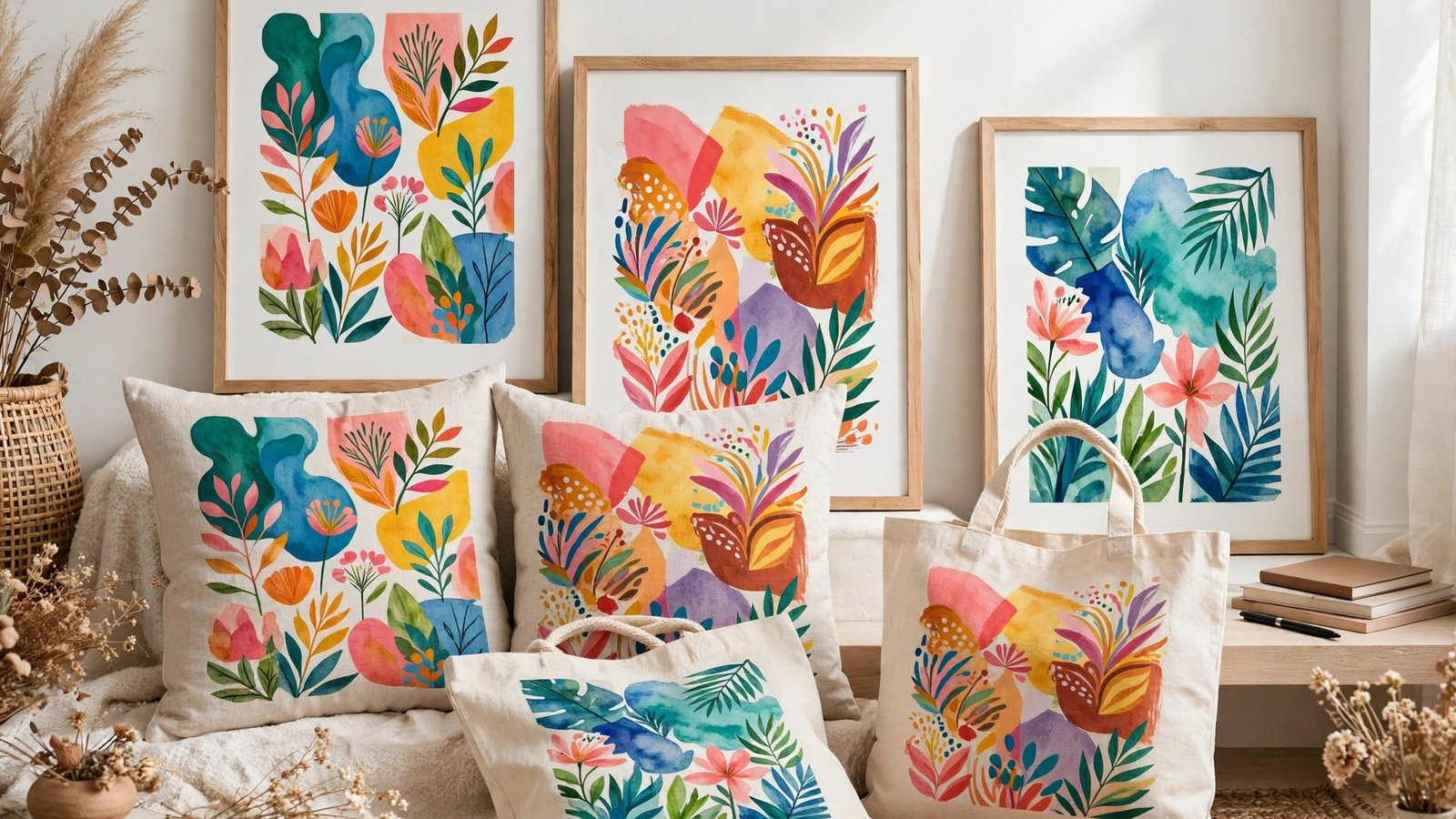
Society6 still pays artists for print-on-demand sales in 2026 — but the platform you remember from a few years ago is gone. In February 2025 Society6 cut thousands of artist accounts, switched to an invite-and-approve curation model, and standardized royalties instead of letting artists set their own margins. Independent guides that checked the platform’s pages in October and November 2026 still quote the old working figures — 10% on wall art, 5% on most other products — which works out to roughly $1 to $3 per sale on typical items. But Society6 itself has not published a new standardized rate, and you only learn your exact rate inside an approved account.
That changes the whole calculation. Society6 used to be a “upload and forget it” side income: free to join, instant to list, predictable math. Now it’s a gated marketplace where you apply first, wait for approval, and price blind. For some artists — especially those whose work suits large prints and home decor — it’s still worth it. For others, it’s a poor use of uploading time. This guide lays out the real per-sale math, the realistic monthly income, and how Society6 stacks up against Redbubble in 2026, so you can decide with open eyes.
What changed on February 3, 2025
On February 3, 2025, Society6 emailed its artist base with the subject line “Important Updates to Your Society6 Artist Account.” There were two versions of that email, and which one you got decided your next year. One told artists they were being removed. The other told the artists who were kept that the rules had changed.
Accounts marked for removal lost the ability to upload new work immediately and were disabled on March 18, 2025. Society6 never published how many accounts it cut — “thousands” is the figure every independent write-up uses, and the company hasn’t corrected it. The shift was to what Society6 called a “more curated marketplace”: fewer artists, chosen by the platform, instead of the open-upload model that had run for over a decade.
Three structural changes came with that email, and they matter more than the cull itself:
Royalties were standardized. Before 2025, Society6 paid a default 10% royalty on most products, and artists could adjust their own margin upward on wall art, canvas prints, and framed art — you could set your own price above the platform’s base cost and keep the difference. After March 18, 2025, royalties are standardized across the board, set by Society6 rather than chosen by the artist. The company has not published the new flat rate anywhere public.
New artists must apply. Society6 is now, in its own words, “implementing a new artwork submission and approval process” for anyone joining. Uploading is no longer instant for a new account. The company points prospective artists to its “Sell Your Art” page for the specifics of that process — and approval is no longer guaranteed the way opening a free account used to be.
Shipping fees stopped coming out of your earnings. This one actually helps artists. Before the change, shipping costs — roughly $0.30 for a sticker up to around $8.00 for large furniture-adjacent items — were deducted from the artist’s earnings rather than billed separately. For orders placed after March 18, 2025, artist shipping fees are no longer deducted. It’s a quiet win that partly offsets the loss of pricing control, and it’s the one part of the 2025 change that every independent comparison agrees is seller-favorable.
The net effect is a platform that asks more of you before you earn a cent, and tells you less about what you’ll earn. The three numbers you’d normally want before committing time to a new channel — what it costs to join, what you’ll earn per sale, and whether you’ll be accepted at all — are no longer available in advance. That’s the honest starting point for everything that follows.
What artists actually earn per sale in 2026
Here’s where I have to be straight with you about a genuine conflict in the sources. Society6 has not published its standardized royalty rate. But every independent guide that checked the platform’s own pages in late 2026 quotes the same working figures: 10% on posters, framed art, pillows, and tapestries, and 5% on everything else, with trade, wholesale, and marketplace orders paying a 5% net-sale commission. Those figures come from comparisons updated in October and November 2026, and they match the pre-2025 defaults — which is either reassuring or suspicious, depending on how much you trust a rate the platform itself won’t confirm.
Treat 10% and 5% as the working figures, and check the rate inside your own account the moment you’re approved. If the number Society6 shows you is different, that number wins — it’s your account, your rate.
At those rates, here’s the per-sale math on typical Society6 products, using the retail prices current seller guides quote:
| Product | Typical retail price | Your cut at 10% | Your cut at 5% |
|---|---|---|---|
| Framed art print | ~$62 | ~$6.24 | — |
| Rectangle pillow | ~$39 | ~$3.90 | — |
| Wall tapestry | ~$45 | ~$4.50 | — |
| T-shirt | ~$32 | — | ~$1.60 |
| Mug | ~$21 | — | ~$1.05 |
| Tote bag | ~$28 | — | ~$1.40 |
The pattern is obvious: Society6 pays best on the big-ticket home decor items, and worst on the small impulse buys. A framed print earns you roughly four times what a t-shirt does, even though the t-shirt is the product most new artists default to uploading. If you’re choosing what to design for, design for walls first — large prints, tapestries, pillows — because that’s where the per-sale math actually works.
One more wrinkle: whether you can still set your own price on art prints is genuinely disputed between current guides. Some say art prints, framed prints, and canvas prints still let you set your own price above Society6’s base, which would push your effective royalty well above 10% on those items. Others say the March 2025 change removed self-set pricing entirely. Until Society6 publishes a clear answer, assume 10% on art prints and treat anything above that as a bonus, not a plan.
And the payouts themselves: artists are paid monthly via PayPal, after a 30-day clearance period, with a $20 minimum payout threshold. Some seller guides report a longer hold — up to 60 days — on brand-new accounts, so don’t count on your first sale landing in your PayPal the following month. PayPal is required; there’s no direct-deposit or check option.
For a visual walkthrough of how selling on Society6 works, this video covers the setup and the product range: How to Sell on Society6.
How much can you realistically make?
This is the question that decides whether Society6 deserves your time, and the honest answer is: less than the YouTube thumbnails promise, more than zero if you treat it like a slow-building asset.
Third-party estimates from 2026 put typical print-on-demand earnings at $50–$400 a month for artists with consistent effort over 3–12 months, and $50–$300 a month once you have 50+ active designs driving steady traffic. One 2026 designer survey of 100+ participants put Society6 specifically at $30–$200 a month with 50 designs, and $300–$1,500 a month with 200+ designs. Top sellers earn far more, but they’re the exception — and every one of those figures is a third-party estimate, not a platform-published average, because Society6 doesn’t publish artist earnings data.
The math behind those ranges is unforgiving, so let’s do it openly. Say your goal is $500 a month from Society6. At 5% on a $32 t-shirt, you earn $1.60 per sale — you’d need 313 sales a month. At 10% on a $62 framed print, you earn $6.24 — you’d need 80 sales a month. At 10% on a $39 pillow, $3.90 a sale, you’d need 128. None of those numbers is impossible, but all of them require either a large catalog or real traffic, and most artists have neither when they start.
That’s why the realistic framing matters: Society6 is a secondary income channel for most artists, not a primary one. The people who make real money on it tend to have three things — a catalog of 100+ designs, work that suits home decor (where the per-sale earnings are highest), and an existing audience somewhere else (Instagram, Pinterest, an Etsy shop) that they funnel toward their Society6 storefront. Society6’s own marketplace traffic exists — the platform reports around 5 million annual visitors and 15–25 million monthly visits by some measures — but its search and discovery favor established shops, and a new artist with ten designs is a needle in a very large haystack.
There’s also a time cost most “passive income” pitches skip. Each design needs to be uploaded, previewed across dozens of products, tagged, and titled — and under the new curation model, approved. Budget roughly 15–20 minutes per design for a careful listing. Fifty designs is a full weekend of focused work before you’ve earned a dollar. That’s fine if the catalog then earns for years — and it can, since a design listed once can sell again and again — but it’s not “passive” in the first month. It’s delayed income, and you should go in knowing that.
Society6 vs Redbubble in 2026
Most artists choosing a print-on-demand marketplace are really choosing between Society6 and Redbubble, and in 2026 the two platforms have moved in opposite directions on the one thing that matters most: who controls your margin.
Redbubble still lets you set your own markup per product, typically 15–30%, with a 20% default. But in September 2025 Redbubble added a tiered platform fee of 0–50% of your earnings on top of your margin, based on your account tier — and the details of that fee are exactly what our Redbubble tier guide breaks down. Society6 went the other way: it took margin control away entirely and standardized the rate, but it doesn’t charge a separate platform fee on top.
Here’s the comparison that matters:
| Society6 | Redbubble | |
|---|---|---|
| Royalty model | Fixed 10% wall art / 5% other (unpublished standardized rate) | You set markup, typically 15–30% |
| Platform fee | None on top of the royalty | Tiered fee, 0–50% of earnings (since Sept 2025) |
| Average earnings per sale | $1–$3 | $2–$5 |
| Joining | Application + approval since 2025 | Free, instant |
| Best for | Fine art, photography, home decor | Stickers, t-shirts, volume designs |
| Product range | ~50 types, home-decor heavy | Broader, sticker-led |
| Payout | Monthly PayPal, $20 minimum, 30-day clearance | Monthly, similar thresholds |
Redbubble pays more per sale on most products because you control the markup, and it wins on volume — stickers and t-shirts sell in quantities that framed prints don’t. Society6 wins on two things: its buyers spend more per order (they’re decorating homes, not impulse-buying stickers), and its home-furnishing range — wall tapestries, duvet covers, shower curtains, area rugs — has no real Redbubble equivalent.
The honest answer for most designers in 2026 is still the same as before the fee changes: list on both. The platforms don’t require exclusivity, the same artwork can be uploaded to each, and they reach different buyers. Society6 is your premium channel; Redbubble is your volume channel. If you only have time for one, pick Redbubble if your work is graphic, bold, and sticker-friendly, and Society6 if your work is photographic, painterly, or made to hang on a wall.
One more comparison worth making: print-on-demand versus digital downloads is the real strategic choice. Digital downloads pay you the full price minus a small platform fee, but you handle the marketing and the customer. Print-on-demand pays you a thin slice, but the platform handles production, shipping, and support. Society6’s $1.60 on a t-shirt looks bad next to a $12 digital download — until you remember the t-shirt sale required zero customer service from you.
The application process now
If you’ve decided Society6 is worth a shot, here’s what joining looks like under the curation model.
First, go to Society6’s “Sell Your Art” page and start the application. You’ll submit a portfolio of your work — this is now a genuine review, not a formality. Lead with your strongest pieces, and lead with pieces that suit Society6’s buyers: large-format art, photography, and designs that work as home decor. A portfolio of ten variations on the same t-shirt graphic is the wrong signal for a platform that earns its money from wall art.
Second, understand the membership tiers, because they gate how much you can list. Current seller guides list three: Free, which allows 10 designs; Basic at $4.99 a month, which allows 100 designs; and Pro at $12.99 a month, which allows up to 10,000 designs. Verify the current prices at signup — Society6 has changed these before, and the tier page is the authority, not a guide written months ago. The practical point is that the free tier’s 10-design cap is a trial, not a business: you can’t build a catalog that earns real money on 10 listings. Budget for Basic at minimum if you’re serious, and treat the $4.99 as a cost of doing business rather than a reason to stay small.
Third, prepare your files properly. Society6 prints at large sizes, so your source files need to be high resolution — low-res images that look fine on a phone screen turn to mush on a 24×36-inch tapestry. Upload the largest file you have, check the preview on every product type before publishing, and pay attention to how a design crops on a pillow versus a framed print. A design that works on one product and fails on another still gets listed on both unless you disable it.
Fourth, expect a wait. Society6 doesn’t publish an approval timeline, and the review queue is the price of the curated model. While you wait, use the time to build your catalog elsewhere — upload the same designs to Redbubble, or list digital versions on Etsy — so the work isn’t idle.
How to make Society6 work as passive income
If you’re going to invest the weekend building a catalog, do it in a way that gives the catalog the best chance of earning for years.
Design for the wall, not the wardrobe. The per-sale math says it plainly: framed prints, tapestries, and pillows pay $3.90–$6.24 a sale; t-shirts and mugs pay $1.05–$1.60. Every hour you spend on a design that only works small is an hour spent on the lowest-paying product in the store. Abstract art, landscape photography, botanical prints, and bold geometric patterns all translate well to large formats. Text-heavy meme designs mostly don’t — and Society6’s buyer isn’t shopping for memes anyway.
Build to 100 designs before judging it. The earnings surveys are consistent on this: income scales with catalog size, and the jump from 50 to 200 designs is where monthly earnings start to look like real money. Ten designs is a test, not a store. If you’re on the free tier, that’s your signal to either commit to Basic or stop — a 10-design shop earning $3 a month isn’t a failed business, it’s an unfinished one.
Drive your own traffic. Society6’s internal search favors established shops, so your best traffic source is you. Pin your designs on Pinterest with links to the Society6 product page. Post the framed-print mockups on Instagram. If you sell on Etsy, link your Society6 shop for the products Etsy can’t fulfill. The artists who earn the most on print-on-demand are almost never the ones waiting for marketplace search to find them.
Treat it as one channel, not the business. Society6’s curation shift is a reminder that any single platform can change its rules overnight — Redbubble did the same thing with its September 2025 fee, and Etsy changes its fee structure regularly. The durable version of this income is a catalog that lives on three or four platforms at once, so no single policy change wipes you out. Society6 is a good second or third channel. It’s a fragile first one.
Reinvest the first payouts. The first $20 payout threshold you clear is a milestone, not a payday. Put it toward the Basic tier, or toward better source files, or toward a month of Pinterest scheduling. The catalog compounds — each new design adds a small permanent chance of future sales — and the artists who treat early earnings as seed money build faster than the ones who withdraw $23 and call it income.
Who should skip Society6
Not everyone should apply, and saying so plainly is part of the service. Skip Society6 if you need money fast — the application wait plus the 30-day clearance plus the $20 threshold means your first payout is months away at best. Skip it if your work is text-based, meme-based, or niche-fan-art — Society6’s buyers are decorating homes, and the platform’s curation leans toward fine art and photography. Skip it if you can’t produce high-resolution files — a 1500-pixel image will look fine on a mug and terrible on a tapestry, and bad print quality is the fastest way to kill repeat buyers. And skip it if the idea of a platform setting your royalty rate without publishing it bothers you on principle — Redbubble, INPRNT, and Fine Art America all give you more control, and there’s no shortage of alternatives.
But if you’re a photographer or illustrator with a real back catalog, if your work already suits large-format printing, and if you can treat the application as the start of a slow-building asset rather than a quick payout — Society6 is still a legitimate channel in 2026. Just go in knowing the deal: you apply, they decide, the rate is theirs, and the money is thin per sale. The artists who do well there aren’t the ones who believed the pitch. They’re the ones who did the math first.
Earnings figures in this article come from independent seller guides and designer surveys checked in October–November 2026, not from Society6, which does not publish artist earnings data. Royalty rates should be verified inside your own Society6 account after approval, as the platform has not published its standardized rate since February 2025.
Frequently Asked Questions
How much do Society6 artists earn per sale in 2026?
At the rates independent guides quote for late 2026 — 10% on wall art and 5% on most other products — a typical sale earns $1–$3. A framed art print at ~$62 earns about $6.24; a t-shirt at ~$32 earns about $1.60; a mug at ~$21 earns about $1.05. Society6 itself has not published its standardized rate since the February 2025 change, so verify the rate inside your approved account.
Can anyone join Society6 as an artist in 2026?
Not instantly anymore. Since February 2025, new artists must go through Society6’s artwork submission and approval process — the old open-upload model is gone. You apply with a portfolio, Society6 reviews it, and approval is not guaranteed. Existing artists who survived the March 2025 cull were kept on automatically.
What happened to Society6 artists in February 2025?
On February 3, 2025, Society6 announced a shift to a “more curated marketplace.” Thousands of artist accounts were cut effective March 18, 2025, royalties were standardized platform-wide instead of artist-set, and new artists must now apply and be approved. Shipping fees also stopped being deducted from artist earnings for orders after March 18, 2025.
Is Society6 or Redbubble better for artists in 2026?
It depends on your work. Redbubble pays more per sale on most products because you set your own markup (typically 15–30%), but it added a tiered platform fee of 0–50% in September 2025. Society6 pays a fixed 10%/5% with no added platform fee, and wins on home decor and higher-spending buyers. Most serious sellers list on both, since neither requires exclusivity.
How and when does Society6 pay artists?
Monthly, via PayPal, after a 30-day clearance period, with a $20 minimum payout threshold. Some seller guides report a longer hold (up to 60 days) on brand-new accounts. PayPal is required — there is no direct-deposit or check option.
How many designs do I need on Society6 to make real money?
Earnings scale with catalog size. Surveys of designers in 2026 put Society6 at roughly $30–$200 a month with 50 designs and $300–$1,500 a month with 200+ designs — but those are third-party estimates, not guarantees. The free tier caps you at 10 designs, which is a trial, not a business; the Basic tier ($4.99/month) allows 100.