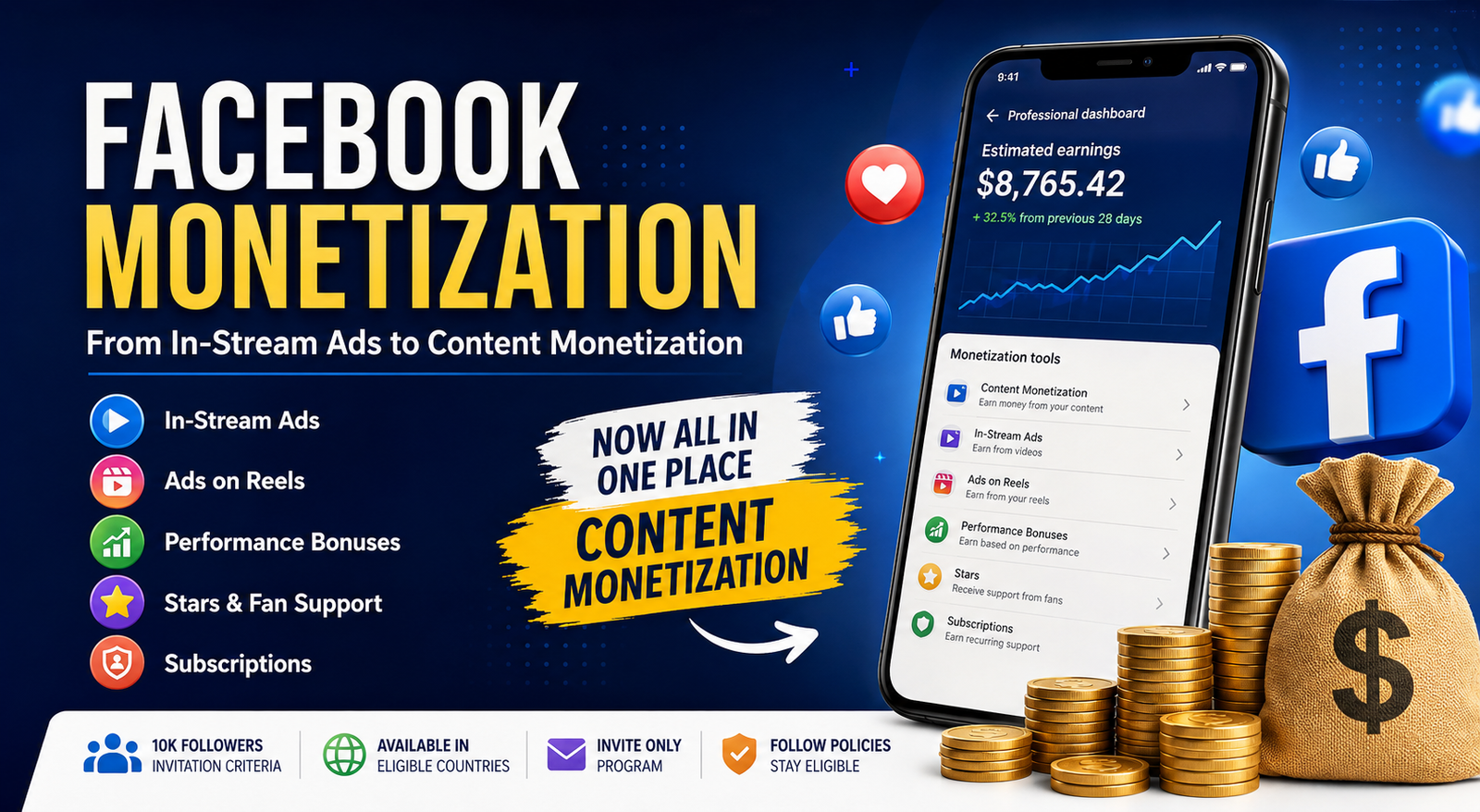
Facebook has transformed from a social networking platform into one of the biggest opportunities for creators to earn money online. Over the years, Meta has introduced several monetization tools, including In-Stream Ads, Ads on Reels, Performance Bonuses, Stars, Subscriptions, and other creator monetization features.
The biggest change came with the introduction of Facebook Content Monetization, which brought several major performance-based monetization programs under one system.
Today, creators can potentially earn from multiple types of content, including Facebook Reels, long-form videos, Stories, photos, and text posts, depending on their eligibility and the monetization features available to their account.
Meta says Facebook paid creators nearly $3 billion in 2025, with Reels accounting for about 60% of total creator payouts. (About Facebook)
Let’s look at how Facebook monetization evolved and how the current Content Monetization system works.
The Beginning: Facebook In-Stream Ads
One of Facebook’s most important steps toward creator monetization was the introduction and expansion of In-Stream Ads.
In-Stream Ads allowed eligible Facebook Pages to earn money when advertisements were displayed around or inside eligible video content. Facebook eventually supported different advertising placements, including pre-roll, mid-roll and post-roll formats, as well as advertising opportunities around Live content. (About Facebook)
For many years, In-Stream Ads became the primary monetization method for video creators.
Creators focused heavily on:
- Increasing followers
- Producing longer videos
- Increasing watch time
- Improving audience retention
- Creating original video content
- Meeting Facebook’s monetization policies
At one point, Facebook’s traditional In-Stream Ads requirements included 10,000 followers for many Pages, along with other requirements related to video views/watch time, age, location and policy compliance. (About Facebook)
This created a new generation of Facebook video creators who were able to turn their Pages into online businesses.
Facebook Moves Toward Short-Form Content
The popularity of TikTok and short-form video changed the social media industry.
Facebook responded by heavily investing in Facebook Reels.
Instead of focusing exclusively on long videos, Facebook began providing creators with opportunities to earn from short-form content.
The Ads on Reels program was introduced and expanded to more creators. Meta later changed the payout approach so that creator earnings were increasingly connected to the performance of public Reels rather than simply the advertising revenue generated by advertisements displayed on an individual Reel. (About Facebook)
That changed the game for short-form creators. Instead of worrying about which ad played on their Reel, they could just focus on making the Reel good — better performance meant better earnings, full stop.
Performance Bonuses Added Another Opportunity
Facebook also experimented with various performance-based bonus programs.
The Performance Bonus rewarded selected creators based on the performance of eligible content. This encouraged creators to produce content that generated views, engagement and audience interaction.
Facebook expanded its performance bonus opportunities and eventually allowed creators to earn from different formats, including photos, text posts, long-form videos, Live content and Reels. (About Facebook)
This was a real shift: video was no longer the only thing that could earn. A photo, a text post, even a Story could now bring in revenue if it performed well.
Facebook Stars and Fan Support
Facebook also introduced Stars, which provided another way for fans to financially support creators.
Stars are virtual items that viewers can purchase and send to eligible creators, particularly during Live streams and other eligible content experiences.
Unlike advertising, Stars are based more directly on audience support.
This created two different monetization approaches:
Advertising-based monetization:
Facebook’s advertising system generates revenue around eligible content.
Fan-supported monetization:
Viewers support creators directly through features such as Stars.
Facebook also reduced some Stars eligibility requirements in 2023, making the feature accessible to more developing creators. (About Facebook)
Facebook Subscriptions
Another important monetization tool is Facebook Subscriptions.
Subscriptions allow eligible creators to build a recurring revenue relationship with their audience. Followers can pay a recurring subscription fee in exchange for benefits offered by the creator.
Facebook has expanded ways for followers to subscribe, including through Reels and Stories, and has also provided creators with more control over subscription pricing. (About Facebook)
Subscriptions are particularly useful for creators with a loyal community because they can create recurring income instead of relying entirely on views.
The Major Change: Facebook Content Monetization
The biggest development in Facebook’s creator monetization journey was the introduction of Facebook Content Monetization.
In October 2024, Meta announced its new streamlined Content Monetization program.
The program combined three major Facebook-funded creator monetization programs:
- In-Stream Ads
- Ads on Reels
- Performance Bonus
Meta explained that Content Monetization would allow creators to monetize multiple content formats through one program. (About Facebook)
Instead of managing completely separate monetization programs, creators could use a more unified system.
What Can Facebook Content Monetization Pay For?
Depending on eligibility and Meta’s policies, Facebook Content Monetization can provide earning opportunities for:
- Facebook Reels
- Long-form videos
- Short-form videos
- Stories
- Photos
- Text posts
Meta says the current program is performance-based, meaning earnings are connected to how eligible content performs rather than being a simple fixed payment for every view. (About Facebook)
This is why creators should focus on qualified views, watch time, engagement, originality and audience retention, rather than simply chasing raw view counts.
Is Facebook Content Monetization Invite Only?
Yes. Facebook Content Monetization remains invite-only, according to Meta’s current creator information.
Creators can express interest through the Professional Dashboard → Monetization → Content Monetization section, but submitting an interest form does not guarantee an invitation. (About Facebook)
If Facebook invites a creator, the invitation should appear through an official Facebook or Meta interface such as the Professional Dashboard or Meta Business Suite.
Creators should be careful about people selling fake “Content Monetization invitations” through Messenger, WhatsApp or other platforms.
Is 10,000 Followers Enough for Content Monetization?
This point needs clarification.
10,000 followers should not be treated as an automatic guarantee of Facebook Content Monetization access.
The historical 10,000-follower requirement was strongly associated with Facebook’s traditional In-Stream Ads eligibility. (About Facebook)
The current Content Monetization system is invitation-based, and Meta can consider multiple factors when determining eligibility.
Having 10,000 or more followers can therefore be an important milestone, but reaching 10,000 followers alone does not automatically activate Content Monetization.
Creators should also maintain:
- Original content
- Good account standing
- Policy compliance
- Authentic engagement
- Consistent publishing
- Eligible content
- A supported location
- Proper payout information
Facebook Content Monetization Eligible Countries
Facebook monetization availability varies by program, account, feature and location, and Meta can change eligibility over time.
Because of this, creators should always check the Monetization section of their own Professional Dashboard rather than relying only on an old country list.
Historically, Facebook has supported monetization across many countries and regions, including markets such as:
- United States
- Canada
- United Kingdom
- Australia
- New Zealand
- India
- Pakistan
- Bangladesh
- Philippines
- Indonesia
- Thailand
- Malaysia
- Singapore
- Japan
- South Korea
- Mexico
- Brazil
- Colombia
- Argentina
- Peru
- France
- Germany
- Italy
- Spain
- Netherlands
- Sweden
- Norway
- Denmark
- Finland
- Ireland
- Poland
- Romania
- Portugal
- Austria
- Belgium
- Switzerland
- South Africa
- United Arab Emirates
- Saudi Arabia
- Egypt
- Turkey
Important: This should not be interpreted as a guarantee that every Content Monetization feature is currently available in every one of these countries. Meta’s monetization programs have different historical eligibility rules, and availability can change.
The safest method is to open Facebook Professional Dashboard → Monetization and check the features available specifically for your Page or Professional Mode profile.
What Determines Facebook Content Monetization Earnings?
Facebook Content Monetization is performance-based.
That means two creators with the same number of views can potentially earn different amounts.
Factors can include:
1. Qualified Views
Not every view necessarily qualifies for monetization. Meta has introduced metrics such as Qualified Views, Earnings Rate and Non-Qualified Views to help creators understand their performance. (About Facebook)
2. Audience Location
Audience geography can influence advertising value and therefore potential earnings.
For example, creators with audiences in countries with strong advertising markets may experience different RPMs than creators whose audiences are primarily from lower-ad-spending markets.
3. Content Quality
Original and engaging content is increasingly important.
Meta has stated that it is placing greater emphasis on original content, deeper engagement, longer watch time and qualified views. (About Facebook)
4. Watch Time
Longer and more engaging content can create stronger audience signals.
5. Engagement
Comments, shares, reactions and other meaningful interactions can help content reach more people.
However, creators should never use fake engagement or engagement manipulation.
6. Originality
Reused, copied or low-value content can create monetization problems.
Facebook’s monetization policies are designed to encourage creators to publish content they have the right to use and that provides meaningful value to viewers.
How to Increase Your Chances of Getting Facebook Monetization
If your goal is to become eligible for Facebook Content Monetization, focus on building a strong creator account rather than simply trying to reach a follower number.
Create Original Content
Avoid simply downloading videos from TikTok, YouTube or other Facebook Pages and reposting them.
Create your own videos, commentary, educational content, storytelling, entertainment or other original formats.
Build a Real Audience
10,000 followers can be a useful milestone, but quality matters.
A Page with 10,000 genuine followers who actively watch and interact with content can be more valuable than a Page with 50,000 inactive or low-quality followers.
Focus on Reels
Reels remain an important part of Facebook’s creator ecosystem. Meta reported that approximately 60% of its 2025 creator payouts went to Reels. (About Facebook)
Avoid Copyright Problems
Don’t use copyrighted music, videos, images or other material unless you have appropriate rights or the content is permitted under the applicable rules.
Follow Meta Policies
Policy violations can affect monetization eligibility.
Creators should pay attention to both Partner Monetization Policies and Content Monetization Policies.
Don’t Buy Fake Followers
Fake followers may increase a number temporarily but can damage engagement rates and audience quality.
The goal should be genuine audience growth.
Frequently Asked Questions
Is Facebook Content Monetization free?
Yes. There is no need to pay someone to activate Content Monetization. If your account receives an official invitation, you can onboard through Facebook or Meta Business Suite.
Is Facebook Content Monetization invite-only?
Yes. Meta’s current information describes Content Monetization as invite-only. Creators can express interest through their Professional Dashboard, but an interest submission does not guarantee an invitation. (About Facebook)
Do I need 10,000 followers to get Content Monetization?
Not as an automatic rule. The 10,000-follower threshold was historically important for In-Stream Ads. Current Content Monetization is invitation-based, and eligibility can depend on several factors.
Can Reels make money on Facebook?
Yes. Reels are one of the major content formats included in Facebook Content Monetization, subject to eligibility and monetization policies.
Can photos and text posts make money?
Yes. Facebook Content Monetization can include eligible photos and text posts in addition to videos and Reels. (About Facebook)
Does Facebook pay for every view?
No. A raw view does not necessarily equal a monetized or qualified view. Facebook uses performance and eligibility signals to determine potential earnings.
Can I earn money from Facebook Stars and Content Monetization?
These are different monetization mechanisms. Content Monetization is performance-based, while Stars allow eligible fans to financially support creators.
Can I monetize a Facebook Page from Pakistan?
Pakistan has historically been included among Facebook’s monetization markets, but availability can vary by specific program and account. The best way to confirm current eligibility is through the Monetization section of your Facebook Professional Dashboard.
Can 10,000 followers guarantee monetization?
No. Reaching 10,000 followers does not guarantee an invitation. Your content quality, originality, policy compliance, account history, location and other factors can matter.
Conclusion
Facebook monetization has changed dramatically over the years.
The journey started with In-Stream Ads, where creators primarily earned through advertising placed around eligible videos. Facebook then expanded into short-form content with Ads on Reels, introduced Performance Bonuses, expanded fan-support features such as Stars, and developed Subscriptions for recurring creator revenue.
The biggest evolution came with Facebook Content Monetization, which brought In-Stream Ads, Ads on Reels and the Performance Bonus into a unified monetization program. Meta now gives creators opportunities to earn from multiple formats, including Reels, videos, Stories, photos and text posts. (About Facebook)
If there’s one takeaway here, it’s this: Facebook monetization is no longer just a followers game. Original content, qualified views, watch time, meaningful engagement, audience quality and policy compliance are becoming increasingly important.
If you want to build a sustainable Facebook income, don’t focus only on reaching 10,000 followers. Build an authentic audience, publish original content consistently, understand your analytics and keep your account in good standing.
Facebook monetization will continue to evolve, but creators who understand the platform’s changing monetization system will be better positioned to turn their content and audience into a long-term digital business.
Related reading: How to Create a Muse AI Account With a USA IP and Get 1 Billion Free Tokens
[…] Related reading: Facebook Monetization: From In-Stream Ads to Facebook Content Monetization […]
[…] once the money starts coming in — say, from your Facebook monetization payouts — you’ll be glad the banking side was sorted […]
[…] pair naturally with a content business — if you’re turning videos into income, our guide to Facebook’s content monetization program explains how short-form video earns on that platform […]
[…] building income across platforms, video pairs well with other monetization — our breakdown of Facebook’s content monetization program covers how creators earn from short-form video there […]
[…] you’re building the content side too, check out our Facebook monetization guide for the social platform revenue picture. And if AI tools are your thing generally, our Muse AI […]