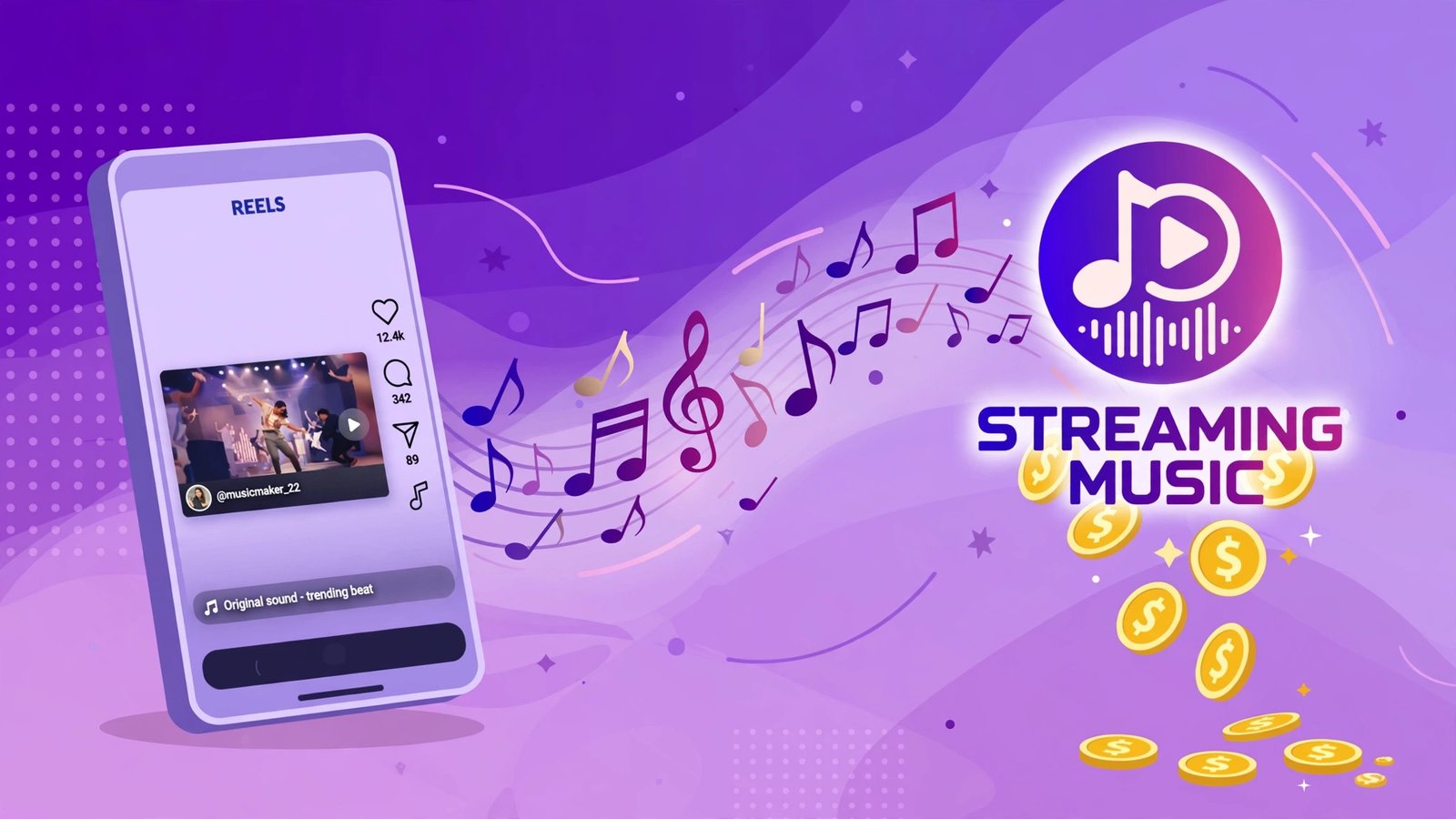
AI music went from novelty to legitimate income stream fast. Thousands of creators now generate songs with Suno, distribute them through DistroKid, and earn from streaming, licensing, and content — all without touching an instrument.
But there’s a lot of hype and very little honesty in this space. Claims of “$10,000 a month on autopilot” are usually selling you a course, not describing reality. This guide gives you the straight version: what it actually costs, the rights rules that can make or break you, realistic earnings, and one strategy most people overlook — using your own AI tracks as the soundtrack for your own reels, Shorts, and TikToks.
What You Actually Need to Start
The startup costs are small, but they’re not zero. Here’s the real stack:
- Suno Pro plan (~$10/month). This is non-negotiable if you want to earn anything. The Pro tier grants commercial rights to the songs you generate. The free tier does not — more on that below.
- A distributor like DistroKid (~$24.99/year). You can’t upload directly to Spotify or Apple Music. DistroKid gives you unlimited uploads and takes 0% commission, which makes it the standard choice for high-volume AI music creators.
- Cover art. Streaming platforms require square 3000×3000 artwork. AI image generators handle this fine.
- Your time. The creators who earn treat this like a business: consistent releases, real strategy, patience.
Total to start: roughly $35 for the first month, then about $10/month plus the annual DistroKid renewal. That’s genuinely cheap for a music business — but don’t mistake “cheap to start” for “easy money.”
The Rights Rules That Matter Most
This is the section that saves people from expensive mistakes. Read it twice.
Free-tier Suno songs are non-commercial forever. This is the rule most beginners break. Songs generated on Suno’s free plan can never be used commercially — and upgrading to Pro later does not retroactively license them. If you made a great track on the free plan, you must regenerate it under your paid account before doing anything commercial with it.
Pro gives you a commercial license, not a copyright. Suno Pro lets you use songs commercially, but that license isn’t the same as owning a copyright. To strengthen your position, add genuine human authorship: write your own lyrics, edit the arrangement, add your own vocals or instrumentation. The US Copyright Office only registers human-authored parts of a work — your lyrics are protectable; the raw AI-generated melody and production are not.
Disclose AI use on YouTube. You can monetize your own videos that contain your AI music and earn ad revenue from them. But YouTube requires you to disclose AI-generated content in the upload flow, and you should run the checks for copyright issues before publishing.
Don’t enroll raw AI masters in Content ID. YouTube’s Content ID system requires you to own the exclusive rights to the master recording. Raw AI-generated tracks from stock voices don’t cleanly meet that bar, and enrolling them can cause account problems. Monetize your own uploads; don’t try to claim everyone else’s.
Distributors are scanning for AI. Use a distributor that accepts AI-assisted music (DistroKid does, with proper disclosure) and disclose the AI involvement in your metadata. Trying to sneak fully AI tracks through distributors that reject them is a good way to get your catalog pulled.
Step-by-Step: From Song to Streaming Revenue
Here’s the practical workflow:
- Generate on Suno Pro. Use detailed prompts — genre, tempo, mood, instrumentation, structure. Hook-first writing matters: streaming rewards songs that grab attention in the first 15 seconds. Write your own lyrics whenever you can; it strengthens both quality and your rights position.
- Export your WAV master from Suno and do basic cleanup — trim silence, check levels, make sure it sounds consistent on phone speakers (that’s where most listeners are).
- Create cover art (3000×3000) and pick a consistent artist name and visual brand.
- Upload through DistroKid. Choose your stores — Spotify, Apple Music, Amazon, YouTube Music, and importantly TikTok and Instagram, which is where the reels strategy comes in. Fill in title, artist, release date, and credits honestly.
- Go live and claim your profiles. Spotify typically goes live in 24–72 hours, Apple Music in 2–5 days. Claim your Spotify for Artists page immediately and get verified.
- Release consistently. The math of streaming favors catalogs, not singles. Creators who earn treat this as a volume game done well — regular quality releases that compound over time.
The Reels Strategy: Your Own Music in Your Own Videos
Here’s the angle most AI music guides miss. Instead of only chasing Spotify streams, use your own tracks as the soundtrack for your own short-form content — your Reels, Shorts, and TikToks.
Why this works so well:
- Zero copyright risk. The #1 fear of every creator is a copyright strike or a muted video. When the music is yours (properly licensed under Suno Pro), that fear disappears entirely. You can post aggressively without worrying.
- You build an “official sound.” When you distribute through DistroKid to TikTok and Instagram, your track becomes a selectable sound on those platforms. Use it in your own videos first to seed it, and other creators can then discover and use it too — each use driving more streams back to you.
- It solves the music problem for faceless content. If you run faceless channels — facts, finance tips, motivational clips, aesthetic compilations — you need a constant supply of background music. Your own AI catalog is an unlimited, strike-free supply.
- Double income. The same track earns streaming royalties and powers content that earns ad revenue or affiliate income. One asset, two revenue lines.
The practical move: for every track you release to streaming, cut a 7–15 second hook version optimized for short-form — a beat drop, a catchy vocal line, a chant. Post it with your own content, tag the official sound, and let the algorithm do the rest.
If you’re also monetizing short-form video itself, this pairs perfectly with platform payouts. Our guides to TikTok monetization requirements and YouTube Shorts monetization break down what those programs actually pay — and using your own music means you keep the full revenue share instead of splitting it with music publishers.
Realistic Earnings: The Honest Math
Let’s be straight about money, because this space is full of inflated claims.
Streaming pays fractions of a cent per play. Apple Music pays roughly $8–10 per 1,000 streams; Spotify less. Nobody earns a living from ten songs with a hundred streams each. The creators earning real money share a pattern:
- Volume plus consistency. Dozens of tracks released steadily, not one “viral hit” attempt.
- Multiple income paths. Streaming royalties plus content revenue from videos using the music plus occasionally selling tracks as background music to other creators ($20–50 per track) or doing small custom jingles for businesses.
- Compounding over months. A realistic trajectory looks like $50–100/month early on, growing to a few hundred as the catalog builds, with $1,000+/month achievable after sustained effort across multiple income paths — not from streaming alone.
Anyone promising thousands per month from week one is selling something. Treat AI music like what it is: a real business with real startup costs, real rules, and real (but gradual) upside.
Mistakes That Kill AI Music Income
- Uploading a free-tier song commercially. Non-commercial forever. Regenerate under Pro.
- Skipping AI disclosure on YouTube or distributor metadata. Platforms are actively checking now.
- Enrolling AI masters in Content ID. Monetize your own videos; don’t claim the world’s.
- Zero human input. Pure prompt-to-song output is the weakest position legally and often the weakest creatively. Your lyrics, your edits, your curation — that’s what makes it yours.
- Releasing three songs and quitting. Streaming is a catalog game. Consistency beats perfection.
- Ignoring the short-form angle. Streams alone are slow. Your own reels and TikToks are the marketing engine most AI musicians never build.
Frequently Asked Questions
Can I really make money with AI-generated music?
Yes, but treat it as a business, not a lottery ticket. Income comes from streaming royalties, content revenue, and licensing — and it compounds with catalog size and consistency. Most successful AI music creators combine two or three income paths.
Do I need Suno Pro to earn money?
Yes. Commercial rights start at the Pro tier (~$10/month). Free-plan songs are non-commercial permanently, and upgrading doesn’t change the status of songs you already generated.
Will Spotify remove AI music?
Spotify removes tracks that violate its policies — fake streams, misleading metadata, spam tactics. Properly disclosed AI-assisted music distributed through a legitimate distributor like DistroKid, with real human curation behind it, is a different category from spam.
Can I use my Suno music in monetized YouTube videos?
Yes. You can earn ad revenue on your own videos containing your Pro-licensed AI music. Just disclose the AI-generated content in YouTube’s upload flow and don’t enroll the raw masters in Content ID.
How many songs should I release?
There’s no magic number, but the earners treat it as a volume game with quality control — think regular releases (several per month) rather than one perfect single per quarter. Keep each release’s quality high enough that you’d proudly attach your artist name to it.
Should I write my own lyrics or let the AI do it?
Write your own whenever possible. It’s better for quality, it’s better for your legal position (human-authored lyrics are copyrightable), and it’s what separates a real artist project from disposable prompt output.
The Bottom Line
AI music is a genuine income opportunity in 2026 — small startup costs, real distribution, real royalties. The winners follow the rules (Pro plan, disclosure, honest metadata), add human creativity, release consistently, and market through their own short-form content instead of hoping the algorithm finds their Spotify page.
If you’re building the content side too, check out our Facebook monetization guide for the social platform revenue picture. And if AI tools are your thing generally, our Muse AI account guide covers another powerful AI tool worth having in your stack.
[…] own music (including AI-generated tracks they properly license) sidestep this entire problem. Our AI music monetization guide covers exactly how to do […]
[…] you want the deeper walkthrough on the Suno-to-reels side of this, I wrote a companion piece on making money with AI music, Suno, DistroKid, and reels. And when the money starts arriving, how you receive it matters — withdrawal fees eat small […]