The short answer
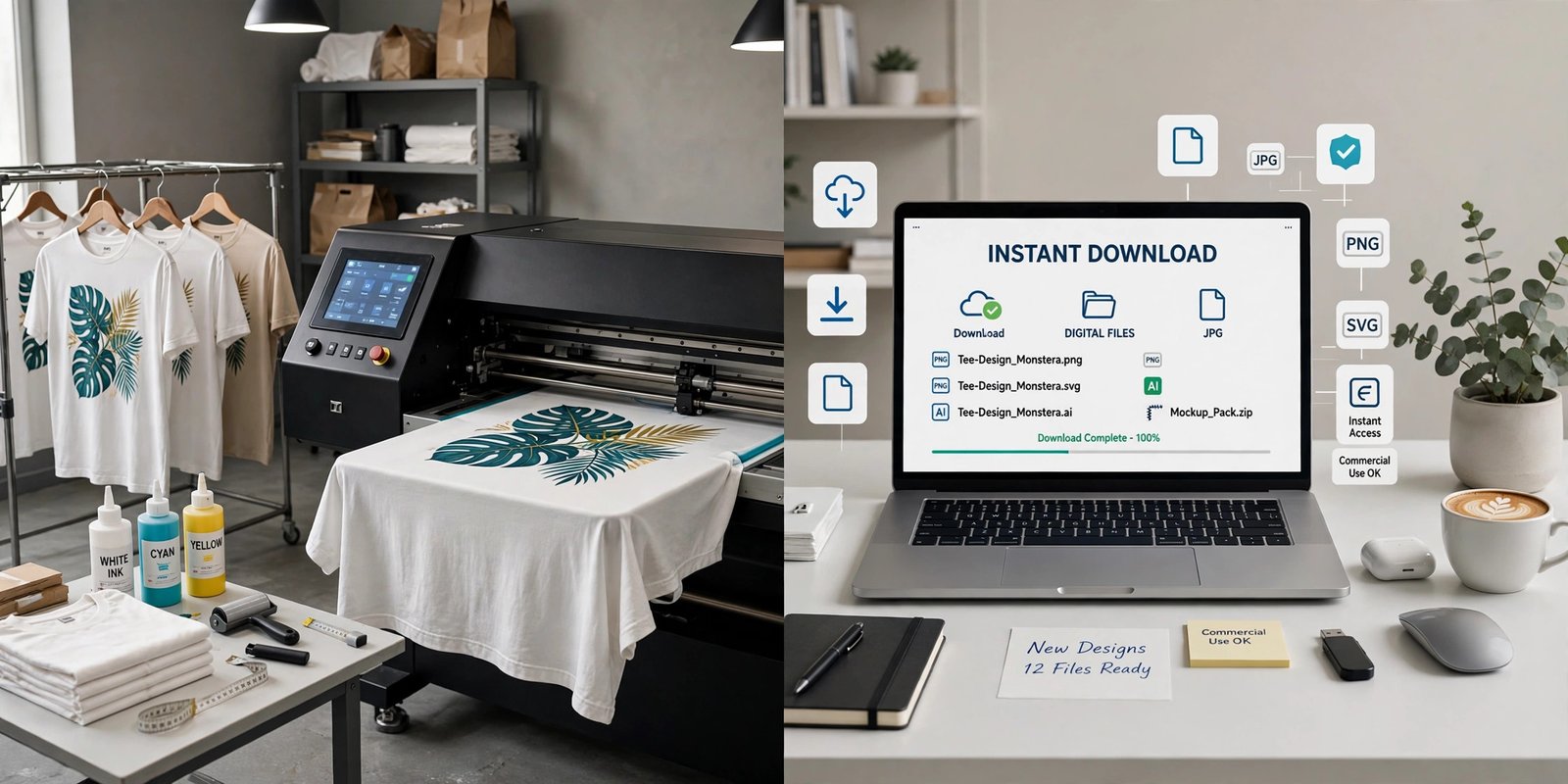
Neither model is universally better — they reward different people. Digital downloads win on margins (50–90%) and automation: you create once, Etsy delivers forever, and there’s no shipping, sizing, or returns. Print on demand wins on speed to market and price points: you can list dozens of designs on shirts, mugs, and posters in an afternoon with less design intensity per listing. The catch: POD margins run 30–35% before marketing (about $4 profit on a $25 shirt), and you inherit every customer-service headache of physical goods.
Pick based on who you are, not which guru is louder. Here’s the full comparison.
How each model actually works
Digital downloads: You create a file — a planner PDF, printable wall art, a spreadsheet template, a font. You upload it to Etsy (or Gumroad, or your own site). The customer buys, downloads instantly, and you never touch the transaction again. Your work ends at upload.
Print on demand: You create a design and upload it to a POD provider (Printful, Printify). You list the design on products — t-shirts, hoodies, mugs, tote bags, posters. When a customer orders, the provider prints, packs, and ships it. You never hold inventory, but you’re the face of a physical product business: the quality, the shipping time, and the wrong-size complaints all land on you.
Both can run on Etsy. Both can make real money. They just feel like completely different businesses day to day.
Startup costs and margins
This is where the models diverge hardest.
| Digital Downloads | Print on Demand | |
|---|---|---|
| Startup cost | $0–$30 | $0–$30 |
| Gross margins | 50–90% | 30–50% (net ~30–35% before marketing) |
| Example | $15 printable → ~$12.70 kept | $25 shirt → ~$4 profit |
| Inventory | None, ever | None (provider holds it) |
| Fulfillment | Instant, automatic | Provider prints & ships per order |
Digital wins margins by a mile because the marginal cost of one more sale is zero. POD’s margin gets squeezed three ways: the provider’s base cost, Etsy’s fees, and shipping. That $4-on-$25-shirt math is why POD sellers live and die by volume — and why a single return can wipe out the profit of ten sales. (ProfitTree’s POD vs. digital comparison breaks the same numbers down in detail.)
Startup costs are a wash: both start near zero. The real cost difference is time, which brings us to effort.
Effort and skills required
Digital downloads are front-loaded. A good planner or template pack might take you a weekend (or a focused afternoon with AI assistance) to design, test, and package. The barrier is design skill and completeness — buyers can tell instantly whether a $15 planner was thrown together. But once it’s live, it’s done. It can sell for years with zero additional work.
POD is fast to list, slow to win. You can put one design on 20 products in an hour, which makes testing ideas cheap. The design intensity per listing is lower — a clever phrase on a shirt needs less craft than a 40-page planner. (Illustrators weighing the same tradeoff often land here too — see Women of Illustration’s POD vs. digital breakdown.) But the treadmill never stops: trends expire, seasons rotate, and your catalog needs constant feeding to stay relevant.
Personality fit matters more than people admit. If you’re patient, detail-oriented, and like building assets that compound — digital. If you’re a fast tester who likes riding trends and doesn’t mind the grind — POD.
Customer service: the hidden tax
Ask any seller what actually eats their week and the answer is never “making products.” It’s customers.
Digital: Minimal. The product either downloads or it doesn’t. Occasional “how do I print this?” questions, rare refund requests. Maybe an hour a week at scale.
POD: The full physical-goods experience, except you don’t control the physical goods. Wrong sizes, print quality complaints, shipping delays, lost packages, returns — every one of them arrives in your inbox, and you’re the one issuing the refund while the provider reprints. Sellers consistently cite this as the part of POD they underestimated.
There’s also a platform risk worth knowing: Etsy has been banning POD-heavy accounts in waves, particularly shops that look like thin resellers rather than genuine designers. If you go POD, your designs need to be clearly yours, and you must disclose your production partner (Etsy requires it).
Reach and pricing
POD reaches further, cheaper. A $25 shirt is an easier impulse buy than a $25 digital file, and POD products show up in gift searches where digital can’t compete. Higher price points also mean paid ads can work — it’s hard to make Etsy Ads profitable on a $3 printable, much easier on a $28 hoodie.
Digital has a pricing ceiling problem. Buyers are anchored to cheap: years of $2 printables trained them to expect digital = nearly free. Selling a $29 template pack means fighting that anchor with obviously-superior quality and packaging. It can be done — Notion templates and business kits prove it daily — but it’s a marketing job, not just a listing job.
The decision framework
Stop asking “which is better” and ask “which is better for me”:
- Choose digital downloads if: you have (or will learn) real design skills, you want maximum automation, you hate customer service, and you’re patient enough to build a catalog that compounds.
- Choose print on demand if: you want to test ideas fast, you follow trends closely, you’re comfortable with thin margins at volume, and customer messages don’t ruin your day.
- Choose both if: you’re established. Plenty of sellers run digital planners alongside POD apparel in the same niche (a “dog mom” brand with both printable wall art and dog-mom shirts). Just don’t launch both on day one — pick one, learn the ropes, then expand.
One more honest note: the product format matters less than the business mechanics underneath. Either way you need three things — a hungry market, a specific problem you solve, and consistent effort. Get those right and both models pay. Get them wrong and neither will.
If you lean digital, my beginner’s guide to selling digital products on Etsy walks through the setup. And if you’re timing a launch, check the Etsy Q4 seller calendar — holiday season treats the two models very differently.
Frequently Asked Questions
Which is more profitable: print on demand or digital downloads?
Digital downloads, on margin: 50–90% vs ~30–35% for POD before marketing. But POD can win on total revenue through higher price points and volume. Margin percentage isn’t the same as money in your pocket.
Is print on demand still worth it in 2026?
Yes, for sellers who treat it as a real design business — original designs, disclosed production partners, trend-aware catalogs. Thin reseller-style shops are the ones getting banned.
Do digital downloads really sell with no marketing?
They sell with Etsy’s built-in search traffic, which is the closest thing to “no marketing” that exists. But competitive niches still reward Pinterest, good SEO, and seasonal timing. Nothing is fully passive on day one.
Can I sell both POD and digital products in one Etsy shop?
Yes. Many sellers run both under one brand. Start with one model until it’s working, then add the second — splitting focus on day one slows both down.
What are the biggest hidden costs of print on demand?
Returns and reprints (which eat your thin margin), customer service time, and Etsy Ads spend that’s hard to make profitable below ~$20 price points. Factor all three before you project earnings.