Why Creators Keep Coming Back to Veo 3.1
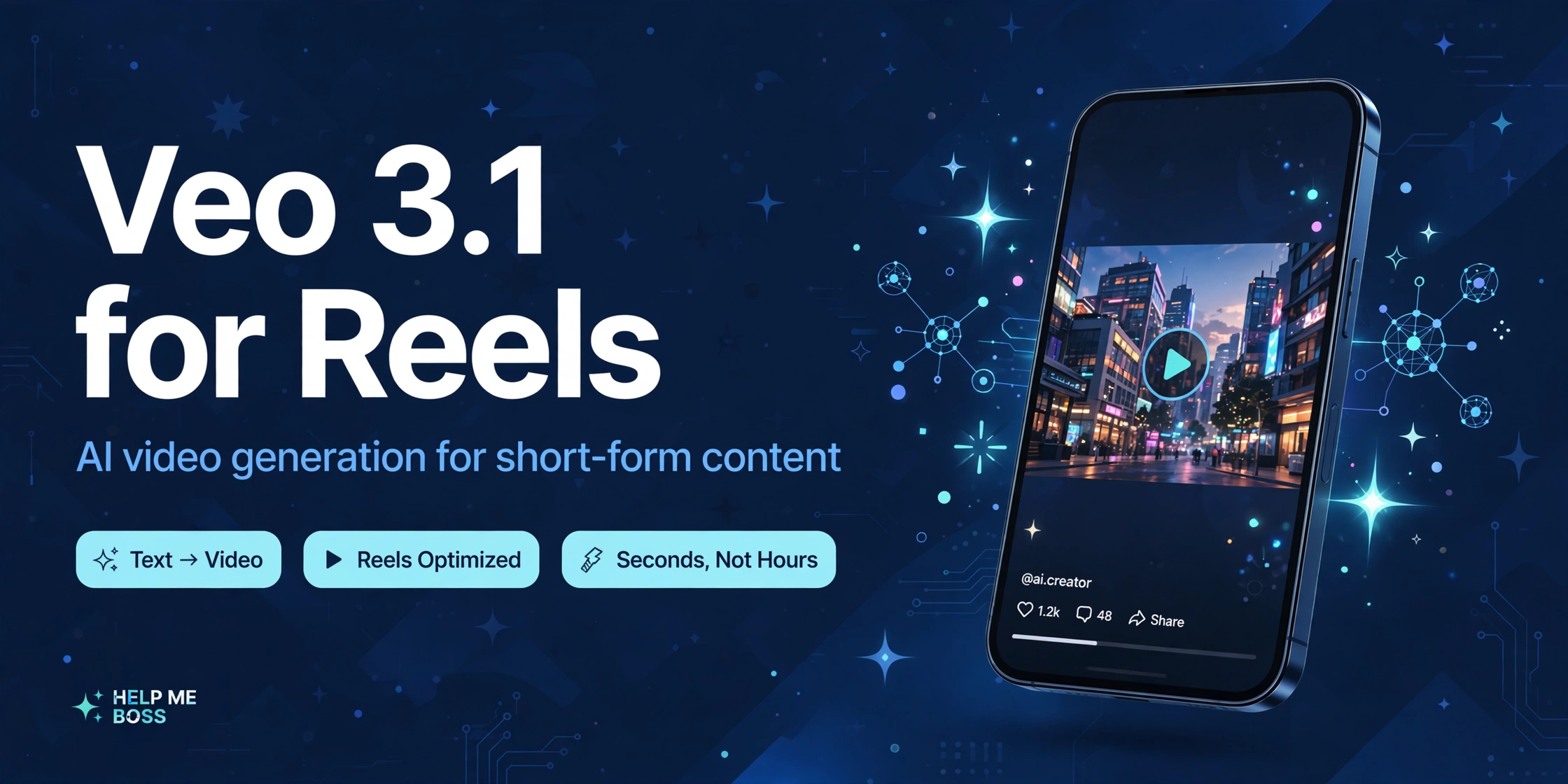
Google’s Veo 3.1 is the AI video model creators recommend when reliability matters more than novelty. It’s not the cheapest option, and it’s not the flashiest — but for Reels, Shorts, and TikTok, it does the unglamorous things right: dialogue that actually syncs, sound effects that land on the action, and portrait video that doesn’t need cropping or reframing.
If you’ve burned credits on models that generate beautiful silent clips and then leave you assembling audio in post, Veo 3.1’s one-pass approach — video, dialogue, effects, and music from a single prompt — is the feature that changes your workflow.
The Features That Matter for Short-Form
Native 9:16 portrait output
Veo 3.1 generates natively in 9:16 for Shorts, Reels, and TikTok, plus 16:9 for landscape. Native matters: cropping a landscape generation to vertical throws away half your pixels and usually wrecks the composition. Veo composes for the format you ask for.
Dialogue, effects, and music in one pass
This is Veo’s signature. One prompt produces the video with synchronized dialogue, sound effects, and ambient audio baked in. The lip sync is the best in the category — good enough that talking-head style AI content is actually viable. For creators making character-driven Reels, this eliminates an entire post-production step (separate voiceover recording, syncing, and sound design) that used to eat hours.
Reference images and frame control
Upload 1-3 reference images and Veo holds your subject consistent across the generation (R2V mode). Start/end frame interpolation lets you define the opening and closing images and have the model generate the transition between them — genuinely useful for controlled scene changes instead of prompt-and-pray.
Up to 60 seconds per generation
Veo 3.1 can generate up to 60 seconds in a single run, though quality is strongest in the 10-20 second range. For Reels, 4-8 second clips chained together remain the practical workflow — but the longer ceiling gives you room for scenes that breathe.
SynthID watermarking
Every Veo generation carries Google’s SynthID watermark embedded invisibly in the frames. Rather than a drawback, this is a compliance asset: if a platform or client asks whether a clip is AI-generated, you have a checkable answer. With disclosure rules tightening on every platform, built-in provenance is worth more than it used to be.
Pricing: The Three Ways In
Free tier via Google Vids. Any personal Google account gets 10 free video generations per month through Google Vids at 720p, up to 8 seconds per clip. No credit card, no trial — a real free tier. Enough to test the model properly before spending anything.
Google AI Pro — $19.99/month. Includes Veo 3.1 Fast, the speed-optimized model, plus 1,000 monthly credits, priority queue, and 1080p output. This is the sweet spot for most creators: fast iteration at a price that pays for itself with one client video.
Google AI Ultra — $249.99/month. Full-quality Veo 3.1, up to 1,000 generations, 4K export, scene extensions. This is for agencies and high-volume producers, not solo creators starting out.
API (developers). Three tiers through the Gemini API: Lite ($0.05-$0.08/sec, draft quality), Fast ($0.10-$0.30/sec), and Standard ($0.40-$0.60/sec) — all with audio included. An 8-second 1080p clip on Fast costs roughly $0.96; on Standard about $3.20. Iterate on Lite or Fast, render finals on Standard.
The Honest Limitations
- No HDR or EXR export. If you’re finishing in a broadcast pipeline, you’ll still need traditional footage or a different tool for the final grade.
- Consistency drifts on long generations. Reference images help, but chaining many scenes with the same character still needs spot-checking.
- The interface is built for simplicity, not filmmaking. Power users wanting keyframe-level camera control will find it limiting compared to dedicated tools.
- It’s Google-priced. The per-second API cost is 2-4x Kling 3.0’s. For volume work, the math favors competitors — see our Kling 3.0 vs Veo 3.1 comparison for the full cost breakdown.
A Practical Reels Workflow With Veo 3.1
- Script the audio first. Since Veo generates dialogue natively, write your lines before your visuals. Good dialogue prompts produce dramatically better results than visuals-first prompting.
- Generate in 4-8 second beats. One beat per shot. Chain beats in CapCut or Premiere rather than asking for long single generations.
- Use reference images for recurring characters. If your Reels feature the same AI persona, lock 2-3 reference images and reuse them every session.
- Render drafts on Fast, finals on Standard. The quality jump is real, but so is the price jump — don’t pay Standard rates for throwaway iterations.
- Disclose. Platforms increasingly require AI content labels, and SynthID gives you nothing to hide. Label your uploads; it protects your account.
New to the space? Our best AI video generators for beginners covers the full field before you commit to one tool.
Free Tier vs Paid: Where the Line Is
The free tier (10 generations/month, 720p, 8-second max) is genuinely useful for three things: learning prompting, testing whether AI video fits your content style, and producing the occasional clip. It’s not a production plan — ten clips is one ambitious Reel.
The jump that matters is free → AI Pro ($19.99/month). You go from 10 monthly generations to 1,000 credits, 720p to 1080p, standard queue to priority, and watermarked to clean output. For a creator posting 3-5 Reels a week, Pro is the first tier where Veo becomes a real production tool rather than a toy.
Ultra ($249.99/month) only makes sense when video generation is directly tied to revenue — client work, a monetized channel with real volume, or an agency pipeline. A good rule: don’t buy Ultra until your AI video output is earning at least 3x the subscription.
Veo 3.1 vs Doing It the Old Way
It’s worth stating the baseline plainly. Before AI video, a 30-second product demo with dialogue meant: scripting, casting or filming yourself, shooting, editing, sound design — a full day at minimum, or $500+ to outsource. With Veo 3.1 on the Pro tier, the same deliverable is an afternoon of prompting and roughly $2-4 in generation costs.
That doesn’t mean the old skills are worthless — prompting well is directing, and editing AI clips into a watchable Reel is still editing. But the cost floor for “video with dialogue” has collapsed, which is why every creator who publishes regularly should have at least the free tier in their toolkit.
Official source: Google DeepMind Veo
Frequently Asked Questions
Is Veo 3.1 free?
There’s a genuine free tier: 10 generations per month at 720p through Google Vids with any personal Google account. Paid tiers start at $19.99/month (Google AI Pro).
What’s the best Veo 3.1 tier for a Reels creator?
Google AI Pro at $19.99/month. You get Veo 3.1 Fast, 1080p output, and enough credits for steady short-form production. Ultra only makes sense at agency volume.
Does Veo 3.1 make vertical video?
Yes — native 9:16 portrait alongside 16:9 landscape. No cropping needed.
How long can Veo 3.1 clips be?
Up to 60 seconds per generation, with the best quality at 10-20 seconds. For Reels, 4-8 second clips chained in an editor is the standard workflow.
Is Veo 3.1 better than Kling 3.0?
For dialogue, lip sync, and ecosystem integration, yes. For price-per-clip and multi-shot sequences, Kling 3.0 wins. Most serious creators end up using both for different jobs.
Will viewers know my video is AI-generated?
Veo embeds an invisible SynthID watermark in every frame. Visible quality is high enough that casual viewers often can’t tell — which is exactly why you should disclose AI use on platforms that require it.