
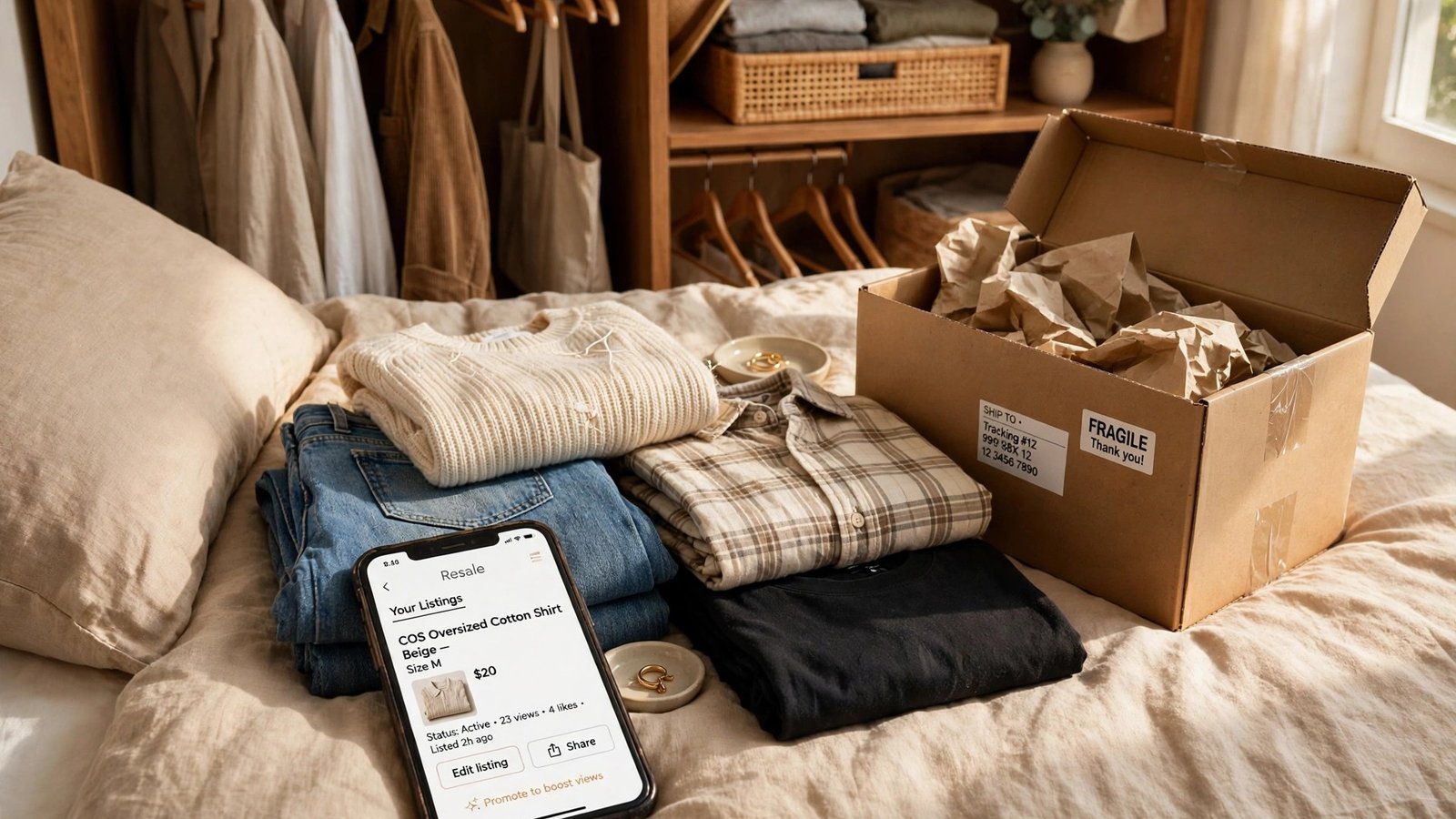
Yes, Vinted charges US sellers nothing in 2026. No listing fee, no commission, no payment processing cut. Sell a jacket for $50 and $50 lands in your Vinted balance. The catch — and it’s a small one — is that the buyer pays instead: a “Vinted fee” of usually 5% of the item price plus $0.70 at checkout. That’s the whole deal, and for anyone clearing out a closet, it’s the cheapest way to sell online in America right now.
But “free” deserves a closer look before you move your whole closet over. The buyer fee changes how you should price, Vinted’s US rules limit you to personal selling, and the platform is still young here — it only made its big American push in January 2026.
What “0% seller fees” actually means on Vinted
Vinted’s own help center states it in one plain sentence — see Vinted’s help page on the fee: “There are no fees for uploading your items or selling them on Vinted.” That covers everything a seller would normally pay. There is no fee to list an item, no final value fee when it sells, and no payment processing deduction skimmed off your payout. The price you set is the price you receive.
That is unusual. Every other major US resale app takes something from the seller’s side: Depop still charges payment processing, Mercari takes a flat 10%, Poshmark 20%, and eBay around 13.6% in most clothing categories. Vinted is the only one where the seller’s column reads $0.00 across the board.
It matters most on small sales. A $12 top on Poshmark costs you $2.95 — nearly a quarter of the price. On Vinted, that same $12 is $12. Ten $20 sales is $200 on Vinted versus $160 on Poshmark, and that $40 gap is real money for a side hustle built on stuff you already own.
The zero-fee model also changes what gets listed. When every listing carries a fee risk, you hesitate over the $8 t-shirt or the kids’ jacket your daughter outgrew. On Vinted there’s no penalty for listing it, so the marginal items that would never be worth photographing elsewhere suddenly are.
One thing to keep straight: “no seller fees” doesn’t mean “no costs at all.” You still pay for shipping supplies — mailers, tape, tissue paper — and a Bump, Vinted’s optional paid promotion, costs money if you choose it. Shipping itself is paid by the buyer at checkout.
What the buyer pays: the Vinted fee, explained
Vinted makes its money on the other side of the transaction. Every order placed with the “Buy now” button carries a mandatory buyer fee: usually 5% of the item price plus $0.70, per Vinted’s US price list. On a $50 item that’s $3.20 on top of the price, plus shipping. The buyer sees the full total before paying, and the seller never touches that money.
The fee used to be called the Buyer Protection fee. In Vinted’s US terms update of October 8, 2026, it was renamed the “Vinted fee.” Vinted’s own help page about the change is explicit: “This is not a new or additional fee,” and “the way it’s calculated is not changing.” If you still see “Buyer Protection fee” in some help articles or on some screens, it’s the same charge — Vinted says the new name is rolling out gradually across the platform.
That rename matters for one practical reason: older guides and videos call it the Buyer Protection fee, newer ones the Vinted fee. Same charge — 5% + $0.70 — not two fees.
The word “usually” does real work: Vinted says the fee can vary with the item, the order value, and whether it’s a bundle. In practice, 5% + $0.70 is the standard figure on a single US item, and that’s the number to use for your pricing math.
The fee also funds the buyer protection that comes with paying through Vinted: secure payments, order support, and refunds where they apply — if an item doesn’t arrive, arrives damaged, or is significantly not as described. That’s the deal Vinted offers buyers in exchange for the fee.
The keep-table: what a $50 sale leaves you on five platforms
All figures below are for a standard US seller account, no boosts or promotions, worked from each platform’s published fee schedule as checked in November 2026. The table isolates the fee cut on the item price only — shipping is handled separately.
The $50 sale, step by step
Vinted — you keep $50.00. The math is the shortest in reselling: $50.00 sale price, minus $0.00 in seller fees, equals $50.00. The buyer pays $3.20 in Vinted fees ($2.50 + $0.70) plus shipping on top, so their total is $53.20 before shipping. You never see that $3.20 and it never comes out of your money.
Depop — you keep $47.90. Depop charges no selling commission for US sellers — it dropped the old 10% fee in July 2024 — but it still charges payment processing of 3.3% plus $0.45 per transaction. On $50, that’s $1.65 plus $0.45, or $2.10, leaving $47.90. One wrinkle: Depop calculates that 3.3% on the price plus shipping plus sales tax, so on a real shipped order your keep is a little lower.
Mercari — you keep $45.00. Mercari charges a flat 10% selling fee on the item price, with no separate payment processing fee since January 6, 2025. Ten percent of $50 is $5.00, so you keep $45.00. Mercari’s fee is also charged on the shipping the buyer pays. (Some older guides still quote Mercari’s pre-2025 structure — the current 10% flat fee is what applies now.)
Poshmark — you keep $40.00. Poshmark takes a flat 20% commission on sales of $15 or more, and a $2.95 flat fee on sales under $15. Twenty percent of $50 is $10.00, so you keep $40.00. That 20% includes payment processing and the prepaid shipping label, which is part of why Poshmark can charge it — the shipping experience is genuinely the simplest in the business. But on pure keep, it’s the steepest cut of the five.
eBay — you keep $42.80. eBay’s final value fee in most categories, including clothing, is 13.6% of the total order plus a $0.40 per-order fee on sales over $10. On $50 that’s $6.80 plus $0.40, or $7.20 in fees, leaving $42.80. The fee is calculated on the total sale including shipping and tax, so the real keep on a shipped order runs slightly lower.
The same sale at $25 and $100
The gap scales with price, and it looks different at the low end, where flat fees bite hardest:
| Sale price | Vinted | Depop | Mercari | Poshmark | eBay |
|---|---|---|---|---|---|
| $25 | $25.00 | $23.73 | $22.50 | $20.00 | $21.20 |
| $50 | $50.00 | $47.90 | $45.00 | $40.00 | $42.80 |
| $100 | $100.00 | $96.25 | $90.00 | $80.00 | $86.00 |
At $100, the Vinted advantage over Poshmark is a full $20.00 on a single sale. Sell ten $50 items and the difference is $100.00 in your pocket — that’s the whole profit on a small side hustle.
The honest framing, though, is that keeping 100% of a sale that never happens is worth $0. A platform’s fee is only half the equation; the other half is whether your item actually sells, and how fast. Vinted’s US audience is growing quickly but smaller than Poshmark’s or eBay’s. The keep-table tells you what you earn if it sells. The rest of this article is about whether it will.
Why Vinted can afford 0% — the January 2026 US push
Vinted isn’t a startup gambling on growth. It’s a Lithuanian company founded in 2008 and the dominant secondhand marketplace in Europe. It was valued at €5 billion in a 2024 share sale, then at roughly €8 billion in an April 2026 share sale reported by the Financial Times, after revenue rose 38% in 2025 to €1.1 billion. The company is profitable — net profit of €62 million in 2025 — which is what lets it run a seller-friendly fee model a venture-funded rival couldn’t sustain.
Vinted had technically been available to Americans since 2013, but only to a small base, and in late 2025 it tested cross-border transactions between UK and US users. The real push began in January 2026, with a major launch campaign starting in New York. Vinted’s research with GWI, published around the launch, found that 50% of Americans wear half their closet or less, and 42% don’t know the resale value of their old clothing — a big, untapped supply of exactly the inventory Vinted sells best.
The growth since then has been fast. Apptopia’s app data shows Vinted overtook Depop in US weekly active users in the week of May 11, 2026, and held the lead for thirteen straight weeks. By early August, Vinted held about 20% of weekly active users across the five largest US resale apps, with eBay at 49% and Depop at 17%. Time spent on Vinted’s US app went from just 2.6% of eBay’s in early January to 84% by August 3.
Vinted is also building revenue that doesn’t touch sellers. In November 2026 it expanded its partnership with the e-commerce firm Rokt, bringing personalized post-purchase advertising to American shoppers, a line it has run in the UK and six European markets since 2024. Vinted’s ads director said the rollout monetizes its growing audience “without introducing fees for sellers.” Read that as a signal — the zero-fee model is the strategy, not a launch promotion with an expiry date. Fees can always change, though, so check Vinted’s price list before assuming 0% lasts forever.
The catches: what Vinted’s US rules actually say
Zero fees is a great headline. The fine print is where sellers get tripped up, and Vinted’s US terms are stricter than the headline suggests.
Personal use only — no business selling. Vinted’s US terms limit the service to personal, non-professional use. There is no Vinted Pro business-seller option in the US, unlike in some European markets. If you’re buying inventory wholesale to flip, or running a resale operation at volume, Vinted’s US terms don’t cover you — sellers who treat it as a business account risk having listings removed or the account restricted. Vinted is a great outlet for stuff you already own, and a poor home for a sourcing-and-flipping business.
Counterfeit flags come with a 48-hour clock. Under the October 2026 terms, if Vinted flags strong evidence that an item may be counterfeit, you have 48 hours to provide proof of authenticity — receipts or proof of purchase you may not have kept for a bag you bought three years ago. The practical lesson is simple: only list items you’re confident are genuine, and keep receipts for anything expensive.
The buyer fee can cost you the sale. A buyer comparing the same jacket at $50 on Vinted and $50 on Poshmark sees $53.20 plus shipping on Vinted against $50 plus shipping on Poshmark. Some buyers do that math and walk away. Vinted’s bet is that lower seller fees mean sellers list at lower prices, which offsets the fee — and for many items that’s true. But on higher-priced items, where 5% + $0.70 is real money, price-sensitive buyers may balk. If your item isn’t moving, the buyer fee is one of the first explanations to check.
You ship on a deadline. Vinted gives sellers a shipping window after a sale, and the buyer confirms the order is fine before you’re paid. That’s standard marketplace practice, but it means Vinted isn’t a list-it-and-forget-it platform — if you travel for a week without shipping, expect problems.
Payouts aren’t instant. You get paid after the buyer confirms the item arrived as described, so your money sits in your Vinted balance for a few days after each sale. If you need same-week cash, plan around that delay.
Optional Bumps are the only fee you’ll ever see. Vinted sells an optional promotion called a Bump, which boosts a listing’s visibility for 3 or 7 days. You never have to buy one, and for most closet-clear-out sellers you shouldn’t.
How to sell on Vinted in the US
The process is deliberately phone-first and fast, which is part of why the platform works for casual sellers. Here’s the walkthrough:
- Download the app or go to vinted.com and create an account. Sign up with email, Google, or Apple. There’s no seller application — a standard account is ready to list immediately.
- Photograph the item in good light. Natural daylight, a clean background, and at least four photos: front, back, label or tag, and any flaw. Include the size tag — it answers the most common buyer question before it’s asked.
- Write a title that says what it is. Brand, item type, size, and color: “J.Crew wool blazer, women’s medium, navy.” Skip the cute titles. Buyers search for plain words.
- Describe honestly, flaws included. Measurements beat size labels — a “medium” varies by brand, but a 19-inch pit-to-pit measurement doesn’t. Note every stain, pull, or missing button.
- Price with the buyer fee in mind. The buyer pays your price plus 5% + $0.70 plus shipping, so a $20 item costs them about $21.70 before shipping. If comparable items sell for $20 all-in elsewhere, list at $18 or $19 so the buyer’s total lands in the same place. You still keep the full $18 or $19.
- Ship promptly when it sells. Print the label, drop the parcel off within the window Vinted gives you, and keep the tracking receipt until the buyer confirms.
- Withdraw your balance when you’re ready. Your earnings sit in your Vinted balance until you move them out — withdraw on your own schedule rather than after every sale.
Pricing strategy when the buyer pays the fee
The zero-fee model flips the usual pricing logic. On Poshmark, you price high because you know 20% disappears; on Vinted, the price you set is the price you keep, so the only question is what the buyer will pay in total.
A practical rule: price to the buyer’s total, not to your list price. If a similar jacket sells for $50 all-in on Mercari, your Vinted buyer pays $50 plus $3.20 in fees plus shipping — making your $50 listing the more expensive option. List at $46 or $47 instead. You keep $46 or $47 — still more than the $45.00 you’d keep on Mercari at $50 — and the buyer pays roughly the same total.
The other lever is bundles. Vinted’s fee can vary on bundles, and buyers who buy two or three items from one seller save on shipping. Offering three tops for $40 instead of $15 each moves inventory faster and costs you nothing in fees.
And don’t underprice just because the fee is zero. The most common beginner mistake on Vinted is listing everything at $5 because “it’s free to sell.” Your time isn’t free — photographing, describing, packing, and shipping a $5 item earns you $5 for maybe 20 minutes of work. Price items at what they’re worth, and let the zero fee be your margin, not your discount.
When Vinted is the wrong choice
Vinted wins on fees, but fees aren’t everything. Here’s where the other apps still earn their cut.
Depop for vintage, streetwear, and Gen Z buyers. Depop’s audience skews younger and fashion-forward, and its feed-style shops reward styling and photography. If you’re selling Y2K pieces, vintage denim, or streetwear, Depop’s buyers will find it faster — and its only cost is 3.3% + $0.45, so you’re keeping $47.90 on a $50 sale, close enough to Vinted’s $50.00 that audience matters more than the $2.10 difference. For a deeper dive, see our Depop fees guide for 2026.
Poshmark for the biggest fashion audience and the easiest shipping. Poshmark’s 20% is steep, but it buys the largest US fashion buyer pool and prepaid labels with no weighing or post office math. If your item is a mid-range designer piece and you want it sold this week, the $10.00 fee on a $50 sale can be worth it. Poshmark’s community features — sharing, parties, closet follows — also move items that would sit quietly on Vinted.
Mercari for general goods beyond clothing. Vinted is strongest in fashion, kids’ items, and home textiles. Mercari takes almost anything legal — electronics, toys, collectibles, home goods — and its flat 10% is simple to price around. If your side hustle is clearing out a garage rather than a closet, Mercari’s broader categories win. Our Mercari seller fees guide walks through its current 10% structure.
eBay for rare, high-value, or niche items. eBay’s 13.6% stings, but its search-driven buyer pool is unmatched for anything unusual — a rare sneaker, a discontinued gadget, a collectible with a specific model number. When the buyer is searching for exactly one thing, eBay finds them.
The smartest approach for a serious closet clear-out is to cross-list: everyday clothes on Vinted, vintage pieces on Depop, designer items on Poshmark. Just remember to remove a listing everywhere else the moment it sells in one place.
The tax note nobody should skip
Keeping 100% of the sale price doesn’t mean keeping 100% of it from the IRS. Resale income is still income, and whether you owe tax depends on whether you sold at a profit — not on which app you used. Selling your own used clothes at a loss is generally not taxable income, but flipping items for a profit is, and the reporting thresholds have been shifting. Our guide to the 1099-K threshold changes for 2026 explains the current rules. This isn’t professional tax advice — if you’re selling at real volume, check with a tax professional and keep records of what you paid for items you resell.
Frequently Asked Questions
Does Vinted really charge US sellers 0% in 2026?
Yes. Vinted charges no listing fee, no commission, and no payment processing fee to US sellers — you keep 100% of the item price. The buyer pays a Vinted fee of usually 5% of the item price plus $0.70 at checkout, plus shipping. Vinted’s own help center confirms there are no selling fees, and its US price list, last updated October 8, 2026, shows the buyer fee at the same 5% + $0.70 figure.
What is the Vinted fee, and is it the same as the Buyer Protection fee?
It’s the same fee with a new name. Vinted renamed the Buyer Protection fee to the Vinted fee in its US terms update of October 8, 2026, and says the change is “not a new or additional fee” and the calculation didn’t change. You’ll still see the old name in some help articles while the rename rolls out. Either way, the buyer pays it — usually 5% + $0.70 — and it never comes out of your payout.
How much do you keep on a $50 sale on Vinted versus Poshmark?
On Vinted you keep the full $50.00. On Poshmark you keep $40.00 after its 20% commission, on Depop $47.90 after 3.3% + $0.45 in payment processing, on Mercari $45.00 after its flat 10% fee, and on eBay $42.80 after 13.6% plus a $0.40 per-order fee. Those are item-price-only figures for a standard US account with no boosts or promotions.
Can you run a business on Vinted in the US?
Not under Vinted’s current US terms, which limit the service to personal, non-professional use. There is no Vinted Pro business-seller option in the US. The platform is designed for selling your own pre-owned items. If you’re sourcing inventory to flip at volume, Depop, Mercari, or eBay are better fits — and their fee structures are built for that kind of selling.
What happens if Vinted flags your item as possibly counterfeit?
Under the October 2026 terms, if Vinted flags strong evidence that an item may be counterfeit, you have 48 hours to provide proof of authenticity — a receipt or proof of purchase. If you can’t provide it in time, the listing can be removed. Keep receipts for designer items, and only list pieces you’re confident are genuine.
Is Vinted safe for sellers?
Vinted’s buyer-paid fee funds its protection system: secure payments, order support, and refunds where they apply. The safest way to sell is to stay inside the app — never take payment or communication off-platform, ship with tracking, and photograph items thoroughly before sending them.
Vinted’s zero-fee pitch is real, and for the right seller it’s the best deal in American reselling right now. If your side hustle is a closet full of clothes you no longer wear, list there first — you’ll keep every dollar of the price you set. Just price with the buyer’s fee in mind and stay inside the personal-use rules.