
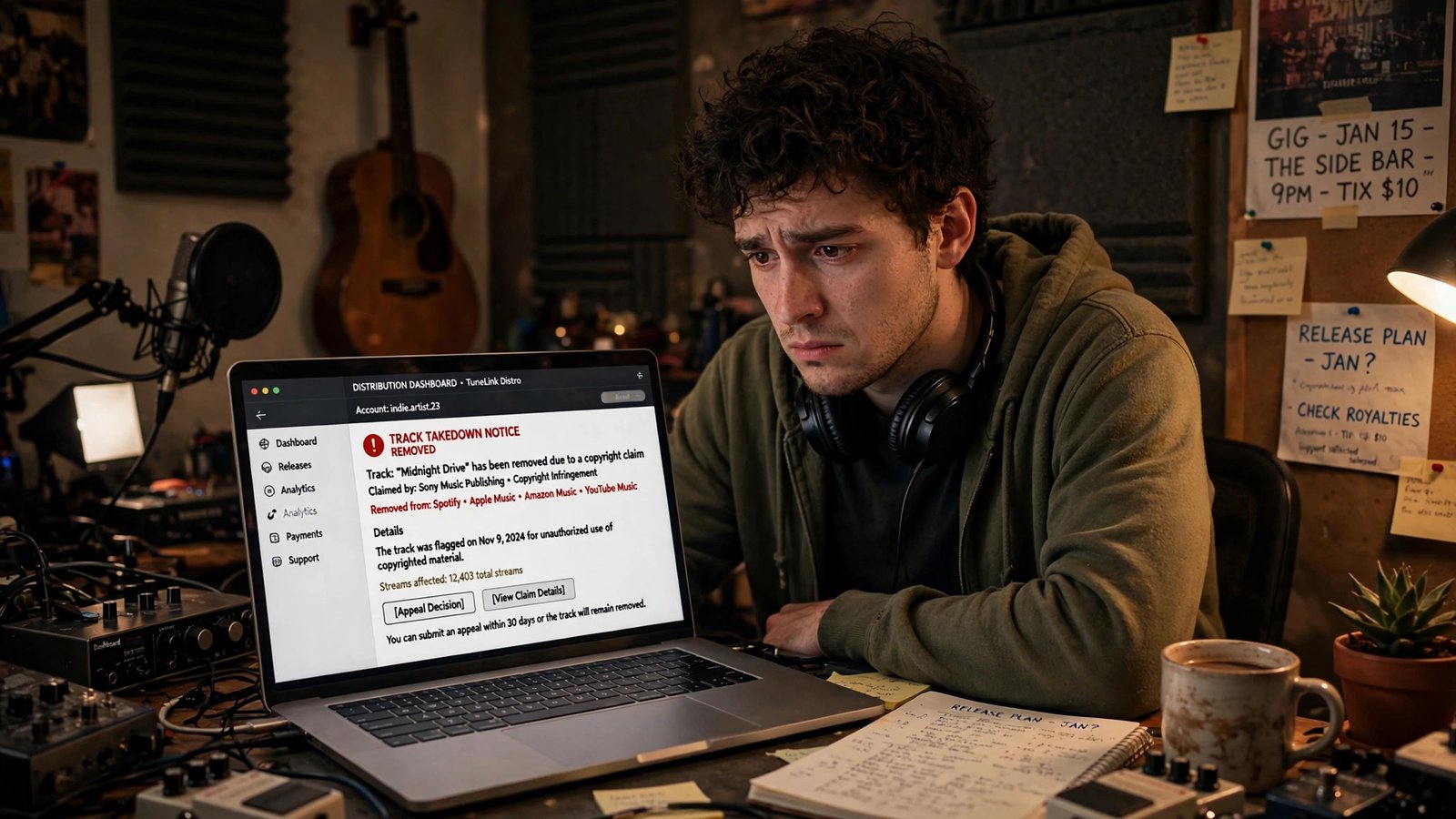
If your DistroKid track disappeared from Spotify or Apple Music in October 2026, you are not imagining it — and you are probably not the target of the lawsuit. On September 15, 2026, Universal Music Group sued DistroKid in federal court in Delaware, and in October DistroKid confirmed it had removed “a very small number” of recordings in response to UMG’s claims (Music Business Worldwide). Some of those recordings belonged to independent artists who say their music was original, licensed, or both. The case is still ongoing, no court has ruled on anything yet, and your job right now is practical, not legal: figure out whether you were caught in the sweep, gather your proof, and decide whether to dispute the removal or wait it out. This guide walks you through all three steps.
A quick note before we go further: I am not a lawyer, and nothing here is legal advice. If a takedown threatens your income or your catalog, talk to an entertainment attorney — even a short consultation can save you from a costly mistake. What follows is a clear, practical rundown of what has happened so far, what DistroKid’s own process looks like, and how working artists are protecting themselves while the case plays out.
What Actually Happened Between UMG and DistroKid
The lawsuit, in plain English
On September 15, 2026, UMG Recordings, Capitol Records, and Capitol CMG filed a 52-page complaint against DistroKid in the U.S. District Court for the District of Delaware (case number 1:26-cv-01156-MN, assigned to Judge Maryellen Noreika). The complaint runs to five counts, including copyright infringement and deceptive trade practices under Delaware law.
UMG’s core allegation is that DistroKid distributed unauthorized versions of its recordings — remixes, sped-up versions, and tracks with replacement vocals — and kept some of them live after being told about the rights conflicts. The complaint also accuses DistroKid of building what it calls an “AI slop pipeline”: mass-produced, undisclosed AI-generated tracks that UMG says divert streams and revenue from real artists. The exhibits list roughly 1,000 specific recordings, and reporting on the complaint has put the alleged total closer to 2,000. UMG is seeking statutory damages of up to $150,000 per infringed work, plus an order forcing DistroKid to remove infringing tracks and terminate repeat infringers.
Here is the part that matters most for independent artists: UMG has said the case is not about AI music that is clearly labeled as AI. It is about undisclosed AI tracks and unlicensed copies of existing recordings. DistroKid, for its part, says it “strongly disputes” the allegations and was disappointed that UMG chose litigation over what it calls established industry processes.
None of this has been decided. The allegations are just that — allegations. No judge has ruled on whether DistroKid did anything wrong, and no ruling is expected soon.
The takedowns artists actually experienced
The lawsuit might have stayed a courtroom story if the music had stayed up. It did not. In early October 2026, independent artists started posting that their songs had vanished from streaming services — often with no email, no warning, and no explanation.
On October 10, 2026, DistroKid confirmed to The Verge that the removals were real and directly connected to UMG’s claims. Amanda Ferri, DistroKid’s vice president of artist services, said: “A very small number of recordings distributed through DistroKid have been removed in response to claims made by UMG. We strongly dispute the allegations underlying UMG’s lawsuit and regret the disruption to affected artists.”
The artists who spoke up publicly did not sound like the people UMG’s complaint describes. Musician McGwire told The Verge that six of his songs came down, including a cover of Stevie Wonder’s “Isn’t She Lovely” that he says he held a license for — and a track flagged for an uncleared sample of a song that was released two years after his own track. Rapper Insane Ian said an original song was removed without warning or explanation. King Chase said an album by an artist he works with was taken down after three or four years online without any prior copyright strike. Nashville singer-songwriter Josh Sahunta found out his 2022 album Mellowdrama had disappeared only when a friend asked why it was unavailable — and he says the removal came with a copyright strike that froze his royalty payments.
Digital Music News also reported Reddit users describing similar experiences: one artist said an album scheduled for release on Friday, October 16 was rejected outright because one track matched another artist’s song — even though both artists had used the same beat, and the poster said he had paid for the lease while the other artist had not. Another Redditor said a song from 2001 was flagged against a 2003 song because both used the same commercially available sample pack. These are individual accounts, not court findings, and the rights status of each removed recording has not been independently verified. But the pattern is hard to ignore: automated matching and rights claims cannot always tell a licensed beat from a stolen one, or a shared sample pack from a copied song.
Is My Track Affected? The Checklist
Before you panic or file anything, run through this checklist. It takes about fifteen minutes and tells you whether you have a problem, how big it is, and what evidence you already have.
1. Check every platform, not just Spotify. A track can be grayed out on Spotify while still live on Apple Music, or gone everywhere at once. Open Spotify, Apple Music, YouTube Music, Amazon Music, and Tidal, and search for each of your releases by exact title. Note which ones are missing and where.
2. Check your DistroKid dashboard. Log in and look at each release. Artists have reported tracks showing as grayed out or missing entirely in the dashboard before disappearing from streaming services. Screenshot everything you see — including the absence. A screenshot of a missing release is evidence too.
3. Check your email, including spam. Some artists got no notice at all. Others received a notice only after the track was already gone, referring to a rights-owner complaint and a copyright strike without naming the disputed track, the recording it allegedly copied, or the claimant. Search your inbox and spam folder for “DistroKid,” “copyright,” “takedown,” and “strike.”
4. Check your DistroKid Bank balance. At least one artist reported their balance dropping to zero and the withdrawal option disappearing, again with no warning. If your balance changed unexpectedly, screenshot it and note the date.
5. Ask a friend to search, too. Sometimes a track disappears from your own account view before it disappears from search results, or vice versa. A second pair of eyes — and a second screenshot — costs nothing.
If everything checks out and nothing is missing, you are probably fine for now. But do not skip the next section: the artists who got hit hardest were the ones who had no backups and no paperwork when the music vanished.
Your Documentation Kit: Build It Before You Need It
Think of this as the folder that proves your music is yours. If your track gets pulled, this kit is the difference between a dispute you can win and a weeks-long email chain that goes nowhere. Build it now, while your releases are still live.
Release receipts. Save the DistroKid confirmation email for every release, plus screenshots of each release page in your dashboard showing the release date, UPC, and ISRC codes. Export this data if you can. Your ISRC is your recording’s fingerprint — it is how you prove that the track on Spotify was the same one you uploaded.
Distribution confirmations. Keep screenshots of your tracks live on each streaming platform, with dates visible. A dated screenshot of your song on Spotify is simple, boring, and surprisingly powerful.
Beat leases and sample licenses. If you bought or leased a beat, keep the receipt, the license agreement, and the producer’s name and contact information. If you used a sample pack, keep the purchase receipt and the pack’s license terms — especially the part that says the samples are cleared for commercial use. The 2001-versus-2003 example above is exactly the kind of mix-up a sample-pack receipt can untangle.
Cover song licenses. If you released a cover, keep the mechanical license (from a service like Easy Song Licensing, Harry Fox, or DistroKid’s own cover-song licensing) and the payment receipt. A licensed cover is still your recording, and the license is your proof.
Session files and project files. Keep your DAW project files, stems, and raw vocal takes. They prove you made the track, and they let you re-upload or re-master it quickly if you need to. Store them somewhere other than the laptop you record on — an external drive or cloud storage.
Correspondence. From today on, save every email and support ticket about a takedown. If DistroKid support tells you something by email, keep the email. If they tell you something in a chat, screenshot it. Dates, names, and ticket numbers matter.
A simple spreadsheet. One row per track: title, ISRC, release date, platforms, license type, license receipt location, and current status (live, removed, disputed).
What to Do If Your Track Was Taken Down
Step 1: Don’t re-upload it immediately
This is the hardest advice to follow, and the most important. Your instinct will be to put the song back up right away. Resist it. Re-uploading a track that was removed for a copyright claim — especially while a dispute is open — can trigger a second strike, complicate your counter-notice, or get your account flagged as a repeat infringer. UMG’s complaint specifically asks the court to order DistroKid to terminate repeat infringers. Do not hand anyone a reason to put you in that category.
Step 2: Contact DistroKid support in writing
Open a support ticket (email, not just a chat window) and include:
- The track title, ISRC, and release date
- The date you discovered the removal
- Which platforms it disappeared from
- Whether you received any notice, and what it said
- A clear statement of your position: the track is your original work, or you hold a license for the cover/beat/sample — whichever applies
- Your documentation attached: license receipts, release confirmations, project files if relevant
Ask two specific questions: what was the basis for the removal, and what is the process and timeline for reinstatement? Get the answers in writing. If support gives you a vague reply, reply politely and ask again. A paper trail protects you.
Step 3: File a counter-notice if you have the rights
DistroKid’s published guidance says artists who believe their content was wrongly removed can file a counter-notice. Once filed, DistroKid is obligated to wait 10 business days before reinstating the content. That waiting period exists so the claimant has time to respond.
Be honest with yourself before filing: a counter-notice is a formal statement that you have the right to distribute the recording. If you are certain your track is original or properly licensed, file it — that is what the process is for. If you are not sure — say, you used a beat from a YouTube “free for profit” download with no written license — do not file a counter-notice until you have sorted out the rights. Filing a false counter-notice can expose you to legal liability.
One more wrinkle to know about: even after the 10-business-day wait, streaming services “may choose not to reinstate content based on their terms of use, internal policies, or other factors that are outside of DistroKid’s control.” That is DistroKid’s own language, and it means reinstatement is not guaranteed. Plan for that possibility instead of counting on it.
Step 4: Protect your money
If your DistroKid Bank balance froze or dropped, ask support about it in the same ticket — in writing, with screenshots. Do not assume it will sort itself out. Also check whether any of your other releases are affected. A strike on one track can have consequences for your whole account, so find out where you stand before you release anything new.
Step 5: Keep your audience in the loop
If the missing track was one your fans stream regularly, a short post helps: “My song [title] is temporarily unavailable on streaming while a rights issue gets sorted out. I’m working on it and I’ll update you here.” You do not need to explain the lawsuit, name UMG, or share details. Fans are far more forgiving about a missing track when they hear it from you first instead of discovering it themselves.
Dispute It, Wait It Out, or Move On? A Decision Framework
Not every takedown deserves the same response. Here is how to think about it:
Dispute it now if: the track is original or fully licensed, it earns meaningful streams or royalties, and you have the paperwork to prove your rights. File the counter-notice, attach your documentation, and follow up in writing. This is your strongest position, and the 10-business-day clock does not start until you file.
Wait and watch if: the track earns very little, you are unsure about the rights (for example, an old beat lease with unclear terms), or DistroKid support has told you the removal is under review. Use the waiting time to sort out your licenses and build your documentation kit. You can always dispute later; you cannot un-file a counter-notice you regret.
Move on if: the track clearly infringes — an unlicensed remix, a sped-up version of someone else’s song, a track built on a sample you never cleared. In that case, the takedown is doing what copyright law is designed to do. Pull the track yourself if it is still up anywhere, learn from it, and focus your energy on the music you own outright. Trying to fight a takedown you would lose only burns time and risks your account.
Consider a second distributor — carefully — if: you have a large catalog and want to reduce single-distributor risk. But do not yank your whole catalog to a new distributor in a panic. Moving distributors means new ISRCs, lost playlist placements, and reset stream counts. If you decide to diversify, move new releases first and test the process before migrating anything that earns. And if you are comparing options, our breakdown of DistroKid vs CD Baby, TuneCore, Ditto, and RouteNote covers pricing, royalties, and AI-music rules side by side.
Protecting Your Catalog While the Case Plays Out
The lawsuit is a reminder of something every independent artist should already know: your distributor is a partner, not a vault. Here is how to make your catalog takedown-resistant.
Label AI involvement clearly. UMG says disclosed AI music is not the issue; undisclosed AI tracks are. If you use AI tools anywhere in your process — lyrics, vocals, production — say so in your release metadata and descriptions where the distributor asks. Transparency is now a form of protection, and our guide to AI music distributor rules and Content ID explains what the major distributors currently require.
Stay diversified in your income. A track that earns only from streaming is a track that vanishes when streaming hiccups. Merch, sync licensing, live shows, and direct fan support (Bandcamp, Patreon, your own store) do not disappear because a distributor had a bad month.
What the November 13 and December 4 Dates Mean — and What They Don’t
Two dates keep showing up in coverage of this case, and both are easy to misread.
November 13, 2026: DistroKid and UMG are expected to complete an initial court conference on or before this date. An initial conference is a scheduling and case-management meeting — the judge and the lawyers talk about timelines, discovery, and next steps. It is not a hearing on whether DistroKid did anything wrong, and it will not decide whether any individual recording comes back. If you are waiting for November 13 to get your song restored, you are waiting for the wrong thing. Your reinstatement runs through DistroKid’s counter-notice process, not the court calendar.
December 4, 2026: DistroKid’s response to the complaint is due on this date, under a September 28 court order that extended the original deadline (Exposed Vocals). If DistroKid asks the court to dismiss the case, UMG would have until mid-January to respond, and DistroKid’s reply would not be due until early February 2027. In other words, December 4 is the start of the legal argument, not the end of it. The case will take months — possibly much longer — to resolve.
There is also a separate, related fight worth knowing about so you do not confuse the two: in October, UMG and Sony Music asked a Manhattan federal court to force DistroKid to hand over data about AI-generated tracks and its AI-detection tools, as part of their separate lawsuit against Suno. DistroKid’s response in that subpoena fight was due November 6. That dispute is about data, not about your recordings — but it shows how wide the labels’ scrutiny of DistroKid has become.
The honest summary: the legal case will grind on for months. Your catalog decisions cannot wait for it. Build your documentation kit, know your rights position on every track, and use the processes that exist today.
If You’re Choosing a Distributor Right Now
If you are new to distribution and wondering whether to sign up with DistroKid while this lawsuit is pending, here is my honest take: DistroKid remains one of the cheapest and fastest ways to get music onto every major platform, and the number of affected recordings is small relative to its catalog. But go in with your eyes open — keep your own backups, keep every license, and do not treat any single distributor as the only home for your music.
If you do decide DistroKid is right for you, you can sign up through our referral link here: DistroKid (affiliate link) — using it supports this site at no extra cost to you. And before your first upload, read our list of DistroKid upload mistakes beginners should avoid so your first release does not run into a preventable problem.
Frequently Asked Questions
Is DistroKid shutting down because of the UMG lawsuit?
No. The lawsuit is ongoing, DistroKid is still operating normally, and no court has ordered it to stop distributing music. DistroKid says it strongly disputes UMG’s allegations. The removals so far involve what DistroKid calls “a very small number” of recordings.
Will my track come back automatically if DistroKid wins?
Not necessarily, and not automatically. Reinstatement runs through DistroKid’s counter-notice process, not the court case. If your track was removed, you need to dispute it yourself — file a counter-notice with your proof of rights and follow up in writing. Even then, streaming services may choose not to reinstate a track based on their own policies. Do not wait for the lawsuit to end; it could take many months.
How long does a DistroKid counter-notice take?
Once you file a counter-notice, DistroKid must wait 10 business days before reinstating the content. That is the minimum timeline — the actual process can take longer if the claimant responds, if support needs more documentation, or if a streaming service declines to restore the track. Keep every email and ticket number so you can follow up if the timeline slips.
Can UMG take down my original song even if I didn’t sample anything?
That is what several artists say happened to them — original songs, licensed covers, and tracks built on purchased beats were removed, sometimes with no explanation. Automated matching and rights claims can misfire, especially when two songs share a sample pack or a beat. That is exactly why your documentation kit matters: a beat lease receipt or sample-pack license is often the fastest way to show a removal was a mistake.
Should I switch distributors because of this lawsuit?
For most artists, a panicked switch is worse than staying put. Moving distributors means new ISRCs, lost playlist placements, and reset stream counts. A better approach is to diversify gradually: keep your existing catalog where it is, send new releases to a second distributor as a test, and keep your own backups of everything either way.
Does this lawsuit affect AI music on DistroKid?
Partly. UMG’s complaint targets undisclosed AI-generated tracks that it says were presented as human-made, along with unlicensed copies of its recordings. UMG has said clearly labeled AI music is not the issue. If you make AI-assisted music, disclose it clearly in your release information and keep records of your process. The rules are tightening across every distributor, and transparency is your best protection.