
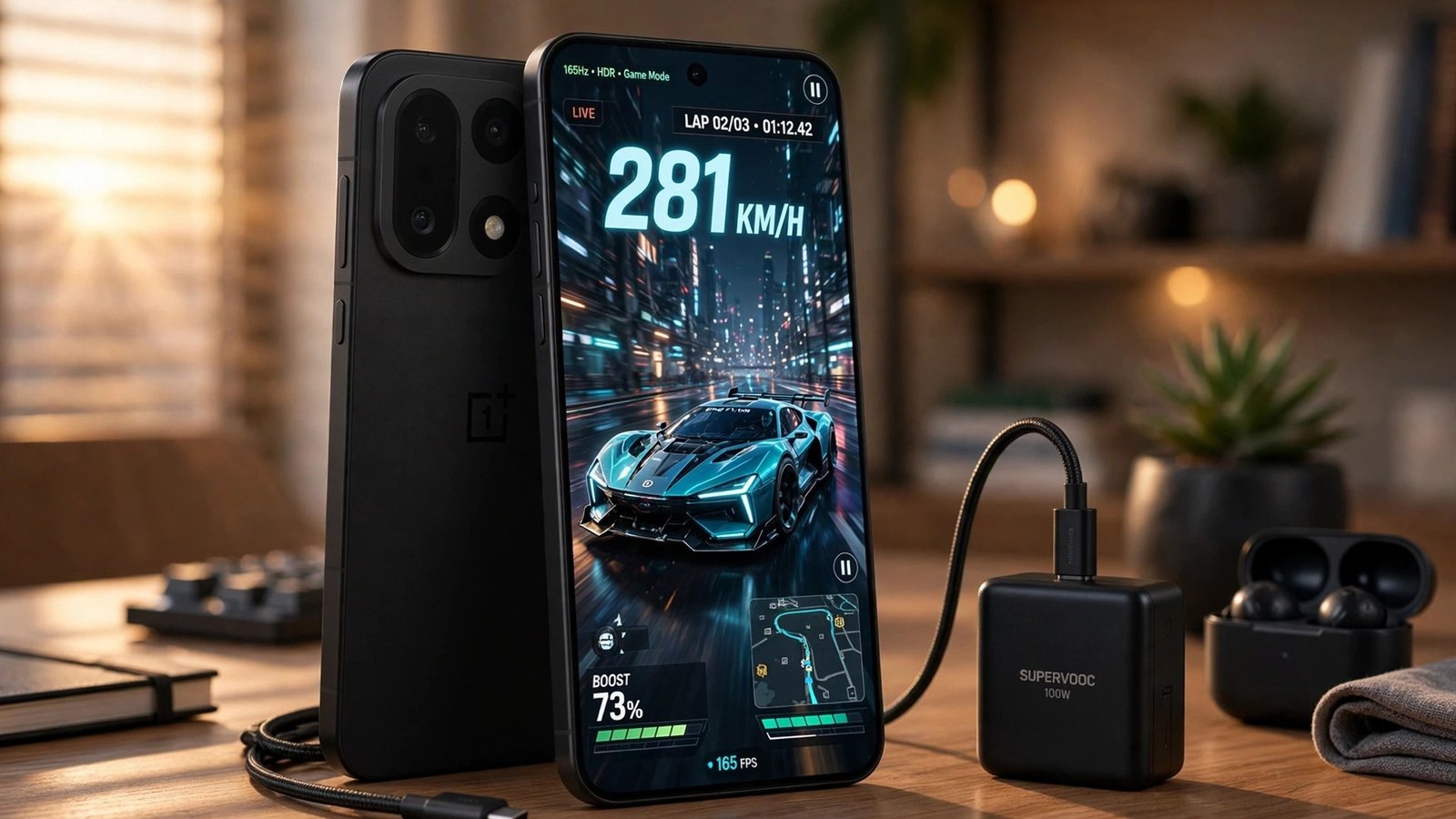
If you searched for the OnePlus 15 global launch on November 13, 2026, here’s the honest answer first: that date is a year off. The OnePlus 15 launched in China on October 27, 2025, went global on November 13, 2025, and reached the United States on December 4, 2025. So this November, the phone is celebrating its first birthday, not its launch — and that changes the buying math completely. The $899.99 launch price, the 165Hz display, and the 7,300mAh battery are all real. But a year later, the street price has moved, the Galaxy S26 Ultra has had a price hike of its own, and the question is no longer “should you pre-order?” It’s “is a year-old flagship still the best $900-ish phone you can buy?”
I’ve checked the launch record, the current US prices, and the specs against each other, and the short version is this: the OnePlus 15 is still a remarkable phone for the money — but the deal that made it famous has quietly gotten worse, and Samsung’s flagship is now cheaper than it on the street.
The date correction: what actually happened with the OnePlus 15 launch
Let’s clear this up properly, because a lot of pages still get the year wrong. The OnePlus 15’s story ran like this:
| Date | What happened |
|---|---|
| October 27, 2025 | OnePlus 15 announced and launched in China |
| October 28, 2025 | China release; sales begin in OnePlus’s home market |
| November 13, 2025 | Global launch announced, with pricing for the UK, Europe, Canada, and India |
| December 4, 2025 | US pre-orders open after FCC certification cleared |
| November 2026 | Phone is one year old and widely available in the US |
The most interesting wrinkle in that timeline is the American delay. When OnePlus announced global pricing on November 13, 2025, it could not confirm US pre-order or open-sales dates at all. The reason was bureaucratic, not technical: the phone had already passed all the required lab tests, and its FCC certification application had been formally submitted, but the US government shutdown meant the FCC wasn’t processing certifications.
That delay lasted about three weeks. Once the FCC certification came through, OnePlus opened US pre-orders on December 4, 2025, at 11 AM EST, with a genuinely generous sweetener: pre-order the 16GB/512GB model and you got a free OnePlus Watch 3 (43mm), worth $299.99. Pre-order the 12GB/256GB model and you got free OnePlus Buds Pro 3, worth $179.99. Notebookcheck covered the US arrival and the pre-order gifts in detail. That launch bundle is long gone now, which is worth remembering when you compare today’s price to the launch price — the early buyers didn’t just pay $899.99, they paid $899.99 and walked away with $180 of earbuds.
Why does the year matter? If you’re shopping in November 2026 and you think this phone just launched, you’ll pay a launch price for a phone that’s already a year into its life. A year-old flagship isn’t a bad buy, but it should cost less than a brand-new one, and the software support clock has already been ticking for twelve months.
OnePlus 15 specs at a glance
Here’s the full spec sheet, verified against GSMArena’s listing and Notebookcheck’s launch coverage. Nothing here is from memory — every number below was checked this morning.
| Spec | OnePlus 15 |
|---|---|
| Chip | Qualcomm Snapdragon 8 Elite Gen 5 (3nm) |
| Display | 6.78-inch LTPO AMOLED, 1.5K (2,772 × 1,272), 1–120Hz adaptive, up to 165Hz in supported games |
| Brightness | 800 nits typical, 1,800 nits HBM |
| RAM / storage | 12GB/256GB or 16GB/512GB (UFS 4.1, LPDDR5X) |
| Battery | 7,300mAh silicon-carbon |
| Wired charging | 120W globally (80W in the US) |
| Wireless charging | 50W, plus 10W reverse wireless and bypass charging |
| Rear cameras | Triple 50MP: main (Sony IMX906, f/1.8, OIS), ultrawide (116° field of view), 3.5x periscope telephoto (OIS) |
| Software | OxygenOS 16 based on Android 16 |
| Water resistance | IP69K |
| Colors | Infinite Black, Sand Storm, Ultra Violet |
| Thickness | 8.1mm |
First, the chip. The Snapdragon 8 Elite Gen 5 was Qualcomm’s top silicon when this phone launched, and a year later it’s still the chip in most 2026 Android flagships — including the Galaxy S26 Ultra, which shares the same generation of Qualcomm hardware. That matters for longevity: you’re not buying last year’s chip, you’re buying the current one. The phone also carries a dedicated touch-response chip and an independent Wi-Fi chip, both aimed at gaming, plus a dedicated P3 display chip.
Second, the battery. At 7,300mAh, this was the largest battery ever put in a OnePlus phone, and it remains one of the biggest in any mainstream flagship a year later. OnePlus got there with silicon-carbon battery chemistry — the same technology that lets phone makers pack more capacity into the same space — and the phone is still only 8.1mm thick. For comparison, most flagships in this class carry batteries in the 5,000–5,500mAh range, so the OnePlus 15 is carrying roughly 35–45% more capacity than the typical rival.
Third, the cameras. OnePlus ended its Hasselblad partnership with this generation and replaced it with an in-house computational system called the DetailMax Engine. The hardware is a triple 50MP array: a 50MP main sensor with optical image stabilization, a 50MP ultrawide with autofocus (which doubles as a macro camera), and a 50MP periscope telephoto with 3.5x optical zoom and 7x lossless zoom. On paper that’s a strong, balanced setup. In practice, the camera system is the one area where the OnePlus 15 doesn’t clearly beat its rivals — Samsung and Google both have longer track records in computational photography, and the DetailMax engine was brand new when this phone shipped. If photography is your top priority, that should weigh in your decision.
The 165Hz display: the reality check
The 165Hz refresh rate is the spec OnePlus shouts about loudest, and it’s also the one most likely to mislead you. So let’s be precise about what it does and doesn’t mean.
The OnePlus 15’s 6.78-inch LTPO AMOLED panel has an adaptive refresh rate that runs from 1Hz to 120Hz in normal use. The 165Hz mode is not the everyday refresh rate. It kicks in only in supported gaming scenarios — specific games that support high frame rates, with the right settings enabled. In regular use — scrolling your email, reading the news, watching YouTube — the display tops out at 120Hz, exactly like most other flagships.
That’s not a scam, but it is a narrower feature than the marketing suggests. The panel is a 1.5K display (2,772 × 1,272 pixels), which sits between standard 1080p and full QHD, and its peak brightness of 1,800 nits in high-brightness mode is good but not class-leading. The LTPO technology does help battery life, dropping the refresh rate to as low as 1Hz on still images.
Who actually benefits from 165Hz? Competitive mobile gamers playing supported titles — OnePlus was the official phone of the 2025 Call of Duty: Mobile World Championship Finals, which tells you exactly who this feature is for. If you play those games, the difference between 120Hz and 165Hz is real. If you don’t game on your phone, the 165Hz figure will change nothing about your daily experience.
My honest take: treat 165Hz as a bonus for gamers, not as a reason to choose this phone. The battery is the real headline.
The battery and charging: still the best reason to buy this phone
If there’s one reason the OnePlus 15 still makes sense in November 2026, it’s the power system. Let’s work through the numbers, because they hold up better than any other part of the spec sheet.
A 7,300mAh battery in a phone this thin is genuinely unusual. Here’s what that capacity means in everyday terms: most reviewers and owners report two-day battery life with moderate use, and a full day of heavy use — gaming, navigation, camera, 5G — with room to spare. OnePlus rates the phone for up to 31 hours of video playback. The silicon-carbon cell also comes with a four-year battery health guarantee, with OnePlus promising the battery will maintain 80% of its capacity over that period.
Then there’s the charging, and here you need to know about a US-specific catch. The global model charges at 120W wired, which OnePlus says takes the phone from empty to 50% in about 15 minutes and to full in about 40 minutes. But the US model is capped at 80W wired charging, according to Android Central’s launch coverage. That’s still faster than Samsung’s 60W and far faster than Google’s or Apple’s wired speeds. Wireless charging is 50W, and the phone also supports bypass charging, which powers the phone directly from the outlet during gaming so the battery isn’t being charged and discharged at the same time.
Let’s do the price math that actually matters here. At the $899.99 launch price, you were paying about 12.3 cents per mAh of battery ($899.99 ÷ 7,300). At the Galaxy S26 Ultra’s $1,399.99 list price, with a battery in the 5,000mAh class, you’d be paying roughly 28 cents per mAh — more than double. That’s a crude metric, but it captures something real: the OnePlus 15 gives you far more battery per dollar than any phone in its class, and a year later, that advantage hasn’t shrunk at all.
US pricing: launch price vs. what you’ll pay in November 2026
This is where the story gets complicated, and where you need current numbers rather than launch-day memories.
At launch, the US pricing was simple: $899.99 for 12GB of RAM and 256GB of storage, and $999.99 for 16GB and 512GB. The 12GB model was sold only in Infinite Black; the 16GB model came in all three colors. In China, the same 12GB/256GB configuration started at CNY 3,999 — about $561. That means American buyers paid roughly $339 more than Chinese buyers for the identical hardware, a gap of about 60%, driven by tariffs, certification costs, distribution, and the simple fact that OnePlus prices differently by market.
A year later, the price has moved — and not in the direction you’d hope. Price trackers show the 12GB/256GB model selling at around $1,029 on Amazon in November 2026, up $50 in the past month alone. The 16GB/512GB model is listed around $1,125. OnePlus’s own US store shows the phone starting from $999.99, with a $200 trade-in credit available when you trade in any device in any condition — which would bring the effective price to $799.99 if you have an old phone to send in.
| Configuration | Launch price (Dec 2025) | Street price (Nov 2026) | Change |
|---|---|---|---|
| 12GB / 256GB | $899.99 | ~$1,029 (Amazon) | +$129 (+14%) |
| 16GB / 512GB | $999.99 | ~$1,125 (Amazon) | +$126 (+13%) |
| 12GB / 256GB with $200 trade-in | $899.99 | ~$799.99 effective (OnePlus store) | −$100 |
That’s an unusual pattern: a year-old phone that costs more now than it did at launch. The likely drivers are the same tariff and component-cost pressures that pushed Samsung to raise the Galaxy S26 Ultra’s price by $100 in October 2026. It also means the famous “$899.99 flagship killer” price is currently a memory, not a deal you can walk in and get — unless you use the trade-in credit.
One more comparison: OnePlus now also sells the OnePlus 15R from $699.99, a step-down model for buyers who want the brand and the OxygenOS experience without the flagship price.
OnePlus 15 vs. Galaxy S26 Ultra: the comparison that decides it
The brief for this article asked for a OnePlus 15 vs. Galaxy S26 Ultra comparison, and the honest version of that comparison has a twist nobody expected a year ago: on the street, the Samsung is now the cheaper phone.
The Galaxy S26 Ultra launched on March 11, 2026, at $1,299.99. On October 1, 2026, Samsung raised the US list price to $1,399.99 for the 256GB model, $1,599.99 for 512GB, and $1,999.99 for 1TB. But within a week of that increase, Amazon was selling the 256GB model for about $949 — $450 below Samsung’s own list price. Samsung’s list price now says very little about what buyers actually pay.
Here’s the full comparison on the facts I verified this morning:
| OnePlus 15 | Galaxy S26 Ultra | |
|---|---|---|
| US list price (256GB) | $899.99 at launch | $1,399.99 (since Oct 1, 2026) |
| Street price, Nov 2026 | ~$1,029 (Amazon) | ~$949 (Amazon) |
| Launch date | Nov 13, 2025 (global); Dec 4, 2025 (US) | March 11, 2026 |
| Chip | Snapdragon 8 Elite Gen 5 | Same Qualcomm generation |
| Display | 6.78″ 1.5K LTPO AMOLED, up to 165Hz in games | Privacy Display, brighter main and 5x lenses |
| Battery | 7,300mAh | Smaller; independent tests show ~2 hrs more than the S25 Ultra |
| Wired charging | 120W global / 80W US | 60W |
| Wireless charging | 50W | 25W |
| Cameras | Triple 50MP, 3.5x periscope | Same rear sensors as S25 Ultra, brighter lenses |
Read that table carefully, because the conclusion isn’t obvious. At list price, the OnePlus 15 is $500 cheaper than the Samsung — a huge gap. At street price, the Samsung is about $80 cheaper than the OnePlus. The OnePlus wins on battery capacity and charging speed by a wide margin. The Samsung wins on camera maturity, its privacy display, and the broader ecosystem.
So which one should you buy? It depends on what you value. If battery life and charging speed are your top priorities, the OnePlus 15 is still the better phone — nothing else in this class touches a 7,300mAh battery with 80W wired charging. If you want the best camera system, the longest software support, and the easiest carrier financing, the Galaxy S26 Ultra at its current $949 street price is the better buy right now, and it’s not close. And if you’re choosing between them at list price, the OnePlus wins on value — but almost nobody should be paying list price for either phone in November 2026.
Buy now or wait? My verdict
Here’s my honest call, broken down by who you are:
Buy the OnePlus 15 now if: you want the biggest battery in a flagship and the fastest charging, you game on your phone, and you can use the $200 trade-in credit to get the effective price to $799.99. At that price, with a free trade-in on any old device in any condition, the phone is genuinely good value even a year after launch.
Wait if: you’re paying full street price. At ~$1,029 on Amazon, you’re paying 14% more than launch price for a year-old phone, while the Galaxy S26 Ultra sits at ~$949. Black Friday week is days away, and OnePlus has historically discounted aggressively in late November — last year’s biggest OnePlus deals hit 50% off. If you can wait a week or two, you may see the 15 back under $900, or a better trade-in offer.
Skip it if: photography is your top priority, or you want the longest possible software support window. The S26 Ultra’s camera system is more proven, Samsung’s update commitment is longer, and at current street prices the Samsung costs less.
Consider the OnePlus 15R if: your budget tops out at $700. It starts at $699.99 and gets you into the OnePlus ecosystem without flagship money.
One more practical note: if you buy, get the 16GB/512GB model if you can. The 12GB model is only sold in Infinite Black, while the 16GB model comes in all three colors — and the extra storage matters more than it used to, since there’s no microSD slot and 256GB fills up fast once you start shooting 4K video. The $100 step-up at launch pricing was reasonable; at current street prices the gap is closer to $96, and it’s still worth it.
What to check before you buy
A few practical checks that will save you trouble:
US model vs. global model. The US model caps wired charging at 80W, while the global model does 120W. If you’re buying from a third-party importer, confirm which version you’re getting — and remember that grey-market imports may not carry a US warranty. Buy from OnePlus’s US store or Amazon’s official listing, not a marketplace seller shipping from overseas.
Colors and configuration. The 12GB/256GB model comes only in Infinite Black. If you want Sand Storm or Ultra Violet, you need the 16GB/512GB model. Check before you fall in love with a color.
Software updates. The phone launched on OxygenOS 16 with Android 16, and OnePlus has been pushing regular updates — including the November 2026 Android security update cycle. Before buying, it’s worth confirming the phone you’re getting is on a current patch level, since security updates are the quiet part of the value equation. Our guide to the Android November 2026 security update explains what’s in the latest patch and why the zero-click fixes matter.
Trade-in timing. The $200 any-device trade-in credit is a limited-time offer on OnePlus’s store. If you’re planning to use it, don’t assume it will still be there next month — trade-in promotions change constantly, and the value of your old phone as a trade-in drops as it ages too.
Accessories. At 80W charging speeds, you need the right charger to get the full rate. The phone ships with a charger in the box in most markets, but confirm this for the US listing you’re buying from — and if you want 50W wireless charging, you’ll need a compatible OnePlus wireless charger, since standard Qi chargers top out much lower.
Frequently Asked Questions
When did the OnePlus 15 launch globally?
The OnePlus 15 launched in China on October 27, 2025, and globally on November 13, 2025. US sales were delayed by the government shutdown, which stalled FCC certification, and American pre-orders finally opened on December 4, 2025. Any page telling you the global launch is November 13, 2026 has the year wrong.
How much does the OnePlus 15 cost in the US?
The launch price was $899.99 for 12GB/256GB and $999.99 for 16GB/512GB. In November 2026, price trackers show the 12GB model at around $1,029 on Amazon — up about $129 from launch — while OnePlus’s own store lists it from $999.99 with a $200 trade-in credit that can bring the effective price to $799.99.
Is the OnePlus 15’s 165Hz display real?
Yes, but with a big caveat. The 6.78-inch LTPO AMOLED panel runs at 1–120Hz in normal use and only reaches 165Hz in supported games. Everyday scrolling, video, and apps top out at 120Hz. Gamers playing supported titles get the benefit; everyone else gets a very good 120Hz screen.
How big is the OnePlus 15 battery, and how fast does it charge?
The battery is 7,300mAh — the largest ever in a OnePlus phone and one of the biggest in any mainstream flagship. It charges at 120W wired globally, but the US model is capped at 80W, which still takes the phone to about 50% in roughly 15 minutes. Wireless charging is 50W, and the phone supports bypass charging for gaming while plugged in.
Is the OnePlus 15 better than the Galaxy S26 Ultra?
It depends on your priorities. The OnePlus 15 has a much bigger battery and faster charging, and its $899.99 launch price was $500 below the S26 Ultra’s current $1,399.99 list price. But in November 2026, the S26 Ultra’s street price (around $949 on Amazon) is actually lower than the OnePlus 15’s (around $1,029), and Samsung’s camera system and software support are stronger. For battery and charging, pick OnePlus. For cameras and long-term support at today’s street prices, pick Samsung.
Should I buy the OnePlus 15 now or wait for Black Friday?
If you can use the $200 trade-in credit, buying now at an effective $799.99 is a solid deal. If you’re paying full street price, wait — Black Friday week is days away, OnePlus has historically discounted heavily in late November, and paying $1,029 for a year-old phone makes little sense when the Galaxy S26 Ultra is selling for less. If you’re trading in an older phone, check current values first — our Pixel 11 trade-in guide explains how trade-in deadlines and values work, and the same logic applies to any phone you’re sending in.