Picking a music distributor in 2026 is really picking a business model: subscription, one-time fee, or revenue share. The five big DIY options — DistroKid, TuneCore, CD Baby, Ditto, and RouteNote — all get your music onto Spotify and Apple Music, but they charge differently, pay differently, and treat you very differently when something goes wrong.
Every price below was checked against current 2026 comparisons and the distributors’ own pricing pages. Confirm before you buy — prices move.
The pricing, side by side
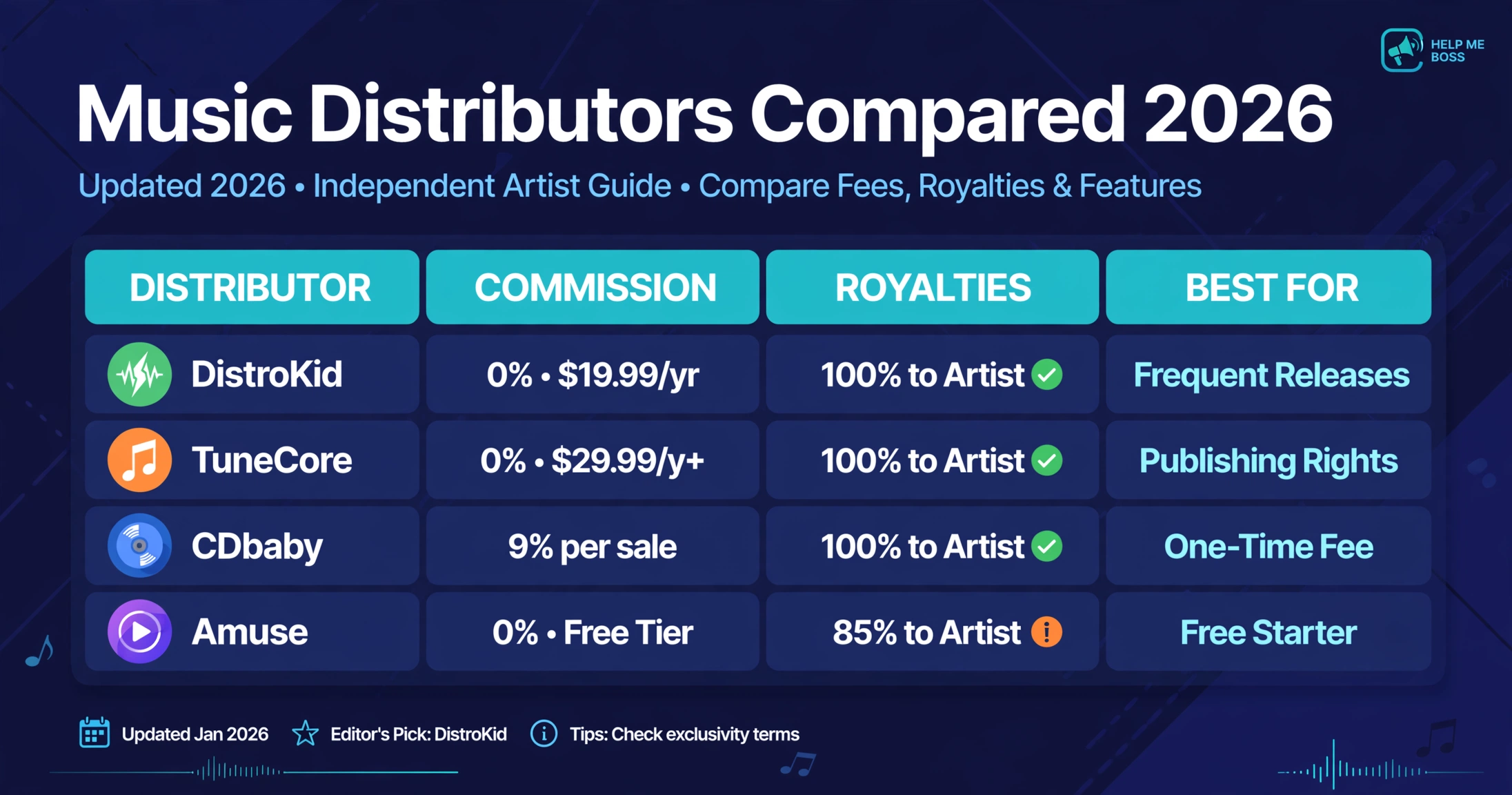
| Distributor | Price (2026) | You keep | If you stop paying |
|---|---|---|---|
| DistroKid | $24.99/yr (1 artist), $44.99/yr (2 artists), $89.99/yr (up to 100) | 100% of streaming royalties | Music comes down unless you buy Leave a Legacy ($29/single, $49/album) |
| TuneCore | $24.99–$54.99/yr (Rising $24.99, Breakout $34.99, Professional $49.99) | 100% | Releases come down the day the plan expires |
| CD Baby | $9.99/single, $14.99/album — one-time | 91% (CD Baby keeps 9%) | Nothing changes — no subscription |
| Ditto | $19/yr | 100% | Starter plan releases come down; Pro/Labels stay live |
| RouteNote | Free (you keep 85%) or Premium $10/single (you keep 100%) | 85% / 100% | Free tier takes 15% ongoing |
The math flips depending on your release volume. Releasing an album a month? DistroKid’s flat $24.99/year with unlimited uploads is brutally efficient. Releasing one single a year? CD Baby’s one-time $9.99 with no annual bill wins — though its permanent 9% cut costs more once a track actually earns.
Royalties, reports, and payout speed
- DistroKid pays 100% of store royalties, monthly. Its “Splits” feature divides earnings between collaborators automatically. Royalty reporting is solid but slower on detail than TuneCore’s.
- TuneCore also pays 100%, with weekly withdrawals and the most detailed reporting in the group — daily sales trends on higher tiers. Its publishing administration add-on (extra fee) handles global mechanicals and sync royalties in one place.
- CD Baby keeps 9% forever but pays reliably, offers sync licensing, and still does physical distribution (CDs/vinyl) — the only one here with real physical infrastructure.
- Ditto pays 100% and positions itself as the budget pick for prolific artists, with playlist pitching and PR services on higher tiers.
- RouteNote‘s free tier is the cheapest way to start (85% kept), and Premium at $10 per single gets you 100%.
YouTube Content ID terms differ too: DistroKid charges for it ($4.95 per single or $14.95 per album per year via its Social Media Pack, and keeps 20% of that revenue). TuneCore includes Content ID but takes 20% of social/UGC revenue. CD Baby includes it in the release fee. RouteNote reserves Content ID for paid users.
Support reputation: what creators actually say
This is where the comparison gets real. Pricing pages are promises; support is what happens when your release is stuck.
DistroKid runs support through a help-center chatbot (DistroBot) that can escalate to a human, plus email tickets — no phone support. That’s the single most consistent complaint across creator communities: when an account gets flagged or royalties stall, reaching a person is hard. Entertainment attorneys Miss Krystle and Briana Martinez devoted a whole video to the pattern — “DistroKid Problems Are Getting Worse” — covering unresponsive customer service, withheld royalties, and takedowns. The podcast My Point Four Cents dug into why support has become so problematic across distributors, tying it to automation and profitability pressure. And on the VI-Control forum, one label owner described DistroKid’s “editorial discretion” takedown process as a shoestring operation: “something got triggered by an automated process that no human there is willing to undo” (thread).
TuneCore offers email support with historically available phone support, and publishes response-time targets (about 3 business days on Rising Artist, 2 on Breakout, 1 on Professional). Not instant, but a defined escalation path exists.
CD Baby is the support standout: phone and email support from an actual artist support team, plus human review on some services. For beginners who expect to need help, that matters more than a few dollars of fees.
The UMG lawsuit question
You may have seen headlines: on September 15, 2026, Universal Music Group sued DistroKid in Delaware federal court (case 1:26-cv-01156), alleging copyright infringement and deceptive trade practices tied partly to AI-generated music. DistroKid denies the claims and says it will defend itself vigorously. The case is pending — no ruling, no findings. Importantly, UMG’s own complaint says it is not about “the distribution of AI-generated music when clearly disclosed as such.”
Should it change your choice? For now, it’s a lawsuit to watch, not a reason to panic-move your catalog. Distributors get sued; what matters is whether your own uploads are clean, disclosed, and properly licensed.
Switching distributors without losing your streams
One more thing the pricing tables never show: what it costs to leave. If you ever switch distributors, do it in this order — getting it backwards is how artists lose playlist placements:
- Upload the same recordings through the new distributor with the same ISRC codes and identical metadata (title, artist spelling, track order).
- Wait until the new versions are live and confirm play counts and playlist placements carried over. Streaming services match recordings by ISRC, so counts usually transfer.
- Only then take the releases down at the old distributor.
Cancel first and re-upload later, and you’ll spend weeks with dead links and split histories. This matters most for DistroKid and TuneCore users, since both pull releases when subscriptions lapse — plan any switch while your current plan is still active.
Who each distributor is best for
- DistroKid — prolific releasers who want the cheapest unlimited-upload flat fee and automated splits. Best value if you release monthly and can live with chatbot-first support. Ready to release? Join DistroKid here (affiliate link) and keep 100% of your royalties.
- TuneCore — artists who want detailed reporting, weekly payouts, and publishing admin in one place. Slightly pricier, more business-like.
- CD Baby — slow releasers (1–2 songs a year) who hate subscriptions, plus anyone who wants phone support, sync licensing, or physical distribution.
- Ditto — budget-conscious artists who want 100% royalties at the lowest annual price ($19/yr).
- RouteNote — artists earning almost nothing yet who want zero upfront risk; the free tier’s 85% beats paying $25/year to earn $30.
If you’re making AI music specifically, read our breakdown of which distributors allow AI music and their Content ID rules before you choose — the disclosure rules differ, and they matter more than the price gap.
Related: DistroKid vs Ditto for AI Music Releases: Which Wins? (2026)
Frequently Asked Questions
Which is cheapest: DistroKid, TuneCore, CD Baby, Ditto, or RouteNote?
It depends on volume. One single a year: RouteNote Free ($0) or CD Baby ($9.99 one-time). Monthly releases: DistroKid ($24.99/yr unlimited) or Ditto ($19/yr). High earners: any 100% option beats CD Baby’s permanent 9% cut.
Does DistroKid take a percentage of royalties?
No — DistroKid takes 0% of streaming royalties; you keep 100%. Its costs are the annual subscription plus optional add-ons (Content ID, Leave a Legacy, Store Maximizer). Note it does take 20% of YouTube Content ID/social revenue.
What happens to my music if I cancel DistroKid?
Your releases come down within weeks unless you’ve bought Leave a Legacy ($29 per single, $49 per album). TuneCore also removes releases when the plan expires; CD Baby’s stay up because there’s no subscription.
Which distributor has the best customer support?
CD Baby, by most creator accounts — phone and email support from a human team. DistroKid is the most criticized (chatbot-first, no phone). TuneCore sits in the middle with tiered email response targets.
Is DistroKid safe to use during the UMG lawsuit?
The lawsuit (filed Sept 15, 2026) is pending with no ruling, and UMG’s complaint explicitly excludes properly disclosed AI music. There’s no verified reason to pull a clean catalog today — but keep your uploads disclosed and licensed regardless of distributor.