
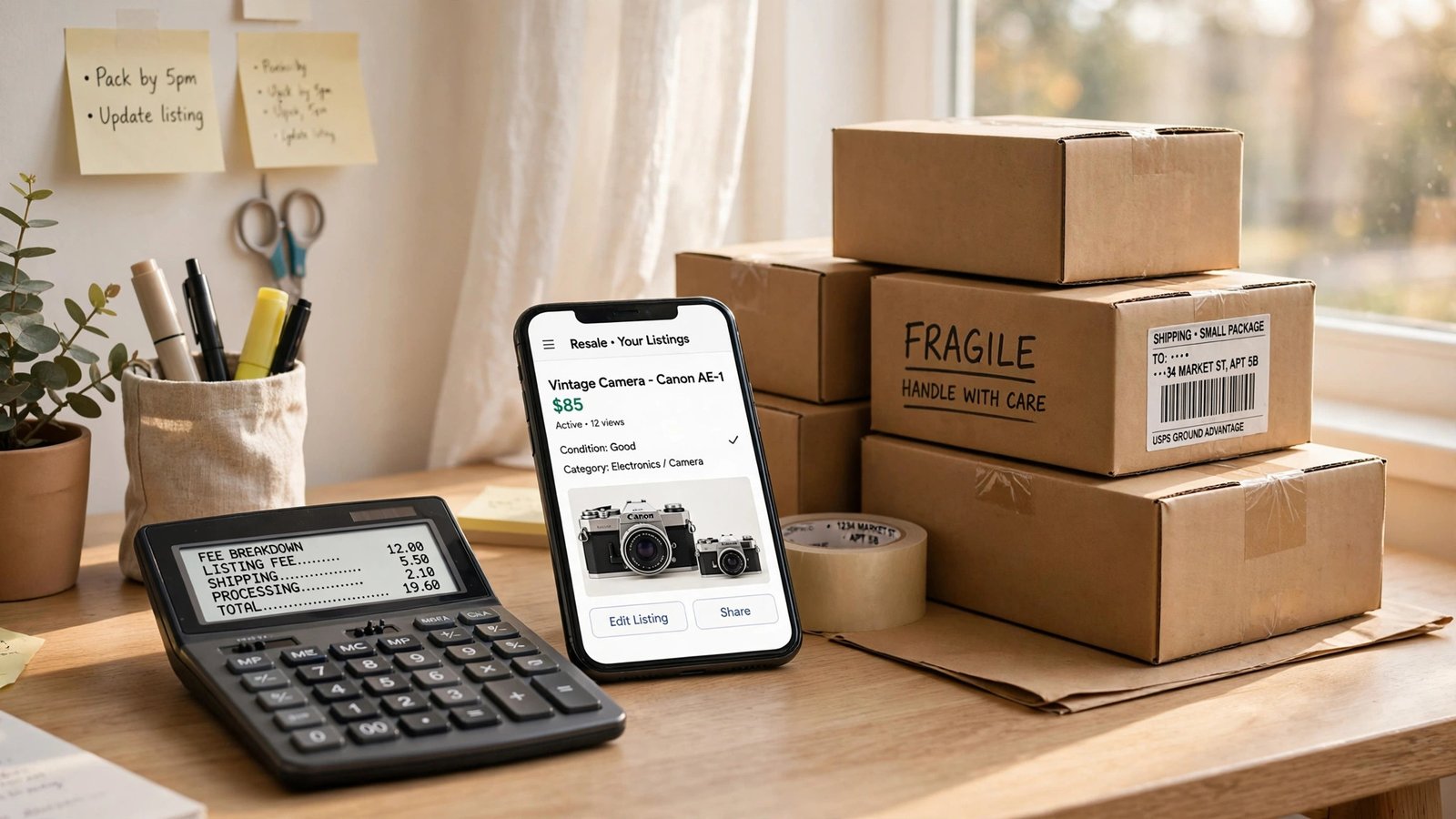
The Direct Answer
Mercari charges sellers a flat 10% selling fee on the item price plus any shipping the buyer pays. There are no listing fees and no separate payment-processing fee — that old 2.9% + $0.50 charge was eliminated on January 6, 2025. The buyer separately pays a 3.6% Buyer Protection fee at checkout, which never comes out of your payout. So on a $50 sale where the buyer pays a $7.99 label, your fee is $5.80 and you’re paid $44.20. That’s the math in one line. The rest of this guide explains why that 10% is often not 10% of your price — and how to price around it.
Every Mercari Fee in One Table (2026)
Here’s the complete cost picture, verified against Mercari’s Help Center and current third-party fee guides checked in October 2026:
| Fee | Amount | Who pays | When |
|---|---|---|---|
| Selling fee | 10% of item price + buyer-paid shipping | Seller | Every completed sale |
| Listing / monthly / setup fee | $0 | — | Never |
| Payment-processing fee | $0 (eliminated Jan 6, 2025) | — | — |
| Buyer Protection fee | 3.6% of item + shipping | Buyer | At checkout |
| Instant Pay cash-out | $3 per transfer (max $600/month) | Seller | When you cash out fast |
| Standard direct deposit | $0 | Seller | When you cash out normally |
| Failed direct deposit | $2, non-refundable | Seller | Only if your transfer bounces |
| Cancellation fee | 5% of item price, capped at $25 | Seller | Frequent seller-caused cancellations |
| Mercari Authenticate listing | $5 | Seller | Only if you use the service |
| Authentication certificate | $10 | Seller | Only if you use the service |
Two numbers trip people up, so read them carefully: the 10% applies to buyer-paid shipping too, and Instant Pay costs you $3 every single time you use it. Everything else only matters in edge cases.
The 2024–2025 Fee Flip-Flop: What Actually Happened
If you read older guides, they’ll tell you conflicting stories — and that’s because Mercari rewrote its fee structure twice in nine months.
Before March 2024, sellers paid the familiar model: 10% selling fee plus a 2.9% + $0.50 payment-processing fee.
March 27, 2024: Mercari pulled a dramatic move — it dropped the seller fee to 0% for new listings and pushed all the costs onto buyers, who started paying a variable service fee plus payment processing at checkout. Sellers cheered. The math looked amazing on paper.
It didn’t work. With buyers seeing sticker prices balloon 10% or more at checkout, conversion dropped. Sellers watched their sales dry up — the platform had made its listings less affordable for buyers, and fewer transactions happened overall. Mercari’s own post-mortem was blunt: the zero-fee structure, in their words, “underserved buyers, wasn’t helping sellers sell more” (quoted in fluf.io’s 2026 Mercari guide, citing Mercari’s Help Center announcement).
January 6, 2025: Mercari reversed course. Sellers went back to paying a flat 10% — but with two meaningful differences from the pre-2024 era: the 10% now applies to buyer-paid shipping as well as the item price, and the old 2.9% + $0.50 processing fee was eliminated entirely. The buyer pays a flat 3.6% Buyer Protection fee instead.
Two takeaways. First, any guide that says “Mercari has no seller fees” is describing a dead era — ignore it. Second, the January 2025 structure is cheaper than the pre-2024 one on cheap items (that flat $0.50 charge used to sting on $10–$15 sales), but pricier on shipping-heavy items, because the 10% now reaches into buyer-paid shipping.
How the 10% Fee Is Really Calculated
This is the part almost nobody states plainly: the 10% fee base is (completed item price + buyer-paid shipping). Not just your price. Not the price minus discounts. The final amount plus whatever shipping the buyer paid.
Worked example — $75 sneakers, buyer pays a 2 lb USPS Ground Advantage label at the new $13.09 rate:
- Fee base: $75 + $13.09 = $88.09
- Mercari fee: 10% × $88.09 = $8.81
- You’re paid: $75 − $8.81 = $66.19
That $8.81 is 11.7% of your $75 item price — not 10%. The fee-on-shipping quietly pushes your real rate above the headline.
Now watch what happens if you pay that same $13.09 label instead (free shipping on the listing):
- Fee base: $75 (no buyer-paid shipping)
- Mercari fee: 10% × $75 = $7.50
- You’re paid: $75 − $7.50 − $13.09 = $54.41
So the seller-pays route has the lower fee ($7.50 vs $8.81) but leaves you with $54.41 instead of $66.19. Keep that gap — $11.78 — in mind, because it’s the core insight of this whole guide.
Worked Payout Math: $25, $50, and $120 Sales
Let’s put the buyer-pays vs. seller-pays decision in a table using the October 2026 best-rate 1 lb label ($7.99) as the constant. “Buyer-pays” means the buyer covers the label at checkout; “you-pay” means free shipping, with the label deducted from your payout.
| Sale price | Buyer-pays shipping: fee → you keep | You pay shipping: fee → you keep |
|---|---|---|
| $25 | $3.30 → $21.70 | $2.50 → $14.51 |
| $50 | $5.80 → $44.20 | $5.00 → $37.01 |
| $120 | $12.80 → $107.20 | $12.00 → $100.01 |
The pattern is unmissable. Letting the buyer pay shipping costs you more in fees (about $0.80 extra per sale here) but nets you roughly $7 more per sale — because you’re not absorbing the label yourself. On the $25 sale the gap is $7.19, on the $120 sale it’s $7.19. That’s not a coincidence: the $7.19 difference is exactly the label cost minus the extra fee-on-shipping.
One more worked case, because cheap items behave differently. A $10 item where you pay a 4 oz label ($5.39):
- Fee: $1.00
- You’re paid: $10 − $1.00 − $5.39 = $3.61
The 10% fee isn’t the problem on cheap items — the label is. Before 2024, the extra $0.50 processing fee made cheap items even worse. Today’s structure is kinder to them, but anything under about $15 with seller-paid shipping is barely worth listing.
The One Pricing Rule That Saves You Money
Here’s the mental math the table above implies. If you want to take home $X on a sale where the buyer pays shipping:
List price = X ÷ 0.9 (roughly X × 1.111)
Why: with buyer-paid shipping, you’re paid exactly 90% of your item price. So $55.56 listed → $50.00 paid to you. If you want $100 in your pocket, list at $111.11. That “1.111” multiplier is the single most useful number on Mercari.
If you’re offering free shipping (you pay the label), the formula shifts — you need to cover the label too:
List price = (X + label cost) ÷ 0.9
Example: you want $50 in your pocket on a 1 lb item with a $7.99 label. ($50 + $7.99) ÷ 0.9 = $64.43. Check it: 10% fee on $64.43 is $6.44; $64.43 − $6.44 − $7.99 = $50.00. It lands exactly.
One honest caveat: while buyer-pays shipping nets you more dollars per sale, “free shipping” is a filter buyers actively use, and many sellers report faster sales with it. Try both on similar items for a few weeks and measure what you actually net, not just what sells faster.
Note: if you use Mercari’s Smart Pricing tool (which auto-drops your price over time), set the floor at least 20% above the breakeven you calculated — the tool is built to move inventory, not protect your margin.
October 2026 Label Changes (and the Holiday Promo You Should Use)
This is the timely part most fee guides are missing. On September 17, 2026, Mercari’s Help Center announced that prepaid label prices for select weight categories would change on October 19, 2026 — reflecting the carriers’ annual rate updates. These apply to new and existing listings, and to both buyer-paid and seller-paid labels. Mercari says its prepaid labels still average about 53% below retail carrier rates.
The new best-rate USPS Ground Advantage prices (package ≤ 1 cubic foot, longest side ≤ 22 inches — bigger boxes pay higher “Standard” rates):
- 4 oz: $5.39 · 8 oz: $5.99 · 12 oz: $7.39 · 1 lb: $7.99 · 2 lb: $13.09 · 3 lb: $13.99 · 5 lb: $15.99 · 10 lb: $21.99 · 20 lb: $35.99
Compare to the old rates: the 1 lb label was $7.48 (now $7.99), the 2 lb was $12.83 (now $13.09). Small bumps, but the difference flows straight into your fee math too — the 10% applies to buyer-paid shipping, so a pricier label raises the fee base.
There’s a silver lining, timed for the holidays. Two days before the rate increase, Mercari announced a free-shipping promotion running October 22, 2026 through January 4, 2027: orders of $50 or more (up to 5 lbs) ship free. Single-item purchases must use Mercari’s Best Rate prepaid option; bundles from the same seller qualify regardless of shipping rate or carrier. Separately, trading cards and paper collectibles get a free 1 oz First-Class Envelope through the same end date (1–3 oz envelopes run $0.49).
If you’re selling $50+ items this holiday season, this promo effectively moves the shipping-cost question off the table for two and a half months. Price for it, and note the end date: January 4, 2027.
Cashing Out: Instant Pay vs. Direct Deposit
Getting your money out has its own fee structure, and the wrong habit costs more than people realize.
- Standard direct deposit (ACH): free. Funds land in 1–5 business days. You’re limited to one withdrawal per day. If your transfer fails — wrong account number, closed account — Mercari charges a $2 non-refundable fee. Get your bank details right the first time.
- Instant Pay: $3 per transfer. Money hits your debit card within about 30 minutes. It’s capped at $600 per month and limited to once daily.
The math on Instant Pay is brutal as a habit — $3 a week is $156 a year to receive money that was already yours. Make free direct deposit your default and reserve Instant Pay for genuine cash-flow emergencies.
A related wrinkle: funds aren’t available the instant something sells. The buyer has three days after confirmed delivery to rate the transaction or raise an issue; after that, the transaction auto-completes and your balance releases. Only then can you withdraw.
Five Mistakes That Silently Eat Your Profit
1. Guessing the package weight. Mercari has charged an 8% penalty on underpaid shipping since March 2025 — when the parcel you send is heavier or larger than the label you bought. (Mercari adjusted this policy again in mid-2025, so if you’re shipping anything close to a weight boundary, check the current help-center wording.) Either way, the lesson is permanent: weigh the packed parcel — box, padding, everything — on a kitchen scale before you buy the label. A $12 scale pays for itself the first time it catches an underpaid 2 lb label.
2. Trusting old fee guides. A shocking number of articles and fee calculators still describe the March 2024 zero-fee structure, or still subtract the old 2.9% + $0.50 processing charge. Any calculator doing that is wrong for every listing created or updated since January 6, 2025. Check the publication date before trusting anyone’s fee math — including this article’s. When in doubt, confirm on Mercari’s Help Center shipping announcements page, which documents the October 2026 rate changes.
3. Inflating shipping to look cheap. It doesn’t work anymore. Because the 10% fee follows buyer-paid shipping, listing a $20 item with $12 shipping doesn’t dodge the fee — it pays a $3.20 fee instead of $2.00. Price the item fairly and let shipping be shipping.
4. Using Instant Pay as a habit. Covered above — $3 per transfer adds up to real money over a year.
5. Cancelling sales casually. Seller-caused cancellations can trigger a 5% cancellation fee, capped at $25, on frequent cancellers. The fee itself is small; the bigger cost is the damage to your seller metrics. Only list what you actually have, and ship it.
Mercari vs. the Other Platforms: $50 Sale, Side by Side
Here’s where the 10% lands in the broader resale market. The scenario: a $50 item, buyer pays the $7.99 label, seller’s net before their own item cost. Tax excluded for apples-to-apples comparison (it varies by state and Mercari collects it — more on that below).
| Platform | Seller cost | You keep on a $50 sale |
|---|---|---|
| Mercari | 10% of item + buyer-paid shipping | $44.20 |
| eBay | 13.6% final value fee on item + shipping, + $0.40/order | $41.71 |
| Poshmark | 20% on sales $15+ ($2.95 under $15) | $40.00 |
| Depop | 0% US selling fee + 3.3% + $0.45 processing | $47.64 |
| Vinted | 0% seller fee; buyer pays shipping | $50.00 |
eBay’s fee math: 13.6% on the $57.99 total is $7.89, plus $0.40, leaving a $49.70 payout — then the $7.99 label comes out of that, netting $41.71. The honest headline of this table: on a shipping-heavy sale, Mercari’s flat 10% beats eBay despite the higher headline percentage, because eBay also charges its final value fee on the shipping and adds a per-order fee. Mercari’s real fee rivals here are Depop and Vinted — which is exactly why the 0%-seller-fee platforms are gaining resellers. If you’re comparing fee math across platforms more broadly, our Etsy fee math breakdown for Q4 2026 runs the same kind of worked example for Etsy’s very different structure.
The other platforms’ buyer-side numbers, for context: Poshmark’s buyer pays the shipping label by default; Depop’s buyer pays a separate fee and the seller eats 3.3% + $0.45 on the transaction; Vinted charges sellers nothing and puts a ~5% + $0.70 Buyer Protection fee on the buyer. Vinted, long dominant in Europe, made a major US expansion push starting January 2026 — it’s now the fee-friendliest option for sellers with fashion and everyday goods, though its buyer base is smaller and more bargain-hunting.
So is Mercari’s 10% “good”? It’s mid-pack on pure fee math. Where Mercari genuinely wins is simplicity (one flat rate, no category tiers), zero listing cost (you can park 200 listings for six months and pay nothing), and a three-day buyer rating window — eBay’s Money Back Guarantee runs 30 days. For mixed general-goods inventory, it’s a strong additional channel; just know Mercari US has roughly 4.2–4.3 million monthly active users in 2026, slightly down year over year even as total sales volume grew.
Sales Tax: You Don’t Handle It
One thing you don’t need to calculate: sales tax. Under US marketplace facilitator laws (the post-Wayfair rules now in every state that has a sales tax), Mercari collects sales tax from the buyer at checkout and remits it to the states directly. It never touches your payout, and it isn’t part of your 10% fee base. You are still responsible for reporting your net business profits as income — sales tax and income tax are separate systems — but on Mercari itself, sales tax is Mercari’s problem.
Frequently Asked Questions
What percent does Mercari take from sellers in 2026?
Ten percent. Mercari deducts a flat 10% selling fee calculated on the completed item price plus any shipping the buyer pays. There are no listing fees, no monthly fees, and no separate payment-processing fee. The fee applies equally across all categories — clothing, electronics, collectibles, everything.
Does Mercari charge a payment-processing fee in 2026?
No. The old 2.9% + $0.50 processing fee was permanently eliminated for sellers on January 6, 2025, as part of the fee-structure reversal. If a fee calculator or guide still subtracts it, it’s using pre-2025 data and its result is wrong. Buyers pay a flat 3.6% Buyer Protection fee instead, which comes out of the buyer’s pocket, not yours.
Should I pay shipping myself or let the buyer pay it?
Let the buyer pay it — almost always. The 10% does apply to buyer-paid shipping, but absorbing the label yourself costs far more. On a $50 sale with a $7.99 label, buyer-pays leaves you $44.20; you-pay leaves you $37.01. The exception: if you’re using “free shipping” as a conversion strategy, raise the price with (target take-home + label) ÷ 0.9 so the label is fully priced in.
Is Mercari Instant Pay worth the $3 fee?
Only when you genuinely need the money today. Instant Pay sends funds to your debit card within about 30 minutes, but it costs $3 per transfer, is capped at $600 a month, and is limited to once daily. Using it weekly costs $156 a year. Standard direct deposit is free and lands in 1–5 business days — make that your default, and reserve Instant Pay for genuine cash-flow emergencies.
Do I need to collect or report sales tax on Mercari?
No. Mercari is a marketplace facilitator: it automatically calculates sales tax based on the buyer’s address, collects it at checkout, and remits it to the relevant state and local tax authorities. You don’t register for sales-tax permits or file returns for Mercari sales. (Income tax is separate — you still report your net profits on Schedule C like any other self-employment income.)
Is selling on Mercari worth it compared to eBay or Depop in 2026?
It depends on what you sell. On pure fee math for a $50 sale with buyer-paid shipping, net after the $7.99 label: Vinted ($50.00) wins because the seller pays nothing and the buyer covers shipping; Depop ($47.64) is next; Mercari ($44.20) lands mid-pack; eBay ($41.71) trails here because its final value fee also hits the shipping amount, plus a $0.40 per-order fee; Poshmark ($40.00) is the most expensive of the five. But fees aren’t the whole decision — Mercari wins on simplicity (one flat 10% rate, free listings, a three-day payout-release window versus eBay’s 30-day guarantee). If you’re starting out, Mercari is one of the side hustles for beginners we recommend precisely because there’s no upfront cost to test whether a category moves. Most serious resellers cross-list everywhere and let the fees sort themselves out.