
No, Google has not announced a core update as of November 9, 2026. The last broad core update finished on June 2, and the last ranking update of any kind — the September spam update — finished on October 8. If your traffic moved in late October or early November, no confirmed Google update caused it. That is the whole story in one paragraph, and it matters, because right now the loudest voices in SEO are acting like an update is already rolling out. It isn’t.
What is real is the gap. One hundred and sixty days have passed since the May core update ended, the longest stretch between core updates in the record Google’s own dashboard covers. Trackers are spiking, forecasts are flying around, and one low-quality site is already claiming a November spam update that never happened. This article is the honest status page for that confusion: the dated record of every confirmed 2026 update, how long the gap really is, what the volatility you’re seeing actually means, what changed while Google stayed quiet, and the checklist to run now so you’re ready the day a real update does land.
The 2026 record: every confirmed update, with dates
Google confirms ranking updates on its Search Status Dashboard, and the dashboard is the only source that counts. Everything below comes from it, cross-checked against the running lists that track it daily.
| Update | Dates | Length | Type |
|---|---|---|---|
| February Discover update | February 2026 | — | Discover-only core update |
| March spam update | March 2026 | Under a day to ~3 days | Spam |
| March core update | March 27 – April 8 | 12 days, 4 hours | Broad core |
| May core update | May 21 – June 2 | 11 days, 21 hours | Broad core |
| June spam update | June 24 – 26 | ~2 days, 1 hour | Spam |
| August spam update | August 18 – 21 | ~3 days | Spam |
| September spam update | September 24 – October 8 | 13 days, 16 hours | Spam |
That’s the full year so far: two broad core updates, four spam updates, and one Discover-only update. Nothing has started since October 8. The running lists agree — as of November 2, the most recent confirmed update was the September spam update, the most recent core update was May, and nothing was rolling out. A check of the dashboard’s own incident feed on November 8 showed the latest announced update was still September 24.
Two details in that table deserve your attention. First, the March and May core updates arrived just 43 days apart, which is unusually tight — Google released four core updates in 2024 and three in 2025, so two in the first five months of 2026 looked like a normal pace. Then the pace stopped. Second, the September spam update ran for nearly 14 days, roughly five times longer than the June and August spam updates. A two-week spam rollout is the kind of thing that makes site owners assume a core update is hiding inside it. It wasn’t. Google said it was a spam update, and spam updates target sites that break Google’s spam policies, not the broad quality reassessment a core update performs.
How long is the gap, really?
On November 1, 152 days had passed since the May core update finished on June 2. As of today, November 9, that number is 160 days. That is longer than the two previous longest gaps in the dashboard’s record, both 147 days: March 28 to August 22, 2023, and July 17 to December 11, 2025.
For context, the median gap between core updates since the dashboard began in November 2021 is 109 days. We are 51 days past the median. That is not a rounding error, and it is why the SEO world is twitchy.
History also says a core update before the end of the year is likely, though likely is not the same as certain. A core update started between October and December in four of the last five years — November 2, 2023, November 11, 2024, and December 11, 2025 are the three most recent examples. Core updates landed in December in both 2024 and 2025. So the calendar points at the next few weeks. But the calendar is a pattern, not a promise, and Google has never once announced a core update in advance. It posts each one on the dashboard when the rollout starts, and not a day earlier. We published an earlier status check on the same question at the start of November, and every date in it still holds — which is itself the story.
One forecast is getting quoted everywhere, so let me label it properly. In a Search Engine Journal column on October 15, 2026, Dan Taylor said his own prediction model gives a 96.8% chance of a Google update within 30 days, with late October to mid-November as the most likely window. That is one person’s model, not a Google statement. Treat it the way you’d treat a weather forecast: useful for planning, useless as proof. The window it named is already half over, and no update has been announced.
The volatility you’re seeing isn’t an update (yet)
If you run a site, you have probably seen the screenshots: Semrush Sensor hit 9.4 out of 10 for UK desktop results on November 2, and Similarweb’s SERP Seismometer jumped from 42 to 225 on November 3. Search Engine Roundtable reported unusual movement on October 27 and noted, in the same breath, that Google had not officially confirmed an update. One careful read of the October volatility puts it plainly: the only confirmed change in play was the tail of the September spam update, which finished on October 8. Some specialists reported changes that looked more like a broad quality reassessment than a typical spam update. Others noted that third-party ranking trackers have been returning unreliable results lately, which makes it harder to tell whether reported movement is genuine.
Here’s the rule that keeps you sane: a tracking tool showing high volatility does not automatically mean Google released a core update. Trackers measure the search results they can see, and their readings move for plenty of reasons that have nothing to do with a confirmed rollout — a spam update’s tail, a feature test, a data glitch, or a genuine unconfirmed change Google never announces. Until Google posts an incident on the dashboard, any October or November swing is unconfirmed, and you should treat it that way in every decision you make about your site.
That discipline matters because the alternative is already circulating. One low-quality source claimed a “November 2026 spam update” finished on November 2. That claim conflicts with the running-list trackers and with the dashboard itself, which shows nothing. Do not repeat it, do not plan around it, and do not let a client or a colleague cite it at you. If someone tells you an update is rolling out, the only question that matters is: “Is it on the Search Status Dashboard?” If the answer is no, it isn’t confirmed, full stop.
There is a real signal buried in the noise, though. Research from Nozzle found that 8% of the search results pages it analysed since September had been significantly altered. That is a meaningful number, and it fits with what the September spam update’s long rollout and the October volatility suggest: Google’s results have been shifting under the surface even without a named core update. The honest reading is that something is moving, but nobody outside Google can say what, or when it gets a name.
What changed while Google stayed quiet
The absence of a core update does not mean Google did nothing for five months. Three 2026 changes affect how you diagnose a traffic drop, and all three landed while the core-update gap was growing.
October 1, 2026: Google rewrote its helpful content guidance. The updated page now defines “main content,” lists four quality attributes, and calls fake author profiles a form of deception. That last point is the sharp one. If your site has author bios with stock photos, invented credentials, or bylines that don’t belong to a real person, Google’s own guidance now names that as deception. This is not a ranking update — it’s a policy statement — but it tells you exactly what the next core update is likely to reward and punish. Fixing author transparency now is one of the few preparations that is clearly correct whether or not an update lands this month.
August 31, 2026: Search Console’s generative AI report and AI features control reached every site. You can now see how your pages appear in Google’s AI features and control some of that exposure. If you haven’t opened the report, do it this week — it is the baseline you’ll compare against when the next update lands, and it’s also the clearest window into how much of your traffic now flows through AI Overviews and AI Mode rather than the classic ten blue links.
August 28, 2026: Google’s spam policies now cover attempts to manipulate generative AI responses in Search. The same policy update cycle also brought enforcement against back-button hijacking, in force since June 15. The direction is consistent: Google is policing the AI layer of search as aggressively as the link layer it policed for twenty years. Content written to game AI answers — including the answer-seeding tactics that drew a policy response earlier this year — is now explicitly a spam-policy matter, not a grey area.
None of these is a core update. All of them shape what the next core update will do.
What to do while you wait
The best time to prepare for a core update is before it lands. Fixes made after an update usually don’t register until the following one, which is why the quiet weeks are the most valuable weeks in the SEO calendar. Here is the checklist, in the order I’d run it.
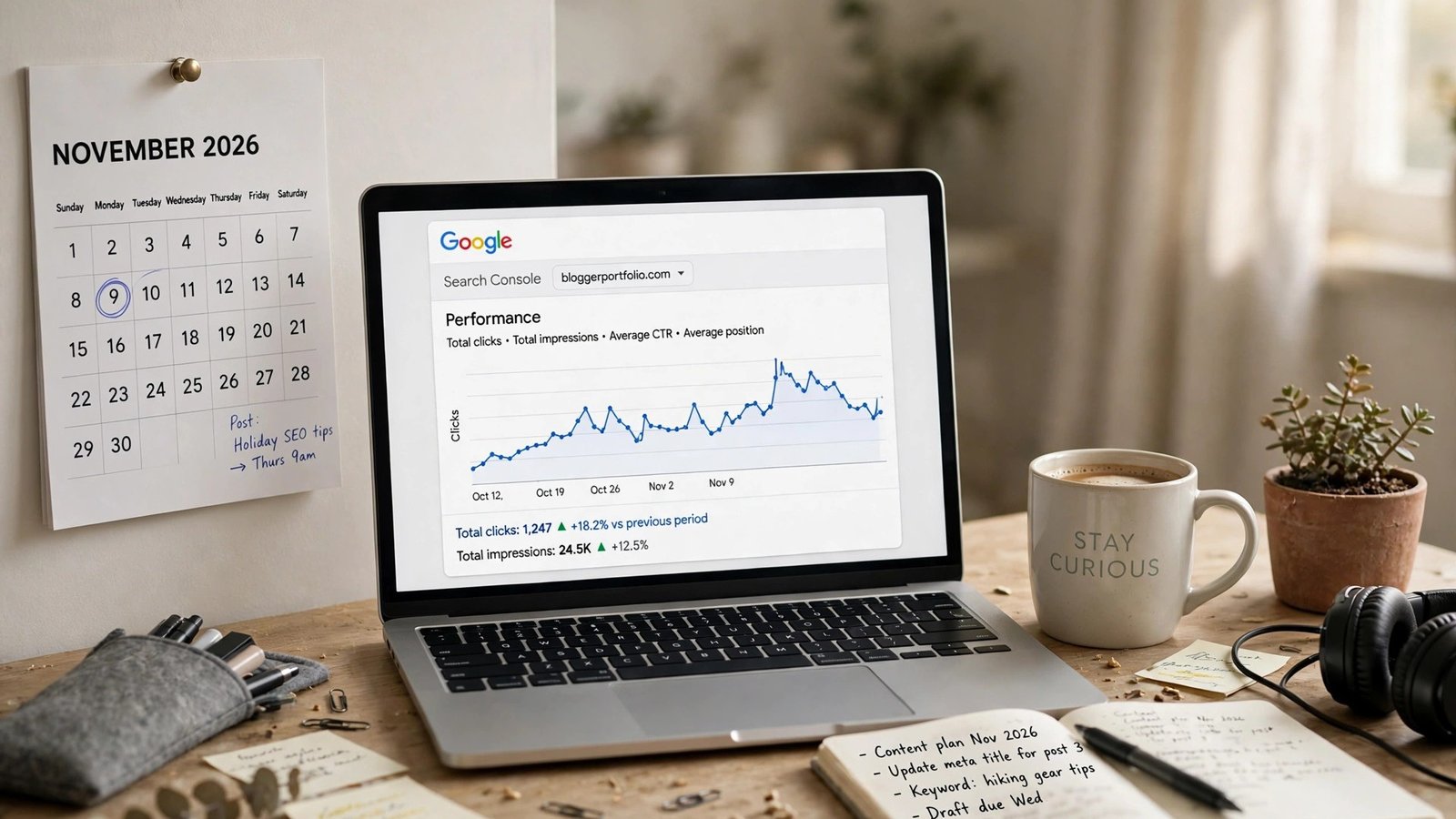
1. Record your baseline today. Screenshot or export your Search Console performance data for the last 28 days and the last 3 months: total clicks, total impressions, average position, and your top 20 queries and pages. Do the same in Google Analytics for organic sessions and your top landing pages. If an update lands next week, this baseline is the only way to measure what actually changed. Without it, you’re guessing from memory, and memory always exaggerates.
2. Check the dashboard, then stop checking it. Bookmark Google’s Search Status Dashboard and look at it once a day. That is the only place a confirmed update appears. The tracker screenshots on social media will keep coming whether or not an update exists, and refreshing them is not preparation.
3. Audit your author pages. Given the October 1 guidance change, this is the single highest-value fix available right now. Every author on your site should be a real person with a real bio, a real photo, and credentials you can defend. Remove or rewrite any byline that isn’t. While you’re there, check that your About page and contact information are current — the same guidance rewards sites that are transparent about who runs them.
4. Read your own content like a stranger. Google’s helpful content guidance asks whether your content demonstrates first-hand experience and whether it answers the question a visitor actually has. Pick your ten highest-traffic posts and read them honestly. If a post is a rewrite of what five other sites say, with no original example, no real number, and no decision the reader can act on, it is exactly the kind of page a core update demotes. Strengthen it now — add the worked example, the real price, the comparison table — or accept that it may lose ground.
5. Fix the technical basics, not the exotic ones. Check that your site loads fast on mobile, that your images have alt text, that your internal links work, and that Search Console shows no new coverage errors. Don’t rebuild your site architecture in November. Don’t change your URL structure. Don’t chase a tracker spike with a redesign. The boring fixes are the ones that survive an update.
6. Do not make panic changes. This is the rule people break most often. If your rankings wobbled in late October, resist the urge to rewrite titles, delete pages, or disavow links in response to unconfirmed volatility. Google’s own guidance is blunt: core updates don’t target specific sites or pages, most sites don’t need to do anything, and a drop doesn’t automatically mean your site did something wrong. Panic fixes made during unconfirmed turbulence are how site owners damage healthy pages.
7. Plan for the worst week, not the best. Black Friday is November 27 and Cyber Monday is November 30. If a core update lands in the same window — and December updates in 2024 and 2025 say it might — affiliate and e-commerce content will be judged while traffic is at its yearly peak. If your holiday content isn’t published and indexed by mid-November, it may be judged in its weakest state. Publish it now.
How to read a ranking drop the day an update DOES land
Sooner or later the dashboard will show a new incident, and when it does, the same discipline applies. Here is how to read it without hurting your site.
Wait for the rollout to end, then wait another week. Core updates take up to two weeks to roll out — both 2026 core updates took about 12 days, and Gary Illyes said on October 2 that core updates generally take two to four weeks. Rankings shift during the rollout, and judging the impact mid-rollout is like judging a race at the halfway mark. Google recommends waiting at least a full week after a core update finishes before drawing conclusions. Mark the end date, add seven days, and only then open the comparison.
Compare like with like. In Search Console, compare the 28 days after the update against the 28 days before it — same length, same weekday mix. A three-day dip means nothing. A 28-day comparison that shows a page down 40% while the rest of the site is flat means something.
Find out whether it’s page-level or site-wide. A core update is a broad reassessment, but its effects are rarely uniform. If three pages dropped and the rest held, the problem is those three pages. If everything dropped together, the problem is the site — its overall quality, its author transparency, its technical health. The fix is completely different in each case, and you can’t choose it until you know which one you’re looking at.
Separate a core update from a spam update. A drop during an announced core update window points at quality and relevance. A drop between September 24 and October 8 pointed at spam policy. The September spam update is the most recent example: sites that lost traffic then should be checking for spam-policy violations — thin affiliate pages, scaled content, manipulative AI output — not rewriting their best articles.
Expect recovery to be slow. Gary Illyes also said in Barcelona on October 2 that typical recovery from a core update can take three to six months. That is the honest timeline, and it’s why the preparation you do now matters more than anything you do after the fact. A site that enters an update with strong content, real authors, and clean technicals has far less to recover from.
Why the next update probably lands before year-end — and why it might not
The case for a 2026 update is strong: the gap is the longest on record, the median gap is 109 days and we’re at 160, core updates have started between October and December in four of the last five years, and Google shipped three core updates in 2025 and four in 2024. Two in 2026 would be a slow year by recent standards, and Google has never gone a full calendar year without a broad core update in the dashboard era.
The case against a date is stronger: nobody outside Google knows. Forecasts are models, trackers are instruments, and patterns are history. Google does not announce core updates in advance, does not publish a schedule, and has shipped updates in every month of the year at one point or another. The December pattern of 2024 and 2025 is two data points, not a rule.
So the right posture is readiness without prediction. Your baseline is recorded. Your authors are real. Your best pages carry original value. Your holiday content is published. The dashboard is bookmarked. When the incident appears — this month, next month, or in January — you’ll know within a day, you’ll know what changed because you measured it, and you’ll know what to do because you decided it before the pressure arrived.
That is the whole point of a status article like this one. It stays correct whether an update lands next week or not, because it describes the record as it stands and the work that is worth doing either way. Check the dashboard tomorrow. Then get back to writing something your readers actually need.
Frequently Asked Questions
Is there a Google core update happening right now?
No. As of November 9, 2026, Google has not announced a core update. The Search Status Dashboard shows no ranking update in progress. The last confirmed update of any kind was the September 2026 spam update, which finished on October 8, and the last broad core update finished on June 2, 2026.
How long has it been since the last Google core update?
The May 2026 core update ran from May 21 to June 2, 2026. As of November 9, 2026, 160 days have passed since it finished — the longest gap between core updates in the record Google’s dashboard covers, beating the previous longest gaps of 147 days. The median gap since November 2021 is 109 days.
When will the next Google core update happen?
Nobody outside Google knows, and Google never announces core updates in advance. History suggests one before the end of 2026 is likely — a core update started between October and December in four of the last five years, and core updates landed in December in both 2024 and 2025. Forecasts, including a Search Engine Journal columnist’s model giving a 96.8% chance of an update within 30 days of October 15, are one person’s prediction, not a Google statement.
What is the difference between a core update and a spam update?
A core update is a broad, significant change to Google’s ranking systems that reassesses content quality across the board. A spam update targets sites that break Google’s spam policies. The September 2026 spam update, which ran September 24 to October 8, was a spam update, not a core update. A traffic drop during a core update window points at quality and relevance; a drop during a spam update points at policy violations.
My rankings dropped in late October. Was it an update?
Probably not a confirmed one. Trackers showed high volatility in late October and early November — Semrush Sensor hit 9.4 out of 10 for UK desktop results on November 2 — but Google confirmed no ranking update in that window. The only confirmed change in play was the tail of the September spam update, which finished October 8. Treat any late-October movement as unconfirmed until Google posts it on the dashboard.
What should I do to prepare for the next core update?
Record your Search Console and Analytics baseline now, audit your author pages for real bylines and credentials (Google’s October 1, 2026 guidance calls fake author profiles a form of deception), strengthen your top-traffic pages with original value, fix technical basics, and don’t make panic changes in response to unconfirmed volatility. If an update lands, wait for the rollout to end plus one more week before judging the impact, then compare 28-day periods in Search Console.