
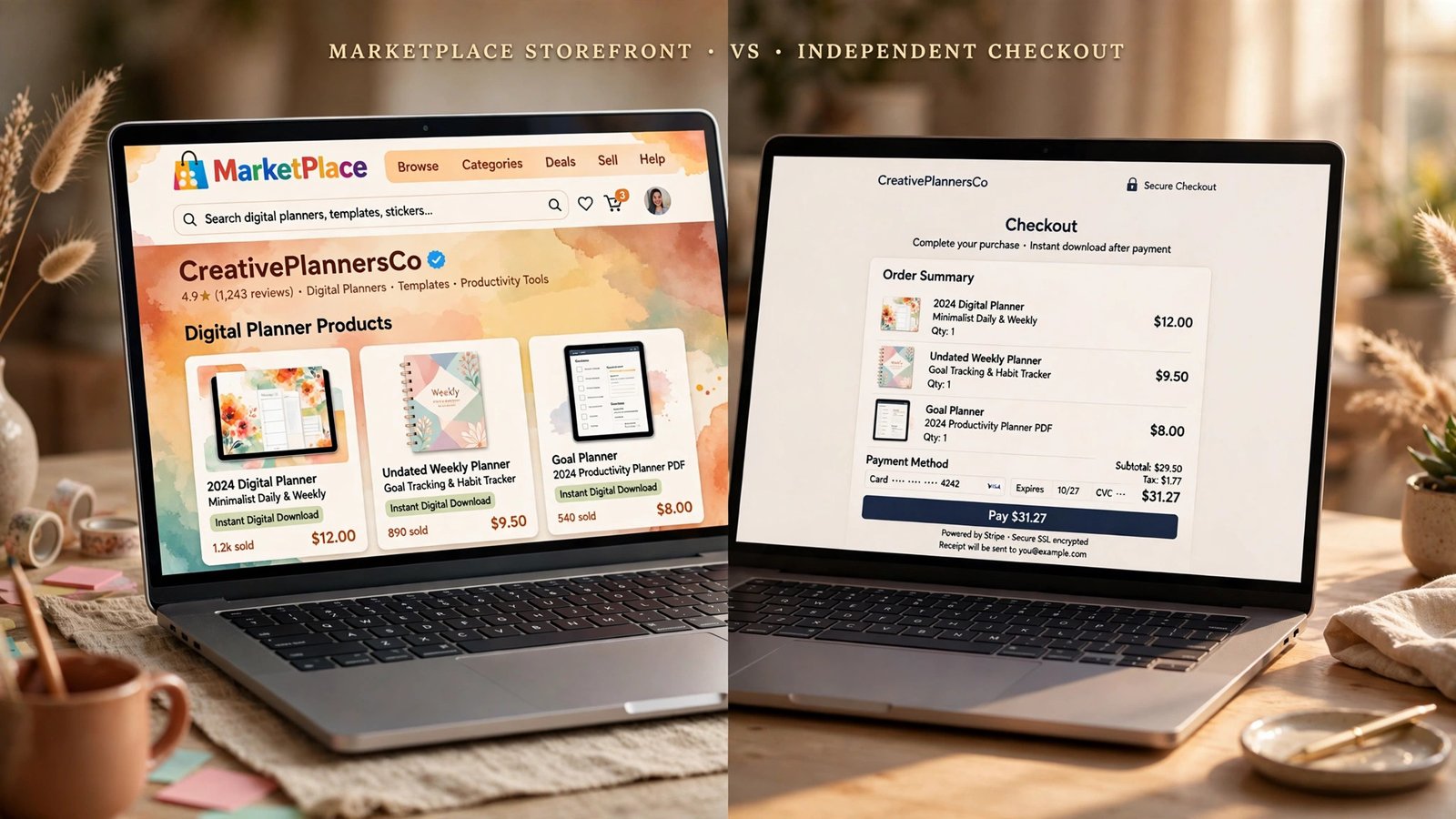
If you sell digital downloads — printables, planners, templates, Lightroom presets — you’ve probably stared at this exact choice: open an Etsy shop, or set up a Payhip storefront? The price lists look close. They’re not.
On a $10 digital download, Etsy takes about $1.40 and you keep $8.60. Payhip’s free plan takes about $1.09 and you keep $8.91. Small gap. But that gap is not the same at every price — it collapses from 8 points at $3 to under 2 points at $200. And fees aren’t the whole story: Etsy brings roughly 86 million active shoppers to your listings, while Payhip brings zero and keeps none of your buyer data hostage.
This article does what no fee table does: it shows you the exact take-home at nine real price points, the monthly-volume math where Payhip’s paid plans beat its free one, the Offsite Ads surcharge that turns Etsy’s “9%” into 24%, and the migration framework for moving bestsellers off Etsy without tanking your sales.
The short answer: who wins at each price
You keep more per sale on Payhip at every price point — but the size of the advantage shrinks dramatically as prices rise. Here’s why this matters: at $3, Etsy’s fixed fees (the $0.20 listing fee and the $0.25 payment-processing fee) are brutal. At $200, they’ve almost vanished into the percentage.
| Sale price | Etsy takes | You keep on Etsy | Payhip Free takes | You keep on Payhip |
|---|---|---|---|---|
| $3 | ~$0.74 (24.5%) | $2.27 | ~$0.49 (16.2%) | $2.51 |
| $5 | ~$0.93 (18.5%) | $4.08 | ~$0.70 (13.9%) | $4.31 |
| $10 | ~$1.40 (14.0%) | $8.60 | ~$1.09 (10.9%) | $8.91 |
| $15 | ~$1.88 (12.5%) | $13.12 | ~$1.49 (9.9%) | $13.51 |
| $20 | ~$2.35 (11.8%) | $17.65 | ~$1.88 (9.4%) | $18.12 |
| $25 | ~$2.83 (11.3%) | $22.18 | ~$2.28 (9.1%) | $22.73 |
| $50 | ~$5.20 (10.4%) | $44.80 | ~$4.25 (8.5%) | $45.75 |
| $100 | ~$9.95 (10.0%) | $90.05 | ~$8.20 (8.2%) | $91.80 |
| $200 | ~$19.45 (9.7%) | $180.55 | ~$16.10 (8.1%) | $183.90 |
How the math works. Etsy’s side: 6.5% transaction fee + $0.20 listing fee + 3% + $0.25 Etsy Payments processing (US rates). Payhip Free side: 5% platform fee + ~2.9% + $0.30 card processing through your own Stripe or PayPal. All figures exclude Etsy’s Offsite Ads, which can add 12–15% on top — more on that below.
The original finding nobody states plainly: the fee gap between the two platforms is a function of your price. At $3, Etsy costs you 8.3 percentage points more than Payhip. At $200, the gap is 1.7 points. This is the number that should drive your decision: if you sell $3 wall art, the platform choice is a real margin decision. If you sell a $150 wedding-planner bundle, fees are nearly a wash — and the question becomes traffic, not fees.
One honest footnote on the $0.20 Etsy listing fee: fee calculators disagree on whether it hits every digital sale or only at listing creation and renewal (every four months). Etsy charges $0.20 when you create a listing and when it renews; several independent fee calculators (Creator Cost Lab, digitalproductfee.com) add it per order as a conservative estimate. On an evergreen listing that sells hundreds of copies between renewals, the $0.20 amortizes toward zero — subtract roughly $0.20 per order from Etsy’s column at high volume. It won’t flip any ranking, but it narrows the gap slightly.
Etsy’s fee stack, line by line
Three fees apply to every digital sale on Etsy in 2026, plus one that only bites sometimes:
- Listing fee — $0.20. Charged per listing at creation and every four months on renewal. Multiple copies of a digital item sold from the same listing don’t each trigger a fresh listing fee the way physical multi-quantity sales do — this is a genuinely favorable quirk for digital sellers, and one reason the evergreen-planner strategy works on Etsy.
- Transaction fee — 6.5% of the sale price. This is the marketplace’s cut for being Etsy.
- Payment processing — 3% + $0.25 for US sellers. The $0.25 fixed piece is what punishes cheap items: on a $3 sale, that quarter alone is 8.3% of the price before any percentage kicks in.
- Offsite Ads — 12% or 15%, sometimes mandatory. This is the one that ruins people. Etsy shows your listings on Google, Facebook, Instagram, and Pinterest. If a sale is attributed to one of those ads, Etsy takes 12% if your shop made over $10,000 in the previous 365 days (mandatory — you cannot opt out) or 15% if under (you can opt out). It’s capped at $100 per order. A $100 sale that came through an Offsite Ad costs you $9.95 in normal fees plus $12–$15 — suddenly Etsy’s “under 10%” is a 22–25% haircut. You don’t control when Etsy promotes you, and you find out after the fact. If you’re under the $10k threshold and not running a traffic strategy that needs Etsy’s ads, seriously consider opting out in your shop settings.
Etsy also has a subscription (Etsy Plus, $10/month) with extra listing credits and ad credits — it doesn’t change the fee percentages, so it rarely matters for digital sellers doing low volume.
Payhip’s fee stack, line by line
Payhip’s model is simpler: one platform fee tier, and you connect your own Stripe and/or PayPal account to take the money.
- Free plan — 5% of every sale, plus card processing (~2.9% + $0.30, set by Stripe/PayPal, not Payhip). Every feature is included: unlimited products, courses, memberships, affiliates, email tools. No revenue cap, no trial clock.
- Plus — $29/month + 2% per sale, plus card processing.
- Pro — $99/month + 0% per sale, plus card processing.
Payhip publishes all three tiers on its official pricing page — the numbers above match it as of October 2026.
The breakeven math. Plus beats Free when 3% of your monthly sales exceeds $29 — that’s $967/month in sales. Pro beats Plus when 2% of monthly sales exceeds $70 — that’s $3,500/month. If you’re doing under $1,000/month, the free plan is the best deal Payhip offers. A seller doing $2,000/month saves about $31/month on platform fees by switching to Plus ($69 vs. $100) — real money, but not life-changing, and only worth it once you’ve been above the line for a couple of months straight.
Payhip also handles EU and UK VAT on digital products for you, which is a genuine relief if you sell to European buyers. On US sales tax, Payhip is not a merchant of record the way platforms like Lemon Squeezy are — meaning US sales-tax compliance largely stays with you. Check Payhip’s current help page and your state’s rules before assuming you’re covered.
The five things fees don’t tell you
1. Who brings the buyers. This is the whole ballgame. Etsy has ~86 million active buyers searching for things to purchase right now. Payhip brings zero. A $13.51 payout on a Payhip sale you made yourself beats $13.12 on Etsy — but zero sales on Payhip beats nothing. Brand-new sellers with no audience almost always make their first sales on Etsy because Etsy is the discovery channel. Fee calculators that crown Payhip without mentioning this are answering the wrong question.
2. Who owns the customer. Etsy owns the relationship. You can’t email your buyers, you can’t market to them later, and if Etsy suspends your shop (it happens — usually around copyright complaints on trending designs), your customer base is gone. On Payhip, every buyer lands in your email tool. Over two years, that list is worth far more than the 2–5% you saved per sale. This is the strongest argument for running both: Etsy for discovery, Payhip for your repeat buyers.
3. Payout speed. Payhip pays out through your connected Stripe/PayPal — effectively instant or on Stripe’s standard 2–7 day schedule, controlled by you. Etsy deposits on a schedule (3–5 days for new sellers), and new-shop holds are real. If cash flow matters week to week, this counts.
4. File limits and delivery. Etsy allows up to 5 files of 20MB each per digital listing, with automatic delivery the moment payment clears. That’s fine for planners, templates, and printables. If you’re selling video courses or big bundles, you’ll hit the ceiling fast — the standard workaround is delivering a small PDF through Etsy that contains a download link to a Drive/Dropbox folder (or, tellingly, to your Payhip-hosted product). Payhip has generous file hosting and streams video for courses natively, which is why people sell courses there, not on Etsy.
5. Trust and conversion. Etsy’s brand does quiet conversion work: buyers trust Etsy’s checkout, its buyer-protection framing, and its reviews. Your standalone Payhip checkout has to earn that trust itself. Expect lower conversion on cold traffic — another reason to keep Etsy running while your own audience warms up.
The decision framework: start on Etsy, migrate bestsellers to Payhip
Here’s the playbook that matches how most successful digital sellers actually operate:
Phase 1 — Validate on Etsy (months 0–6). List your products on Etsy first. Pay the higher fees gladly; they’re buying you data. Which designs get clicks? What do reviews say? Which price points convert? You cannot learn this on a Payhip store nobody visits. Keep prices in the range where Etsy search buyers actually buy — $5 to $30 is the sweet spot for digital.
Phase 2 — Build the direct channel (months 3–9). Set up a Payhip free-plan storefront with the same products. Start routing your own traffic there: Pinterest pins, your email list, TikTok/Instagram bio links. Every sale that comes from traffic you generated costs you 10.9% instead of 14%+ — and it drops a buyer into your email list.
Phase 3 — Migrate the winners (month 6+). Once a product sells reliably, make your Payhip listing the primary one you promote and let the Etsy listing ride on organic search. Many sellers keep the Etsy listing forever as a discovery funnel and put a discount code inside the Etsy-delivered files (“get 10% off your next purchase at my direct store”) to pull repeat buyers over. Etsy tolerates this far more than most sellers assume, as long as you’re not spamming links in listings.
When to stay Etsy-only: you sell under ~$5, you have no audience and no appetite to build one, your products are seasonal one-offs, or your niche lives and dies on Etsy search (certain planner and clipart categories are like this).
When to go Payhip-first: you already bring traffic (email list, Pinterest following, YouTube channel), your average order is $25+, you sell courses or memberships (Etsy can’t do these properly), or you’re crossing ~$1,000/month and the Plus-plan math starts working for you.
The Gumroad footnote
Readers of this site will know our Gumroad fee breakdown: 10% + $0.50 per direct sale plus card processing, 30% for sales through Gumroad Discover. Gumroad beats Etsy at every price on fees, and beats Payhip’s free plan on nothing — Payhip Free’s 5% + processing undercuts Gumroad’s 10% + $0.50 at every price point. The only reason to pick Gumroad over Payhip is its Discover marketplace or a feature you specifically need. For most digital sellers in 2026, the real contest is Etsy vs. Payhip.
Getting paid as a US digital seller
One practical note that belongs in every digital-product article: getting the money out. Etsy’s scheduled deposits land in your bank; Payhip routes through your Stripe/PayPal, which means you need those accounts healthy and verified. If you’re a US freelancer receiving payments from international buyers — common the moment a planner goes semi-viral on Pinterest — our guide to receiving global payments as a US freelancer covers the Payoneer route for keeping more of cross-border payouts.
Frequently Asked Questions
Is Etsy or Payhip cheaper for digital downloads in 2026?
Payhip’s free plan is cheaper at every price point: about 10.9% total on a $10 sale vs. ~14% on Etsy. The gap is widest on cheap items ($3: 16.2% vs. 24.5%) and narrowest on expensive ones ($200: 8.1% vs. 9.7%). But “cheaper” ignores that Etsy brings buyers and Payhip brings none.
Can I sell on both Etsy and Payhip at the same time?
Yes, and most successful sellers do exactly that. Use Etsy for discovery and your Payhip store for traffic you generate yourself. Nothing in either platform’s terms forbids selling the same digital product on both.
What are Etsy’s Offsite Ads and can I turn them off?
Etsy advertises your listings on external platforms and takes 12–15% of attributed sales (capped at $100/order). Shops under $10,000/year can opt out in their shop settings; shops over $10,000 are enrolled mandatorily. Check your settings if you never agreed to this.
At what monthly sales does Payhip Plus become worth it?
$967/month. At that point the Plus plan ($29/month + 2%) costs less than the free plan’s 5%. Pro ($99/month + 0%) beats Plus at $3,500/month.
Does Payhip handle sales tax for digital products?
Payhip collects and remits EU and UK VAT on digital sales. It is not a merchant of record for US sales tax, so US sellers remain responsible for their own state compliance. Verify against Payhip’s current help page for your state.
What’s the cheapest way to sell a $3 digital download?
At $3, Etsy’s fixed fees take ~24.5% and Payhip Free takes ~16.2%. Neither is great — the honest answer is that selling $3 downloads profitably requires volume on either platform, and bundling cheap items into $10+ products is usually the better pricing move.