
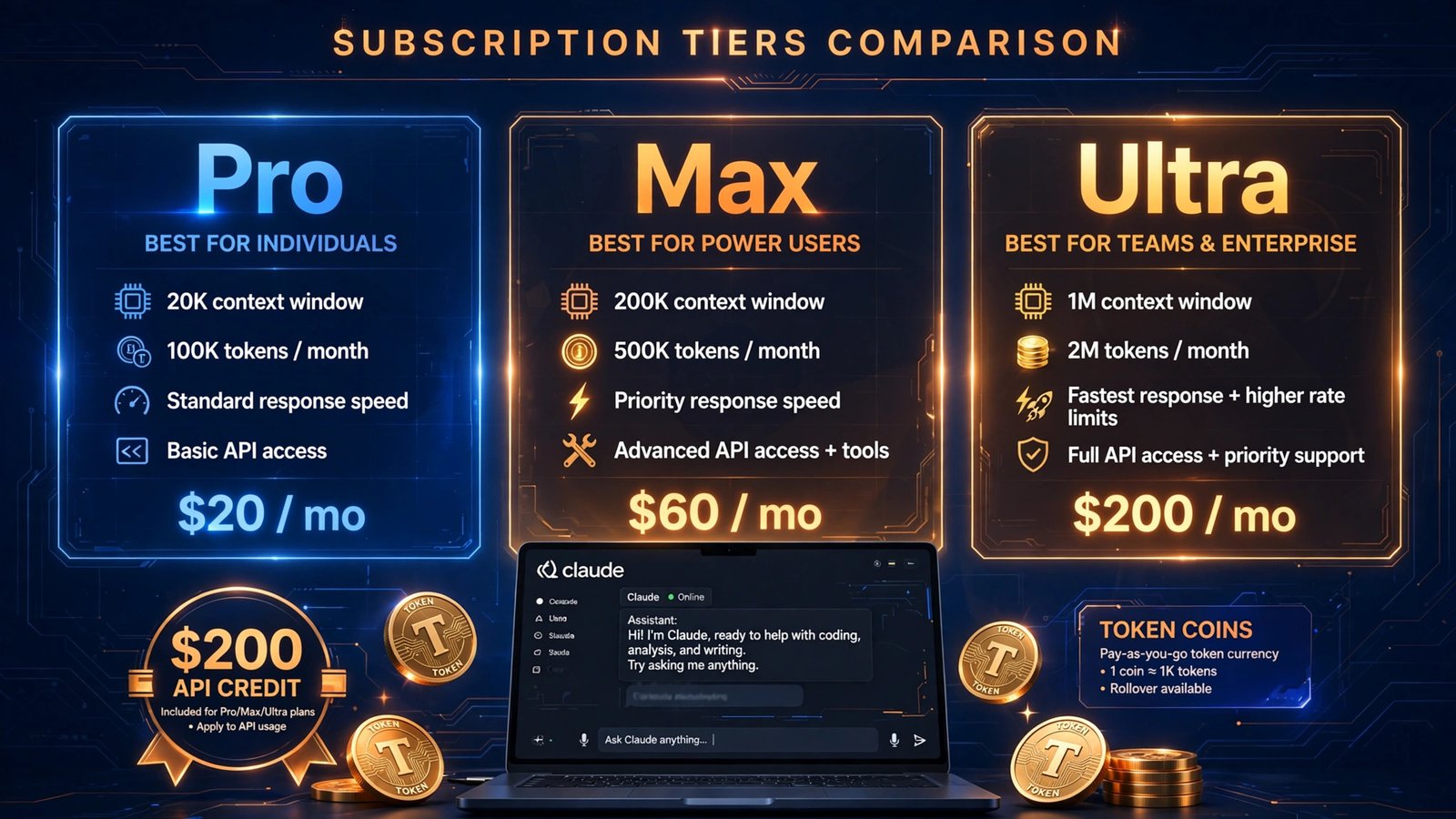
Anthropic renamed Max 5x to Max ($100 a month) and Max 20x to Ultra ($200 a month) on October 30, 2026, with no price change and automatic migration for existing subscribers. The bigger deal for anyone who builds with the API: Max now comes with $100 a month in API credits and Ultra with $200, and those credits buy a very different amount of work depending on which model you run.
The plans at a glance
Here is the whole lineup in one place, at US web prices before tax, as listed on Anthropic’s pricing page in November 2026. Max and Ultra are monthly billing only; Pro is the only individual plan with an annual discount.
| Plan | Price | Weekly usage | 5-hour limit | Monthly API credits |
|---|---|---|---|---|
| Free | $0 | Limited | Yes | None |
| Pro | $20/mo, or $17/mo billed annually ($200/year) | 1x (the baseline) | Yes | None |
| Max | $100/mo | 5x Pro | Yes | $100 |
| Ultra | $200/mo | 10x Pro | No, for verified accounts | $200 |
Every paid plan — Pro, Max, and Ultra — includes Claude Opus 5.5, Claude Sonnet 5.5, and Claude Haiku 5.5, plus Claude Code. Max and Ultra also include Claude Fable 5 and 5.1 for up to half of your weekly allowance; Pro users can only reach Fable with usage credits. Team plans start at $25 per seat per month and pool API credits up to $500 a month.
There is no bulk discount hiding in the higher tiers. Pro costs $20 for 1x of usage, Max $100 for 5x, Ultra $200 for 10x — exactly $20 per 1x of Pro-level usage on every tier.
The rename: why “20x” disappeared, and what it never meant
Anthropic announced the change on X on October 30, 2026: “We’re renaming our Max plans: Max 5x → Max, Max 20x → Ultra. Max is still $100/month, and Ultra is still $200. If you’re a subscriber, there’s nothing you need to do. We’re also removing the 5-hour limit for verified Ultra accounts, starting today with most existing subscribers.”
If you were a Max 20x subscriber, you woke up as an Ultra subscriber. Nothing about your bill changed. The same applied at the $100 tier: Max 5x simply became Max.
So why rename at all? Because the old names were misleading. The “20x” in Max 20x never described your weekly usage — it described only the five-hour session window. Your weekly allowance on Max 20x was always 10x Pro, not 20x. The new names fix that: Ultra is described plainly as “10x Pro usage every week,” and Max is “5x Pro usage every five hours and every week.”
The one real change: no five-hour limit on Ultra
The rename came with exactly one functional change. Verified Ultra accounts no longer have a five-hour usage limit; most existing subscribers got the removal on October 30 itself. Newer accounts keep a temporary limit until Anthropic verifies them, based on account and payment history — phone verification alone does not count.
Why does this matter? Because the five-hour window was the limit heavy users actually hit: a developer four hours into a Claude Code refactor when the session window resets mid-task, or a writer who burns the five-hour budget by early afternoon. The weekly cap rarely bit first. The five-hour cap did, constantly, for exactly the power users paying the most money. On Ultra, that friction is gone for verified accounts — you still have a 10x Pro weekly cap, but you will not get cut off mid-afternoon by a rolling window. Max subscribers still live with the five-hour limit, which is now the clearest practical difference between the two plans besides price.
What $100 and $200 of API credits actually buy
Since October 7, 2026, Max and Ultra have included monthly credits for the Claude Platform API: $100 on Max, $200 on Ultra. Team plans pool credits up to $500 a month. Pro gets none, and neither does Free or Enterprise. The credits reset every month and do not roll over, so they are use-it-or-lose-it.
But “$100 of API credits” means almost nothing until you divide it by the price of the model you actually use. API prices are charged per million tokens, split into input tokens (what you send) and output tokens (what the model writes), and output costs five times input on every current model. I verified the list prices below against Anthropic’s published rate card in early November 2026, and the token math that follows is my own division of those list prices.
| Model | Input per 1M tokens | Output per 1M tokens |
|---|---|---|
| Claude Haiku 5.5 (up to 100K tokens; $0.50/$2.50 above) | $0.10 | $0.50 |
| Claude Sonnet 5.5 | $2 | $10 |
| Claude Opus 5.5 | $4 | $20 |
| Claude Fable 5.1 | $10 | $50 |
| Model | What $100 buys (Max) | What $200 buys (Ultra) |
|---|---|---|
| Haiku 5.5 | 1,000M input tokens, or 200M output tokens | 2,000M input tokens, or 400M output tokens |
| Sonnet 5.5 | 50M input tokens, or 10M output tokens | 100M input tokens, or 20M output tokens |
| Opus 5.5 | 25M input tokens, or 5M output tokens | 50M input tokens, or 10M output tokens |
| Fable 5.1 | 10M input tokens, or 2M output tokens | 20M input tokens, or 4M output tokens |
Your $200 Ultra credit buys two billion Haiku input tokens and only twenty million Fable input tokens — a hundredfold difference. Model choice is your budget.
A realistic mixed workload
Nobody buys input-only or output-only tokens. A typical API call sends a long prompt and gets a shorter answer back — roughly three input tokens for every one output token. On that 3:1 mix, here is what your monthly credits cover:
| Model | Blended cost per 1M mixed tokens | $100 buys | $200 buys |
|---|---|---|---|
| Haiku 5.5 | $0.20 | ~500M tokens | ~1,000M tokens |
| Sonnet 5.5 | $4.00 | ~25M tokens | ~50M tokens |
| Opus 5.5 | $8.00 | ~12.5M tokens | ~25M tokens |
| Fable 5.1 | $20.00 | ~5M tokens | ~10M tokens |
Take one everyday job: a 4,000-token prompt with a 1,000-token answer. On Sonnet 5.5 that costs about $0.018; on Opus 5.5, about $0.036; on Haiku 5.5, about $0.0009; on Fable 5.1, about $0.09. A Max subscriber’s $100 covers roughly 5,500 of those Sonnet jobs a month, or about 2,800 on Opus, or about 1,100 on Fable, or about 111,000 on Haiku. An Ultra subscriber’s $200 doubles every one of those numbers. Run fifty Sonnet calls a day sorting support tickets and that is 1,500 calls a month, about $27 of API spend — your Max credits swallow it entirely, with $73 to spare.
One caution: a token is roughly three-quarters of a word, so a million tokens is about 750,000 words. But a single coding-agent session with a large codebase can chew through hundreds of thousands of tokens in an afternoon, and a retrieval pipeline that stuffs whole documents into every prompt burns input tokens fast.
Where API credits work — and the Claude Code trap
This is the part that catches people, so read it twice. Your monthly API credits work in exactly these places: the Claude API itself, the Message Batches API (at half price), the Console Playground, Claude Managed Agents, and the Claude Agent SDK, including non-interactive claude -p usage.
Your API credits do not work in interactive Claude Code (terminal, IDE, desktop, or web), do not pay for extra usage in Claude, Claude Code, or Cowork beyond your plan’s allowance, and do not work on Bedrock, Vertex AI, or Foundry.
That first exclusion is the trap. If you bought Max or Ultra mainly for Claude Code, your $100 or $200 of API credits will not pay for a single minute of your interactive coding sessions. Those draw on your plan’s weekly usage allowance, not your API balance, and when you hit the allowance you pay with usage credits, not API credits. Plenty of subscribers learned this the expensive way in October.
The credits are still genuinely valuable — a real $100 or $200 of API spend. But they pay for a different kind of work: the scripts, automations, and background agents you run through the API, like the pipeline that drafts fifty product descriptions overnight or the support-ticket triager. If you run nothing through the API today, the credits are worth $0 to you until you build something that uses them. And if you do build: route through the Batches API wherever work can wait, since every rate halves, and use prompt caching — cache reads run as low as $0.01 per million tokens on Haiku.
Fable 5.1: the half-allowance rule that changes the math
Claude Fable 5.1 is Anthropic’s flagship model — the most capable in the lineup, and at $10 per million input tokens and $50 per million output tokens, the most expensive by a wide margin. How you get access to it depends on your plan.
On Max and Ultra, Fable 5 and 5.1 are included, but only for up to half of your weekly allowance. Once your Fable usage crosses that halfway line, you switch to Opus or Sonnet for the rest of the week, or you pay for more Fable with usage credits at API rates. On Pro, Fable is not included at all — the only way in is usage credits.
For most people, the cap is not a problem: Fable earns its keep on the hardest jobs — the gnarly debugging session, the complex reasoning task — while Sonnet or Opus handles the rest. But if you bought Ultra imagining a week of unlimited Fable, the cap is a real constraint. Note that Opus 5.5, included in full on all three paid plans, is no slouch: flagship-grade reasoning at $4 and $20 per million tokens, less than half the price of Fable.
For the price history, Opus 5.5 launched at $4/$20, down from Opus 5’s $5/$25. Our breakdown of Claude Haiku 5.5’s API price cut covers why Haiku now costs a tenth of what its predecessor did for short prompts, and our look at Claude Opus 5.5’s cheaper launch explains what changed when Opus got its price cut.
Usage credits vs API credits: don’t mix them up
Claude now has two different credit systems with confusingly similar names, and mixing them up is how people get surprise bills.
Monthly API credits are the $100 (Max) or $200 (Ultra) included in your subscription. They pay for API-platform work only, reset monthly, do not roll over, and never touch your chat or Claude Code usage.
Usage credits are a separate, pay-as-you-go pool that paid-plan users can buy to keep working after they hit their plan’s usage limits, billed at standard API rates. They also pay for Fable access on Pro, and for extra Fable beyond the half-allowance cap on Max and Ultra. Think of usage credits as the overage meter on your subscription, and API credits as a separate gift card that only works at the API counter.
The practical consequence: a Max subscriber who burns through their weekly allowance mid-week and keeps coding with usage credits is spending real money on top of the $100 subscription, while their $100 of API credits sits untouched, because API credits cannot pay for that overage. Before you enable usage credits, set a spending cap in the Console. The overage meter has no natural stopping point, so the cap is your only guardrail.
Which plan pays for itself: the freelancer calculator
Since every tier costs the same $20 per 1x of Pro usage, the “which plan is cheapest” question has no clever answer. The real question is which plan’s bundle — usage plus API credits — covers the work you actually do without forcing you to buy overage. Run your own numbers with the three tests below.
Test 1: Do you already spend more than $100 a month on the Claude API?
If you already pay Anthropic $100-plus a month in API bills, Max pays for itself on the credits alone — you were spending that money anyway, and now the same $100 hands you $100 of credits plus a 5x chat allowance. Same logic at $200: if your API bill already clears $200 a month, Ultra’s credits cover it and the 10x allowance plus the missing five-hour limit ride along for free. If your API bill is $0 because you have never called the API, the credits are worth $0 to you today. Do not upgrade for credits you will not spend.
Test 2: How many hours a week do you actually use Claude?
Be honest, not aspirational. Pro’s 1x allowance covers everyday use: a few hours of drafting, brainstorming, and coding help spread across the week. If you hit Pro’s limit once a month or less, Pro is your plan, and the occasional usage-credit top-up is cheaper than a permanent upgrade. If you hit Pro’s limit every week, Max is the obvious move. If you hit Max’s limit too, or the five-hour window keeps cutting your long sessions short, Ultra’s extra $100 buys double the weekly allowance, no session window, and another $100 in API credits.
Test 3: The $20-per-1x check
Ask whether one more unit of weekly usage is worth $20 a month to you. A freelance writer billing $75 an hour who saves two hours a week with Claude breaks even on Pro in the first week. A developer billing $150 an hour breaks even on Ultra before lunch on the first Monday of the month. A casual user who opens Claude twice a week does not break even on Max, ever, because the extra allowance sits unused.
Three freelancer scenarios
The part-time content writer — Pro, $20 a month. She drafts four blog posts a week with Claude and never touches the API. Pro covers her comfortably; Max would cost an extra $960 a year for allowance she would not use and credits she would not spend.
The full-time developer — Max, $100 a month. He codes with Claude Code all day, hits Pro’s limits by Wednesday, and runs a small API script triaging support emails — about $40 of API spend a month, which his Max credits absorb entirely.
The agency owner running automations — Ultra, $200 a month. Three client content pipelines plus a research agent burn around $180 of API spend a month, and her long Claude Code sessions used to die at the five-hour mark. Ultra’s $200 credit nearly zeroes her API bill. For her, Ultra is cheaper than Max plus a $180 API bill, which would have cost $280 combined.
Who should pick which plan
Pick Pro if you use Claude every day but in normal bursts — writing, brainstorming, learning, light coding — and you rarely see a limit message. Pay annually and it drops to $17 a month, the only discount in the lineup. You can upgrade mid-month the moment the limits start biting.
Pick Max if you use Claude all day for work, you hit Pro’s limits weekly, and you run at least some API workloads. The $100 API credit is genuinely useful the moment you automate anything, and 5x Pro usage is the point where most full-time users stop watching the meter.
Pick Ultra if you hit Max’s limits, the five-hour window keeps interrupting your long sessions, your API bill already clears $100 a month, or you lean on Fable and keep bumping into the half-allowance cap on Max. If none of those is true, Ultra is $100 a month spent on headroom you will not use.
What about Team? If two or more people share the work, look at Team before stacking individual Ultra plans. Team pools API credits up to $500 a month across seats, and per-seat pricing can work out cheaper than two Ultras once you count the pooled credits.
What to do before you upgrade
A short checklist, because the wrong upgrade is a subscription you forget to cancel.
- Check your current usage. Open Claude’s usage page and look at the last four weeks. If you have never hit Pro’s limit, you do not need Max yet.
- Check your API bill. Look at the last three months of Console spend. Under $50 a month, the credits are a nice bonus, not a reason to upgrade. Over $100, Max starts paying for itself.
- Count your Fable habit. The half-allowance cap applies on Max and Ultra alike. Ultra does not buy you more Fable — it buys you a bigger weekly pie, so half of it is bigger.
- Set a usage-credit cap before you need one. Overage billing without a cap is how a $100 plan quietly becomes a $400 month.
- Remember the annual Pro discount only exists on Pro. Max and Ultra are monthly billing only.
- Re-check the pricing page before you buy. Prices and plans are subject to change at Anthropic’s discretion. Verify the current terms at claude.com/pricing before you enter card details.
Frequently Asked Questions
Is Ultra the same as the old Max 20x?
Yes. Anthropic renamed Max 20x to Ultra on October 30, 2026. The price stayed at $200 a month, existing subscribers moved over automatically, and weekly usage stayed at 10x Pro. The only functional change was the removal of the five-hour limit for verified accounts.
Do Max and Ultra API credits work in Claude Code?
No — the most common misunderstanding about the November 2026 plans. The $100 (Max) and $200 (Ultra) monthly API credits work on the Claude API, the Message Batches API, the Console Playground, Claude Managed Agents, and the Claude Agent SDK. They do not work in interactive Claude Code, do not pay for extra usage in Claude or Claude Code, and do not work on Bedrock, Vertex AI, or Foundry. Interactive Claude Code sessions draw on your plan’s weekly usage allowance instead.
What does $200 of API credits buy on Sonnet 5.5?
At list prices of $2 per million input tokens and $10 per million output tokens, $200 buys 100 million input tokens or 20 million output tokens. On a realistic 3:1 mix, about 50 million mixed tokens — roughly 5,500 of the 5,000-token round-trip jobs above, or about 11,000 through the Batches API at half price. On Haiku 5.5, the same $200 buys about a billion mixed tokens. On Fable 5.1, about 10 million.
Why is Ultra called 10x if it used to be Max 20x?
Because the weekly usage was always 10x Pro. The “20x” label described the five-hour session window only. The rename corrects the label to match the weekly allowance Anthropic actually enforces.
Can Pro users get API credits?
No. Pro includes no monthly API credits, and neither do the Free or Enterprise plans. Only Max ($100 a month in credits), Ultra ($200), and Team (pooled up to $500 a month) include them. Pro users who want API access pay for it separately through a Console account.
Do API credits roll over to the next month?
No. Monthly API credits reset every billing cycle and do not roll over. If you end the month with $60 of your $100 Max credit unspent, that $60 disappears. If your API usage is spiky, route flexible work through the Batches API in heavy months so the credits stretch further, and do not size your plan around a single big month.
The bottom line
November 2026 gave Claude’s lineup its clearest shape yet. Pro is $20 a month for everyday use. Max is $100 for five times the usage plus $100 of API credits. Ultra is $200 for ten times the weekly usage, no five-hour limit once you are verified, and $200 of API credits.
Your decision comes down to two honest measurements: how much of your plan’s allowance you actually burn each week, and how much you already spend — or will spend — on the API. Measure those, match them to the table at the top of this article, and the right plan picks itself. And if you are still on Pro and happy there, stay there. The best subscription is the cheapest one that never gets in your way.
Sources: Anthropic’s pricing page at claude.com/pricing; the rename analysis at api.getmegabrain.com and the Max-vs-Pro breakdown at danilchenko.dev. API list prices verified against Anthropic’s published rate card in early November 2026; token math is the author’s own division of those list prices.