
If a YouTube Premium member watches your video, you get paid — no ad ever plays. The money comes from a pool: creators share 30% of net Premium subscription revenue, and 60% of net Premium Lite revenue. Inside that pool, long-form videos take 55% and Shorts take 45%, divided by member watch time and views. And on February 1, 2027, the rules around that money change in ways that matter more than the pool itself, because YouTube is doubling the bar to join the Partner Program and adding a monthly test for Shorts earnings.
Here’s the part nobody will give you straight: there is no fixed Premium rate per 1,000 views. YouTube has never published one, and any article that quotes one as fact is guessing. What you can do — and what this article does — is work out the mechanics, the real ad-side RPM data by niche, and what the February 2027 rewrite changes for your channel. The short version: Premium is a small but growing slice of most channels’ income, it’s worth more per viewer than ads, and the February changes reward channels that already have real watch time while making the door harder to walk through for the first time.
How YouTube Premium money actually reaches you
The formula has three steps, and it’s worth understanding each one because they decide whether Premium is a rounding error or a real line on your revenue report.
Step one: the pool. YouTube puts 30% of net Premium subscription revenue into a creator pool. For Premium Lite — the cheaper tier without YouTube Music — the pool is 60% of net subscription revenue. That difference is the first thing most creators miss. A Lite subscriber’s dollar is worth twice as much to the creator pool as a full Premium subscriber’s dollar, because YouTube keeps a smaller cut of the cheaper plan.
Step two: the split. Inside each pool, 55% goes to long-form videos and 45% goes to Shorts. That split is fixed. It doesn’t matter how many Shorts your audience watches relative to your long videos — the pool is divided 55/45 first, and then each half is shared out by watch time and views within that format.
Step three: your share. Your cut of the long-form half is proportional to how much Premium member watch time your long videos captured. Your cut of the Shorts half is proportional to your share of Premium member Shorts views. More watch time from paying members, more money. It’s that simple, and that brutal — a channel whose audience is mostly free viewers earns almost nothing from Premium no matter how big its view count is.
One more thing YouTube itself says, and it’s worth quoting because it cuts against the usual cynicism: based on 2026 performance, creators earn more on average per Premium user than from ad viewers. A paying subscriber is simply worth more than a free viewer who might skip the ad. That doesn’t mean Premium beats ads for your channel — it depends entirely on what share of your audience pays — but it does mean Premium viewers are the most valuable viewers you have, view for view.
The February 2027 change, in plain English
On August 10, 2026, YouTube announced the first major rewrite of the YouTube Partner Program since 2018. The changes take effect on February 1, 2027, and every partner has to accept the updated terms in YouTube Studio by January 31, 2027 to keep monetizing fully. If you don’t accept, you stop earning from the affected features until you do. That’s the deadline that matters most — put it on your calendar now. The full official rundown is on YouTube’s own help page for the changes.
There are three changes, and they hit different creators differently.
Change one: Premium Lite goes everywhere, and the new pools are already live. YouTube is expanding Premium Lite to every country where Premium is available, and the 30%/60% pool formula is already rolling out alongside that expansion. This is the one change that isn’t waiting for February. If your audience includes countries where Premium Lite just launched, your Premium revenue can move before the new year even starts.
Change two: the entry bar doubles for new applicants. Starting February 1, 2027, a new channel applying for ad and Premium revenue sharing needs 1,000 subscribers plus either 8,000 qualified watch hours in the last 365 days or 20 million qualified Shorts views in the last 90 days. Today’s bar is 4,000 watch hours or 10 million Shorts views. Existing partners are not affected by the new entry requirements — if you’re already in, you stay in — but the door is twice as high for everyone still trying to get through it. If you’re close to the current threshold, applying before February is the single highest-value thing you can do this winter.
Change three: Shorts earnings get a monthly test. From February 1, 2027, earning from Shorts ads and Premium revenue requires 10 million qualified Shorts views in the last 90 days, checked every month. Fall below it and your Shorts stop earning until you’re back above it — your long-form videos keep earning. “Qualified” is doing real work here: it means views of public Shorts where the viewer watches past the first few seconds, not counting loops. A channel with 12 million raw Shorts views that are mostly two-second scrolls may not clear the bar at all.
There’s also a smaller piece that gets lost in the coverage: the 500-subscriber route to fan funding — memberships, Super Chat, Super Thanks — hasn’t changed. If you’re a small channel, fan funding is still the earliest monetization you can reach, and it’s the one door YouTube didn’t raise.
For the full threshold-by-threshold breakdown and an action plan for channels near the line, see our guide to the doubled Partner Program thresholds.
What Premium is worth per 1,000 views: the honest answer
Let’s be straight about what we know and what we don’t. YouTube publishes no Premium rate per view. The pool is divided by total member watch time across the whole platform, so your per-view Premium earnings depend on how much total Premium watch time exists in a given month — a number only YouTube sees. Any article that tells you Premium pays exactly $X per 1,000 views is inventing a number.
What we do have is the best transparent dataset on what a YouTube view is actually worth: AIR Media-Tech’s July 2026 study, which read the real YouTube Analytics of 300 channels — 3,595 monetized channel-months from May 2025 to May 2026 — and published median RPM (revenue per 1,000 views, after YouTube’s cut) by niche. It’s not a random sample — it’s AIR’s own client base, and the company sells channel audits, so read it with that caveat attached. But it’s real Studio data, not advertiser estimates, and it’s the only dataset with a stated method.
Here’s the table that matters:
| Niche | Median RPM per 1,000 views | Views to earn $1,000 |
|---|---|---|
| Education & Science | $10.22 | ~98,000 |
| Lifestyle | $2.98 | ~336,000 |
| Entertainment | $2.43 | ~412,000 |
| Crafting & Handmade | $2.39 | ~418,000 |
| Gadgets & Tech | $2.33 | ~430,000 |
| Music | $2.28 | ~439,000 |
| Gaming | $2.05 | ~488,000 |
| Business & Finance | $2.01 | ~498,000 |
| Kids & Teens | $0.33 | ~3,000,000 |
The all-niche median is $2.30 per 1,000 long-form views — about $2,300 per million views. But the spread is the story. Education pays $10.22, more than four times the median and roughly thirty times what kids’ content earns at $0.33. An education channel needs about 98,000 views to make $1,000. A kids’ channel needs about 3 million. Same platform, same effort, a 30x gap — because advertisers pay wildly different amounts to reach different audiences, and Premium pools follow the same watch-time logic.
Two more facts from the same study that change how you should read your own numbers. First, channel size barely moves the rate: small channels (10,000 to 100,000 subscribers) had a median around $2.14, medium channels (100,000 to 10 million) around $2.04. Your niche matters far more than your subscriber count. Second, there’s a seasonal swing: the median ran about $2.35 in November and fell to about $1.56 in January. If your January revenue dropped, it probably wasn’t your content — advertisers spend less after the holidays, every year, on every channel.
And Shorts? AIR’s separate Shorts study of 274 channels puts most niches between $0.07 and $0.20 per 1,000 Shorts views — roughly 3% to 14% of the same niche’s long-form RPM. That’s the number that makes the February 2027 Shorts test sting: you need 10 million qualified Shorts views every 90 days to earn from a format that pays pennies per thousand. For a full comparison of what Shorts actually pay, see our Shorts pay rates breakdown.
Premium vs Premium Lite: why Lite viewers pay you better per dollar
This is the part of the August announcement that most coverage skimmed past, and it’s the most useful thing in it for a working creator.
A full Premium subscriber pays more per month than a Lite subscriber. But the creator pool takes 60% of Lite’s net revenue and only 30% of full Premium’s. So per dollar of subscription revenue, a Lite viewer contributes twice as much to the pool as a full Premium viewer. The Lite subscriber is cheaper for the viewer and more generous to you, proportionally.
That doesn’t mean Lite subscribers are worth more in absolute terms — a full Premium subscription costs roughly twice what Lite costs, so the absolute pool contribution per subscriber is roughly similar. But as Lite expands to every Premium country, the mix of your Premium audience shifts. A channel whose viewers skew price-sensitive — younger audiences, international audiences, students — will see more of its Premium watch time coming from Lite subscribers. That’s good news for your Premium line, not bad news, because the 60% pool is doing heavier lifting per viewer.
The math: three worked examples
Since YouTube won’t give us a per-view Premium rate, here’s what we can do honestly: take the AIR median RPMs, apply them to realistic channels, and show what Premium adds when a slice of the audience pays. Every number below is labeled as an assumption — treat these as illustrations of the mechanics, not promises.
Example one: a small education channel. Say you publish long-form tutorials, you get 100,000 views a month, and your niche median RPM is $10.22. Ad revenue alone is roughly $1,022 a month. Now suppose 8% of your watch time comes from Premium members — a reasonable figure for an education audience, which skews toward paying subscribers. YouTube says Premium users are worth more per user than ad viewers on average, so that 8% of watch time is worth more than 8% of your ad revenue. Even a conservative Premium uplift — say your total climbs 10–15% — puts you at $1,125 to $1,175 a month. The Premium line doesn’t replace ads. It stacks on top, and in a high-RPM niche it stacks meaningfully.
Example two: a mid-size gaming channel. 500,000 long-form views a month at the gaming median of $2.05 is about $1,025 in ads. Gaming audiences skew young and free-tier, so say only 4% of watch time is Premium. The uplift is smaller — maybe 5–7% — taking you to roughly $1,075 to $1,100. Same view count as the education channel’s bigger month, one-fifth the money. That’s the niche gap in action, and no amount of Premium optimization closes it. If you’re a gaming creator, Premium is a bonus, not a strategy — which is exactly why the Super Chat and Super Thanks take-home math deserves a look alongside this article. Fan payments pay 70% to the creator, a far better split than any ad or subscription pool.
Example three: a Shorts-heavy channel. 20 million Shorts views in 90 days clears the February 2027 bar — barely. At $0.07 to $0.20 per 1,000 Shorts views, that’s $1,400 to $4,000 per quarter from Shorts ads and Premium combined, and the range is that wide because niche and watch quality move the number that much. The risk is the monthly check: one slow 90-day window and the Shorts revenue switches off until you’re back above 10 million. If Shorts are your whole business, the February change turns a stable income into a rolling test you have to pass every month. The rational response is to build a long-form back catalog — long-form has no monthly view test, and it pays 55% of the Premium pool against Shorts’ 45%.
What to do before January 31, 2027
The deadline is the action item. Everything else is strategy.
Accept the new terms in YouTube Studio. Go to YouTube Studio, find the Partner Program terms notice, and accept the updated modules before January 31, 2027. Existing partners who don’t accept stop earning from the affected features until they do. This takes two minutes. Do it this week, not in January, because YouTube’s own help pages note that partners must review and accept — and January is when everyone else will be doing it at once.
If you’re near the current threshold, apply now. The bar doubles on February 1. If you have 1,000 subscribers and you’re sitting at 3,500 watch hours, you have about ten weeks to close a 500-hour gap under the old rules. After February, that same channel needs 8,000 hours. Publish the long video you’ve been sitting on. Make the tutorial your audience keeps asking for. Long-form watch time is the currency, and the exchange rate doubles in February.
Check your Shorts trailing 90 days. Open YouTube Analytics, look at your qualified Shorts views over the last 90 days — not raw views, qualified views, where viewers watched past the first few seconds. If you’re between 10 and 15 million, you’re in the danger zone: one soft month drops you below the line. The fix isn’t more Shorts. It’s better Shorts — hooks that hold past the first few seconds — plus a long-form catalog that earns regardless.
Stop chasing Premium viewers specifically. You can’t target them. There’s no setting, no tag, no thumbnail trick that makes Premium members watch you more. What you can do is make the kind of content Premium subscribers watch: longer, deeper videos that people sit with. Watch time from paying members is the entire game, and the best way to win it is the same as the best way to win ad revenue — videos people finish.
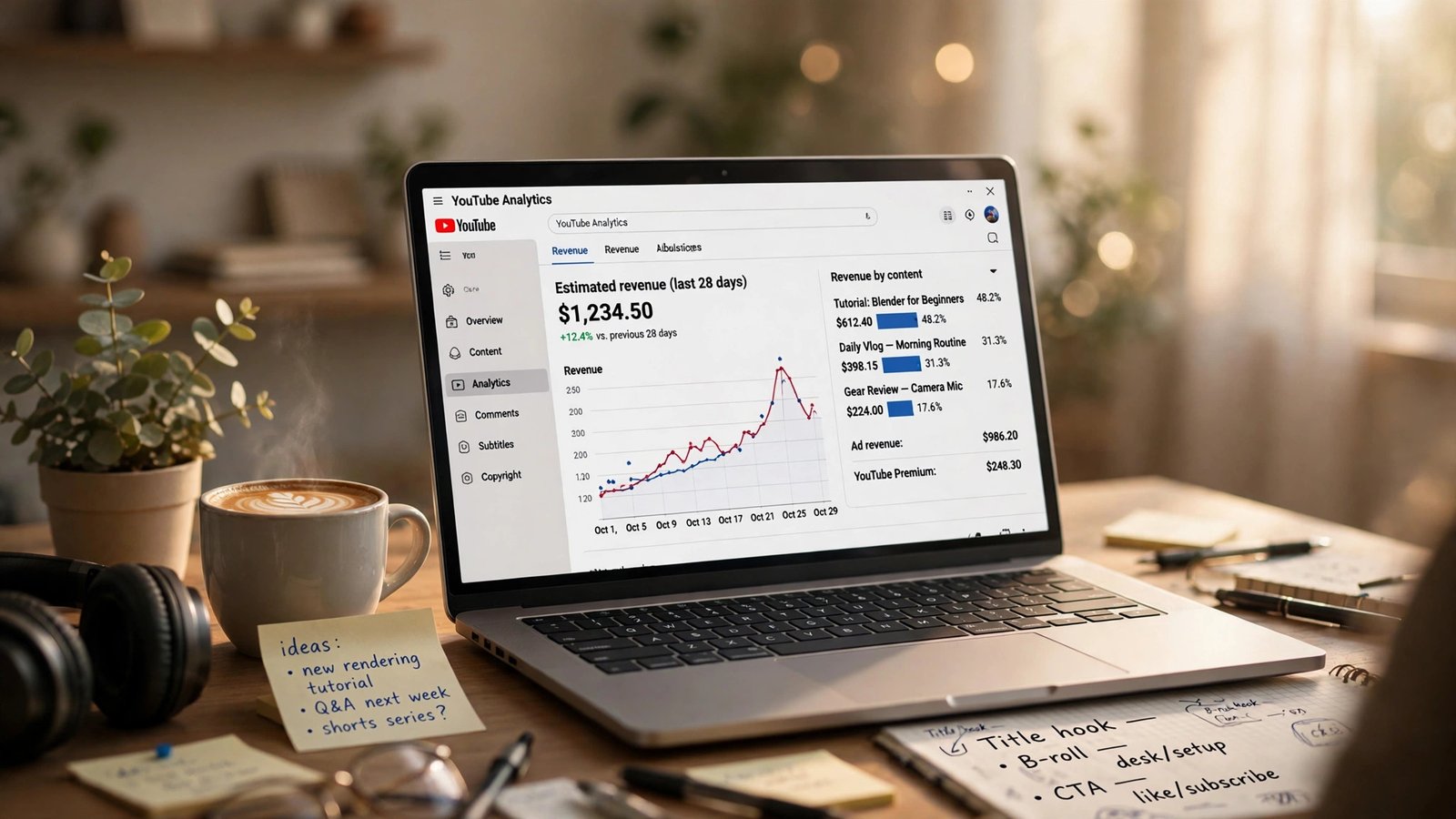
Check where your money actually comes from. In YouTube Studio, go to Analytics, then Revenue, and look at the Premium line as a share of your total. If it’s under 5%, Premium is a footnote for your channel right now and your energy belongs in ads, memberships or sponsorships. If it’s over 15%, you have a paying audience — protect it.
Premium vs ads vs fan payments: where the money actually sits
Premium is one of four ways a viewer puts money in your pocket, and it’s worth ranking them honestly.
Ads pay 55% to creators on long-form and 45% of the Shorts pool, at RPMs that range from $0.33 to $10.22 per 1,000 views depending on your niche. It’s the biggest line for most channels and the most volatile — January dips, advertiser pullbacks, demonetization.
Premium pays from the 30%/60% pools, split 55/45 between formats, with no fixed per-view rate. It’s smaller than ads for most channels, steadier month to month, and worth more per viewer. It grows as Premium subscriptions grow, and Premium Lite’s global expansion is a tailwind.
Fan payments — memberships, Super Chat, Super Stickers, Super Thanks — pay 70% to the creator after tax and fees. That’s the best split on the platform by a wide margin, and it’s available at just 500 subscribers through the fan funding route that February’s changes left untouched. A single $10 Super Chat puts $7 in your pocket. To earn $7 from ads at the median RPM, you need about 3,000 views.
The point isn’t that Premium is the best or the worst. It’s that each stream behaves differently, and the February 2027 rewrite changes their relative value. Ads get harder to qualify for. Shorts get a monthly test. Premium gets a bigger, wider pool. Fan funding stays where it is. A channel that leans on all four is the one that survives a rule change — a channel that leans on one is the one that writes a panicked post about it.
The bottom line
YouTube Premium revenue is real money, but it’s pool money, not rate money. You earn a share of 30% of Premium revenue or 60% of Premium Lite revenue, split 55% to long-form and 45% to Shorts, divided by the watch time your videos capture from paying members. There’s no per-view rate to quote, and anyone who gives you one is guessing.
What you can control is everything around the pool: whether you’re in the Partner Program before the bar doubles on February 1, 2027; whether your Shorts clear 10 million qualified views every 90 days; whether you accept the new terms by January 31; and whether your content is the kind people — paying people especially — actually finish watching.
The February rewrite is the biggest Partner Program change since 2018. It rewards channels with real watch time and punishes channels that were coasting on old thresholds. If your channel is the first kind, the new Premium pools are a raise. If it’s the second kind, you have about ten weeks to become the first kind.
Frequently Asked Questions
How much does YouTube pay creators per 1,000 Premium views?
YouTube doesn’t publish a fixed Premium rate per 1,000 views. Premium revenue comes from a pool — 30% of net Premium subscription revenue, 60% for Premium Lite — divided by member watch time and views, with 55% going to long-form and 45% to Shorts. Your per-view earnings depend on your share of total Premium watch time that month, which only YouTube can see. For context, the AIR Media-Tech study of 300 channels found a median ad RPM of $2.30 per 1,000 long-form views, ranging from $10.22 in Education to $0.33 in Kids content.
What changes for YouTube creators on February 1, 2027?
Three things. First, Premium Lite expands to every country where Premium is available, with the new 30%/60% creator pools already rolling out. Second, new Partner Program applicants need 8,000 qualified watch hours in 365 days or 20 million qualified Shorts views in 90 days, up from 4,000 hours or 10 million views. Third, earning from Shorts requires 10 million qualified Shorts views in the trailing 90 days, checked monthly. Existing partners keep their status but must accept the updated terms in YouTube Studio by January 31, 2027.
Do I earn Premium revenue from Shorts?
Yes. Shorts take 45% of each Premium pool, shared out by Premium member Shorts views. But from February 1, 2027, you only earn from Shorts — ads and Premium — if you hold 10 million qualified Shorts views in the last 90 days, rechecked every month. Shorts RPMs are far lower than long-form: AIR’s Shorts study puts most niches at $0.07 to $0.20 per 1,000 views.
Is YouTube Premium Lite good or bad for creators?
Mostly good. Lite subscribers pay less, but creators share in a pool of 60% of Lite’s net revenue versus 30% of full Premium’s — so per dollar of subscription revenue, Lite contributes twice as much to the creator pool. As Lite expands globally, channels with price-sensitive audiences should see their Premium revenue hold up or grow, even though each Lite subscriber pays less than a full Premium subscriber.
How do I check my YouTube Premium earnings?
In YouTube Studio, go to Analytics, then Revenue. Premium earnings appear under your YouTube Premium metrics, with Premium Lite earnings included in the same line. You can see the Premium share of your total revenue there, but YouTube doesn’t break out a per-view Premium rate or separate Lite from full Premium.
Should small channels care about Premium revenue?
Not yet, and that’s fine. Premium only pays Partner Program members, and the February 2027 changes raise the entry bar to 8,000 watch hours or 20 million Shorts views. The earliest money for a small channel is fan funding — memberships, Super Chat and Super Thanks pay 70% to creators and open at 500 subscribers. Build watch time first, join the Partner Program, and Premium becomes a growing bonus on top of ads.