
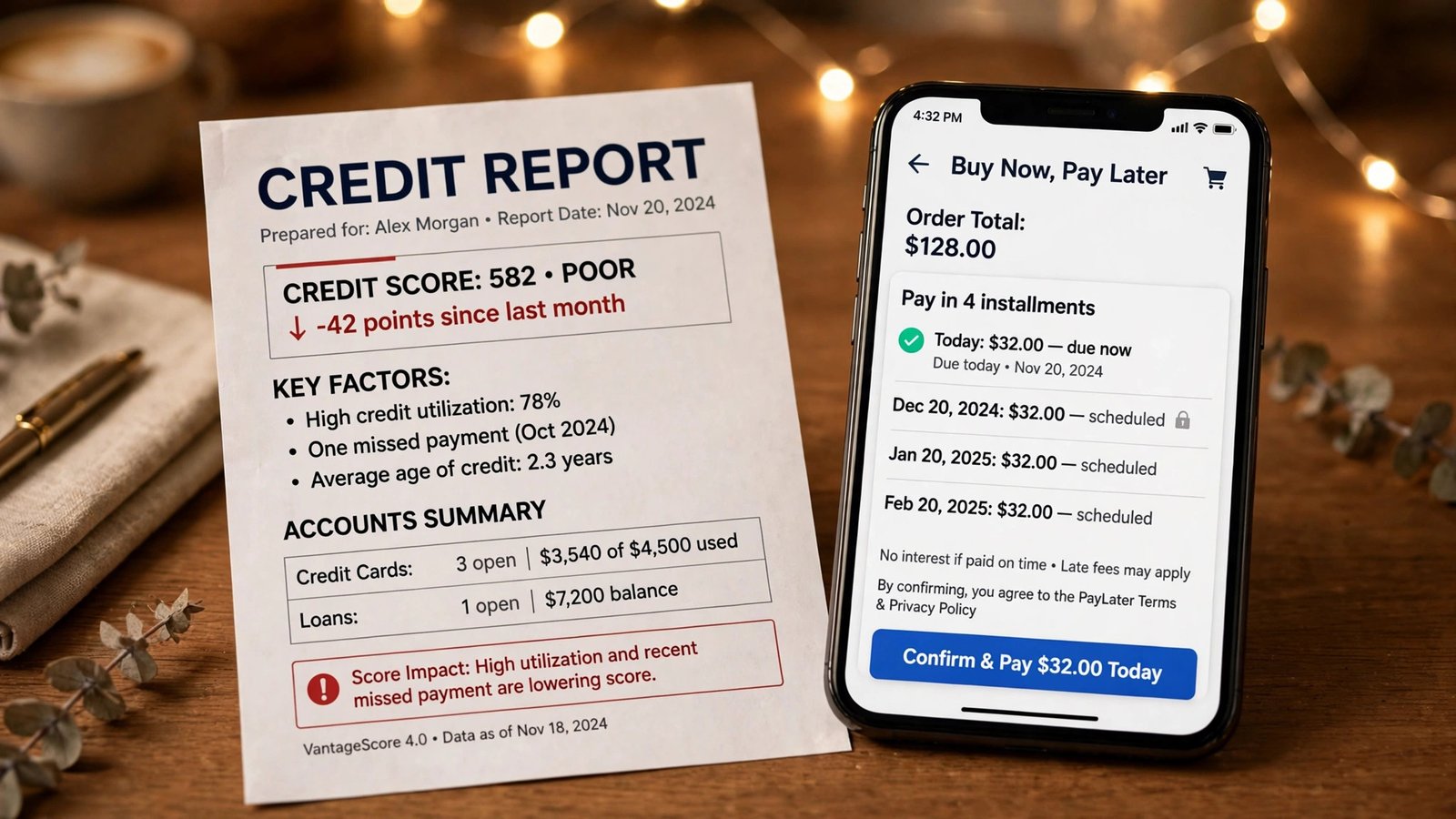
For years, the pitch behind buy now, pay later was simple and seductive: split your purchase into four easy payments, pay nothing extra, and — best of all — none of it touches your credit. That last part was the real selling point for a lot of shoppers. That era is ending — here’s what’s changed and what it means for your score.
The Short Answer: Yes, BNPL Can Now Affect Your Credit Score
The honest answer in late 2026 is: it depends on which app you use, which score a lender pulls, and whether you pay on time.
For most of the last decade, BNPL loans lived in a blind spot. The big three credit bureaus — Equifax, Experian, and TransUnion — didn’t feed BNPL account data into FICO Score calculations, and the standard FICO scores lenders actually use didn’t see those loans at all. You could stack five Pay in 4 plans in a month and your score wouldn’t flinch.
Two things changed that. First, the providers themselves started reporting. Affirm began reporting all of its pay-over-time products to Experian on April 1, 2025, and to TransUnion on May 1, 2025. Second, FICO built a score designed to read that data. On June 23, 2025, FICO announced FICO Score 10 BNPL and FICO Score 10 T BNPL — the first scores from a leading scoring company built specifically to factor BNPL loans into the number.
“On Your Report” vs “In Your Score”: The Distinction That Changes Everything
This is the single most important idea in this whole story, and it’s the one most articles get wrong.
Is a BNPL loan on your credit report? That means the loan appears as a tradeline on your file at Equifax, Experian, or TransUnion — visible to any lender that pulls your report. For Affirm users, the answer is increasingly yes at Experian and TransUnion.
Is a BNPL loan in your credit score? That means the loan actually moves your three-digit number. For the standard FICO scores most lenders use today, the answer is still no. Per myFICO’s own FAQ, none of the three major bureaus currently feeds BNPL account data into a FICO Score calculation.
So a loan can be visible to a lender without moving the three-digit number — until a lender pulls a BNPL-aware score. That’s the gap, and it’s closing.
Why does the distinction matter in practice? Because lenders don’t only look at your score. When you apply for a mortgage, an auto loan, or a credit card, the underwriter can see the accounts listed on your report. A file showing a dozen small BNPL loans tells a story about your spending habits even if none of those loans moved your FICO score by a single point. And once lenders start adopting FICO 10 BNPL, the score itself will start telling that story too.
Think of it this way: your credit report is the full file, and your credit score is the summary. BNPL used to be in neither. Now it’s entering the file first, and the summary is catching up.
What FICO 10 BNPL Actually Does
When FICO announced FICO Score 10 BNPL and FICO Score 10 T BNPL on June 23, 2025, it solved a problem that had kept BNPL out of scoring models for years: how do you count a loan that lasts six weeks?
Traditional scoring models were built for credit cards and loans that last months or years. A Pay in 4 loan is over in six weeks. If a scoring model treated every BNPL purchase like a brand-new account, a normal shopper buying a few things a month would look like someone opening accounts recklessly.
FICO’s answer was to aggregate. Instead of treating each BNPL loan as a separate new account, FICO 10 BNPL groups multiple concurrent BNPL loans together and reads them as a pattern — how many you have open at once, whether you’re paying them on time, and how that fits with the rest of your credit history.
The “T” version — FICO Score 10 T BNPL — adds trended data, looking at how your balances and behavior have moved over time, not just a single snapshot.
One thing to keep straight: FICO building the score doesn’t mean every lender uses it overnight. Lenders adopt new FICO versions on their own timetables, and many still use older versions. But the direction of travel is clear.
What the FICO and Affirm Study Found: The Numbers Are Reassuring — Mostly
FICO and Affirm ran a validation study on more than 500,000 consumers to see what happens to scores when BNPL data is included. The results are more reassuring than the headlines suggest — with one important catch.
Opening a new BNPL loan moved the score by less than 10 points for over 85% of people in the study. That’s roughly the size of normal month-to-month movement from a credit card balance changing. And the movement was more often up than down for people who paid on time. A BNPL loan you pay as agreed can actually help your score slightly under a BNPL-aware model, because it’s evidence of on-time payments.
The catch shows up at the heavy end. Among the heaviest users — people with five or more active BNPL loans — 97% saw a change of under 20 points. That’s still a modest move, but it’s bigger, and it cuts both ways. Stack enough loans and the model starts to notice. The pattern matters: one or two loans paid on time is a non-event. Five-plus loans running at the same time starts to look like stretched finances, and the score reflects that.
The takeaway isn’t “never use BNPL.” It’s “use it like a tool, not like a lifestyle.” One plan at a time, paid on schedule, is unlikely to hurt you and may even help a little under the new scores. Five plans running at once is where the risk starts to build — and that’s before we even get to late payments.
Who Reports What: The Provider-by-Provider Breakdown
Here’s where the story gets practical, because the BNPL world is not one system. Each provider has its own reporting policy, and the differences are big. Your Klarna Pay in 4 and your Affirm Pay in 4 are not the same thing when it comes to your credit file.
| Provider | What gets reported | Which bureaus | Since when |
|---|---|---|---|
| Affirm | All pay-over-time products, including Pay in 4 | Experian, TransUnion (not Equifax) | Experian: April 1, 2025; TransUnion: May 1, 2025 |
| Klarna | Term loans only | TransUnion | November 1, 2024 |
| Afterpay | Nothing currently | None | — |
| PayPal Pay in 4 | Not confirmed in available sources | — | Check PayPal’s current terms |
Let’s walk through each one.
Affirm: The Full Reporter
Affirm is the most thorough reporter of the big BNPL providers. It reports all of its pay-over-time products — including Pay in 4 — to Experian and TransUnion. It does not report to Equifax, so your Affirm loans won’t show up on that bureau’s file. Affirm keeps expanding where you can use it, too — we’ve covered Affirm’s pay-over-time launch at Sam’s Club — so the number of places your Affirm activity can start is only growing.
One detail that matters: Affirm says its plans are installment loans, so they do not count toward your credit utilization. A maxed-out credit card hurts your score fast. An Affirm loan doesn’t work that way. It shows up as an installment account, and on-time payments on installment accounts are generally positive. But the flip side is real too: if you miss payments on an Affirm plan, that history is now sitting on two of your three bureau files, where future lenders can see it.
Klarna: Only Term Loans
Klarna takes a narrower approach. Since November 1, 2024, it reports only its term loans to TransUnion. Its short-term products — Pay in 4, Pay Later in 30 Days, and pay-now purchases — are not shared with the bureaus.
That means the Klarna purchase most people actually make — the four-payment split at checkout — is still invisible to the credit system. But if you take out a longer Klarna financing plan, the kind with monthly payments over several months, that one is reported to TransUnion. Klarna is also pushing deeper into US banking — it has applied for a US bank charter — so expect its products to keep moving closer to traditional credit, not further away.
Afterpay: Not Reporting — For Now
Afterpay does not currently report payment data to any US credit bureau. It has said publicly that it will wait until there is evidence that reporting helps customers’ scores more than it hurts them. That’s a deliberate policy choice, and it makes Afterpay the most credit-invisible of the major providers right now.
The key words there are “for now.” Afterpay’s position is conditional, not permanent. If the evidence shifts — if FICO 10 BNPL adoption grows and the data shows reporting helps more consumers than it hurts — Afterpay could change course. Treat its current non-reporting as today’s policy, not a lifetime guarantee.
PayPal Pay in 4: Check Before You Assume
For PayPal Pay in 4, the reporting status is not confirmed in the sources available for this article — PayPal’s policies have shifted over time. Don’t guess: check PayPal’s current terms and help pages before you use it, or if you already use it regularly.
Why Your Standard FICO Score Still Ignores BNPL — For Now
If all this reporting is happening, why hasn’t your FICO score changed? Because the score most lenders pull today isn’t reading BNPL data yet.
Per myFICO’s own FAQ, none of the three major bureaus currently feeds BNPL account data into a FICO Score calculation. Your everyday FICO 8 or FICO 9 score — the versions most credit card issuers and auto lenders use — still doesn’t see your BNPL loans, even if those loans are sitting on your Experian or TransUnion report.
TransUnion has said the same thing from its side: BNPL data on its reports does not currently affect the scores it provides. But it has also put a date on the change. From October 2026, TransUnion says select BNPL and point-of-sale loan data may begin to affect some credit decisions. That’s not a distant future — it’s the current window.
This is the part that trips people up. “My score didn’t change” is true today, and it will be false for more and more lenders as BNPL-aware scores roll out. The data is already on the reports. The scores that read it already exist. The only thing still catching up is adoption, and adoption is already underway.
The 30-Days-Past-Due Threshold: When a Late Payment Actually Hits Your File
Here’s a detail that saves a lot of people unnecessary panic — and catches a lot of people off guard. A payment that’s a few days late is not the same as a late payment on your credit report.
Across the credit system, lenders generally don’t report a payment as late to the bureaus until it’s at least 30 days past due. Miss your due date by three days, pay on day five, and you’ll probably owe a late fee — but the bureaus usually never hear about it.
Cross that 30-day line, though, and the picture changes completely. A 30-day late mark goes on your credit file, and it’s one of the most damaging single entries a score can take. Payment history is the largest factor in FICO scoring, and a 30-day late mark can drag a good score down by dozens of points. Worse, it stays there — late marks can remain on your report for up to seven years, though their impact fades over time as you build newer on-time history.
That 30-day threshold is exactly why the LendingTree number in this story should get your attention. LendingTree’s 2026 survey found that 47% of BNPL users paid late in the past year. Nearly half. Some of those were a few days late — annoying, but not reportable. Some of them crossed 30 days. And every one of them was a person who probably thought of BNPL as the easy, consequence-free option.
The practical rule is simple: if you’re going to be late, get it paid before day 30. Set a reminder for day 25. Call the provider and ask about a grace period or a payment extension. Many BNPL providers will work with you if you reach out before the account goes 30 days past due — but almost none of them will undo a late mark once it’s been reported.
The Real Ways BNPL Can Still Hurt You
Even before BNPL-aware scores go mainstream, there are three ways a BNPL habit can damage your credit. All three are live right now.
Collections. Any BNPL provider can send a missed payment to a collections agency if you stop paying. Once a debt goes to collections, the collector reports it to Equifax, Experian, and TransUnion — all three — and it stays on your file for seven years from the original date of first delinquency, under the Fair Credit Reporting Act. It doesn’t matter that the original purchase was a $60 pair of shoes. A $60 debt in collections is a collections account, and lenders treat it that way.
Stacked loans that look like distress. Even before the score catches up, a lender pulling your full report can see the pattern. Ten open BNPL loans across three apps tells a story, and it’s not a story about careful budgeting. Mortgage underwriters in particular look at the whole file, not just the score. If you’re planning to apply for a mortgage or an auto loan in the next year, cleaning up open BNPL plans before you apply is one of the cheapest credit moves you can make.
The spending habit itself. BNPL makes it easy to say yes at checkout. Roughly 130 million Americans use BNPL apps, according to industry estimates. But four payments of $25 still add up to $100, and five plans running at once is $500 of obligations that don’t feel like debt because no single payment looks big. The LendingTree finding — 47% paying late — is what happens when the payments pile up faster than the paychecks. It’s the same trap as deferred-interest store cards: the deal looks free until the payments stack up.
Washington Is Watching
The regulatory picture has been moving fast. The Consumer Financial Protection Bureau withdrew its 2024 rule that would have treated BNPL lenders like credit card issuers in May 2025, which took some pressure off the industry. But Congress hasn’t gone quiet. In May 2026, Senator Elizabeth Warren and other members of the Senate Banking Committee sent letters to all three credit bureaus pressing them on how they handle BNPL data — how it’s reported, how it affects scores, and whether consumers are being treated fairly.
That matters because it signals BNPL reporting is now a mainstream policy question, not a niche fintech issue. The only safe assumption is that the direction is toward more visibility, not less.
What to Do Before Your Next Checkout
You don’t need to quit BNPL. You need to use it with your eyes open. Here’s a checklist to run through before you tap “Pay in 4” again:
-
Know your provider’s reporting policy. Affirm reports to Experian and TransUnion. Klarna reports term loans to TransUnion only. Afterpay doesn’t report yet. PayPal — check its current terms. If you switch apps, you’re switching reporting rules too.
-
Count your active plans. Open every BNPL app you use and count how many plans are still running. If the total is five or more, you’re in the heaviest-user group from the FICO/Affirm study — the group where score movement gets bigger. Pay one off before you start another.
-
Set payment reminders for day 25, not the due date. The 30-day threshold is the line that matters. A reminder five days early gives you time to move money or contact the provider before a late mark is possible.
-
Never let a BNPL balance go to collections. If you can’t pay, contact the provider first. A payment plan, an extension, or even a partial payment beats a collections account every time. Collections stay on your file for seven years — the purchase isn’t worth that.
-
Check your reports for free. Pull your reports from AnnualCreditReport.com, the official free site, and look for BNPL accounts you didn’t expect to see. If an Affirm loan is listed, that’s normal now. If something looks wrong — a loan you never took out, a balance that doesn’t match — dispute it with the bureau.
-
Pause BNPL before a big application. If a mortgage, auto loan, or major credit card application is coming up in the next few months, stop opening new BNPL plans and pay off the ones you have. You want your file to look calm and simple when a lender reads it.
The Bottom Line
Buy now, pay later used to be invisible to the credit system. That invisibility is gone — or going, provider by provider and score by score. Affirm reports to two bureaus. FICO built a score that reads BNPL loans. TransUnion has said select BNPL data may start affecting some credit decisions from October 2026. And the study data says that for most on-time payers, the effect is small — under 10 points for more than 85% of people — while the risk concentrates among heavy users and anyone who pays late.
None of that makes BNPL a bad product. Used sparingly and paid on time, it’s a reasonable way to spread out a purchase. But the days of treating it as free money with no paper trail are over. Every plan you open is a choice that can now show up on your file, and the smart move is to make that choice deliberately: fewer plans, on time, with a provider whose reporting policy you’ve actually checked.
This article is for general information only and is not professional financial advice. BNPL reporting policies and scoring models change over time, so check the current terms of any provider before you use it, and consider speaking with a qualified financial advisor if you’re making a major credit decision.
Frequently Asked Questions
Does buy now pay later affect your credit score in 2026?
It can now, depending on the provider and the score. Affirm reports its pay-over-time products to Experian and TransUnion, and FICO’s FICO Score 10 BNPL reads BNPL loans. But the standard FICO scores most lenders use today still don’t factor in BNPL data, so your everyday score may not move yet — even if the loans are visible on your report.
Does Affirm report Pay in 4 to the credit bureaus?
Yes. Affirm reports all of its pay-over-time products, including Pay in 4, to Experian (since April 1, 2025) and TransUnion (since May 1, 2025). It does not report to Equifax. Affirm says its plans are installment loans, so they don’t count toward your credit utilization.
Does Klarna affect your credit score?
Klarna reports only its term loans to TransUnion, since November 1, 2024. Its Pay in 4, Pay Later in 30 Days, and pay-now products are not shared with the bureaus. So a typical Klarna Pay in 4 purchase doesn’t currently affect your credit file, but a longer Klarna financing plan does show up at TransUnion.
Does Afterpay report to credit bureaus?
No, Afterpay does not currently report payment data to any US credit bureau. It has said publicly it will wait until there is evidence that reporting helps customers’ scores more than it hurts them. That policy could change, so it’s worth checking before assuming it will stay that way.
How much can a BNPL loan change your credit score?
According to the FICO/Affirm validation study of more than 500,000 consumers, opening a new BNPL loan moved the score by less than 10 points for over 85% of people, and the movement was more often up than down for on-time payers. Among the heaviest users with five or more active loans, 97% saw a change under 20 points. Late payments and collections can hurt far more than the loan itself.
Can a BNPL debt go to collections and stay on your credit report?
Yes. Any BNPL provider can send an unpaid balance to a collections agency, and collections accounts are reported to Equifax, Experian, and TransUnion. Under the Fair Credit Reporting Act, a collections account can stay on your report for seven years from the original date of first delinquency. If you can’t pay, contact the provider before the account reaches collections.