
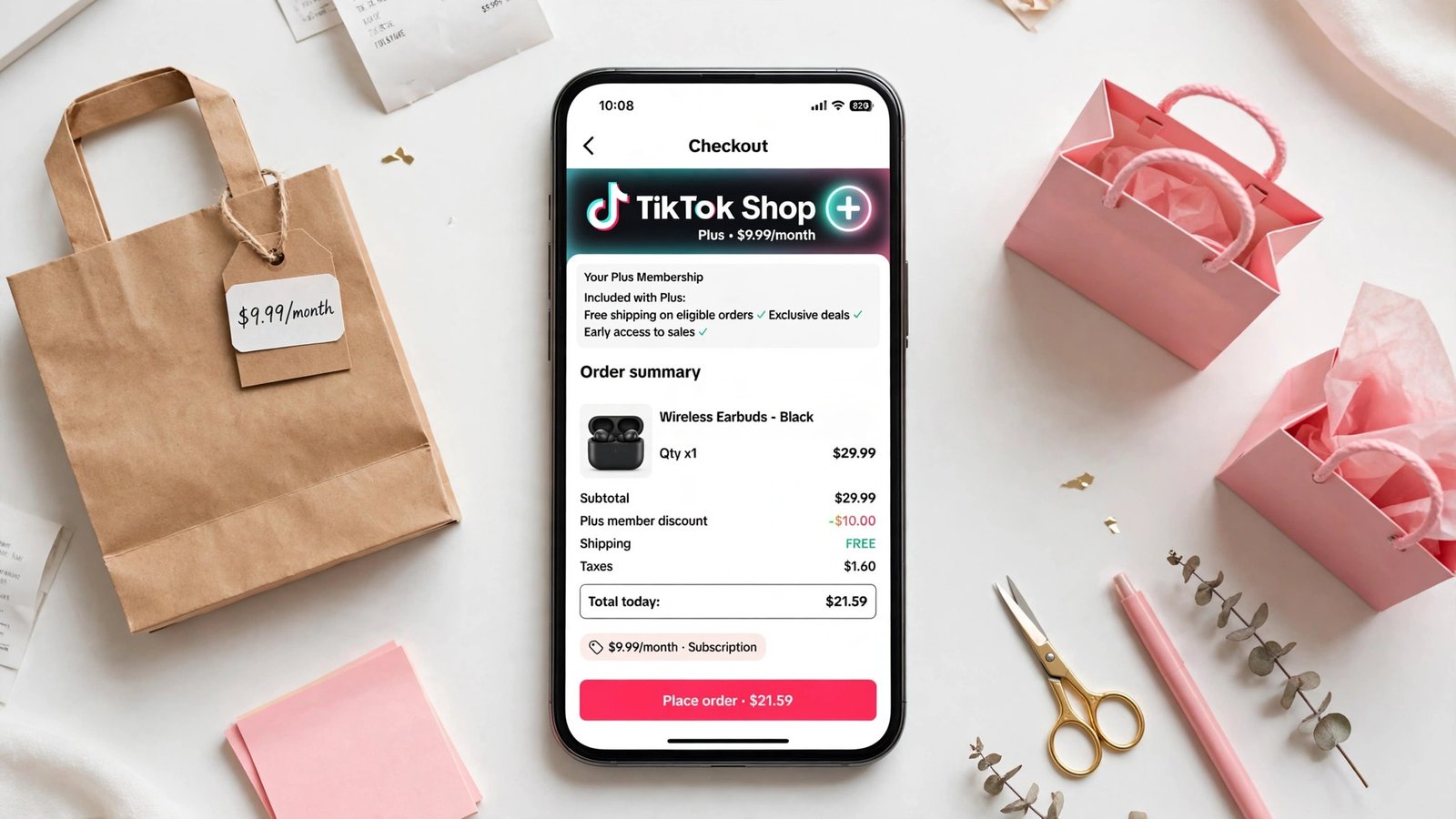
TikTok Shop Plus is a $9.99-per-month membership pilot for shoppers — and if you sell or promote products on TikTok Shop, it changes your math even though you never signed up for it. It launched as a pilot in the US over the weekend of November 7–8, 2026, offered to more than 1 million of TikTok’s most loyal US shoppers, with a 30-day free trial before the monthly charge kicks in. You can’t join it as a seller perk or buy your way in for your whole catalogue, and TikTok hasn’t said if it will roll out to everyone. What you can do is check which of your listings carry the Plus badge, rework your margins around the coupons TikTok now controls, and get ready before Black Friday on November 27.
What TikTok Shop Plus Actually Is
TikTok Shop launched in the US in September 2023, built on creators selling through short videos that viewers buy from without leaving the app. TikTok Shop Plus adds a paid loyalty layer on top of that flow. For $9.99 a month after a 30-day free trial, invited shoppers get free shipping on Plus-badged items, an extra 10% off select products, a monthly coupon bundle, faster store-credit refunds on qualifying returns, and extra coupons during big sale events.
The launch was reported by Modern Retail on November 9, Digiday on November 11, and Retail Dive on November 12, 2026. This is a fast-moving pilot, not a settled program, so check whether TikTok itself said something or a third-party guide is interpreting it.
TikTok Shop Strategic Initiatives president Patrick Nommensen put it in careful pilot language: the membership is “currently being piloted with an expanding group of eligible U.S. users… As we gradually scale access to the pilot, we’ll continue to gather feedback and refine the experience.” There’s no nationwide rollout date and no public sign-up page. It’s invitation-only, for more than 1 million of TikTok’s most loyal US shoppers.
If you’re a small seller, Plus isn’t a new channel you can opt into wholesale — it’s a change in how your most active buyers shop and which discounts they see first. TikTok tested $6, $10, and $15 price points in July 2026 before settling on $9.99 for this pilot, and that price isn’t locked forever.
The timeline that counts is the holiday one. TikTok Shop’s Black Friday/Cyber Monday campaign runs November 11–30, 2026 — Black Friday on November 27, Cyber Monday on November 30 — and Plus members get extra coupons during the campaign on top of the regular monthly bundle. Listings that aren’t ready when those coupons go live miss sales in front of TikTok’s most loyal shoppers.
What’s Inside the $9.99 Membership
- Free shipping on Plus-badged items only. Not free shipping on everything in TikTok Shop — only on items that carry the Plus badge.
- An extra 10% off select products. TikTok hasn’t published a list of which products qualify.
- A monthly coupon bundle: $5 off with no minimum spend, $10 off orders of $59 or more, and $30 off orders of $119 or more.
- Two times instant store-credit refunds per month on qualifying returns. That’s store credit, not cash back to the original payment method, capped at twice a month.
- Extra Black Friday/Cyber Monday coupons during the November 11–30 campaign.
Notice what’s missing. TikTok hasn’t said what share of listings carry the Plus badge, how a seller earns it, or how long a listing keeps it — and anyone claiming a coverage percentage is guessing. The 1-million-plus figure describes invited shoppers, not covered products. Build your own map of where your products sit, listing by listing.
How $9.99 Stacks Up Against Prime and Walmart+
Digiday’s November 11 reporting put the price in context: Amazon Prime costs $14.99 a month, and Walmart+ costs $12.95 a month. TikTok Shop Plus, at $9.99, undercuts both on headline price — but that’s not the whole comparison. Prime bundles fast shipping across Amazon’s huge catalogue, video streaming, and more; Walmart+ bundles grocery delivery, fuel discounts, and other perks. TikTok Shop Plus is narrower: a loyalty program for one shopping surface inside a social app, whose value lives or dies on how much a person already buys through TikTok Shop.
For sellers, that means Plus members are committed buyers, not casual browsers — more likely to return, use a coupon, and notice whether your listing carries the badge that unlocks free shipping.
The Break-Even Math: When Does Plus Pay for a Shopper?
All numbers in this section are illustrations — worked examples, not promises about what any real shopper will save. Real savings depend on which products carry the Plus badge, which get the extra 10% off, how often the shopper uses the coupons, and what shipping would have cost. TikTok hasn’t published averages for any of that.
The fixed cost is $9.99 a month after the 30-day free trial — $119.88 over a full year if the price holds. The trial month costs zero, so any saving then is pure gain. Using only the $5-off coupon saves $5 — still $4.99 short. Add the $10-off coupon on a $59-plus order and savings reach $15, clearing the fee by $5.01. Use the $30-off coupon on a $119-plus order plus the $5-off coupon on a smaller order and savings reach $35 — all before shipping and the extra 10% off.
| Shopper | Spend | Coupons used | Coupon savings | vs. $9.99 fee |
|---|---|---|---|---|
| Light buyer | One $25 item | $5 off, no minimum | $5, plus free shipping on the badged item | Short unless shipping was ~$4.99+ |
| Regular buyer | ~$70 across two orders | $10 off $59+ and $5 off | $15 | Clears fee by $5.01, before shipping/10% off |
| Heavy buyer | $130 | $30 off $119+ and $5 off | $35 | Clears fee by $25.01, before shipping/10% off |
The light buyer is the borderline case: if shipping on that $25 order would have been $4.99, total saving is $9.99 and the membership exactly breaks even — but TikTok hasn’t published a typical shipping figure, so the outcome hinges on a number we can’t verify. The regular buyer clears the fee on coupons alone, which is why the $59 threshold matters. The heavy buyer is an easy yes, if their spending is on Plus-eligible products.
For you as a seller, the lesson is the thresholds: $59 and $119. A $58 cart is one dollar from a $10 coupon; a $115 cart is four dollars from a $30 coupon. Shoppers who’ve paid for Plus have a reason to add one more item or bundle two products to cross a line — a shop selling $12–$18 items can build bundles landing just over $59, and a $49 hero product plus a $10 add-on crosses the line too. But don’t reprice blindly to chase a threshold — it’s a nudge, not a pricing strategy.
There’s a second lesson. The $5-off coupon with no minimum spend teaches a Plus member to expect a discount on every order. If that coupon comes out of TikTok’s pocket, fine — but if any part of the Plus discount is funded by sellers, and TikTok hasn’t spelled out the funding split, you need to know before you celebrate the extra volume. Check your Seller Center statements and campaign terms. Don’t assume a coupon is free to you just because it’s free to the shopper. This is not financial advice — run your own margin math first.
Check Each SKU’s Plus-Badge Status in Seller Center
The practical work starts in Seller Center, not in a news article. Go through your catalogue and check, SKU by SKU, whether each listing carries the Plus badge. TikTok has said nothing about what share of a seller’s catalogue is covered, so don’t estimate coverage from the 1-million-shopper figure, and don’t assume one badged product means the rest are too.
Make a simple list as you go: product name, SKU, badge status, price, and whether it qualifies for the extra 10% off where you can tell. That’s your Plus map — which products read as free-shipping-eligible, and which look pricier without the badge.
If none of your products are badged, don’t panic and don’t guess at a fix. Check for a Plus eligibility setting, campaign enrollment, or shipping-template requirement you haven’t met; if there’s no clear path, move on to what you can control — price, images, title, and coupon stacking. If some products are badged and others aren’t, look for a pattern first: bestsellers or slow movers, one category, one price band, one warehouse. A pattern might point to a shipping or fulfillment factor you can fix; a random scatter probably means the rollout is still expanding. Either way, write down what you see today and date it — pilot coverage changes.
The Affiliate Squeeze: TikTok Is Bringing Coupons and Loyalty In-House
If you earn as a TikTok Shop affiliate promoting other sellers’ products for commission, Plus deserves a closer look. It doesn’t replace affiliate marketing, but it changes what affiliates compete with.
For years, a big part of the affiliate’s value was the deal: find the discount, share the code, and give followers a reason to buy through your link right now. Now TikTok is bringing coupons and loyalty in-house — the platform hands the Plus member a monthly coupon bundle, an extra 10% off select products, and extra Black Friday/Cyber Monday coupons. The shopper doesn’t need to hunt for a code.
That doesn’t make affiliates useless — it raises the bar. A creator who only posts a product and a discount code now competes directly with TikTok’s own coupon bundle, while a creator who shows the product in use, answers a real question, or compares two options honestly offers something a coupon can’t copy. If your content is mostly “here’s 10% off,” Plus should worry you. If it’s mostly “here’s what this does, and who it’s for,” Plus is background noise.
The Commission Context You Need to Know
The squeeze isn’t happening in a vacuum. Third-party guides — not TikTok statements — describe a tightening picture: the Kaldon blog reports TikTok Shop US platform referral fees rose from 6% to 8% in August 2026, and default affiliate commission floors dropped to 5–8% in July 2026, down from 10–15%. TikTok’s algorithm, under a system reportedly called Project Clearwater, is said to deprioritize listings paying commissions well above the suggested floor. Typical commissions still run about 10–20%, according to The Prevailing in October 28, 2026, and Seller Center allows rates from 1% to 80%.
The reported trend points to a platform that wants commissions near a suggested level, not a bidding war. Offering 30% or 40% on a thin-margin product may now buy you less visibility, and the higher referral fee leaves less margin underneath. Check whether your commission still makes sense at 8% referral fees plus the commission, shipping, and any Plus discount funding before Black Friday. For affiliates, the mirror question is which sellers still pay a rate worth your time — a 10% commission on a $60 product that converts because your video helped someone decide beats 25% on a product nobody trusts, because the shopper already has a coupon in their pocket.
Margin Math: The 8% Referral Fee Plus Commission
Do the seller-side math the same careful way — with labeled illustrations, not promises. On a $50 product, the reported 8% platform referral fee is $4.00, before product cost, shipping, packaging, returns, or commission. For the full Q4 fee picture, see our TikTok Shop fees breakdown for Q4 2026 — it works the referral fee, shipping, and peak-season charges on the same kind of example. Pay an affiliate 10% ($5.00) and your combined platform-plus-affiliate cost is $9.00, or 18% of the price. At a 15% commission ($7.50) it’s $11.50, or 23%. At 20% ($10.00) it’s $14.00, or 28%. Use your own figures; these are illustrations.
Before Black Friday, run this subtraction on your top five products: true product cost (item, packaging, inbound shipping per unit), plus the 8% referral fee at your current price (confirm the rate in Seller Center), plus your actual affiliate commission, plus outbound shipping — noting whether the Plus badge changes who pays for it. What’s left must cover returns, customer service, and profit. If it’s thin or negative on your bestseller, Black Friday volume will make that problem worse, not better. This is not financial advice; it’s bookkeeping.
Should you raise, lower, or hold your commission? There’s no single right answer. Raising it can backfire if the reported algorithm behavior is real — listings paying well above the suggested floor are said to get less favor. A higher commission won’t fix a weak listing. Lowering it might protect profit per order but can quiet your affiliate pipeline right before the biggest shopping week of the year. For most small sellers, holding steady through Black Friday is the calmer move; test a change in December.
What a Small Seller Should Do Before Black Friday (November 27)
You have days, not weeks — do the short list that moves the needle, not a whole rebuild.
First, finish your badge map. For every product you plan to push during the November 11–30 campaign, know whether it’s badged, its price, and whether it qualifies for the extra 10% off as far as you can tell. Put badged products at the front of your holiday push.
Second, check coupon stacking before you promise it. Plus members get a monthly coupon bundle plus extra Black Friday/Cyber Monday coupons, and your shop may run its own coupons too. Before you tell a customer that discounts stack, verify it in the campaign terms in Seller Center — or test with a small order. A creator who promises “$30 off plus 10% off plus free shipping” and is wrong will hear about it in the comments. Stacking matters for margin too: on a $119-plus order with the $30-off coupon and the extra 10% off on top, the effective price can sit far below your list price, so run the margin subtraction on the stacked price.
Third, build one bundle that crosses a threshold honestly. Pick one pairing that makes sense on its own — two products people actually use together, or a main product plus a useful add-on — and price it so the cart lands just over $59 or just over $119. A $49 product plus a $12 add-on brings the cart to $61 in this illustration; a $95 product plus a $25 item brings it to $120. Those are illustrations, not recommendations. Think in carts, not single items.
Fourth, refresh the five listings that will carry the volume. The title should say what the product is in plain words, the first image should show it clearly, and the description should answer the two questions a Plus member will ask: “Does this ship free with my membership?” and “Is this the one that gets the extra 10% off?” If you don’t know, don’t guess.
For the holiday timeline, see our TikTok Shop Black Friday checklist — it covers the November 11 start of the campaign and the steps that still apply alongside the new Plus questions in this article.
Fifth, brief your affiliates: which products are Plus-badged, which coupons their audience can use, and whether your commission is holding steady. Creators who know the badge status can show it on screen and avoid promising a discount that doesn’t apply. A two-paragraph brief is cheap; a week of confused affiliate content is not.
Sixth, set a watchlist. Check Seller Center every couple of days through November 30 for badge changes, new campaign or coupon terms, and any message from TikTok about Plus eligibility. If a product gains the badge, feature it; if one loses it, pull it from the front of your push. Don’t assume today’s badge map holds on Cyber Monday.
What TikTok Hasn’t Said — and Why You Shouldn’t Fill the Gaps
TikTok hasn’t said what percentage of listings are Plus-badged, how sellers earn or keep the badge, or whether badge status varies by category or price — so don’t repeat a coverage percentage from a comment thread as if it were official; use your own badge map. TikTok hasn’t said how the Plus discounts are funded, when the pilot ends, or when it opens to all US shoppers — so don’t assume a coupon is free to you, don’t plan on Plus being universal by January, and don’t tell customers they can join if they haven’t been invited. And TikTok hasn’t said whether the $9.99 price, the coupon values, or the 2x monthly refunds will hold — treat them as the pilot’s current terms, not a permanent contract.
Plus helps the heavy TikTok Shop buyer whose favorites carry the badge, the seller whose catalogue is heavily badged with prices near the $59 and $119 thresholds, and the affiliate whose content is genuinely useful. It pressures the seller whose products aren’t badged and who doesn’t know why, the affiliate whose whole pitch is a discount code, and any seller on thin margins who hasn’t redone the math at the 8% referral fee plus their actual commission.
Frequently Asked Questions
Is TikTok Shop Plus available to all US shoppers?
No. As of the November 2026 reporting, TikTok Shop Plus is an invitation-only pilot offered to more than 1 million of TikTok’s most loyal US shoppers. TikTok’s Patrick Nommensen said the company is piloting it with “an expanding group of eligible U.S. users” and will “continue to gather feedback and refine the experience” as it gradually scales access. There’s no nationwide rollout date. If you haven’t been invited, you can’t join yet.
How much does TikTok Shop Plus cost?
The pilot price is $9.99 a month after a 30-day free trial. TikTok tested $6, $10, and $15 in July 2026, but the November pilot uses $9.99 — $119.88 over a full year if the price holds, an illustration from the monthly price, not a separate TikTok announcement. Digiday’s November 11 reporting puts Amazon Prime at $14.99 a month and Walmart+ at $12.95 a month.
What do Plus members actually get?
Members get free shipping on Plus-badged items, an extra 10% off select products, a monthly coupon bundle ($5 off with no minimum spend, $10 off orders of $59 or more, $30 off orders of $119 or more), 2x instant store-credit refunds per month on qualifying returns, and extra coupons during TikTok Shop’s Black Friday/Cyber Monday campaign from November 11–30, 2026. The limits are in the words “Plus-badged” and “select” — not every item qualifies.
How can a seller check if their products are Plus-badged?
Check each SKU in Seller Center and build your own list — product, SKU, badge status, and price. TikTok has said nothing about what share of a seller’s catalogue is covered, so don’t estimate coverage from the 1-million-shopper figure. If some products are badged and others aren’t, look for a pattern before you change anything, and date your notes.
Does TikTok Shop Plus replace affiliate marketing?
No, but it changes what affiliates compete with. TikTok now gives Plus members its own coupon bundle and extra sale coupons, so a creator whose only pitch is a discount code competes with the platform itself. Affiliates who show a product in use or compare options honestly still offer something a coupon can’t copy. Reported context: referral fees rose from 6% to 8% in August 2026 per the Kaldon blog, commission floors reportedly dropped to 5–8% in July 2026, and typical commissions run about 10–20% per The Prevailing — all third-party reporting, not TikTok statements.
What should a small seller do before Black Friday on November 27?
Finish your Plus-badge map in Seller Center, verify coupon stacking before you promise it, build one honest bundle crossing the $59 or $119 threshold, refresh your top five listings, brief your affiliates, and recheck Seller Center every couple of days through Cyber Monday on November 30. Run your margin math at the 8% referral fee plus your actual commission on the stacked price, not the list price. This is general information, not financial advice.