
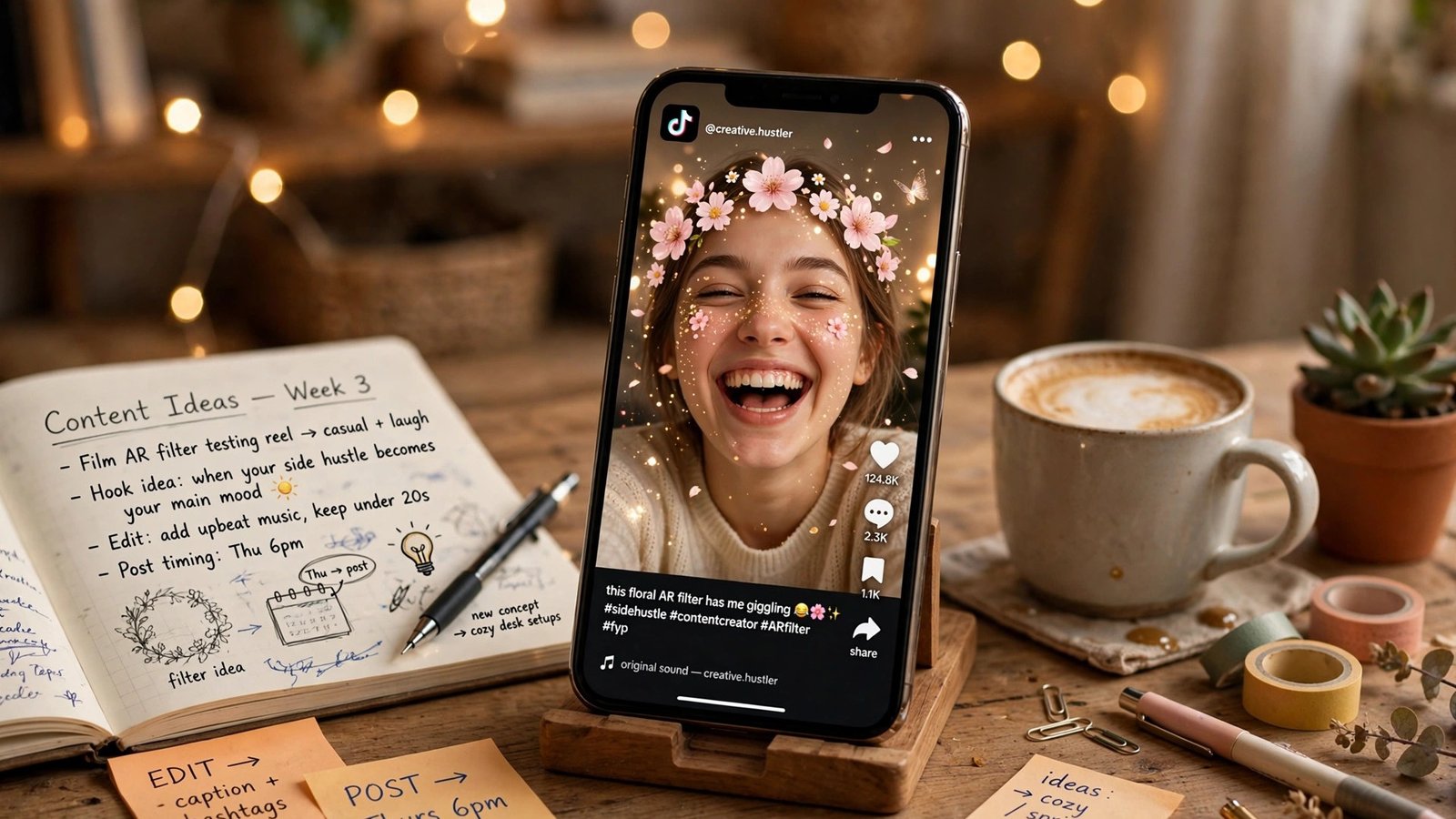
Yes — TikTok really does pay people to build filters, and you never have to film yourself, grow a following, or post a single video. The Effect Creator Rewards program pays creators of AR effects up to $14,000 per effect and up to $50,000 per creator per month. There’s no audience requirement. You build an effect once, and if other people use it in their videos, you earn.
Here’s the honest version up front: most people who build TikTok effects earn little or nothing. The program rewards viral hits, and virality is hard. But it’s a genuine side hustle with zero startup cost — the software is free — and the earning mechanics are public, so you can judge for yourself. Earnings vary widely and are not guaranteed. This article walks through exactly how the payouts work in 2026, what it takes to qualify, and a realistic plan for your first 30 days.
Why this side hustle is different from every other creator hustle
Nearly every TikTok income stream I’ve ever looked at asks you to be the product. You post daily, chase trends, build an audience, and hope the algorithm notices. It’s a full-time job disguised as a side hustle.
Building effects flips the whole model around. You are not the performer — you’re the toolmaker. Somebody makes a goofy “which pumpkin are you?” randomizer filter, millions of strangers use it in their Halloween videos, and the builder gets paid based on how many unique public videos used the effect. One build, potentially millions of uses. That’s the leverage.
A few things make this unusual as side hustles go:
No audience required. You don’t need followers. You don’t even need a TikTok account that posts anything. Your effect shows up in the effects tray, and other people’s audiences do the distributing for you.
The software is free. Effect House is TikTok’s official desktop tool for building AR effects. Download it, build filters, publish them — no fees, no subscriptions. If you can use basic design software, you can start, and there’s a Discord community of more than 400,000 members where beginners get help.
The earning window is brutally short, but the upside is real. Rewards only accumulate during the first 30 days of an effect’s life. That compresses your launch, promotion, and luck into one month. But if an effect catches fire in that window, the ceilings are serious: $14,000 per effect, $50,000 per month per creator.
How the payout math actually works
This is the part most articles get sloppy about, so let’s be precise. TikTok pays based on something called “qualified video publishes.” A qualified video publish means a unique public video, posted from an eligible region, that used your effect — and it has to happen within the first 30 days of the effect’s life.
Two critical details: first, TikTok does not publish a per-publish dollar rate. You cannot calculate “$X per video used” because TikTok hasn’t told anyone the rate, and reward amounts vary depending on the region where the videos were published. Second, there’s a threshold you have to clear before earning starts at all, and that threshold depends on the effect category:
- Game & Randomizer effects: 5,000 unique video publishes
- Makeup effects: 100,000 unique video publishes
- Green screen effects: 100,000 unique video publishes
- All other categories: 5,000 unique video publishes
Once you clear the threshold, rewards keep accumulating for every additional qualified publish until the 30-day window closes or you hit the maximum payout. Then earning on that effect stops — permanently.
AI-generated effects are not eligible for rewards at all. This matters more in 2026 than ever, because Effect House ships with AI-powered tools like Art Maker and Asset Studio, and TikTok has tightened its AI labeling rules this year. You can use the tools to help you build, but a fully AI-generated effect can’t earn. Your effect has to be your original creation, and under the current rules TikTok automatically labels AI-generated content — so don’t try to sneak one through.
Let me walk through a hypothetical so the mechanics click. Say you build a “Which Thanksgiving side dish are you?” randomizer filter and publish it November 1. A friend shares it, a small meme account picks it up, and by November 10 it’s been used in 5,000 unique public videos. You’ve now crossed the threshold — rewards start accumulating. By November 25 the effect has been used in 300,000 videos and then interest fades. Your payout is based on every qualified publish above that 5,000 threshold across the full 30 days, at a rate TikTok sets internally and varies by region. You don’t know the exact dollar figure until it’s calculated — but it’s capped at $14,000 for that single effect no matter how viral it goes.
Now the uncomfortable part of this example: your hypothetical Thanksgiving filter earned for 30 days and then never earns again. An effect you spent two weeks building could have a one-month earning life. That’s the program’s defining constraint, and it shapes every strategy decision you’ll read below.
What it takes to qualify
Not everyone can join the program on day one. Here’s the gate:
- Be 18 or older and located in an eligible country. The list is long — 40+ countries including the US, UK, Canada, Germany, France, Australia, Brazil, Japan, Korea, Mexico, and most of Europe.
- Earn a Gold badge or higher in the effect creator community. Gold means at least 5 published effects, at least 3 effects each used in 1,000+ qualified videos, and completed tax and payment setup.
- Apply through Effect House, which collects your tax information during the application.
One more rule that trips people up: only effects published after you’re accepted into the program earn rewards. Anything you published before getting in does not retroactively qualify. So the path is clear — build a small portfolio of effects first, hit the badge requirements with them, then join, then publish your real money shots afterward.
On payouts: rewards over $10 are paid on the 15th of the following month to your preferred payment method. If you earned less than $10, it accrues until it hits $10 or six months pass, whichever comes first. TikTok collects your tax info during the application, so this is real reportable income, not internet funny money. (Quick note: this is a creator-income article, not tax advice — talk to a tax professional about how to report it.)
The official rules live in TikTok’s own Effect Creator Rewards FAQ, which is the only source you should trust for program details — the official Effect House FAQ covers the thresholds, maximums, and payout timing in full.
The 2026 context you need to understand
The program didn’t start this year — it launched back in May 2023 with a $6 million fund, and at that point the terms were roughly $700 per effect used in 500,000 videos in 90 days. In March 2024 TikTok expanded it and lowered the barriers to entry. The current version is the mature form of that program.
What’s new is the backdrop. In January 2026, TikTok’s US operations became a separate US company under the USDS joint venture arrangement — the biggest structural change in the platform’s history. TikTok also rolled out new Community Guidelines in August 2026, and has been steadily tightening how AI-generated content gets labeled. As reported in Search Engine Land’s coverage of the rewards expansion, TikTok has confirmed that some creators have reached the maximum payouts of $14,000 per effect and $50,000 per month.
Why does the corporate structure matter to a side hustler? Brands now treat TikTok as a permanent, US-stabilized platform again, and custom branded effects are one of the most requested formats in sponsored campaigns. An effect builder with a viral portfolio has two income paths: the rewards program itself, and freelance work building custom effects for companies. That second path has quietly become the steadier one.
What actually goes viral (and which categories are worth your time)
Look at those thresholds again and a strategy starts to form. Game & Randomizer effects need just 5,000 unique video publishes to start earning. Makeup and green-screen effects need 100,000 — twenty times more. That doesn’t mean makeup effects are bad. It means they’re a harder bet, and you should know it before you spend three weeks perfecting one.
Categories that travel well share a few traits:
Randomizers and “which one are you?” games. Low threshold, naturally viral, endlessly remixable for holidays, seasons, and memes. “Which Halloween candy are you?” will outperform a technically impressive 3D mask nine times out of ten, because the format invites duets, stitches, and friend-tagging. This is the highest-volume, lowest-barrier category.
Seasonal and trend effects. Effects tied to a moment — a holiday, a sports event, a viral meme format — get their best shot inside that 30-day window. This is where the short earning period actually becomes an advantage: you can time a launch to a specific date. A Thanksgiving effect published November 1 gets a full month of seasonal momentum. An evergreen effect published on a random Tuesday gets nothing special.
Simple interactive games. Tap-the-screen games, catch-the-object filters, and reaction-test effects get used because they’re fun to play on camera. They don’t need to be complex — simple is often better, because the effect has to work on older phones too.
Niche culture effects. Effects built for a specific fandom, sport, or community can spread fast within that group even if they never go mainstream. Five thousand video publishes is not a big number if a passionate community picks your effect up. Think sports fans, K-pop stans, gaming communities.
What doesn’t work as well: technically stunning effects with no shareable hook. An effect can be a masterpiece of AR engineering and still get 200 uses, because nobody could see themselves posting it. The shareable idea matters more than the technical skill.
The honest caveats
I want to be straight with you, because this article would be sloppy if it just sold the upside.
Most effect creators earn little. The program pays for viral hits, and the vast majority of effects never reach the thresholds. TikTok confirmed maximums have been reached by some creators — that’s the ceiling, not the typical experience. Think of it like a lottery ticket you can engineer: your odds improve with skill, timing, and volume, but the base rate is still low.
The 30-day window is the brutal part. Effects have a shelf life. You build for weeks, launch, and have one month to catch fire. Miss the window and that effect will never earn a cent, even if it finds an audience in month three. Your real product isn’t one effect — it’s a pipeline of effects, launched on a schedule, each with its own 30-day shot.
Regional variation affects your rate. Two effects with identical usage numbers can pay differently depending on where the videos were published. You can’t control this, and TikTok doesn’t publish the regional rates.
Competition is intense. Millions of effects have been published. Standing out requires either genuinely clever ideas or riding a trend early. The Discord community of 400,000+ is a resource — but it’s also a reminder of how many people are building.
The caps cut both ways. $14,000 per effect is a great ceiling, but it’s also a hard stop. If your effect somehow got used in 50 million videos, you still get $14,000. The $50,000 monthly cap means you’d need a remarkable run of hits to max it out.
AI-generated effects are excluded, and the rules keep tightening. If your workflow depends heavily on generative AI output, you’re building something that can’t earn. Build original.
Compared to the alternatives: TikTok’s Creator Rewards for posting pays you to be a content creator — an ongoing grind. TikTok Shop affiliates pay commissions for selling products. Effect building is the only one of the three that pays you for something you make once and stop thinking about.
For perspective on how opaque creator payouts can be across platforms, my breakdown of the creator payouts reality check covers why “no fixed rate” programs demand the same clear-eyed math — and my piece on TikTok’s 30-day creator payouts covers TikTok’s payout timing from the creator side.
Your first 30 days: a starter plan
Don’t try to build a masterpiece first. The goal of month one is to learn the system, hit the Gold badge requirements, and get accepted into the program. Here’s the plan:
Days 1–7: Learn Effect House and ship ugly. Download Effect House (free, desktop). Work through the starter templates — there’s a randomizer template that’s basically half your future income strategy. Publish your first 2–3 effects. They will be bad. That’s fine. You’re learning the publish flow, the review process, and what the effects tray looks like from the builder’s side.
Days 8–14: Study what’s working, then copy the format (not the content). Scroll the effects tray and note which effects have massive usage counts. Pick the formats with the lowest thresholds and highest usage. Build 2–3 more effects in those formats with your own original ideas. Join the Effect House Discord and ask beginner questions — 400,000 members means someone has hit your exact bug before.
Days 15–21: Push for the Gold badge. You need 5 published effects and 3 effects each used in 1,000+ videos. Promote where people discover effects: post your own demo videos using them, share in relevant communities, and time one launch to an upcoming event or holiday. A thousand uses per effect is very achievable with modest promotion.
Days 22–30: Apply and plan your first real launch. Complete your tax and payment setup, apply to the Effect Creator Rewards program, and start building your first post-acceptance effect — the one designed to earn. Remember: anything published before acceptance doesn’t qualify, so keep your best ideas for after the approval lands.
After that, the rhythm is: build, launch, promote for 30 days, repeat. Treat it like a portfolio. Most effects will earn nothing. A few might earn a little. One might surprise you. That’s the honest shape of this side hustle.
The bottom line
Building TikTok filters is one of the few side hustles in 2026 where the mechanics are fully public, the tools are free, and you never have to be on camera. The thresholds, maximums, and payout timing are all documented. The catch — the 30-day earning window, the unshared per-publish rate, the fact that most effects earn nothing — is also fully visible if you look.
It’s not passive income. It’s leveraged income: concentrated effort up front, a one-month window to catch fire, and no further work if it does. If that shape appeals to you more than posting every day, download Effect House tonight. Your first filter won’t earn you a dollar. But it’ll teach you the system, and the system is the actual skill here.
Earnings from creator reward programs vary widely and are not guaranteed. This article is for informational purposes and is not tax or financial advice.
Frequently Asked Questions
Do I need followers to earn from TikTok Effect Creator Rewards?
No. There is no follower or audience requirement. You need to be 18+, in an eligible country, hold a Gold badge or higher (5 published effects, 3 effects each used in 1,000+ videos, plus tax/payment setup), and be accepted into the program. Other people’s audiences do the distributing when they use your effect.
How much does TikTok pay per effect use?
TikTok does not publish a per-publish rate, so nobody outside TikTok can tell you a dollar-per-video figure. Rewards are calculated from qualified video publishes within the effect’s first 30 days, and the rate varies by the region where videos were published. What is public: a maximum of $14,000 per effect and $50,000 per creator per month.
Can I earn from effects I already published?
No. Only effects published after you are accepted into the Effect Creator Rewards program can earn. Anything published before acceptance never retroactively qualifies, which is why the strategy is to build your badge-qualifying portfolio first and save your best ideas for after approval.
Are AI-generated TikTok effects eligible for rewards?
No. Fully AI-generated effects are not eligible for Effect Creator Rewards. This is an important line in 2026: Effect House includes AI-powered tools like Art Maker and Asset Studio, and TikTok has tightened AI labeling rules this year. Use the tools to help you build, but the effect itself must be your original creation.
When and how do I get paid?
Rewards over $10 are paid on the 15th of the following month to your preferred payment method. Amounts under $10 accrue until they reach $10 or six months pass, whichever comes first. TikTok collects your tax information during the application process, so rewards are reportable income.
Is building TikTok effects better than posting videos for Creator Rewards?
They’re different bets. Posting pays you to perform continuously — an ongoing grind. Effect building pays you for something you build once, with a one-month earning window per effect. Effects require no audience and no camera presence, but most effects earn nothing and virality is unpredictable. Some creators do both; the skills barely overlap.