
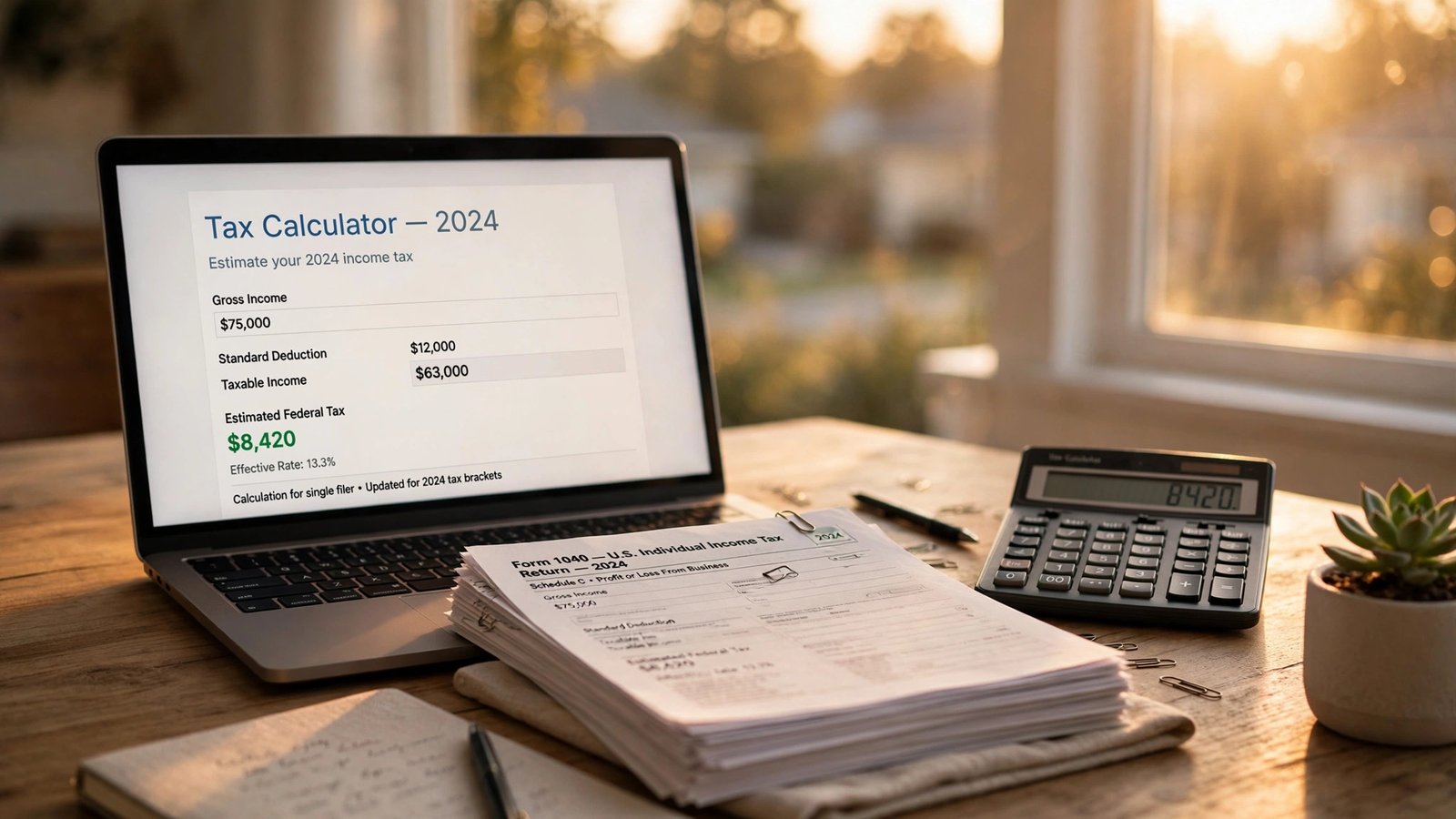
Here’s the bottom line: the 20% qualified business income (QBI) deduction isn’t going anywhere. The One Big Beautiful Bill Act — signed July 4, 2025 — made the Section 199A deduction permanent, ending the sunset that was supposed to kill it after 2025. And 2026 brings two real changes on top of that: a new $400 minimum deduction for small active businesses, and wider phase-out ranges that let higher-earning freelancers keep more of the break.
If you’re self-employed — sole proprietor, LLC owner, partner, or S-corp shareholder — this is one of the biggest levers you have on your tax bill. A freelancer with $85,000 in net profit can shave roughly $3,700 off their income tax with this single line on their return. Let me walk through exactly what changed for 2026, who qualifies, and the traps that catch freelancers every year.
Why 2026 Is Different: The Deduction Survived Its Sunset
When Congress created the QBI deduction in the 2017 Tax Cuts and Jobs Act, it came with an expiration date: December 31, 2025. For years, tax planners told self-employed clients to model two futures — one with the 20% break, one without.
That guessing is over. The One Big Beautiful Bill Act made Section 199A a permanent part of the tax code in July 2025. The IRS’s qualified business income deduction overview covers the eligibility rules and filing basics in plain English. No renewal votes, no cliff. If you’ve been claiming this deduction since 2018, nothing about the core benefit changes: you can still deduct up to 20% of your qualified business income, and it’s claimed “below the line” — it reduces your taxable income whether or not you itemize. That’s a detail worth appreciating. Most freelancers take the standard deduction, and this is one of the few breaks that stacks on top of it.
The permanence matters most for planning. Decisions like S-corp elections, estimated-tax payments, and retirement contributions now live in a world where the QBI math is stable. That doesn’t mean 2026 is a copy of 2025, though. Two things actually changed this year.
New in 2026: A $400 Minimum Deduction
This is the quiet little win most freelancers will feel first. Starting in 2026, if you have at least $1,000 of “active” qualified business income — meaning income from a business you materially participate in, under the IRC Section 469(h) standard of regular, continuous, and substantial involvement — your QBI deduction is at least $400.
Why does that matter? Because without the minimum, a tiny side business gets almost nothing. Twenty percent of $1,500 of QBI is $300. Under the old rules, that was your deduction, period — barely worth the form. Now the floor is $400, even when the 20% math comes out lower. Both the $400 floor and the $1,000 requirement get inflation adjustments starting in 2027.
Think of it as a nod to the side hustler: the Etsy shop, the occasional consulting gig, the part-time freelance practice. The regular 20% deduction doesn’t kick in fully until you have $2,000 of QBI (20% of $2,000 is $400). If your side business nets between $1,000 and $2,000, the minimum does the heavy lifting for you.
The catch, and it’s a fair one: passive income doesn’t count. If you hold an interest in a limited partnership or some other passive vehicle and don’t materially participate, the minimum isn’t available to you. The floor is reserved for people actually working in their businesses.
New in 2026: Wider Phase-Out Ranges for Higher Earners
This is the change that matters if your income has crept up over the years you’ve been self-employed.
The full 20% deduction is available when your total taxable income sits at or below the IRS threshold — for 2026, that’s $201,750 if you’re single or head of household, $201,775 if you’re married filing separately, and $403,500 if you’re married filing jointly (per Rev. Proc. 2025-32). Those numbers get inflation adjustments every year, and they’re slightly higher than last year’s.
Above the threshold, the deduction phases down. Here’s what’s new: the phase-out ranges are now 50% wider. Instead of $50,000 (single) and $100,000 (joint), the phase-out now spans $75,000 for single filers and $150,000 for joint filers. In practice, that means the deduction fully disappears at $276,750 of taxable income (single) instead of the old lower cliff, and at $553,500 for married couples filing jointly.
If you’re a successful consultant or agency owner hovering just above the old thresholds, that extra room is real money. Every dollar of phase-out range you gain is a dollar of deduction you keep that you would have lost under the old rules.
Who Actually Qualifies (and Who Doesn’t)
Let’s get concrete. The deduction is available to owners of pass-through businesses: sole proprietorships, partnerships, LLCs taxed as sole proprietorships or partnerships, and S corporations. Your business income flows through to your personal return, and the deduction applies at the individual level.
What counts as qualified business income is narrower than “money my business made.” Excluded entirely:
- W-2 wages, including the reasonable salary you pay yourself through an S corporation
- Capital gains and losses
- Dividends, interest, and most investment income
- Income from C corporations
- Foreign-sourced business income
That S-corp salary point deserves a spotlight, because it bites people. If you run an S-corp and pay yourself $90,000 in salary while the business earns $150,000 total, your QBI is only $60,000 — the salary is W-2 income and doesn’t qualify. Every dollar you move into salary shrinks the deduction. That’s one of the hidden costs of the S-corp election, and it’s worth modeling against the payroll-tax savings before you file the election. If you’re weighing the trade-off, our guide to LLC vs S-corp for freelancers walks through both sides of that math.
There’s also a cap on the deduction itself: it’s 20% of your QBI, but never more than 20% of your taxable income minus net capital gains. For most self-employed people with modest investment income, the QBI side is the binding number.
The SSTB Rules: If You’re in a Service Business
Specified service trades or businesses — SSTBs — face the strictest version of these rules once income crosses the thresholds. The IRS list covers health, law, accounting, actuarial science, performing arts, consulting, athletics, financial services, and brokerage, plus any business where the principal asset is the reputation or skill of one or more owners. If you’re a freelance consultant, coach, designer-for-hire, or therapist in private practice, there’s a decent chance you’re an SSTB.
Here’s what that means in practice:
- Below the threshold ($201,750 single / $403,500 joint): SSTBs get the full 20% like everyone else. No penalty, no special math.
- Inside the phase-out range: the deduction shrinks gradually. The wider 2026 ranges help here — you hold onto the deduction longer than you used to.
- Above $276,750 (single) or $553,500 (joint): the SSTB deduction is gone entirely. Zero.
If you’re not an SSTB — you sell products, run a marketing agency with staff, operate a rental business through the safe harbor — crossing the threshold doesn’t kill the deduction outright. Instead, it becomes limited by what the IRS calls the W-2 wage and property limit: your deduction can’t exceed the greater of 50% of the W-2 wages your business pays, or 25% of W-2 wages plus 2.5% of the unadjusted basis of depreciable property the business owns. In plain English: the bigger your payroll and equipment base, the more deduction you keep at high incomes.
The honest takeaway: if you’re a solo consultant earning well above the threshold with no employees, the QBI deduction at that income level is likely minimal or zero — and that’s been true since 2018. The 2026 changes soften the landing zone, they don’t remove the cliff.
How to Claim It: Form 8995 vs. 8995-A
The mechanics are straightforward, which is nice given how much math sits behind them:
- Income at or below the threshold? Use Form 8995. It’s a short form — a few lines, and you’re done.
- Income above the threshold? Use Form 8995-A, the longer version that walks through the phase-out, SSTB limitations, and the wage/property caps.
- The final deduction lands on Form 1040, line 13, reducing your taxable income below the line.
Your accounting software or tax preparer should handle this automatically, but it’s worth checking that the deduction actually appears. I’ve seen returns where a freelancer’s software computed everything else correctly and simply skipped Form 8995 because the prior-year return didn’t include it. If you use accounting software for freelancers, make sure your business income is categorized cleanly — garbage in, garbage out on QBI.
The video above covers the Section 199A deduction alongside the other write-offs freelancers most often miss — software subscriptions, phone and internet splits, professional development, and retirement contributions. Worth a watch if you want the full picture beyond QBI.
Real Math: Three Freelancer Examples
Let’s make this tangible with numbers you can sanity-check.
Example 1: The solo freelancer. You’re a freelance web developer, single, Schedule C net profit of $85,000. Your taxable income is below $201,750, so no thresholds apply. Your deduction is 20% × $85,000 = $17,000. At a 22% marginal federal rate, that’s about $3,740 in tax savings — from one line on your return. No employees, no complexity, no SSTB headaches.
Example 2: The small side business. You run a part-time print-on-demand shop that nets $1,500 this year. Twenty percent of $1,500 is $300 — but the new 2026 minimum bumps your deduction to $400, because you have at least $1,000 of active QBI and you materially participate. It’s a small number, but the old rules would have given you $300, and the paperwork is identical.
Example 3: The S-corp owner in the phase-out. You’re a marketing consultant (an SSTB), single, with $240,000 of taxable income. You’re $38,250 into the $75,000 phase-out range (which runs $201,750–$276,750). Your deduction is reduced proportionally — roughly half the full 20% remains. Under the old $50,000 phase-out range, you’d have been 76% through the range and kept far less. That’s the 2026 change doing its job: wider range, gentler fade, more deduction kept.
One more planning note for S-corp owners: because your salary isn’t QBI, the classic move of paying yourself the lowest defensible salary maximizes this deduction — but the IRS can and does reclassify distributions as wages if the salary is unreasonably low. It’s a genuine trade-off, not a loophole. Our piece on how to pay yourself as a freelancer LLC owner covers the reasonable-compensation question in detail.
What to Do Before Year-End 2026
You still have a couple of months to shape this year’s deduction. Four moves worth considering:
- Estimate where your taxable income lands relative to the thresholds. If you’re near $201,750 (single) or $403,500 (joint), timing income and deductions around the line matters more than ever — the wider phase-out range means the penalty for landing just over the line is softer, but the line still matters.
- Track QBI separately by business. If you run two businesses — say, freelancing and a small product line — each is its own QBI calculation. Aggregation rules exist for commonly controlled businesses, but don’t assume; check whether yours qualify.
- If you have an S-corp, review your salary. The salary-vs-distribution split directly controls your QBI base. Run the numbers both ways with the new phase-out ranges before finalizing anything for 2026.
- Keep clean books. The $400 minimum is new, and preparers will be looking for documentation of material participation. Calendar entries, client invoices, and time logs are the kind of records that make this painless.
A brief but necessary disclaimer: this article is general information, not tax advice. Tax law is dense and your situation has details I can’t see — talk to a CPA or enrolled agent before making filing decisions, especially if you’re inside the phase-out range or near the SSTB line.
Frequently Asked Questions
Is the QBI deduction really permanent now?
Yes. The One Big Beautiful Bill Act, signed July 4, 2025, made the Section 199A 20% deduction permanent. The sunset that would have killed it after 2025 no longer exists. The two 2026 changes — the $400 minimum deduction and the wider phase-out ranges — are part of that same law.
What’s the income limit for the QBI deduction in 2026?
The full 20% is available when taxable income is at or below $201,750 (single or head of household), $201,775 (married filing separately), or $403,500 (married filing jointly), per Rev. Proc. 2025-32. Above that, the deduction phases down over $75,000 of additional income for single filers ($150,000 for joint filers), disappearing entirely at $276,750 single / $553,500 joint for SSTBs.
How does the new $400 minimum deduction work?
If you have at least $1,000 of qualified business income from a business you materially participate in, your 2026 QBI deduction is at least $400 — even if 20% of your QBI would be less. The $400 floor and $1,000 requirement will be inflation-adjusted starting in 2027. Passive investors don’t qualify for the minimum.
Does the QBI deduction apply to LLCs?
Yes — but it’s not the LLC itself that matters, it’s how the LLC is taxed. An LLC taxed as a sole proprietorship, partnership, or S corporation can generate qualified business income. A single-member LLC is treated as a disregarded entity, so its income flows straight to your personal return and qualifies normally. The deduction is claimed on your individual Form 1040, not the business return.
Can I claim QBI if I’m an employee with a side business?
Yes, on the side-business income — as long as it’s real business income reported on Schedule C (or a pass-through entity), not W-2 wages. Your employee wages never qualify. And the $400 minimum could help here: if your side gig nets $1,000+ of active QBI, you get at least a $400 deduction from that income stream.
What’s the difference between Form 8995 and Form 8995-A?
Form 8995 is the short form for filers whose taxable income is at or below the threshold — no phase-out math needed. Form 8995-A is the long form for filers above the threshold, covering the phase-out calculation, SSTB limitations, and the W-2 wage/property caps. In both cases the result goes to Form 1040, line 13.