
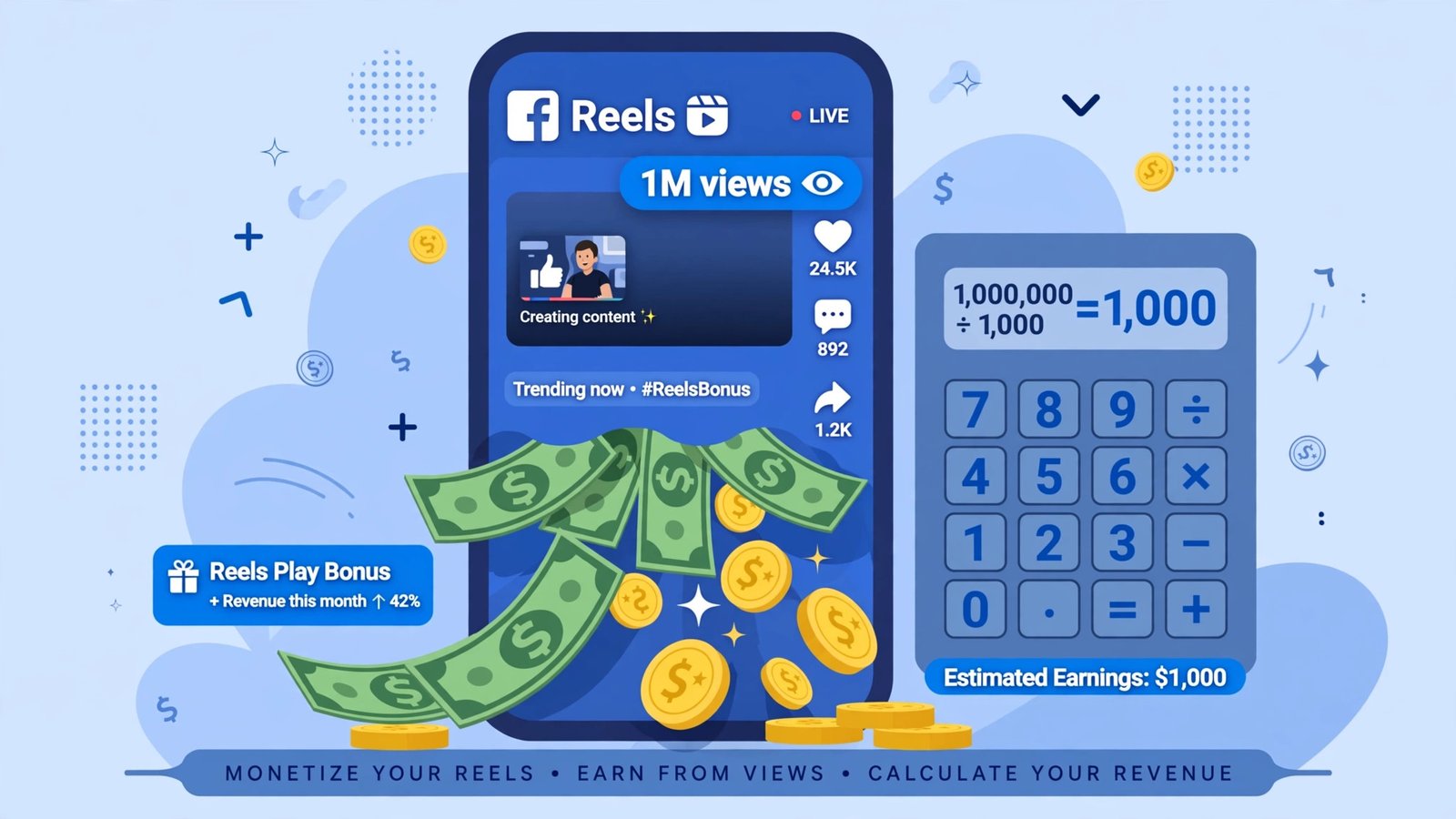
Ask ten creators what a million Facebook Reels views pays and you’ll get ten different answers — $50, $500, $3,000, “basically nothing.” They’re all telling the truth, and I know how maddening that sounds if you’re staring at your own dashboard wondering which number applies to you. That’s because a million Facebook Reels views has no fixed payout from Meta. There is no rate card, no per-view price, no guaranteed dollar figure.
What there is, is a formula. And once you understand it, the wild variation in reported earnings starts making perfect sense.
The formula: qualified views ÷ 1,000 × earnings rate
In March 2026, Meta introduced clearer earnings metrics for creators: qualified views, an earnings rate, and a breakdown of non-qualified views. As Legit.ng’s breakdown explains, the payout math works like this:
Estimated earnings = qualified views ÷ 1,000 × your earnings rate
Two definitions matter enormously here:
- Qualified views are views that may be eligible to generate earnings. Not every view qualifies — far from it.
- Earnings rate shows your approximate revenue per 1,000 qualified views. It’s personal to your account, your audience, and your content.
So the question “what does 1M Reels views pay?” is unanswerable without two more numbers: how many of those views qualified, and what your earnings rate is. A Reel showing one million total views might have 250,000 qualified views, or 500,000, or 80,000. Meta publishes no universal percentage — it varies by content, audience, and circumstance.
The math, worked through
Let’s run the formula with realistic numbers so you can feel how it behaves:
Scenario A — modest reach, modest rate. Your Reel hits 1,000,000 total views. 250,000 qualify. Your earnings rate is $0.20 per 1,000 qualified views.
250,000 ÷ 1,000 × $0.20 = $50
Scenario B — strong qualification, decent rate. Same million views, but 500,000 qualify and your rate is $1.00.
500,000 ÷ 1,000 × $1.00 = $500
Scenario C — US finance audience, high rate. 600,000 qualified views at $5.00 per thousand (achievable in high-value niches with US viewers).
600,000 ÷ 1,000 × $5.00 = $3,000
Same million views. Three payouts: $50, $500, $3,000. All from the same formula. If that feels unfair — welcome to platform monetization, where the view count is the least informative number on your dashboard. This is why anyone quoting a single “Facebook pays $X per million views” figure — $200, $1,000, $5,000 — should be treated with caution unless they show their qualified-view count and earnings rate alongside it. Without those two numbers, a payout claim is just a story.
One more arithmetic check worth internalizing: at a $3–$12 earnings rate, one million qualified views produces $3,000–$12,000 — not $300–$1,200. People constantly mix up total views and qualified views, and the error compounds by a factor of ten.
Why your earnings rate is what it is
Your earnings rate isn’t random. It’s driven by advertiser demand for your specific audience, and five factors dominate:
1. Geography — the single biggest lever. Where your viewers live changes your payout enormously. Reported blended ranges run roughly: United States, UK, Canada, Australia at $3–$12 per 1,000 monetized views; Western Europe $1.50–$6; Eastern Europe and Latin America $0.50–$2; India, Pakistan, Philippines, Indonesia, Bangladesh $0.05–$0.80. That’s up to a 100x spread between the top and bottom. Two identical Reels, one watched in Texas and one in Manila, earn radically different money. This geography breakdown lays out the ranges in detail, and if you want the full picture of why view location crushes your RPM, it’s worth the read.
2. Niche. Advertisers pay more to reach people with money and intent. Finance, business, and tech content earns roughly $2–$5 per 1,000 views; general entertainment sits around $0.30–$1.50. A budgeting Reel and a dance Reel with identical views are not the same product to an advertiser.
3. Watch time and video length. Longer watch time means more ad inventory around your content. A 45-second Reel that people swipe past generates fewer monetizable moments than a 3-minute video viewers actually finish.
4. Ad demand seasonality. Q4 (holiday shopping season) brings higher advertiser spending and higher rates; January is the annual trough. The same content earns more in December than in February.
5. Your account’s standing. Original content, consistent posting, and a clean compliance record keep you in good standing with the monetization system. Reposted or unoriginal content doesn’t just risk demonetization — it was specifically targeted by Meta’s March 2026 unoriginal-content update.
What kills your qualified views
The gap between total views and qualified views is where most creators lose money they thought they’d earned. Views typically fail to qualify when:
- The content isn’t original. Reposts, compilations, and lightly edited viral clips are the first to be excluded — and Meta has been explicit about cracking down.
- The viewer isn’t in a monetizable region. Views from countries where Meta doesn’t serve monetized ads don’t qualify, no matter how real the viewer is.
- Watch time is too short. A 1-second swipe counts as a view in your public counter. It does not count as a qualified view.
- The account isn’t in good standing. Policy strikes and monetization violations shrink or zero out qualification.
This is the mechanism behind the most painful creator experience on Facebook: a Reel goes mega-viral — 2M, 5M views — and the payout is a fraction of what the view count suggests. The views were real. They just weren’t qualified.
Debunking the viral payout claims
Scroll creator TikTok or YouTube and you’ll find confident videos claiming “Facebook pays $1,000 per million views” or “1M views = $5,000 guaranteed.” These numbers usually come from one of three places, and all three are shaky:
A single screenshot, generalized. One creator’s dashboard shows $1,200 on a million-view Reel. That screenshot is real — but it reflects their qualified-view count and their earnings rate, in their niche, with their audience geography. Generalizing it to everyone is like saying every restaurant meal costs $40 because yours did.
Total views confused with qualified views. The most common error. A claim of “$3,000 per million views” at a $3 earnings rate requires one million qualified views — which might mean 2–4 million total views. When someone says “my million-view Reel paid $3,000,” ask what fraction of views qualified. The answer is usually “I don’t know,” which tells you everything.
Bonus-era numbers applied to the ad era. The old Reels Play bonus program (now effectively gone) paid some creators flat bonuses of $1,000–$35,000+ per month for hitting view thresholds. Those were bonuses, not ad payouts — and they’re over. Quoting bonus-era numbers as today’s per-view rates is comparing two different payment systems.
The honest version of the claim: a million total views can pay $1,000+ — but only with high qualification rates, a premium-geography audience, and a valuable niche. Most creators see far less, because most views don’t qualify and most audiences aren’t premium.
Where the money actually flows: ads vs bonuses
It’s worth understanding what you’re being paid for, because Facebook’s unified Content Monetization dashboard blends several income streams:
- Ads on Reels. Short ads served around your Reels. This is the qualified-views × earnings-rate math — the core of this article.
- Performance bonuses. Payments tied to engagement, reach, or other performance metrics rather than direct ad impressions. These can be significant but are the least predictable component.
- In-stream ads. For longer videos (not Reels), ad breaks inserted into the content itself — closer to YouTube’s model.
Your dashboard’s March 2026 metrics — qualified views, earnings rate, non-qualified breakdown — apply primarily to the ads-on-Reels component. If your total earnings look oddly high or low relative to your Reels views, check the split: bonuses and in-stream revenue follow different logic than the Reels formula.
Reading your own dashboard like an auditor
Here’s a practical monthly routine that turns the formula into decisions:
- Pull qualified views and earnings rate for each top Reel. Divide actual earnings by (qualified views ÷ 1,000) to back out your effective rate per piece of content.
- Compare rates across content types. If your finance explainers earn $2.40 per 1,000 qualified views and your entertainment clips earn $0.30, you now have a dollar figure for every content decision.
- Track qualification percentage over time. (Qualified views ÷ total views) trending down means your distribution is shifting toward low-quality or ineligible views — a signal to adjust content or posting strategy.
- Note the geography mix. Your dashboard shows top countries. If 70% of a viral Reel’s views came from regions with $0.10 rates, that explains the payout — and tells you the content traveled well but monetized poorly.
This is unglamorous spreadsheet work, but it’s the difference between creators who guess and creators who know. The March 2026 transparency update gave you the instruments; using them is optional but profitable.
Real numbers: a case study
Theory is nice; real dashboards are better. Here’s a genuine 28-day snapshot from a real Facebook page: 7 million views, ~$572.38 in earnings. Run the blended math: $572.38 ÷ 7,000 = roughly $0.082 per 1,000 views across everything — Reels, longer videos, photo posts combined.
That’s a sobering number, and it’s honest — and honestly, it’s the number most creators are actually living with, even if nobody brags about it on TikTok. It reflects a mixed audience, mixed content lengths, and the reality that only a fraction of views qualified at modest rates. It’s also exactly why the “million views = $X” framing misleads: this page’s 7 million views paid less than some creators report for a single viral Reel with a premium US audience.
Other reported data points for calibration: a UK food creator with 85,000 followers posting five Reels a week reported about £340 for a full month. Facebook Reels RPM broadly runs $0.30–$5 per 1,000 views depending on niche and geography. Meta itself disclosed it paid nearly $3 billion to creators in 2025 — a 35% increase — with Reels accounting for about 60% of total payouts. The money is real and growing. It’s just unevenly distributed by the formula above.
How Facebook compares to YouTube and TikTok
Understanding the formula helps to see where Facebook sits among platforms:
- YouTube pays a revenue share of actual ad dollars (55% long-form, 45% Shorts pool) — more transparent per-view math, but with its own 2027 threshold changes raising the bar.
- TikTok Creator Rewards pays roughly $0.40–$1 per 1,000 qualified views — note the same “qualified” concept — with its own filters and a 1-minute video requirement.
- Facebook sits in the middle on rates but wins on volume potential: Reels distribution is aggressive, the $3B creator payout pool is growing fast, and Content Monetization now merges ads on Reels, performance bonuses, and in-stream ads into one dashboard.
No platform pays “per view” in the way creators imagine. They all pay per monetizable view, filtered through their own qualification systems. Facebook just made its filters visible with the March 2026 metrics update.
How to raise your numbers
You can’t change the formula, but you can change every input to it:
- Chase qualified views, not total views. A Reel with 200K views and 150K qualified beats a Reel with 1M views and 100K qualified. Original, longer, high-retention content qualifies better.
- Court high-value geographies. You can’t choose your viewers directly, but you can choose your language, topics, posting times, and cultural references. English-language finance content posted on US time zones skews toward US viewers.
- Pick a valuable niche. If you’re choosing between two content directions you enjoy equally, the one advertisers pay more for (finance, business, tech, home) wins on earnings rate.
- Go original, always. The March 2026 unoriginal-content update made this non-negotiable. Reposted content is the fastest way to watch your qualified-view count collapse.
- Get into Content Monetization properly. Approval is invite-only with no public application — but consistent original posting in professional mode is how invites happen. There’s no shortcut; there’s just the work.
- Watch your dashboard, not your view counter. The March 2026 metrics — qualified views, earnings rate, non-qualified breakdown — tell you exactly where money is leaking. A Reel with great views and terrible qualification is a content problem you can diagnose and fix.
The program mechanics, briefly
Facebook Content Monetization is the unified program covering Reels ads, performance bonuses, and in-stream ads. Key facts: it’s invite-only (Meta publishes no fixed follower threshold, though established presence of 30+ days and an eligible country are the stated baselines); the minimum payout is $100 before you can withdraw; and the old Reels Play bonus program that once paid some creators five figures a month is effectively gone, replaced by this performance-based system.
For newer creators, Meta’s Creator Fast Track program offers guaranteed monthly payouts for up to three months (up to $1,000/month at 100K+ followers on other platforms, up to $3,000 at 1M+) — but it’s invite-only too, aimed at established creators migrating from TikTok or YouTube.
If you’d rather watch this explained with real dashboard walkthroughs than read about it, this honest review covers Facebook Content Monetization, real Reels RPM by niche, and the Breakthrough Bonus and Creator Fast Track programs:
It’s worth the seven minutes — especially the section on why two videos with wildly different view counts can earn opposite amounts.
Frequently asked questions
How much does 1 million Facebook Reels views pay?
There is no fixed payout. Meta’s formula is: qualified views ÷ 1,000 × your earnings rate. Depending on qualification rate and geography/niche, real payouts range from under $50 to several thousand dollars for the same view count.
What are qualified views on Facebook?
Views that may be eligible to generate earnings, per Meta’s March 2026 metrics update. Not all views qualify — unoriginal content, short watch time, ineligible regions, and policy issues all reduce the qualified count.
What is a good earnings rate for Facebook Reels?
It varies wildly by geography and niche: roughly $0.05–$0.80 per 1,000 in South/Southeast Asia, $0.50–$2 in Latin America/Eastern Europe, $1.50–$6 in Western Europe, and $3–$12 in the US/UK/Canada/Australia. Finance and business niches sit at the top of each range.
Why did my viral Reel earn so little?
Almost always one of three reasons: most views didn’t qualify (unoriginal content, short watch time, or ineligible regions), your audience geography has low ad rates, or both. Check the qualified-views breakdown in your professional dashboard.
Is Facebook Reels monetization invite-only?
Yes. Facebook Content Monetization has no public application — Meta issues invites to eligible pages, typically with 30+ days of established presence in an eligible country, posting original content. The Creator Fast Track program is also invite-only.
What’s the minimum payout on Facebook?
$100. Earnings below the threshold roll over until you hit it.