
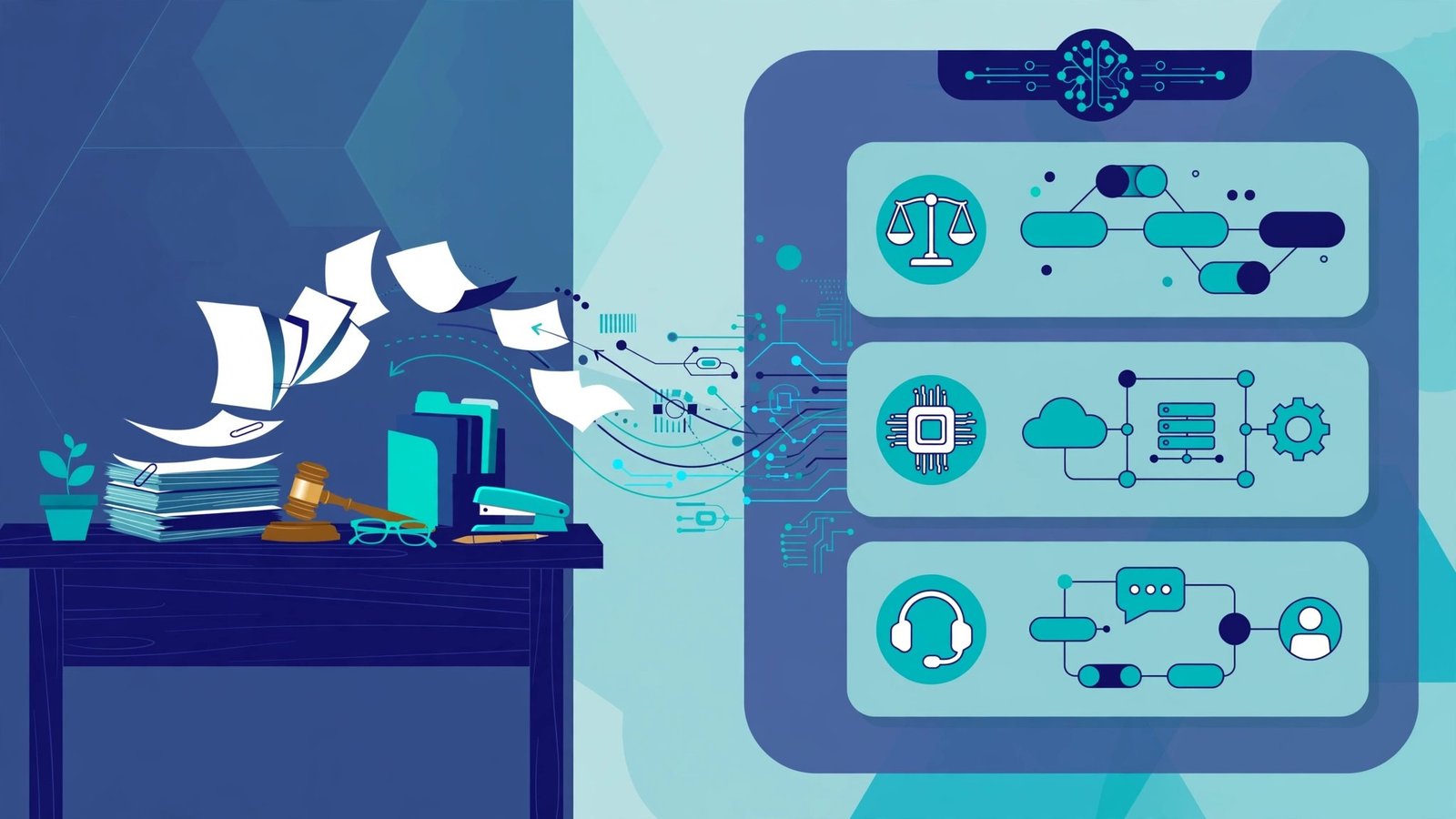
On October 28, 2026, OpenAI made two announcements that, read together, say more about where AI is going than any single model launch this year. It expanded its partnership with ServiceNow, so ServiceNow workflows can now be acted on from inside ChatGPT, and it published a customer story about Legora, a legal technology company building what its CEO calls an “agentic operating system for legal work” on OpenAI models, ChatGPT, and Codex.
Neither announcement is a new chatbot. Both are about the same shift: AI is stopping being a thing you chat with and becoming a department you run — software that knows your company’s processes, touches your company’s systems, and does multi-step work under your company’s rules. Legal got there first, and enterprise IT is close behind. If you run a small business, the question is not whether you can afford Legora or ServiceNow. You almost certainly can’t, at least not yet. The question is what to copy from their setup, what to check before trusting any vertical AI tool with your contracts or client data, and what to avoid while the market sorts itself out.
What actually happened on October 28
Let’s get the facts straight first, because the coverage of both announcements mixes up what is available now with what is planned.
ServiceNow: workflows inside ChatGPT
ServiceNow’s own announcement of the expanded partnership confirms the ChatGPT plugin, the Codex integration plan, and the joint security work described below.
OpenAI and ServiceNow expanded a multi-year partnership first announced on January 20, 2026, which made OpenAI a preferred intelligence capability on the ServiceNow AI Platform. The October expansion works in both directions:
- A ServiceNow plugin for ChatGPT is available now. The ServiceNow MCP plugin is in the OpenAI marketplace today, with enhanced capabilities expected by the end of 2026. It brings business context and workflow actions directly into ChatGPT, so a team member can investigate an issue and take the next step in the same conversation. OpenAI’s example: an IT worker finds similar past incidents, assesses the risk of a change, and updates a ServiceNow record without leaving ChatGPT.
- Governance stays with ServiceNow. Customers connect ChatGPT to their own ServiceNow instance and choose which capabilities to make available. ServiceNow’s Action Fabric applies the customer’s existing business rules and permissions, so the actions a person can take reflect their organization’s configuration and access. ServiceNow remains the system where actions are executed and governed. That sentence matters more than any demo: the chatbot does not become the system of record. It becomes a front door to one.
- Most of the rest is planned, not live. A Codex integration in ServiceNow’s AI Workflow Factory, to help developers build applications using ServiceNow’s business context, is expected in 2027. Joint security capabilities are expected to enter early access in January 2027, with general availability planned for the second quarter of 2027. Voice capabilities in ServiceNow’s Super Intelligence Control Tower — describing an AI use case aloud so the system fills in assessment fields — are expected in the first quarter of 2027. OpenAI models will also power ServiceNow’s Build Agent and Autonomous Engineer tools.
- No new price was disclosed. The October announcement does not announce a new contract value or a price for the expanded integrations. ServiceNow plans to give all of its own employees access to ChatGPT Work and Codex, expanding beyond its engineering team, and OpenAI says it is using ServiceNow workflows in its own operations. Those are deployment facts about two large companies, not a price list you can shop from.
The honest summary: one plugin is live, the ambitious parts are dated plans, and the governance model — your rules, your permissions, your system of record — is the real product.
Legora: legal work as an operating system
Legora is a Stockholm-founded legal technology company, founded in 2023 under the name Leya, which launched its platform in October 2024 and rebranded to Legora in February 2025. OpenAI’s October 28 customer story frames it as building an “agentic operating system” for legal work, using OpenAI models for core workflows spanning agent-run legal tasks and large-scale document review, while its own staff use ChatGPT Work and Codex internally.
The numbers in the story are striking, and they need careful handling because they come from Legora and one unnamed customer, presented in OpenAI’s story — not from an independent study:
- Legora’s own general counsel, Emma Kadri Bergström, estimates that reviewing incoming non-disclosure agreements took about 20% of her team’s capacity. After turning the agreements it had already signed into a playbook, Legora now flags any terms outside it, and the work takes under 1% of capacity.
- A Fortune 100 customer, unnamed in the story, is reported to have cut contract turnaround by 90%, saved more than $20 million on outside litigation and diligence costs, and given each lawyer 9.5 hours a week back.
- Legora reported on October 21, 2026 that it had raised a $550 million Series E at an $8.8 billion post-money valuation, with more than $200 million in annual recurring revenue, more than 1,000 employees across 18 offices, and more than 140,000 legal professionals using its platform at more than 2,400 organizations in over 80 markets. Those operating figures are company-reported, not independently audited.
- In the week before the OpenAI story, Legora announced that Jones Day had selected it as a strategic AI partner and was rolling it out firm-wide to 2,500 lawyers, and that Stoel Rives was deploying it firm-wide.
A separate OpenAI case study from September 3, 2026 gives a more technical example: in a financial-statement tie-out workflow, Legora says an agent using GPT-6 Astra reviewed 41 documents in minutes, found all four deliberately planted errors, and improved performance by nearly 40% against the previous model on that particular task — while the average improvement across Legora’s broader Benchmark for Agentic Reasoning was approximately 3%. That gap between one showcase task (40%) and the broader average (3%) is exactly the kind of detail a small business should look for before believing a vendor’s headline number.
For the source trail, see Unite.AI’s report on the ServiceNow expansion and Blockchain.News’ report on the Legora story.
Why “vertical” beats “general” for real work
A general chatbot is brilliant at drafting and terrible at knowing what your business actually does. It doesn’t know your contract playbook, your approval chain, your client matter numbers, or which terms your firm never accepts. A vertical agent — software built for one department’s workflows, on top of a general model — brings that context with it.
That is the whole bet behind both October 28 announcements, and it explains why legal moved first. Legal work is language-intensive, document-heavy, repetitive at the first pass, and high-stakes at the final sign-off. Those four traits together are the sweet spot for an agent: there is enough repetition to automate, enough structure (clauses, playbooks, precedents) to check against, and enough risk that a human still has to approve the result. The same shape fits bookkeeping, customer support triage, HR onboarding paperwork, and procurement — which is why those niches are next, not because anyone announced them, but because the shape fits.
Here is the decision table I promised. Use it before you buy any vertical AI tool, or before you build a workaround with a general chatbot.
General chatbot vs. vertical agent, by workflow type
| Workflow | General chatbot is enough | Vertical agent earns its keep |
|---|---|---|
| Drafting a one-off email or social post | Yes — fast, cheap, low risk | No — overkill |
| Reviewing NDAs against your firm’s playbook | No — it doesn’t know your playbook | Yes — the playbook is the product |
| Triaging support tickets by urgency and topic | Partly — it can classify, but can’t act | Yes — when it can update tickets under your rules |
| Summarizing a meeting or a long document | Yes — a contained, read-only task | No — unless summaries must follow your template and filing rules |
| Checking invoices against contracts and rates | No — needs your rate cards and approval chain | Yes — structured data plus rules |
| Brainstorming names, slogans, or campaign ideas | Yes — creativity is the general model’s strength | No — don’t pay a vertical premium for ideas |
| Onboarding paperwork with compliance steps | Partly — it can draft, but can’t verify | Yes — when missing steps carry legal risk |
The rule of thumb: if the work’s value comes mostly from knowing your business’s rules, precedents, and systems, a vertical tool is worth evaluating. If the work’s value comes mostly from generating fresh language, a general chatbot is fine, and a vertical premium is wasted money.
What small businesses can steal from Legora’s setup — for free
You don’t need Legora’s budget to copy its structure. The NDA story is really a three-step method, and it works with tools you already have:
1. Write the playbook before you automate anything. Legora’s team turned the NDAs it had already signed into a playbook — the terms it accepts, the terms it rejects, the terms it negotiates. That document is the asset, not the AI. For your business, the equivalent might be a one-page list of your standard payment terms, your refund policy boundaries, your subcontractor must-haves, or your client onboarding checklist. If you can’t write the rule on one page, an AI tool can’t reliably enforce it either.
2. Use the AI for the first pass, never the final sign-off. In Legora’s telling, the system flags terms outside the playbook. A human still decides. That division of labor is the whole safety model: AI is fast at scanning, humans are accountable for deciding. Any vendor that pitches you a system where the AI “handles” contracts, hiring, or client money with no human approval step is selling you risk, not efficiency. This connects directly to a warning we covered recently about AI agents that don’t know when to quit — an agent without a stop condition and an approval gate will keep working past the point where it should have asked you.
3. Measure one workflow, honestly, before you expand. Legora measured NDA review time as a share of team capacity before and after. Pick one workflow in your business — say, first-pass invoice checking, or support ticket triage — and time it for two weeks before you introduce any tool, then two weeks after. If the improvement is small, you have learned something valuable for free. If a vendor quotes you a 90% improvement, ask what they measured, over how many cases, and whether the figure is an average or a showcase. Remember the 40% versus 3% gap above: showcase tasks flatter every vendor.
The vendor-diligence checklist: 8 questions before you sign
Vertical AI is a young market, and young markets reward good questions. Ask these before any contract, free trial, or “pilot” that touches real client data:
- Where does my data go, and does it train the vendor’s models? Get the answer in writing, in the contract, not in a sales call. If your contracts, client names, or financials can be used to train a shared model, that is a decision for you and your lawyer, not a default setting.
- Who is the system of record? In the ServiceNow model, ServiceNow stays the system of record and ChatGPT is a front door. Your setup should have the same clarity: the AI tool should not become the only place a decision, approval, or document lives.
- What happens when the AI is wrong? Ask for the error path, not the success demo. Who sees the mistake, how is it corrected, and can you roll back an action the agent took?
- What approvals are enforced, not suggested? “The AI will ask before sending” is different from “the system cannot send without approval.” The second one is a control. The first one is a hope.
- Can I export my playbook and my data? Your contract playbook, your templates, your history — if leaving the vendor means losing them, you are not buying software, you are renting a hostage situation.
- What does it cost at my volume, not the demo volume? Vertical tools often price by seats, matters, documents, or “credits.” Run your actual monthly volume through the pricing page, not the vendor’s example. A tool that looks cheap at 10 documents a month can be painful at 200.
- Is the headline result an average or a showcase? Ask for the sample size and the average improvement, not just the best customer. If the vendor can’t give you an average, treat the headline as marketing.
- Does it work with my existing tools, or does it demand a migration? A tool that requires you to move your documents, your CRM, or your accounting into its system carries a hidden migration cost that dwarfs the subscription fee. Prefer tools that connect to what you already use.
If a vendor struggles with more than two of these, walk away — or at least, don’t sign an annual contract. A monthly plan and a small pilot, on non-sensitive work, is the right shape for this market in late 2026.
What to avoid right now
Three traps are already visible in this market, and small businesses are the likeliest victims of all three:
Buying the enterprise version of a problem you don’t have. ServiceNow’s setup makes sense for a company running tens of billions of workflows a year. If your business runs a few hundred workflows a month, you need a checklist and a shared document, not an agentic operating system. The most expensive AI mistake a small business can make in 2026 is buying sophistication it can’t staff.
Letting a shared bot send things unsupervised. The same week as the ServiceNow and Legora news, xAI described its own sales team using shared bots for prospecting, quoting, and deal review. Shared bots are a good pattern — one bot per workflow, used by the whole team, instead of every rep prompting alone. But a shared bot that can send quotes, emails, or contract language without approval is a shared liability. The pattern to copy is the shared template plus the approval gate, not the shared bot alone.
Treating a vendor’s customer story as a benchmark. OpenAI’s Legora story is a customer story, not an independent evaluation. It is useful as a pattern — playbook, first pass, human sign-off — and unreliable as a savings forecast for your business. The same caution applies to every “we saved $20 million” claim in this space. Until independent benchmarks exist for a given vertical, assume the real savings for a small team are smaller, slower, and more dependent on how good your playbook was before you started.
A realistic 30-day plan for a small business
If you want to act on this shift without betting the business on it, here is a plan that costs almost nothing:
Week 1: Pick one workflow and write its playbook. Choose the most repetitive, language-heavy task you do — NDA first passes, quote follow-ups, support ticket sorting, invoice checks. Write the rules on one page. If you can’t, that task isn’t ready for automation, and you’ve learned that for free.
Week 2: Time it. Measure how long the workflow takes now, in minutes per case, for at least ten cases. This is your baseline. Without it, every vendor claim is unfalsifiable.
Week 3: Run a general chatbot against the playbook. This is also where always-on agents earn extra scrutiny — see our look at OpenAI’s always-on agents for small business before you leave any agent running unsupervised. Give a general chatbot your one-page playbook and ten past cases, and check its first-pass answers against what you actually decided. Count the errors. If it gets 8 out of 10 right, a vertical tool might push that higher — but you now know the gap is small. If it gets 4 out of 10 right, your playbook needs work before any tool will help.
Week 4: Evaluate one vertical tool, on a pilot, with non-sensitive cases. Use the 8-question checklist above. Insist on monthly billing, data export, and a human approval gate. Measure the same ten-case sample again. Keep the tool only if it beats your chatbot-plus-playbook baseline by enough to justify its price — and only for that one workflow. Expand later, one workflow at a time.
That plan is deliberately boring. Boring is the point. The companies that win from vertical AI will not be the ones that bought the most tools fastest. They will be the ones that wrote the best playbooks, measured honestly, and kept a human in charge of the final decision.
The bottom line
OpenAI’s October 28 announcements are not really about OpenAI, ServiceNow, or Legora. They are about a shape: general models wrapped in department-specific scaffolding, governed by the customer’s own rules, with humans keeping the final say. Legal got there first because its work fits the shape best. Your business’s version of that shape is probably smaller, cheaper, and closer to a one-page playbook than to an operating system — and that’s fine. The playbook is the asset. The AI is just the first pass.
Build the playbook, measure one workflow, keep the approval gate, and let the enterprise vendors fight over the billion-dollar deployments. By the time vertical agents are priced for businesses your size, you’ll already know exactly what you need one to do.
Frequently Asked Questions
What did OpenAI and ServiceNow announce on October 28, 2026?
They expanded their partnership so ServiceNow workflows can be acted on from inside ChatGPT. A ServiceNow MCP plugin is available in the OpenAI marketplace now, with enhanced capabilities expected by the end of 2026. Codex integration, joint security tools, and voice features are planned for 2027, not live yet.
What is Legora’s “agentic operating system for legal work”?
It is Legora’s description of its platform, as presented in OpenAI’s October 28 customer story: software that uses OpenAI models, ChatGPT, and Codex to run multi-step legal workflows — research, document review, drafting, and contract analysis — against a firm’s playbook, so lawyers spend less time on first-pass review and more on advisory work. It is a vendor positioning phrase, not an industry standard.
Should a small business buy Legora or ServiceNow now?
Probably not yet, unless you already run a law firm or an enterprise IT operation at that scale. The pattern to copy — a written playbook, AI first pass, human final sign-off — costs almost nothing to test with tools you already have. Evaluate a vertical tool only after you have measured one workflow and can say what improvement would justify its price.
Are the savings figures in OpenAI’s Legora story reliable?
Treat them as vendor-reported, not independently verified. The 90% faster contract turnaround and $20 million savings figures come from one unnamed Fortune 100 customer in OpenAI’s story, and Legora’s operating figures are company-reported. A separate case study showed a 40% improvement on one showcase task but only about 3% on average across a broader benchmark — a useful reminder to ask for averages, not just best cases.
What is the biggest risk of using a vertical AI agent?
Letting it act without an enforced approval gate, or letting it become the only system where decisions and documents live. Your existing system — your CRM, your document store, your accounting tool — should stay the system of record, with the AI tool as a front door that follows your rules and permissions.
Which business functions are most likely to get good vertical AI tools next?
Workflows that are language-heavy, repetitive at first pass, structured by rules or precedents, and high-stakes at sign-off: bookkeeping and invoice checking, customer support triage, HR onboarding paperwork, and procurement. Creative brainstorming and one-off drafting are already well served by general chatbots and don’t need a vertical premium.