
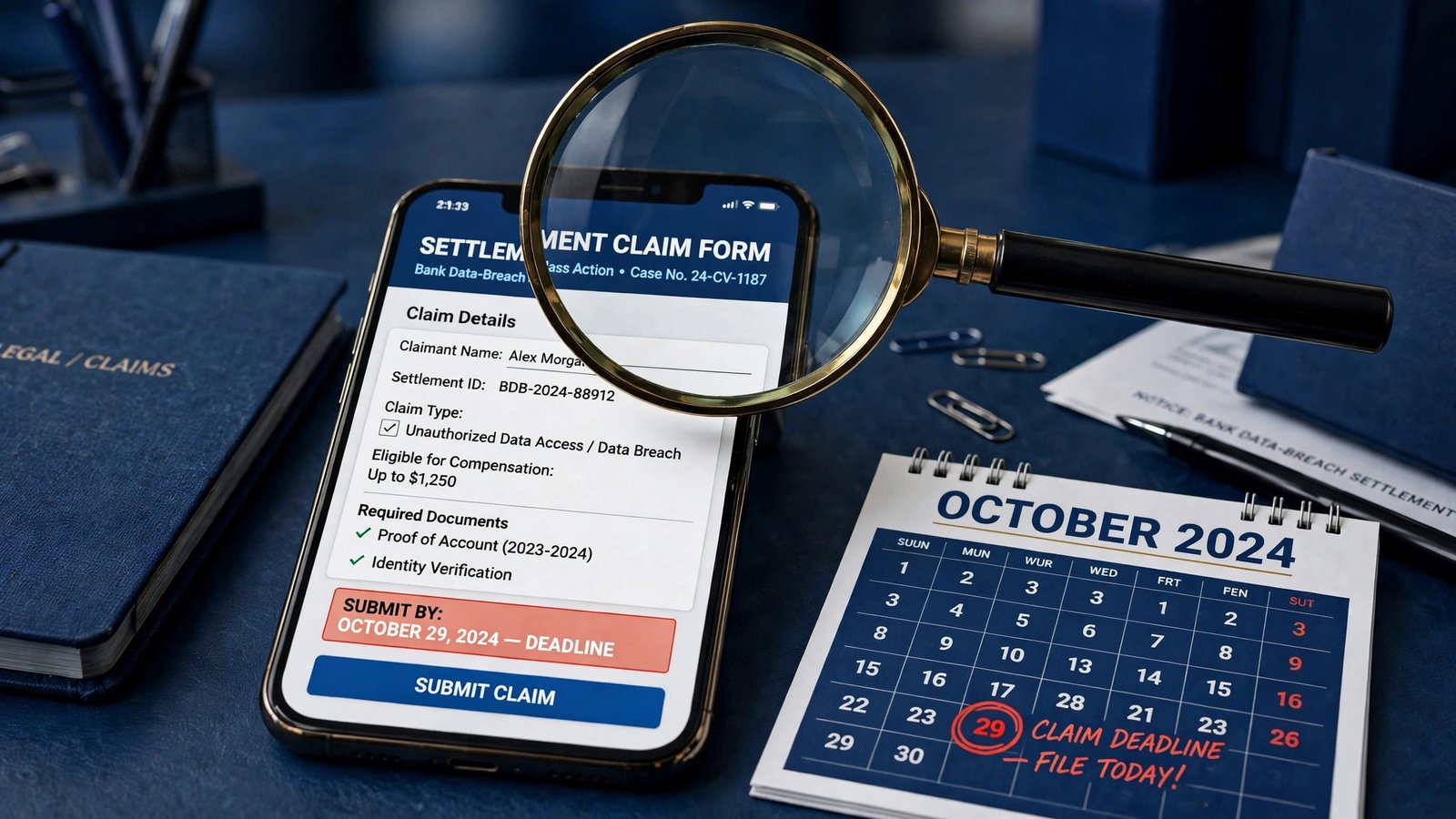
You’ve got six days. If FinWise Bank or American First Finance sent you a data breach notice — a postcard or an email you probably half-ignored — you may be entitled to money from a $2.8 million class action settlement. But the claim deadline is October 29, 2026, and if you miss it, you’re bound by the settlement and get nothing.
The case is Minter v. FinWise Bank, et al. (No. 2:25-cv-00569-JNP-CMR) in the U.S. District Court for the District of Utah. A data incident on or about May 31, 2024 exposed full names, dates of birth, Social Security numbers, and customer account numbers for up to roughly 668,000 people. FinWise Bank, FinWise Bancorp, and American First Finance deny wrongdoing but agreed to pay $2.8 million. Eligible class members can claim either up to $5,000 for documented losses (with receipts) or a pro-rata cash payment with no proof required, plus two years of three-bureau credit monitoring either way. California residents at the time of the breach can get up to double the cash payment.
This guide walks you through the entire filing process in about 15 minutes — which option to pick, the math behind each choice, the mail-timing trap that burns people every settlement, and what happens after the deadline.
What’s Actually in the $2.8 Million Settlement
Let’s start with where the money goes, because it matters for how much you can realistically expect.
The $2,800,000 fund doesn’t all go to class members. Class counsel will ask for up to one-third in attorneys’ fees — about $933,333 — plus costs. Class representatives can receive up to $2,500 each in service awards. Then settlement administration costs and credit monitoring come off the top. Whatever remains is the net fund that pays claimants.
The payout order matters too: credit monitoring is paid first, then documented losses, then the cash fund from whatever is left. Here’s the honest caveat most settlement summaries bury — if approved documented-loss claims use up the net fund, there are no cash fund payments at all, and documented-loss payments get reduced pro rata. That makes “file a cash claim with no proof” less automatic than it sounds, which I’ll get into below.
You pick one of two benefit options — you can’t take both:
Option A: Documented Losses Payment — up to $5,000. This covers out-of-pocket losses fairly traceable to the breach: fraud or identity theft losses, credit report costs, credit monitoring you bought yourself, freeze/unfreeze fees, postage, and phone charges. You need real documentation — receipts, invoices, bank or credit card statements, account statements, tax forms, police reports. If your expenses were already reimbursed from another source (including the identity protection FinWise offered in its notice letter), you can’t claim them again.
Option B: Cash Fund Payment — pro-rata share, no proof needed. You don’t need a single receipt. The catch: the per-person amount is unknown until every claim is counted. With ~668,000 class members and a net fund of roughly $1.8 million after fees and costs, the number swings wildly with participation. If 100,000 people take the cash option, that’s about $18 each. If 30,000 file, it’s around $60. If only 10,000 file, it’s roughly $180. These are illustrative numbers, not predictions — nobody knows until the administrator counts the claims.
The add-on everyone should take: regardless of which option you pick, you can elect two years of three-bureau credit monitoring plus identity theft insurance at no extra cost. You have to actively select it on the claim form — it’s not automatic. With Social Security numbers in the exposed data, this is the single most valuable part of the settlement for most people. Don’t leave it unchecked.
Are You Eligible? A 30-Second Check
You qualify if all of these are true:
- You’re a living person residing in the United States.
- Your private information was affected by the FinWise data incident on or about May 31, 2024.
- You were sent a notice of the incident — a postcard or an email.
That third point covers the vast majority of the ~668,000-person class. If you had, applied for, or carried a FinWise installment loan, a lease-to-own account, or a retail installment sales agreement with American First Finance, you’re in the most likely pool of recipients.
The “at the time of the breach” detail matters for one specific group: the California enhanced payment (up to double the cash fund share) depends on where you lived when the incident happened, not where you live now. Moved from Ohio to California in 2025? The multiplier doesn’t apply to you.
The 15-Minute Filing Walkthrough
Here’s the part no competitor page walks through properly: the actual filing, start to finish, including the two traps that catch people.
Step 1 — Find your notice (2 minutes). Dig up the postcard or email from the FinWise settlement administrator. You need the Unique ID and PIN printed on it. Check spam, search your inbox for “FinWise” or “FinwiseDataSettlement.” If you genuinely can’t find it, call the settlement administrator at 1-877-419-3877 or email info@FinwiseDataSettlement.com. Don’t sit on this — do it today, not October 29.
Step 2 — Gather your proof documents if you’re claiming documented losses (5 minutes). Scan or photograph receipts, bank statements, or whatever documents your expenses. Two rules: each file must be under 20 MB, and the accepted formats are jpg, jpeg, png, gif, tif, tiff, doc, docx, xls, xlsx, pdf, txt, rtf, and zip. If a phone photo is too big, screenshot it or resize — don’t start the form with oversized files waiting.
Step 3 — Go to the official login page (1 minute). Head to the official settlement login page and enter your Unique ID and PIN. Type the main site URL yourself or use a bookmark — scammers spin up copycat settlement sites with every major breach. If a link arrived by text or email asking you to “claim now,” don’t trust it.
Step 4 — Choose your benefit and elect the monitoring (3 minutes). Pick Option A (documented losses) or Option B (cash fund) — one only. Then check the box for two years of three-bureau credit monitoring. Seriously, don’t skip this. It costs you nothing extra, and two years of paid monitoring for a breach that exposed your SSN is the kind of thing you’d pay $120–$300 a year for yourself.
Step 5 — Choose how you’d like to be paid (2 minutes). The administrator pays via Venmo, PayPal, Zelle, or a paper check. Electronic options are faster and eliminate the “check got lost in the mail” problem. If you don’t use any of the digital options, the paper check is fine — just make sure the mailing address on your claim is one you’ll still control in 2027.
Step 6 — Review, sign, and save your confirmation (2 minutes). Read your entries back before submitting. You’re signing under penalty of perjury, so accuracy matters. Submit, then screenshot or save the confirmation page and the confirmation email. If the administrator needs more documentation later, having your confirmation code ready makes that painless.
Trap number one: the online form does not save your progress. Start it, finish it. If you wander off to hunt down a receipt mid-form, you may lose everything you entered. That’s why Steps 1 and 2 come before Step 3.
Trap number two: the mailed-versus-received rule. If you file by mail instead — paper form to FinWise Data Incident Settlement Administrator, P.O. Box 4390, Portland, OR 97208-4390 — the safest play is to get it postmarked at a post office (hand it to a clerk and ask for a manual postmark) or send it Certified Mail. Mailbox pickup dates can be wrong or missing, and “I mailed it on time” loses arguments that a stamped postmark wins. Mail at least a week before the deadline — which means by October 22 if you’re mailing. Honestly, with six days left, file online unless you have a reason not to.
Which Payment Should You Pick? A Decision Framework
This is the question every claim site answers with a shrug. Here’s how to actually think about it.
Go with documented losses (Option A) if: you have receipts or records showing real out-of-pocket costs tied to the breach. Even modest expenses add up fast. Here’s a realistic worked example:
- Credit monitoring you bought after the breach: $120
- Credit reports pulled beyond your free ones: $40
- Freeze and unfreeze fees across three bureaus: $45
- Postage and phone charges dealing with your bank: $25
Total: $230 in documented losses. That’s $230 you’re certain about, paid ahead of cash-fund claimants. If you have a fraud incident with a police report or bank letters showing unauthorized charges you ate, your claim could be much larger — but it can’t exceed $5,000, and every dollar needs documentation.
Go with the cash fund (Option B) if: you don’t have documented losses, or your documented expenses are small enough that the convenience matters more. If your only expense was, say, $12 in postage and one afternoon of annoyance, filing a documented-loss claim is technically better ($12 is $12), but many people reasonably prefer the zero-paperwork cash option.
The honest middle case: remember that documented losses get paid before cash fund shares, and if loss claims exhaust the fund, cash claimants get nothing. In practice, loss claims in a settlement this size rarely zero out the fund — but the rule exists, and it means Option A’s position in line is better than Option B’s.
If you’re a California resident at the time of the breach: the math changes in your favor. You’re eligible for up to two cash shares for every one share paid to non-California cash claimants. So in that illustrative 100,000-claimant scenario, where a standard share might be ~$18, a qualifying California claimant could receive roughly $36. The multiplier applies to the cash fund payment, not to documented losses. And it comes down to where you lived in May 2024, certified on your claim form.
One more rule that trips people up: don’t try to claim losses for things FinWise’s own notice letter already gave you. The settlement explicitly excludes expenses reimbursed from any other source, including identity protection services offered in the breach notice. Double-dipping is a perjury problem, not a clever move.
Your Calendar From Here to the Payday
The deadline math is simple; the timeline after it isn’t. Here’s the full sequence:
- October 22, 2026 (Thursday): last safe day to mail a paper claim.
- October 29, 2026 (Thursday): claim deadline. Online claims must be submitted by this date. Six days from today.
- December 10, 2026, 10:00 a.m.: final approval hearing before Judge Jill N. Parish in the U.S. District Court for the District of Utah. The court decides whether to approve the settlement as fair and reasonable.
- Spring 2027: realistic payment window. The administrator pays approved claimants approximately 90 days after final approval — but “final” means after any appeals are resolved. If someone appeals, everything waits. Plan on spring 2027, and don’t spend the money before it arrives.
What if you do nothing? You get nothing — no cash, no monitoring. And because you didn’t opt out, you’re still bound by the settlement’s release of claims if it becomes final. Important: the exclusion/objection deadline was September 29, 2026, and it has passed. You can no longer opt out of this settlement or object to it. Your remaining options are to file a claim by October 29 or let the deadline pass.
After the Two Free Years: Protecting Your Credit Long-Term
Two years of free monitoring sounds generous until you remember the exposed data — Social Security numbers don’t expire. When the free monitoring ends, the habits still matter: pull your free reports from all three bureaus annually (you’re entitled to them), keep freezes in place by default and lift them only when applying for credit, and watch for tax-season identity theft, which is where stolen SSNs tend to resurface years later.
If a mortgage or auto loan is anywhere in your future, it’s also worth understanding how credit scoring is evolving — the rules lenders use to read your reports keep changing, so check our breakdown of the mortgage credit score changes coming in 2026 so the score you protect is the one lenders actually use.
And if this isn’t your first breach notice — most Americans have a small pile of them by now — the post-incident playbook is the same every time. Our CenterPoint Energy breach victim checklist walks through the universal steps: freezing credit, setting up fraud alerts, and building a paper trail in case the losses turn out to be documented after all.
Red Flags: What to Watch Out For This Week
Deadlines like this one attract two kinds of trouble — honest mistakes and actual scammers.
Don’t file if you’re not sure you qualify. Claims are signed under penalty of perjury. If you never did business with FinWise or American First Finance and never received a notice, you are not in this settlement. Filing anyway hurts real class members by diluting the fund, and it exposes you legally. When in doubt, call the administrator first.
Don’t trust lookalike sites. The only official site is finwisedatasettlement.com. Copycat domains, texts, and emails asking you to “verify your SSN to claim” are phishing. The official form asks for the Unique ID and PIN from your notice — never your full Social Security number to start a claim.
Don’t call the court. The court and the clerk’s office can’t answer settlement questions. The notice says this explicitly, and calling them won’t speed anything up. Direct everything to the settlement administrator at 1-877-419-3877.
Don’t pay anyone to file for you. Filing takes 15 minutes and costs nothing. “Claim filing services” that take a cut of your payout are selling you something the administrator does for free. There are no forms only a lawyer can complete.
Don’t trust secondary sites for the final word. Settlement aggregator sites are useful for discovery — ClassAction.org’s writeup is a solid secondary source — but if an aggregator and the official site disagree on a deadline, the official site wins. Verify everything at finwisedatasettlement.com.
Note: this article is for informational purposes only and isn’t legal or financial advice. Settlement details can change, so confirm the current terms on the official settlement website before you file.
Frequently Asked Questions
I never received a notice — can I still file a claim?
You may, but only if you genuinely qualify. Living U.S. residents whose private information was affected by the incident are class members whether or not a notice reached them. Call the administrator at 1-877-419-3877 or email info@FinwiseDataSettlement.com to ask about your status. The paper claim form lets you leave the Unique ID field blank if you didn’t receive a notice. But don’t file on a guess — the claim is under penalty of perjury.
Can I claim both the documented losses payment and the cash payment?
No. You must choose one. Both options, however, can include the two years of three-bureau credit monitoring and identity theft insurance — elect it on the claim form regardless of which payment you pick.
How much will the cash fund payment actually be?
Nobody knows yet, and anyone who tells you otherwise is guessing. The per-person amount depends on the net fund after fees, administration, monitoring, and documented-loss claims — divided by the number of valid cash claims filed. It could be $15 or $150. If your expectations need a number, use the honest range: settlements of this size, with a class this large, typically produce modest per-person cash payments unless participation is very low.
I live in California now but lived in Ohio during the breach. Do I get the 2x payment?
No. The California enhancement applies to people who were California residents at the time of the data incident (May 2024), certified on your claim form. Current residence doesn’t count.
When will I actually receive my payment?
Realistically, spring 2027 at the earliest. The final approval hearing is December 10, 2026, and payments go out approximately 90 days after the settlement receives final approval — meaning after the court approves it and any appeals are resolved. Appeals can add months. Don’t count on this money for holiday spending.
I missed the exclusion deadline. Can I still do anything?
The exclusion and objection deadline (September 29, 2026) has passed, so you can’t opt out or object anymore. Filing a valid claim by October 29 is your remaining move — otherwise you receive nothing and are still bound by the settlement once it’s final.