
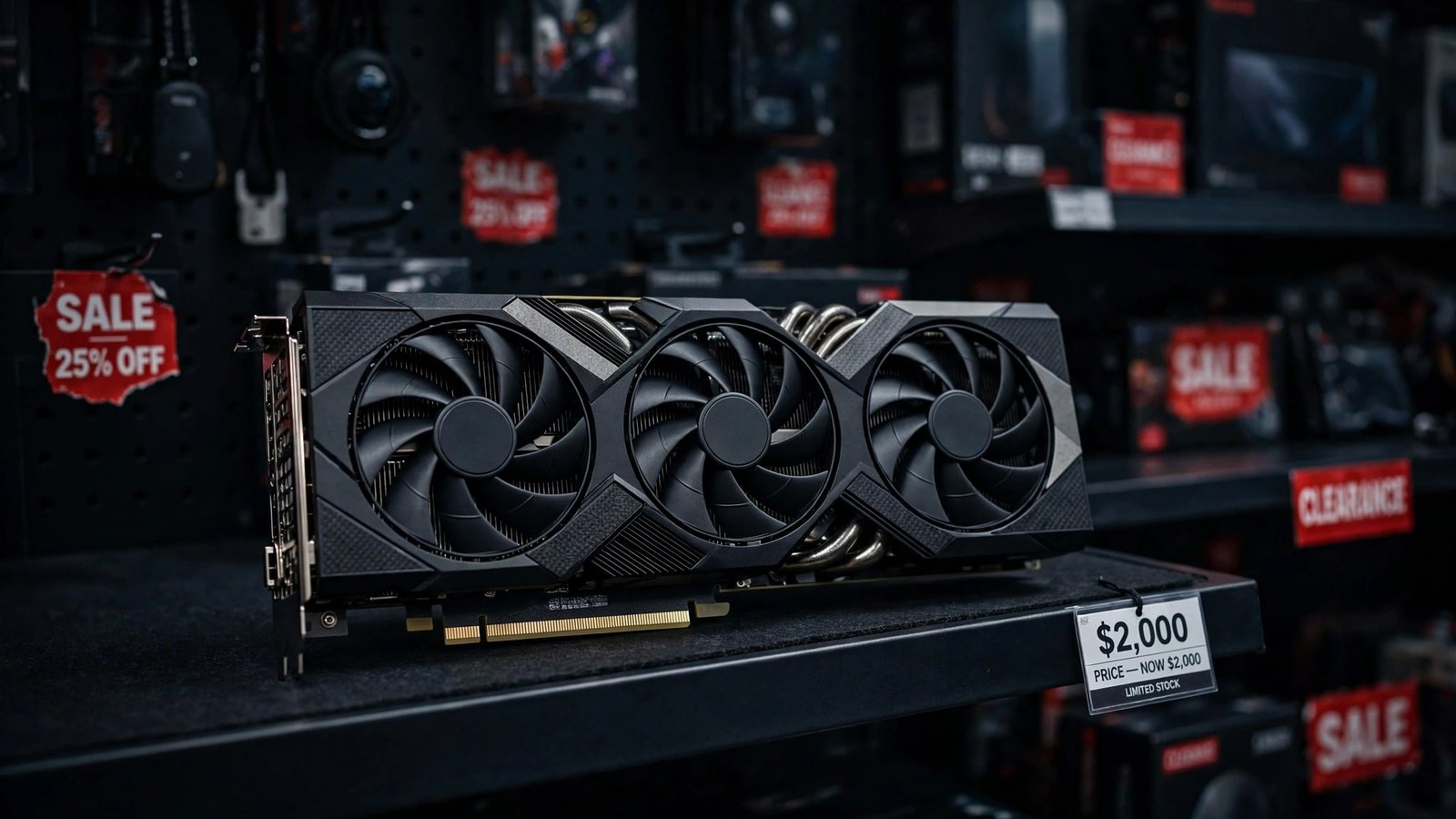
If you were hoping Black Friday 2026 would finally make graphics cards affordable again, here is the short answer: it probably won’t. The cheapest RTX 5080 in the United States now costs around $2,000 — double its $999 launch price — and the cheapest RTX 5090 hit $9,400 in October, a staggering 370% above its $1,999 launch price. Prices have climbed every month since August, manufacturers just announced another round of increases for November, and the memory shortage behind all of this is expected to last into 2027 and beyond. A Black Friday “deal” this year may do nothing more than cancel out the price rise that happened in November. This article lays out the real numbers, card by card, explains why prices are doing this, and gives you a clear buy-now-or-wait answer for every budget.
The numbers: what GPUs actually cost in November 2026
Every price in this section is dated, because in this market a price from last week is already history. The main source is TechSpot’s Q4 2026 GPU pricing update, published November 2, 2026. TechSpot tracks the cheapest in-stock model for each card across 10 countries — the US, Australia, Germany, the UK, Canada, India, the Philippines, Brazil, Poland, and the Netherlands — using price-comparison sites. These are floor prices, the cheapest card you could actually buy, usually a base model at a single retailer. The typical checkout price is often higher.
Here is the picture for the US, as of TechSpot’s October 2026 data (published November 2):
| Graphics card | Launch MSRP | Cheapest US price, Oct 2026 | Above MSRP (US) | Above MSRP (10-country avg) |
|---|---|---|---|---|
| RTX 5090 | $1,999 | $9,400 | 370% | 262% (~$7,240) |
| RTX 5080 | $999 | $2,200 | 120% | 77% |
| RTX 5070 Ti | $749 | $1,250 | 67% | Not reported |
| RTX 5070 | $549 | $900 | 64% | Not reported |
| RX 9070 XT | $599 | $870 | 45% | Not reported |
A few things jump out. First, the 5090 has effectively left the gaming market. Its 10-country average of roughly $7,240 is 262% above launch price, and the US floor of $9,400 jumped 36% in a single month, from $6,890 in September. Second, the 5080 is the card that hurts most people, because it has become Nvidia’s practical top gaming card by default. Its US floor rose 39% in one month, from $1,580 in September to $2,200 in October. Third, the pain is not limited to flagships. The RTX 5070 — a mid-range card that launched at $549 — now starts at $900 in the US.
Other trackers tell a similar story with slightly different numbers, which is normal when prices move daily. Tom’s Hardware’s GPU price tracker, last updated November 3, 2026, put the cheapest in-stock RTX 5080 at $1,999 and the RTX 5070 at $899. A VideoCardz survey on October 28 found the 5080 at $1,979.99 for in-store pickup at Micro Center and $1,999.99 online at Best Buy. How-To Geek, writing November 6, reported 5080 models ranging from $2,000 to nearly $2,900. So treat the 5080 as a roughly $2,000–$2,200 card right now, not a $999 card, and treat any single price as a snapshot that could be outdated by the time you read this.
How we got here: three months of steady climbs
This did not happen overnight, and it did not happen in one jump. Across all cards, TechSpot’s headline figure is that graphics cards now sell for an average of 44% above MSRP across the 10 countries it tracks, with the premium reaching 58% in the US and Canada. TechSpot’s data shows prices were fairly stable through the first half of 2026. Then the market turned:
- August 2026: prices rose about 15% in a single month.
- September 2026: prices rose another 7%.
- October 2026: prices rose roughly 11%.
Stack those together and you get about a 35% increase in three months. When a card costs 35% more than it did in July, a 20% Black Friday discount does not make it cheap — it makes it roughly what it cost in September, when it was already overpriced.
The 5090’s own timeline shows the acceleration. In February 2026, the cheapest US 5090 was $3,500 — already 75% above its $1,999 launch price. By September it was $6,890. By October it was $9,400. The 5080 followed a similar path: $1,400 in February, $1,580 in September, and $2,200 in October. The September-to-October jump alone — $620 in four weeks — is more than half the card’s original launch price.
And November is not shaping up to be a pause. On November 3, Wccftech reported that board partners had confirmed another round of factory price increases for the RTX 50 series, effective during November. According to the report, based on Chinese manufacturer Colorful’s published November pricing policy and channel sources, the increases are roughly $330–$550 on the RTX 5090D v2, $380–$450 on the RTX 5080, about $150 on the RTX 5070 Ti, $90–$135 on the RTX 5070, and about $30 on the RTX 5060 8GB. GALAX/KFA2 was also reported to be preparing similar increases. These are factory cost prices, not retail prices, and they were reported from Chinese sources — but factory costs are what retail prices are built on, and they typically reach US shelves within weeks.
Why memory is the real villain
Every explanation of this price spiral comes back to the same thing: memory. Graphics cards need GDDR memory, and the memory industry is in the middle of what analysts call a supercycle — a period where demand from AI data centers is soaking up so much of the world’s memory output that there is not enough left for consumer products, and prices for what remains keep climbing. The same shortage is hitting system RAM too: a 32GB DDR5 kit that cost far less a year ago is now pushing $450, so the pressure is not limited to graphics cards. Memory makers have limited factory capacity, and they are shifting it toward HBM, the stacked memory used in AI accelerators, because it sells at far higher margins than the GDDR7 on your graphics card. Less GDDR7 gets made, the GDDR7 that does get made costs more, and graphics card prices follow.
The people running these companies are not shy about it, either. Nvidia’s CFO said on the company’s late-August earnings call that memory prices had exceeded expectations and would be even higher next year. Nvidia CEO Jensen Huang has said he believes the memory shortage could last for several years. Micron said in late September that memory supply and demand will be tighter in 2027 and 2028 than in 2026. Some analysts now put the end of the shortage closer to 2030 than 2028.
One important nuance: TechSpot stresses that memory alone does not explain the full markup. The RTX 5080 carries 16GB of GDDR7, and TechSpot points out that 16GB of GDDR7 has not become $700 more expensive. Part of what you are paying is scarcity pricing — retailers and resellers charging what the market will bear because supply is thin. TechSpot’s verdict is blunt: prices have not peaked and are unlikely to return to MSRP during this generation.
Is the RTX 5090 actually discontinued?
You may have seen headlines saying Nvidia is ending RTX 5090 production. Here is what is actually confirmed and what is still rumor, because the distinction matters if you are deciding whether to buy one.
What is confirmed: Nvidia senior vice president Jeff Fisher addressed the rumors directly on October 16, 2026, telling Taiwanese reporters that the RTX 5090 “has not been discontinued, and NVIDIA will continue shipping,” while admitting the supply chain “is indeed somewhat constrained.” That is a denial with an admission attached — the card is not officially dead, but supply is tight, and Fisher gave no restock date and no shipment numbers.
What is also confirmed, from the retail side: the RTX 5090 disappeared from Nvidia’s own US store in mid-October, and the RTX 5080 followed on October 30, leaving the RTX 5070 Ti as the top card in Nvidia’s own catalog. The product pages still exist and still list the launch prices — $1,999 and $999 — but you cannot buy the cards there. Micro Center in the US has moved several RTX 5090 models from “out of stock” to “not carried,” a label retailers usually reserve for products that are not coming back.
What is still rumor: leaker MEGAsizeGPU claimed on October 10 that all future GB202 chips — the die inside the 5090 — would go to RTX Pro workstation cards instead of GeForce boards. Moore’s Law Is Dead claims a major retailer was told production of both the RTX 5090 and the 16GB RTX 5080 ends in the first half of January 2027. BenchLife reports Nvidia plans to launch a 24GB RTX 5080 in the first quarter of 2027 to replace the 16GB model. None of this has been confirmed by Nvidia, so treat it as rumor — but it is rumor that the retail market is behaving as if it believes.
TechSpot’s conclusion is blunt: the card “no longer exists for gamers.” And there is one more piece of the puzzle — reports from Notebookcheck and Tom’s Hardware in September 2026 say Nvidia’s next-generation RTX 60 series is now expected in 2028 rather than 2027. Nvidia has not officially announced the RTX 60 series, so this is also unconfirmed, but if the current generation has to last until 2028, that removes one more reason for prices to fall.
Why Black Friday won’t save you
Black Friday is the biggest shopping event of the year in the US, and every November the same question comes up: should I wait for the deals? In a normal year, waiting makes sense. This is not a normal year, and the math shows why. If an RTX 5080 costs $2,000 today and board partners raise costs by roughly $400 in November, the retail price in December is roughly $2,400. A 20% Black Friday discount on a $2,400 card brings it to $1,920 — barely below today’s price, and still nearly double the $999 launch price. You waited a month, watched prices rise, and ended up roughly where you started.
There are two more reasons to be skeptical of Black Friday GPU deals this year. First, the best “deals” are usually on cards retailers actually have in stock, and right now the cards with the deepest discounts tend to be the ones nobody wants at full price — older models or odd configurations. The cards everyone wants, the 5080 and 5070 Ti, are the ones with the thinnest stock and the least reason to discount. Second, a “discount” is measured against a reference price, and retailers set that reference price. A card listed at $2,600 with a $400 discount is still a $2,200 card. Check the price against the launch MSRP and against last month’s price, not against the crossed-out number on the listing.
Buy now or wait? The answer by budget
There is no single right answer to “should I buy a GPU now or wait?” It depends on your budget, what you need the card for, and how long you can hold out. Here is the honest breakdown, tier by tier, using the November 2026 prices above.
Under $500: wait, or buy used
There is no good new card in this price range right now. The RTX 5060 8GB, the cheapest current-generation Nvidia card, is itself climbing — up about $30 at the factory level in November. If your current card still runs your games, even at lower settings, wait. If it does not, the used market is your best option: a used RTX 4060, RTX 3070, or RX 6700 XT can be found in this range, and all three still handle 1080p gaming well.
$500–$1,000: the hardest tier
This is where the market is most painful. The RTX 5070 launched at $549 and now starts around $900. The RX 9070 XT launched at $599 and now starts around $870–$920. The 9070 XT is the better buy of the two at these prices — TechSpot’s benchmarks found it roughly 25% faster than the RTX 5070 on average, and it carries 16GB of VRAM against the 5070’s 12GB. If you can find a 9070 XT under $900, that is one of the least-bad deals in the current market. If you need Nvidia-specific features like DLSS 4 or CUDA for work, the 5070 at $900 is overpriced but functional — and if your work depends on CUDA, you do not have a real AMD alternative, which is exactly why Nvidia can charge what it charges.
$1,000–$1,500: buy the 5070 Ti if you must, but only at the right price
The RTX 5070 Ti is the card most people in this tier will end up considering. It launched at $749, TechSpot’s October floor was $1,250, and trackers in early November found it up to $1,719. At $1,250 it is expensive but defensible for 1440p and entry-level 4K gaming with 16GB of VRAM. At $1,700 it is not. Set a hard ceiling — $1,300 is a reasonable one — and do not chase the card above it. If prices stay above your ceiling, the 9070 XT at $900 saves you $400–$800 for performance that is close enough in most games.
$1,500–$2,500: the 5080 question
This is the tier where the most money is at stake and the worst value lives. The RTX 5080 launched at $999 and now costs $2,000–$2,200. How-To Geek’s Monica J. White, writing November 6, put it bluntly: she would sooner set $2,000 on fire than buy one, but Nvidia knows buyers do not have anywhere else to go. She is right on both counts. There is no AMD card that matches the 5080, so if you want this level of performance, Nvidia is your only option.
If you genuinely need a 5080 — for 4K high-refresh gaming, for AI work that needs the VRAM and CUDA, for professional rendering — then buy at $2,000 if you can find it there, because the November factory increases and the rumored January production cutoff both point upward, not downward. If you want one but do not need one, wait. A rumored 24GB RTX 5080 in early 2027 could reset this tier. Either way, do not pay $2,500 or more for a 16GB 5080. At that price you are paying flagship money for a card that launched as a $999 product.
Over $2,500: do not buy a 5090
At $9,400, the RTX 5090 is not a gaming purchase — it is a collector’s item or a business expense. For gaming, nothing justifies paying nearly five times the launch price. For professional AI work, the math is different, but even there you should be looking at workstation cards or cloud GPU rentals before spending $9,400 on a consumer card you cannot even buy from Nvidia’s own store.
Escape routes: used cards and previous-gen hardware
When new cards cost double their launch price, the used market starts to look sensible — and for once, the numbers back that up. A used-market tracker (Cresvament’s Used GPU Market Report) found the median used RTX 5080 at $2,000 on November 11, 2026. That is roughly the same as a new card, which tells you the used market for current-gen cards is just as inflated as the new market. The real value in used hardware is one generation back.
A used RTX 4080, RTX 4070 Ti Super, or RX 7900 XTX will handle 1440p and even 4K gaming well, and they sell for far less than a new 5080. A used RTX 3090 or 3090 Ti, with 24GB of VRAM, is a legitimate option if you need memory for AI work — just check the power supply requirements, because the 3090 is a 350W card and the 3090 Ti is 450W.
A few rules for buying used in this market. First, buy locally when you can, and test the card before you pay — run a game or a benchmark for at least 15 minutes and watch for crashes, artifacting, or fan noise. Second, be wary of cards that were used for crypto mining around the clock; a card that ran at full load for two years is not the same as a card that played games on weekends. Ask the seller directly, and treat a vague answer as a no. Third, check the warranty — some manufacturers’ warranties transfer to a second owner, and some do not. Fourth, remember that a used card has no return policy. If the price is only 10–15% below new, the new card’s warranty is worth the difference.
There is also the option that sounds like a joke but is not: do nothing. If your current card plays the games you actually play, even at medium settings, the best financial move in November 2026 is to keep it. GPU prices have risen 35% in three months, and every month you wait with a working card is a month you did not pay double the launch price for a mid-range product. Lower your settings, try upscaling, and revisit the market in early 2027.
What to do if you need a GPU this month
If waiting is not an option — your card died, or you need one for work — keep three rules in mind. First, write down your ceiling before you shop, based on the launch MSRP plus a markup you can live with, and do not raise it in the moment. Second, check at least two trackers before you buy: TechSpot’s full Q4 2026 update is at techspot.com, and Wccftech’s November 3 report on the factory increases is at wccftech.com. Third, compare any price against the launch MSRP, not the crossed-out list price — a $400 discount on a card that is $1,200 above MSRP is not a deal. And if you need a GPU for AI work rather than gaming, weigh cloud options before buying hardware at these prices: running models through a hosted AI service can be far cheaper than a $2,000 card if your usage is occasional. Our guide to creating a Claude AI account with a USA IP walks through getting started with one.
Frequently Asked Questions
How much does an RTX 5080 cost in November 2026?
The cheapest in-stock RTX 5080 in the US was $2,200 in TechSpot’s October 2026 data (published November 2), while Tom’s Hardware’s tracker, updated November 3, put the cheapest at $1,999. Expect to pay roughly $2,000–$2,200, about double the $999 launch price. Prices move daily, so check a live tracker before you buy.
How much does an RTX 5090 cost in November 2026?
The cheapest in-stock RTX 5090 in the US was $9,400 in TechSpot’s October 2026 data, up from $6,890 in September — a 36% jump in one month. The 10-country average is roughly $7,240. Some Newegg listings exceed $10,000. At these prices, the 5090 has effectively left the consumer gaming market.
Why are GPU prices so high in November 2026?
The main driver is a global memory shortage. AI data centers are buying HBM and DRAM faster than manufacturers can make it, so GDDR7 memory for graphics cards is scarce and expensive. Nvidia’s CFO has said memory prices will be even higher next year, and Micron expects supply to be tighter in 2027 and 2028. Scarcity pricing on top of the shortage explains the rest of the markup.
Is the RTX 5090 discontinued?
Nvidia officially denies it. Senior vice president Jeff Fisher said on October 16, 2026, that the RTX 5090 “has not been discontinued, and NVIDIA will continue shipping,” while admitting supply is constrained. But the card has vanished from Nvidia’s own US store, Micro Center has marked some models “not carried,” and leakers claim production ends in January 2027. Officially it is not discontinued; practically, it is almost impossible to buy at anything near its launch price.
Will GPU prices drop on Black Friday 2026?
Probably not in any meaningful way. Manufacturers raised factory prices in November — about $400 on the RTX 5080, $150 on the RTX 5070 Ti — so a Black Friday discount may only cancel out the November increase. A genuine deal is possible on specific models, but measure any discount against the card’s October price and its launch MSRP, not against the crossed-out list price.
Should I buy a GPU now or wait until 2027?
If your current card works, wait — prices have risen 35% in three months, and a rumored 24GB RTX 5080 in early 2027 could change the high end. If you must buy now, the RX 9070 XT around $870–$920 is the best value, and the RTX 5070 Ti is worth it only at $1,300 or less. Do not pay $2,500 or more for a 16GB RTX 5080, and do not buy a 5090 at current prices for gaming.