Etsy is living through an identity crisis, and sellers are caught in the middle. AI-generated listings have flooded search results for wall art, greeting cards, and home decor — and longtime handmade sellers are quitting. One watercolor seller closed her shop after eight years, reporting revenue down more than 60% as cheaper AI alternatives undercut her original work.
Etsy’s official position: AI-made products are allowed, but only with disclosure and genuine creative involvement. Here’s exactly what the 2026 rules require and how to stay compliant.
What Etsy’s policy actually says
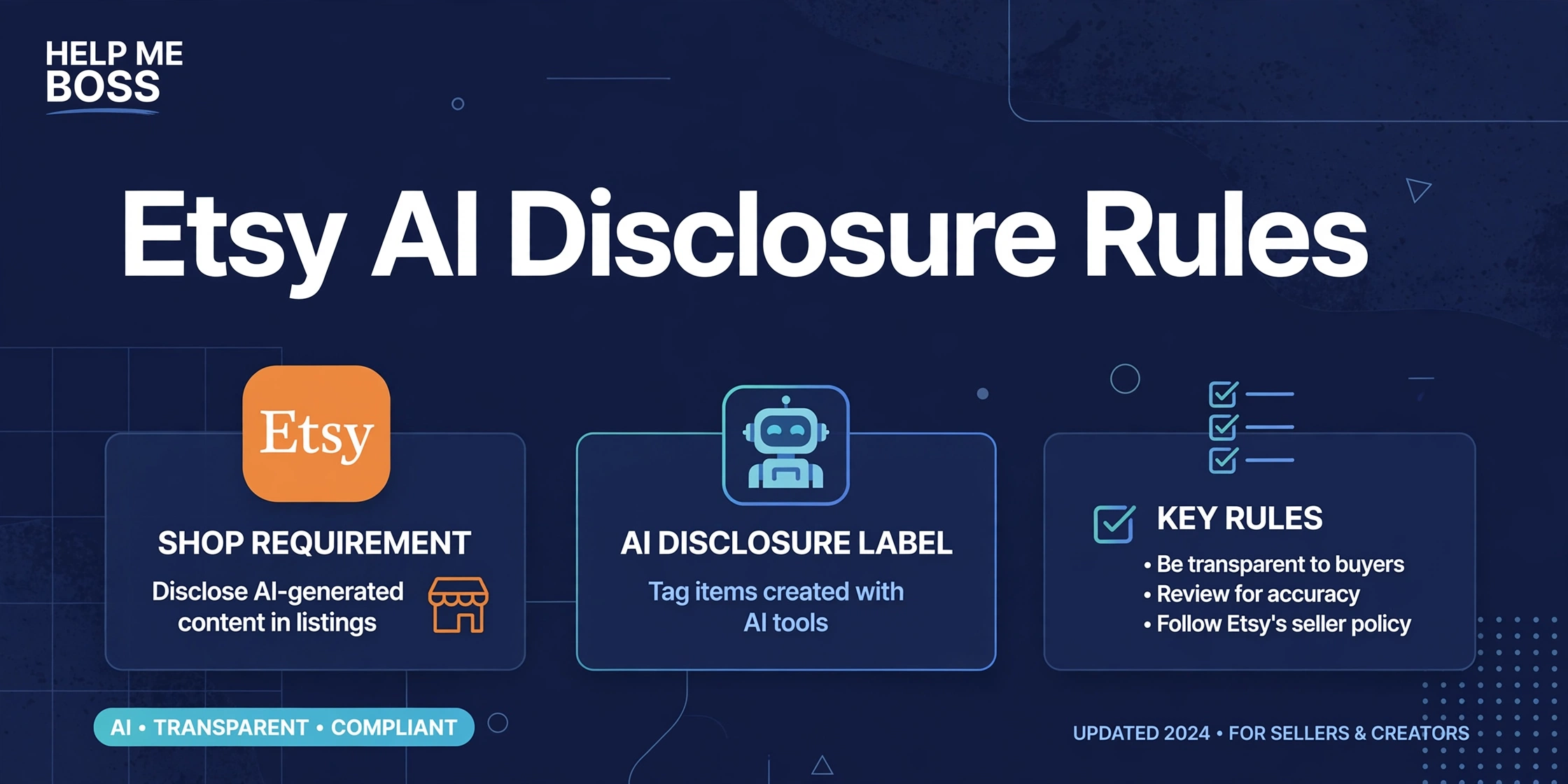
Etsy’s seller policy is direct: if an item is created through the use of artificial intelligence, you must disclose this in your listing. That’s the headline rule, and it applies to both physical and digital products.
The fuller framework, from Etsy’s seller handbook and policy pages:
- “Seller-prompted AI creations” are permitted. If you use your original prompts with AI tools to create artwork you sell, that’s allowed — Etsy explicitly gives examples like a fantasy scene from your original prompt or a custom AI-generated pet portrait.
- List it as “Designed by.” AI-assisted items belong under the “Designed by a seller” creativity standard — signaling to buyers that the item may involve generative AI, a production partner, or other digital tools.
- Disclose in the listing description. State plainly that AI was used in creating the item. Since a 2026 policy update, sellers report a dedicated AI disclosure checkbox in the listing flow — but the description disclosure remains the requirement.
- AI prompts can’t be sold as listings. Listings like “10,000 Midjourney Prompts” get flagged and removed. You’re selling the creative output, not the instructions.
- Machine output can’t be passed off as handmade. AI goods must not be presented as handmade or original human craft.
For listing images specifically: the first image must show the real item the buyer receives — not a rendering or stock photo — and sellers must disclose AI use in images too.
Why sellers are angry anyway
The policy looks reasonable on paper. The enforcement is where sellers lose faith:
- Disclosure is widely ignored. Sellers report that undisclosed AI listings dominate search in popular categories, and takedowns feel random.
- Visual similarity kills differentiation. When an AI print looks nearly identical to a hand-painted original at a tenth of the price, casual browsers can’t tell — and mostly don’t try.
- Etsy is doing fine financially. The company earned $2.8 billion in revenue last year, up 2.7%, which makes struggling sellers feel the platform has little incentive to tighten the screws.
Etsy’s VP of customer operations, James Ossman, has said sellers can use AI as a tool but can’t deceive buyers or copy others’ work, while acknowledging that enforcement at Etsy’s scale is complex. Meanwhile, rival marketplaces are emerging that ban AI-generated goods outright — a bet that “actually handmade” is a marketable differentiator.
How to comply (and stand out) as a seller
1. Disclose clearly in every AI-assisted listing. Don’t bury it — a simple line like “This design was created with AI assistance based on my original concept and finished by hand” satisfies the rule and builds trust. Buyers who care about process reward honesty.
2. Use the “Designed by” categorization. Make sure your creativity-standard settings reflect AI involvement. Mislabeling AI work as handmade is the fastest route to a policy strike.
3. Differentiate on what AI can’t fake. Process videos, work-in-progress shots, the story behind the piece, customization, and human finishing touches. The sellers surviving the flood aren’t competing with AI on price — they’re selling the human story AI can’t tell.
4. Keep your own records. Note which tools you used and your creative inputs for each listing. If a listing is ever flagged, you’ll want to show your creative role quickly.
5. Watch the listing-image rules. First image = the real finished item. AI mockups only in additional images. Watermarked images get excluded from Offsite Ads and filtered by Google Shopping — another reason to keep images clean.
If you’re building an Etsy business around digital products, read how to sell digital products on Etsy as a beginner and how to use AI for Etsy digital products — both written for this exact policy environment.
Copy-paste disclosure wording that actually works
Sellers overthink this. You don’t need legalese — you need one clear sentence in the listing description. Adapt any of these:
- Digital art: “This artwork was designed by me using AI image tools based on my original concept, then refined and finished by hand.”
- Physical product from AI design: “The design for this item was created with AI assistance from my original prompts; the finished piece is [handmade/printed/assembled] by me.”
- AI-assisted mockup images: “Product photos include AI-assisted mockups; the item you receive is the real finished piece shown in the first image.”
Place it near the top of the description, not buried at the bottom. Buyers who care will look for it; buyers who don’t will scroll past. Either way, you’re compliant.
One more tip: don’t apologize for using AI. “Sorry this is AI-made” reads as an admission of low value. Frame it as process transparency — “here’s how this was made” — the same way a woodworker lists their tools. Confidence in your process is part of the product.
Where to watch for policy changes
Etsy’s AI rules have moved twice in two years — the 2024 seller-policy update that permitted AI goods with disclosure, and the 2026 listing-flow update that added the disclosure checkbox. Expect more movement, not less. Three places to watch:
- The Etsy Seller Handbook — policy updates land here first, usually framed as seller guidance rather than announcements.
- Etsy’s legal policy pages — the seller policy’s AI clause is the binding text; handbook articles interpret it.
- Seller community reports — when enforcement waves hit (mass flagging, new checkbox requirements), sellers notice before Etsy announces. Treat sudden forum chatter about takedowns as an early warning to audit your own listings.
The sellers who get hurt by policy shifts are the ones who set up listings once and never revisit them. A quarterly 30-minute audit — disclosure present, categorization correct, images compliant — is cheap insurance against the next enforcement wave.
Official source: Etsy
Frequently Asked Questions
Can I sell AI-generated art on Etsy in 2026?
Yes — seller-prompted AI creations are permitted, but you must categorize the item as “Designed by” and disclose AI use in the listing description.
What happens if I don’t disclose AI use?
Etsy’s automated moderation flags and removes listings that skip disclosure. Repeat violations risk your shop standing.
Can I sell Midjourney or ChatGPT prompts on Etsy?
No. Etsy prohibits listings that sell AI prompts themselves. Sell the creative output, not the instructions.
Does using AI for mockups count as AI use?
If AI generated or altered the listing imagery, disclose it. Computer-generated mockups are allowed only in additional images — the first image must show the real item.
Is Etsy banning AI products?
No — and that isn’t on the table. Etsy’s stance is disclosure plus creative involvement, not prohibition. Sellers who want a no-AI marketplace are migrating to newer alternatives.
Do buyers actually care about AI disclosure?
Many don’t — plenty of shoppers happily buy AI prints. But the buyers who do care (Etsy’s core handmade audience) care intensely, and they’re the ones leaving negative reviews when they feel deceived.