
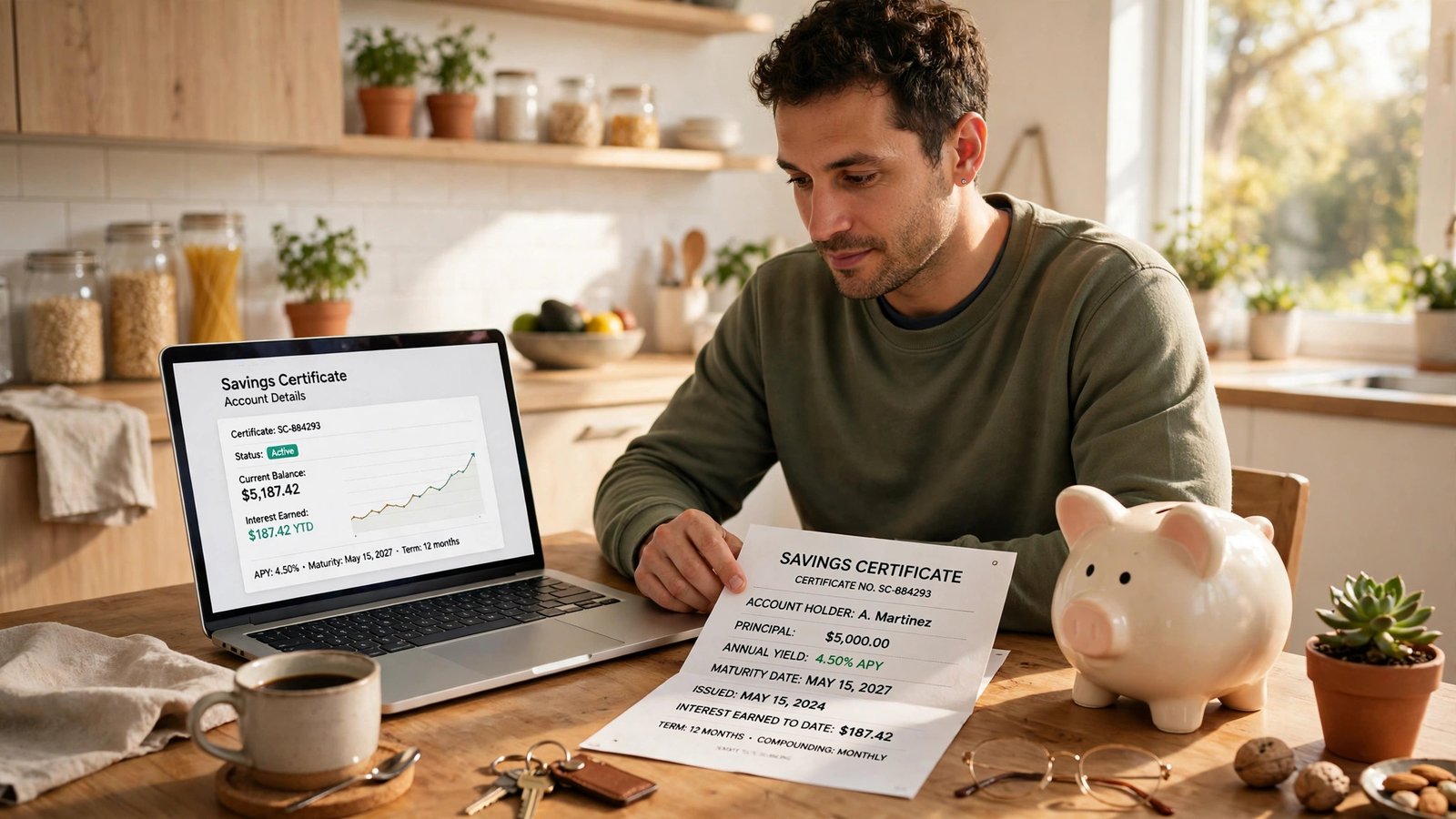
Lock now. That’s the short answer for most savers — but only just, and only if you pick the right CD. The best 1-year certificates of deposit pay 4.50% APY or better in November 2026, and the math shows waiting for the Federal Reserve’s December meeting only pays off if the Fed hikes and banks pass the full increase through to CD rates. If either of those things doesn’t happen, waiting costs you money. Below: the actual numbers, so you can decide on figures instead of a gut feeling.
What the Fed actually did on October 28, 2026
The Federal Open Market Committee (FOMC) held its benchmark federal funds rate at 3.75% to 4.00% on October 28, 2026, six weeks after raising it a quarter point in September — the first hike in nearly three years. The vote was 10–2, with Governor Lisa Cook and Cleveland Fed President Beth Hammack dissenting in favor of another immediate quarter-point increase. The market read the hold as a hawkish pause: CME FedWatch pricing put the odds of a quarter-point hike at the December 8–9 meeting at roughly 85% right after the decision, up from about 78% the day before, though by November 4 those odds had drifted down to roughly 77% as new data came in — a useful reminder that these odds move every day and are not a promise.
Why does this matter for CD rates? The Fed doesn’t set them — banks do. But the federal funds rate anchors the short-term rate environment: when it rises, competition pushes deposit rates up. A December hike would nudge banks to offer a bit more on new CDs, usually over the following weeks, and usually by less than the full quarter point.
The best CD rates in November 2026
Bankrate’s survey of more than 850 institutions, updated November 4, 2026, shows a wide gap between the best online CDs and the national average. The average 1-year CD pays just 2.11% APY. The best pay more than double that. Every rate below is from Bankrate’s November 4, 2026 update.
| Bank | Term | APY | Minimum deposit |
|---|---|---|---|
| E*TRADE from Morgan Stanley | 1 year | 4.55% | $0 |
| Barclays | 1 year | 4.50% | $0 |
| Quorum Federal Credit Union | 1 year | 4.50% | $100 |
| Synchrony Bank | 15 months | 4.50% | $0 |
| Marcus by Goldman Sachs | 1 year | 4.40% | $500 |
| Barclays | 2 years | 4.75% | $0 |
| Happen Bank | 2 years | 4.76% | $500 |
| Popular Direct | 3 years | 4.85% | $10,000 |
| Sallie Mae Bank | 5 years | 5.00% | $2,500 |
A few things jump out. First, the 1-year sweet spot is real: you can get 4.50% to 4.55% with no minimum at all, which means there’s no reason to accept the 2.11% national average or the near-zero rates still common at big brick-and-mortar banks. Second, longer terms pay only slightly more — the 5-year Sallie Mae CD at 5.00% is just 45 basis points above the best 1-year rate. That’s a thin reward for locking your money away for five years, and it’s the first clue that the smart play in November 2026 is short terms, not long ones. Always confirm the live rate on the bank’s own site before you move money — the numbers in this article are dated November 4, 2026, and they will change.
If you want the full, constantly updated list, Bankrate’s CD rates page is the most complete free source I found, and it’s the source for the table above.
The math: locking now vs. waiting for December
This is the question everyone is asking, so let’s answer it with arithmetic instead of vibes. I’ll use a $10,000 deposit and the best verified 1-year rate, 4.50% APY from Barclays, and I’ll compare the two strategies over the same 12-month window starting November 5, 2026.
Strategy A: lock now. You open a 1-year CD at 4.50% APY today. In 12 months you earn $450 in interest. Done. No decisions, no watching the Fed, no risk that rates move against you.
Strategy B: wait for December, then lock. You park the $10,000 in a top high-yield savings account while you wait, then lock a 1-year CD after the December 8–9 Fed meeting. The wait is about five weeks, and the best high-yield savings accounts pay 4.35% APY right now (CIT Bank Platinum Savings, $5,000 minimum balance, per Bankrate’s November 4, 2026 update). The five-week wait earns $10,000 × 4.35% × 35 days ÷ 365 = $41.71.
Then you lock the CD. What rate you get depends entirely on what the Fed does and how banks respond:
- If the Fed hikes 25 basis points and banks pass it through fully, the 1-year CD rate rises to about 4.75%. Over the remaining 330 days of the year: $10,000 × 4.75% × 330 ÷ 365 = $429.45. Total interest for the year: $41.71 + $429.45 = $471.16. Waiting wins by $21.16 per $10,000.
- If the Fed hikes but banks pass through only 10 basis points, the 1-year CD lands around 4.60%. Remaining-year interest: $10,000 × 4.60% × 330 ÷ 365 = $415.89. Total: $457.60. Waiting wins by $7.60.
- If the Fed holds and CD rates stay flat at 4.50%, the remaining-year interest is $10,000 × 4.50% × 330 ÷ 365 = $406.85. Total: $448.56. Waiting loses by $1.44.
- If the Fed holds and banks quietly trim CD rates — which happens when the market decides no more hikes are coming — you could lock at 4.25% or lower, and waiting costs you $20 or more.
The break-even point is precise: waiting beats locking now only if the 1-year CD you can buy after December pays more than 4.52% APY, assuming you park the money at 4.35% while you wait. But notice how small the stakes are either way. On $10,000, the difference between the best and worst realistic outcomes is roughly $25. On $50,000, it’s about $125.
The one scenario where waiting genuinely hurts is the one nobody talks about: you wait, the Fed holds, and you forget to actually lock the CD in December. Your money sits in a savings account that can cut its rate at any time, and six months later you’re earning 3.50% instead of 4.50%. The cost of indecision is far bigger than the cost of picking the “wrong” side of a 25-basis-point coin flip.
When waiting wins — and when it backfires
Waiting makes sense in exactly two situations. First, if the money is currently earning a competitive rate anyway. Parking $10,000 at 4.35% in a top savings account while you wait costs you almost nothing — the gap between 4.35% and 4.50% over five weeks is about $1.44. If your money sits in a big-bank account paying 0.01%, waiting loses roughly $8.60 a week per $10,000.
Second, waiting makes sense if you genuinely need the flexibility. If there’s a real chance you’ll need this cash before next November, don’t lock it at all — keep it in a high-yield savings account.
Waiting backfires when the money is parked somewhere lazy, when you don’t have a firm date to act (mark December 10 on your calendar — the day after the Fed meeting ends), or when you convince yourself that a December hike is a sure thing. At roughly 77% to 85% odds, it’s likely, not certain. And even if the hike happens, banks are under no obligation to raise CD rates by the full amount — deposit rates historically rise more slowly than the Fed’s rate, as banks pocket some of the spread.
My rule of thumb: if the cash is already in a high-yield account paying 4.25% or better, and you will actually check rates on December 10, waiting is a reasonable, low-cost bet. If either condition fails, lock the 4.50% now and move on with your life.
The CD ladder that removes the guesswork
If the lock-now-versus-wait question is giving you a headache, there’s a third option that makes it mostly irrelevant: build a CD ladder. Split your deposit across several terms instead of betting it all on one term and one moment. Every time a rung matures, you reinvest it at whatever the best rate is then — so you automatically capture higher rates if the Fed hikes, and you’re never fully locked out if rates fall. Here’s a four-rung ladder using verified November 4, 2026 rates, built on a $20,000 deposit:
| Rung | Amount | Term | Bank | APY | Interest in year 1 |
|---|---|---|---|---|---|
| 1 | $5,000 | 1 year | Barclays | 4.50% | $225.00 |
| 2 | $5,000 | 2 years | Barclays | 4.75% | $237.50 |
| 3 | $5,000 | 3 years | Popular Direct | 4.85% | $242.50 |
| 4 | $5,000 | 5 years | Sallie Mae | 5.00% | $250.00 |
| Total | $20,000 | 4.78% blended | $955.00 |
The blended first-year yield is 4.78% — higher than any single 1-year CD — and a quarter of your money comes back every year or two for reinvestment at new rates. If the Fed hikes in December, your 1-year rung matures in November 2027 and you roll it into the new top rate. If rates fall, three-quarters of your money is already locked at today’s rates.
Note the minimums: the Popular Direct 3-year CD requires $10,000, so for a $20,000 ladder you’d put $10,000 in that rung and adjust the others. Check minimums before you build the ladder, not after.
What breaking a CD early actually costs
The biggest risk of locking a CD isn’t picking the wrong rate. It’s needing the money back early. Every CD charges an early-withdrawal penalty, measured in days of interest — not a flat fee — so the cost scales with your balance and your rate. Federal rules set a floor (at least seven days’ simple interest if you withdraw within the first six days) but no ceiling, so each bank writes its own schedule. Here’s what major banks charge, based on published schedules checked in late October and early November 2026:
| Bank | 1-year CD penalty | 3-year CD penalty | 5-year CD penalty |
|---|---|---|---|
| Barclays | 90 days of interest | 180 days of interest | 180 days of interest |
| Marcus by Goldman Sachs | 90 days of interest | 180 days of interest | 180 days of interest |
| Ally Bank | 60 days of interest | 90 days of interest | 150 days of interest |
| Capital One | 90 days (3 months) | 180 days (6 months) | 180 days (6 months) |
| Bread Savings | 180 days of interest | 180 days of interest | 365 days of interest |
| Bank of America | 180 days of interest | 180 days of interest | 365 days of interest |
On a $10,000 CD at 4.50% APY, here’s what those penalties mean in dollars (simple interest: $10,000 × 4.50% ÷ 365 = $1.23 per day):
| Penalty | Cost on $10,000 at 4.50% |
|---|---|
| 60 days of interest | $73.97 |
| 90 days of interest | $110.96 |
| 180 days of interest | $221.92 |
| 365 days of interest | $450.00 |
Two things worth noticing. First, a 365-day penalty on a 5-year CD wipes out an entire year of interest — which is why the 5.00% Sallie Mae rate is less attractive than it looks if there’s any chance you’ll need the money. Second, Barclays stands out: just 90 days of interest on terms up to two years, which makes its 4.50% 1-year and 4.75% 2-year CDs unusually forgiving. When two CDs pay the same rate, always pick the one with the lighter penalty.
And remember the grace period: when a CD matures, you typically get about 10 days to withdraw or reinvest before the bank automatically renews it — often at a much lower rate. Set a calendar reminder for every maturity date.
If you think there’s a real chance you’ll need the money, consider a no-penalty CD instead. These typically pay a bit less — competitive no-penalty CDs were advertising roughly 3.75% to 4.34% APY in mid-2026 — but you can withdraw the full balance after a short waiting period (usually seven days) with no penalty at all. For emergency-fund money, that trade is usually worth it.
After tax, the winner might surprise you
Headline APY isn’t what lands in your pocket. CD interest is taxed as ordinary income at both the federal and state level, and the same is true of high-yield savings accounts and money market funds. Treasury bills are different: their interest is exempt from state and local income tax, which changes the ranking for anyone living in a state with an income tax. Here’s the comparison for a $10,000 deposit, using verified November 2026 rates and an example tax situation — 22% federal bracket and 5% state income tax.
| Option | Headline rate | After-tax yield | After-tax interest on $10,000 |
|---|---|---|---|
| 52-week T-bill | 4.496% | 3.51% | $351 |
| 1-year CD (Barclays) | 4.50% | 3.29% | $329 |
| 26-week T-bill | 4.298% | 3.35% | $335 |
| High-yield savings (CIT Bank) | 4.35% | 3.18% | $318 |
| Vanguard Federal Money Market Fund (VMFXX) | 3.89% | 2.97% | $297 |
The T-bill wins after tax despite a slightly lower headline rate than the CD, because the state tax exemption is worth about 22 basis points at a 5% state rate. In a high-tax state like California (9.3% top marginal rate) or New York, the T-bill’s advantage grows; in a no-income-tax state like Florida or Texas, the CD wins outright. Our guide to Treasury bills as after-tax passive income walks through the state-tax math in more detail.
A few details to get right: T-bill rates are the investment rate from the latest auction for each term — 4.496% for the 52-week bill auctioned October 27, 2026, and 4.298% for the 26-week bill auctioned November 2, 2026. You buy them through TreasuryDirect in $100 increments, and you lock the rate at auction rather than earning a floating rate. The money market fund’s 3.89% is a 7-day SEC yield, which moves daily — a snapshot, not a promise like a CD’s fixed APY. And the 22%/5% tax example is just that, an example: your own bracket changes the gaps.
How to lock a CD in November 2026
If you’ve decided to lock, it takes about 15 minutes:
- Confirm the money is truly spare. Only lock cash you won’t need before the term ends. Emergency fund money belongs in a high-yield savings account, not a CD.
- Pick your term first, then your bank. In November 2026, the 1-year term is the sweet spot — the best rate with the least commitment. Two years is reasonable if you like Barclays’ 4.75% and its light 90-day penalty. Five years is hard to justify for 50 extra basis points.
- Check the live rate on the bank’s own website. Rates in this article are dated November 4, 2026. Banks change them without notice, and the rate you see when you apply is the rate you get.
- Read the early-withdrawal penalty before you fund the account. It’s in the deposit agreement, usually under “early withdrawal” or “penalties.” As the table above shows, the same 4.50% rate can come with a $111 penalty or a $222 penalty depending on the bank.
- Fund it and set a maturity reminder. Most online banks let you fund by ACH transfer, which takes one to three business days. Put the maturity date in your calendar the same day, with a reminder a week before.
- Confirm FDIC or NCUA insurance. Every bank in the rate table above is FDIC-insured (or NCUA-insured for the credit union), which protects your deposit up to $250,000 per depositor, per bank.
Who should lock now, and who should wait
Here’s the decision in plain terms:
Lock now if: your cash is sitting in a low-rate account; you want certainty and don’t want to watch Fed meetings; you have $10,000 or more and want to build a ladder; or you know you won’t check rates again on December 10. A 4.50% 1-year CD with no minimum and a 90-day penalty is a good deal — the national average is 2.11%.
Wait until December if: your money is already earning 4.25% or better in a top savings account; you have a firm plan to check rates on December 10 and act the same day; and you accept that the likely payoff is $10 to $25 per $10,000 if the Fed hikes and banks pass it through.
Do neither — keep it flexible — if: you might need the money within a year, in which case a high-yield savings account or a no-penalty CD is the right home for it. Our guide to high-yield savings accounts for gig workers covers the best flexible options, and the Fed’s next moves matter for those rates too — see our earlier piece on the Fed’s next rate hike and freelancer money moves for the broader picture.
One last thought: the debate about locking now versus waiting for December is a debate about roughly $20 per $10,000. The decision that actually moves the needle is the one most savers never make: moving money out of a 0.01% big-bank savings account into anything paying over 4%. On $10,000, that’s the difference between $1 a year and $450 a year. Lock the rate, build the ladder, set the maturity reminder — and then stop checking rates every day.
This article is for general information only and is not professional financial advice. Rates change frequently — verify current rates, terms, and penalties directly with each bank before opening an account.
Frequently Asked Questions
Should I lock in a CD now or wait for the December Fed meeting?
Lock now if your money is earning less than about 4.25% today, or if you won’t reliably check rates on December 10. Waiting only pays if the Fed hikes in December and banks pass the increase through to CD rates — our math shows you’d gain about $21 per $10,000 in the best case, and lose about $1.44 if rates stay flat. The break-even post-December 1-year CD rate is 4.52% APY.
What is the best CD rate in November 2026?
As of November 4, 2026, the best verified 1-year CD rates are E*TRADE at 4.55% APY and Barclays at 4.50% APY, both with no minimum deposit. The best longer terms are Barclays’ 2-year CD at 4.75%, Popular Direct’s 3-year CD at 4.85% ($10,000 minimum), and Sallie Mae’s 5-year CD at 5.00% ($2,500 minimum). The national average 1-year CD pays just 2.11% APY, per Bankrate’s November 4, 2026 survey.
Will CD rates go up if the Fed hikes in December 2026?
Probably, but by less than the full hike and not immediately. Markets price roughly a 77% to 85% chance of a quarter-point hike at the December 8–9 meeting, but banks pass through only part of any increase, and usually over several weeks. A December hike would most likely lift top 1-year CD rates by 10 to 25 basis points, not the full 25.
What happens if I need my money before a CD matures?
You’ll pay an early-withdrawal penalty, measured in days of interest — typically 90 days on a 1-year CD and 180 to 365 days on longer terms. On a $10,000 CD at 4.50%, a 90-day penalty costs about $111, and it can eat into your principal if you haven’t earned that much interest yet. Check the penalty schedule before you open the account.
Are Treasury bills better than CDs after tax?
Often, yes, if you pay state income tax. T-bill interest is exempt from state and local tax, while CD interest is fully taxable. At a 22% federal and 5% state tax rate, a 52-week T-bill at 4.496% keeps about $351 per $10,000 after tax, versus about $329 for a 4.50% CD. In a state with no income tax, the CD wins. T-bills require buying at auction through TreasuryDirect or a brokerage, and you can’t withdraw early without selling on the secondary market.
Is my money safe in an online bank CD?
Yes, as long as the bank is FDIC-insured (or the credit union is NCUA-insured), your deposit is protected up to $250,000 per depositor, per bank — the same protection as a big brick-and-mortar bank. You can verify any bank’s status on the FDIC’s BankFind tool before opening an account.