
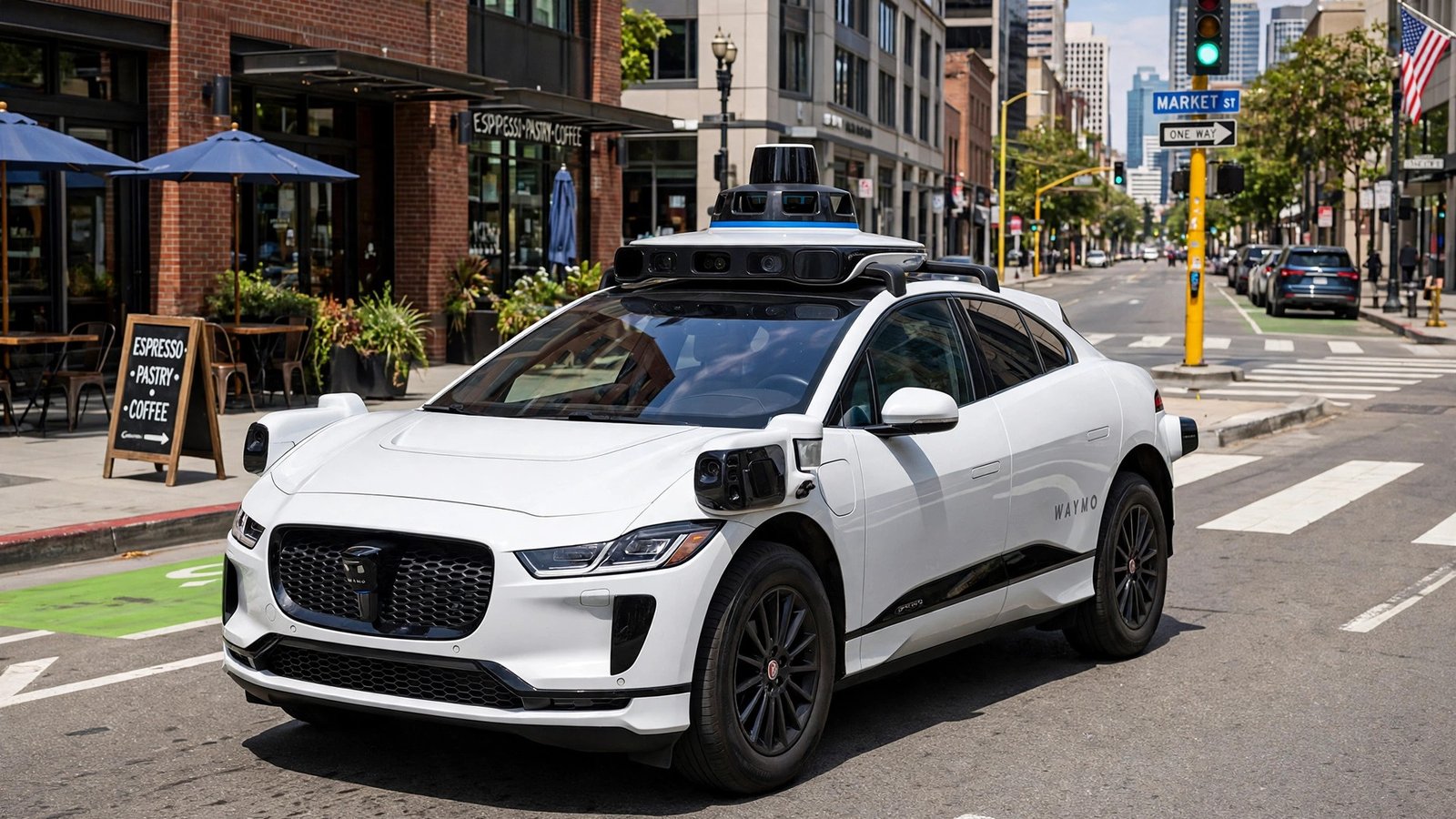
Waymo now runs fully driverless rides in 15 American cities. That sentence would have been the whole story a month ago. Then, on November 17, the news broke that Waymo had suspended driverless freeway rides nationwide — and suddenly the question isn’t just where you can catch a robotaxi, but what kind of trip you can actually take in one.
If you’ve seen the viral posts claiming Waymo “just launched in three new cities” in mid-November, those posts are wrong. The launches they describe happened on September 1. A November 14 article update misdated them, and the error spread fast. Here’s the corrected timeline, the complete 15-city list, and an honest look at what the freeway pause changes for riders.
Here’s the short version: surface-street robotaxi service is running normally in all 15 cities as of November 25, 2026. Freeway rides are paused everywhere while Waymo works through a safety problem that California regulators flagged. No injuries or collisions were involved in the recent incidents. And if you live in one of the 15 cities, you can probably book a ride today — though in two of them, you’ll need an invite first.
The Freeway Suspension: What Actually Happened
On November 17, 2026, news broke that the California Department of Motor Vehicles had issued an operational restriction against Waymo’s driverless freeway operations. The DMV’s order was dated November 11, but it only became public six days later.
The trigger was two incidents in early November. On November 5, three Waymo vehicles entered an active construction closure on US Route 101 near Burlingame, California. The next day, November 6, a Waymo vehicle tried to pass California Highway Patrol vehicles that were running a traffic break on Interstate 280 in San Francisco. A traffic break is when patrol cars slow and weave across lanes to hold traffic back; driving past them is not something any driver — human or software — is supposed to do.
The DMV’s language was blunt. It called driverless freeway operations an “imminent hazard to public safety,” pointing to recurring incursions into active construction zones despite a prior restriction and corrective actions Waymo had already taken after similar incidents on May 18, 2026.
This was not Waymo’s first freeway problem. The company began offering driverless rides on California freeways in November 2025. After the May 2026 construction-zone incidents, it voluntarily paused freeway service, then recalled 3,800 vehicles in June. Service phased back starting in July, beginning in Phoenix, before expanding again.
Waymo complied with the new restriction and went further than the DMV required. Rather than limiting the pause to California, the company voluntarily restricted freeway operations in all of its markets nationwide — including Phoenix, Austin, and Miami — while it evaluates its performance on freeways. Surface-street service continues in all 15 cities. Freeway testing continues, but only with trained autonomous specialists behind the wheel, ready to take over.
No injuries or collisions occurred in the recent incidents, according to Waymo spokesperson Dana Gallagher. And there is no restart date. The restriction stays in place until Waymo demonstrates effective corrective actions to the DMV’s satisfaction.
For the full reporting on the order, see TechCrunch’s coverage of the suspension and Al Jazeera’s report on the nationwide pause.
What the Freeway Pause Actually Changes for Riders
The honest answer: less than the headlines suggest, but more than nothing. Here’s how it breaks down in practice.
Most Waymo trips are short city rides. If you’re going from your apartment to dinner, from a hotel to a downtown office, or across town to meet friends, your ride almost certainly stays on surface streets. Those trips are unaffected. You open the app, a car shows up with no driver, and you ride. Nothing about that has changed.
Where it does matter is the longer, faster trips. Airport runs are the big one. In several cities, the quickest route to the airport runs on a freeway, and Waymo may now route you on surface streets instead — or decline the trip if no surface-street route makes sense. That can mean a longer ride, a higher fare, or a pickup that simply isn’t offered for that destination right now. If you’re catching a flight, check the app well before you need to leave, and keep a backup ride-hailing option in mind.
The same logic applies to cross-town trips that would normally jump on a highway to save twenty minutes. Your Waymo will take the slower road, or it won’t take the trip at all. In compact service areas, you’ll barely notice. In sprawling metros like Los Angeles or Dallas, where the freeway is often the only sane way across town, you’ll notice more.
There’s also a subtle point about trust. Waymo’s safety record is genuinely strong — the company has reported 271.3 million rider-only miles through June 2026, and its published safety data shows lower crash rates than human drivers on comparable streets. But construction zones have now tripped it up three times in six months: May, June’s recall, and now November. That’s a pattern, not a fluke, and it’s the specific pattern the DMV called out. The freeway pause is Waymo’s chance to fix it properly instead of patching it and hoping.
The suspension has not ended: as of November 25, 2026, there is no announced restart date.
All 15 Cities Where You Can Ride a Waymo
Here is the complete list, as of November 25, 2026. Thirteen cities are open to anyone. Two — Denver and Las Vegas — are still invite-based, adding riders gradually. A city being live does not mean every address is served; each city has a defined service area, so check the app for the map before you plan around it.
| City | Booking app | Public since | Status |
|---|---|---|---|
| Phoenix, AZ | Waymo app | 2020 (first city) | Open to all |
| San Francisco Bay Area, CA | Waymo app | 2023 | Open to all |
| Los Angeles, CA | Waymo app | 2024 | Open to all |
| Austin, TX | Uber app | March 2025 | Open to all |
| Atlanta, GA | Uber app | June 2025 | Open to all |
| Miami, FL | Waymo app | January 22, 2026 | Open to all |
| Dallas, TX | Waymo app | February 24, 2026 | Open to all |
| Houston, TX | Waymo app | February 24, 2026 | Open to all |
| San Antonio, TX | Waymo app | February 24, 2026 | Open to all |
| Orlando, FL | Waymo app | February 24, 2026 | Open to all |
| Nashville, TN | Waymo app + Lyft | April 2026 | Open to all |
| Tampa, FL | Waymo app | September 1, 2026 | Open to all |
| San Diego, CA | Waymo app | September 1, 2026 | Open to all |
| Denver, CO | Waymo app | September 1, 2026 | Invite-based |
| Las Vegas, NV | Waymo app | September 14, 2026 | Invite-based |
A few things in that table deserve a closer look.
First, the booking split. In Atlanta and Austin, you don’t use the Waymo app at all — you book through Uber, and a Waymo may show up as your ride. (If you also drive for a rideshare or delivery app, our DoorDash vs Uber Eats driver pay breakdown for 2026 shows how the pay compares, and our Amazon Flex driver pay breakdown for 2026 covers block pay versus net for delivery drivers.) Nashville is the interesting one: it launched in April 2026 as the first city where you can dispatch a Waymo through both the Waymo app and a ride-hailing partner, Lyft. Everywhere else, it’s the Waymo app directly. For a broader city-by-city tracker, RoboTaxiReport’s robotaxi cities page keeps a running tally.
Second, the Texas cluster. Dallas, Houston, San Antonio, and Orlando all opened to first riders on February 24, 2026, taking Waymo from six metros to ten, with weekly paid trips passing 400,000 around the same time. By September 2026, the company was reporting more than 500,000 paid rides per week.
Third, the airport detail. Waymo has been expanding airport service city by city, and on October 14 the company removed waitlists in San Antonio, San Diego, and Tampa — including rides at San Antonio International Airport. But not every airport is covered. Los Angeles International Airport (LAX) still has no Waymo pickup as of late November 2026.
The Corrected 2026 Expansion Timeline
Because the misdated “three new cities in November” posts caused real confusion, here’s the actual sequence of Waymo’s 2026 expansion, in order.
January 22, 2026 — Miami opens. Waymo’s first new metro of the year, and its first in South Florida — a dense, year-round market with heavy tourist traffic and a very different driving environment from Phoenix or San Francisco.
February 24, 2026 — Four cities at once. Dallas, Houston, San Antonio, and Orlando all opened to first riders on the same day — the biggest single expansion day in Waymo’s history, taking the network to 10 metros and pushing weekly trips past 400,000. Texas became the company’s biggest state footprint overnight.
April 2026 — Nashville goes live. Nashville launched on both the Waymo app and Lyft — the first city to dispatch through its own app and a ride-hailing partner from day one. That dual-channel model lets Waymo reach riders who never download its app, and it’s a template other cities may follow.
September 1, 2026 — Denver, San Diego, and Tampa launch. Three paid launches on the same day, with service areas of 59 square miles in Denver, 47 in San Diego, and 44 in Tampa. Denver and Las Vegas (which followed two weeks later) remain invite-based, adding riders gradually. San Diego and Tampa opened to everyone.
September 14, 2026 — Las Vegas takes its first public riders. The Strip city joined the network, invite-based for now, with the obvious appeal of a 24-hour tourist market where a lot of trips are short, predictable hops between hotels and casinos.
October 14, 2026 — Waitlists removed in three cities. San Antonio, San Diego, and Tampa dropped their waitlists entirely, opening to anyone with the app. San Antonio’s change included rides at the city’s international airport.
October 27 to November 3, 2026 — The big service-area push. In about a week, Waymo added roughly 250 square miles across five metros. Los Angeles expanded into the South Bay — Torrance, El Segundo, and Manhattan Beach. Nashville pushed south toward the zoo. Orlando nearly doubled its coverage to the east. San Diego added La Jolla. And the San Francisco Bay Area added a new BART link at Berryessa Station, connecting robotaxi rides to the region’s rail network. This is the expansion that actually happened in late October and early November — not new cities, but much bigger maps inside cities Waymo already served.
November 11–17, 2026 — The freeway restriction. The DMV issued its operational restriction on November 11, it became public on November 17, and Waymo extended the pause nationwide. No new cities launched in November. The viral posts were wrong.
Waymo vs. Tesla Robotaxi: The City-by-City Scoreboard
Waymo isn’t the only robotaxi game in town anymore. Tesla’s Robotaxi service runs in eight cities as of late November 2026: Austin, Dallas, Houston, Miami, Orlando, San Antonio, Tampa, and Fort Worth. Fort Worth joined on November 2, and San Antonio on November 9.
Here’s how the two stack up:
Waymo leads on breadth. Fifteen cities to Tesla’s eight. Waymo is the only service in Phoenix, San Francisco, Los Angeles, Atlanta, Nashville, San Diego, Denver, and Las Vegas. If you live in any of those eight, Tesla Robotaxi isn’t an option yet.
Tesla leads on Texas density. Every Tesla city except Fort Worth overlaps with a Waymo city, and Tesla has now covered the big Texas triangle — Austin, Dallas, Houston, San Antonio, Fort Worth — plus the Florida pair of Miami, Orlando, and Tampa. In those overlapping cities, riders can actually compare the two services on the same trip, which is new. A year ago, that comparison barely existed anywhere.
The overlap cities are where it gets interesting. In Austin, Dallas, Houston, Miami, Orlando, San Antonio, and Tampa, both services operate. That means real competition on price, wait times, and ride quality for the first time. Early rider reports suggest Waymo tends to be pricier than Uber on the same route, while Tesla has positioned its fares competitively — but prices shift with demand, so check both apps before you ride.
The approaches are different, and it shows. Waymo runs sensor-heavy vehicles — mostly Jaguar I-PACE SUVs with lidar, radar, and cameras — and expands city by city with detailed maps. Tesla runs its own vehicles with a camera-only approach and has expanded faster in raw city count this fall. Waymo’s caution is visible in its invite-based rollouts in Denver and Las Vegas; Tesla’s speed is visible in adding two Texas cities in a single week in November.
Safety records aren’t directly comparable yet. Waymo publishes detailed safety data — 271.3 million rider-only miles through June 2026 — and its crash-rate comparisons against human drivers. Tesla has not published equivalent mileage or safety data for its Robotaxi service. That doesn’t mean one is safer than the other; it means only one of them has shown its work in public so far.
For riders, the practical takeaway is simple: if you live in a Waymo-only city, Waymo is your robotaxi. If you live in an overlap city, you now have a genuine choice — try both on the same route and see which one fits your trip better.
First-Rider Checklist: How to Actually Catch a Waymo
If you’ve never ridden in a driverless car, the first trip feels stranger than you’d expect — and then, about two minutes in, surprisingly normal. Here’s how to make it go smoothly.
1. Check the service map first. A city being live does not mean your exact pickup or destination is covered. Open the Waymo app (or Uber in Atlanta and Austin, or Lyft in Nashville), enter your destination, and see whether the app offers a Waymo — before you need the ride, not when you’re standing on a curb with luggage.
2. Know which app to use. Waymo app everywhere except Atlanta and Austin (Uber) and Nashville (Waymo app or Lyft). If you’re visiting Atlanta and open the Waymo app expecting a car, you’ll wait forever. This is the single most common first-timer mistake.
3. Join the waitlist in Denver and Las Vegas. Both cities are still invite-based. Download the app, join the waitlist, and you’ll be added as capacity opens up. There’s no published timeline for when either city goes fully open, so joining early is the only move.
4. Plan airport trips carefully right now. With the freeway pause in effect, airport runs may route on surface streets or may not be offered for some destinations. San Antonio International Airport is covered. LAX is not — no Waymo pickup there at all. Check the app for your specific airport before you rely on it, and have a backup plan for flights.
5. Expect a slightly different pickup. Waymo cars pull to the curb. You unlock the doors from the app, and the handles pop out. Inside, there’s a touchscreen where you tap to start the ride. To get out, pull the interior door handle twice — the first pull unlocks, the second opens.
6. Don’t touch the wheel or pedals. The car will tell you this when you get in. There’s no driver to chat with, which some riders love and others find odd. You can play your own music through the car’s speakers, and the ride is usually quiet — which, after a long day, plenty of people prefer to small talk.
7. Keep perspective on the freeway pause. If your trip is a cross-town surface-street ride, nothing has changed. If it’s a highway trip, expect a slower route or an unavailable ride until the restriction lifts. The pause is a safety fix in progress, not a shutdown, and the cars are still running every day in all 15 cities.
What’s Next: The “Up Next” List
Waymo’s pipeline is crowded. Cities named as planned — not live, not bookable — include New York, Washington DC, Chicago, Boston, and Seattle, plus London and Tokyo internationally, with a second wave of Baltimore, Charlotte, Detroit, Minneapolis, New Orleans, Philadelphia, Pittsburgh, Portland, Sacramento, and St. Louis.
Two notes of caution. First, Washington DC is on hold until at least 2028, so don’t expect robotaxis on the National Mall anytime soon. Second, Waymo is mapping Toronto for a planned 2028 launch, which would be its first Canadian city. Mapping is not operating: months of mapping and testing come before a city opens to riders.
New York is the one to watch. It’s the biggest prize on the list and the hardest driving environment — dense traffic, aggressive drivers, complex intersections, and winter weather. It also has the toughest regulatory path, and no launch date has been announced.
The Bottom Line
Waymo’s November has been a study in contrasts. The company now serves 15 cities, completes more than 500,000 paid rides a week, and has driven over 271 million rider-only miles. Its service areas keep growing — 250 square miles added in a single week in late October. And in the same month, it had to pull driverless cars off freeways nationwide because they kept wandering into construction zones.
Both of those things are true at once. The robotaxi future isn’t arriving in a straight line. It’s arriving city by city, map expansion by map expansion, with setbacks that regulators notice and riders feel. If you’re in one of the 15 cities, the service is real, bookable, and — on surface streets — running normally today. Just check the app, know which one to open, and don’t plan your airport run around a freeway that isn’t available right now.
Frequently Asked Questions
Can I ride a Waymo right now?
If you live in one of the 13 open cities — Phoenix, San Francisco Bay Area, Los Angeles, Austin, Atlanta, Miami, Dallas, Houston, San Antonio, Orlando, Tampa, Nashville, or San Diego — yes, you can book a ride today. Denver and Las Vegas are invite-based, so you’ll need to join the waitlist first. Remember to use the right app: Uber in Atlanta and Austin, the Waymo app or Lyft in Nashville, and the Waymo app everywhere else.
Are Waymo freeway rides really suspended everywhere?
Yes. The California DMV restricted driverless freeway operations in California, and Waymo voluntarily extended the pause nationwide. Surface-street service continues in all 15 cities, and freeway testing continues with trained specialists behind the wheel. No restart date has been announced as of November 25, 2026.
Why did the DMV suspend Waymo’s freeway operations?
After three Waymo vehicles entered an active construction closure on US Route 101 near Burlingame on November 5, 2026, and a separate incident on November 6 where a Waymo tried to pass Highway Patrol vehicles running a traffic break on Interstate 280, the DMV called driverless freeway operations an “imminent hazard to public safety.” Similar construction-zone incidents had already occurred in May 2026, leading to a voluntary pause and a recall of 3,800 vehicles in June. The DMV said the problem kept recurring despite prior restrictions and corrective actions.
Is it safe to ride a Waymo on surface streets during the freeway pause?
The suspension applies only to freeway operations, and surface-street service continues with the same safety systems. Waymo has reported 271.3 million rider-only miles through June 2026, and its published data shows lower crash rates than human drivers on comparable streets. No injuries or collisions occurred in the November incidents. That said, construction zones have now caused problems three times in six months, so the freeway pause exists for a reason.
How much does a Waymo ride cost?
Fares are generally comparable to Uber or Lyft for the same trip, sometimes a little higher at peak times. The price shown in the app is the final price — there’s no driver to tip. Where Tesla Robotaxi also operates, check both, since fares vary with demand.
Which cities are coming next?
Waymo has named New York, Washington DC, Chicago, Boston, and Seattle as planned US cities, plus London and Tokyo, with a second wave including Baltimore, Charlotte, Detroit, Minneapolis, New Orleans, Philadelphia, Pittsburgh, Portland, Sacramento, and St. Louis. Washington DC is on hold until at least 2028, and Toronto is being mapped for a planned 2028 launch. None are bookable yet.