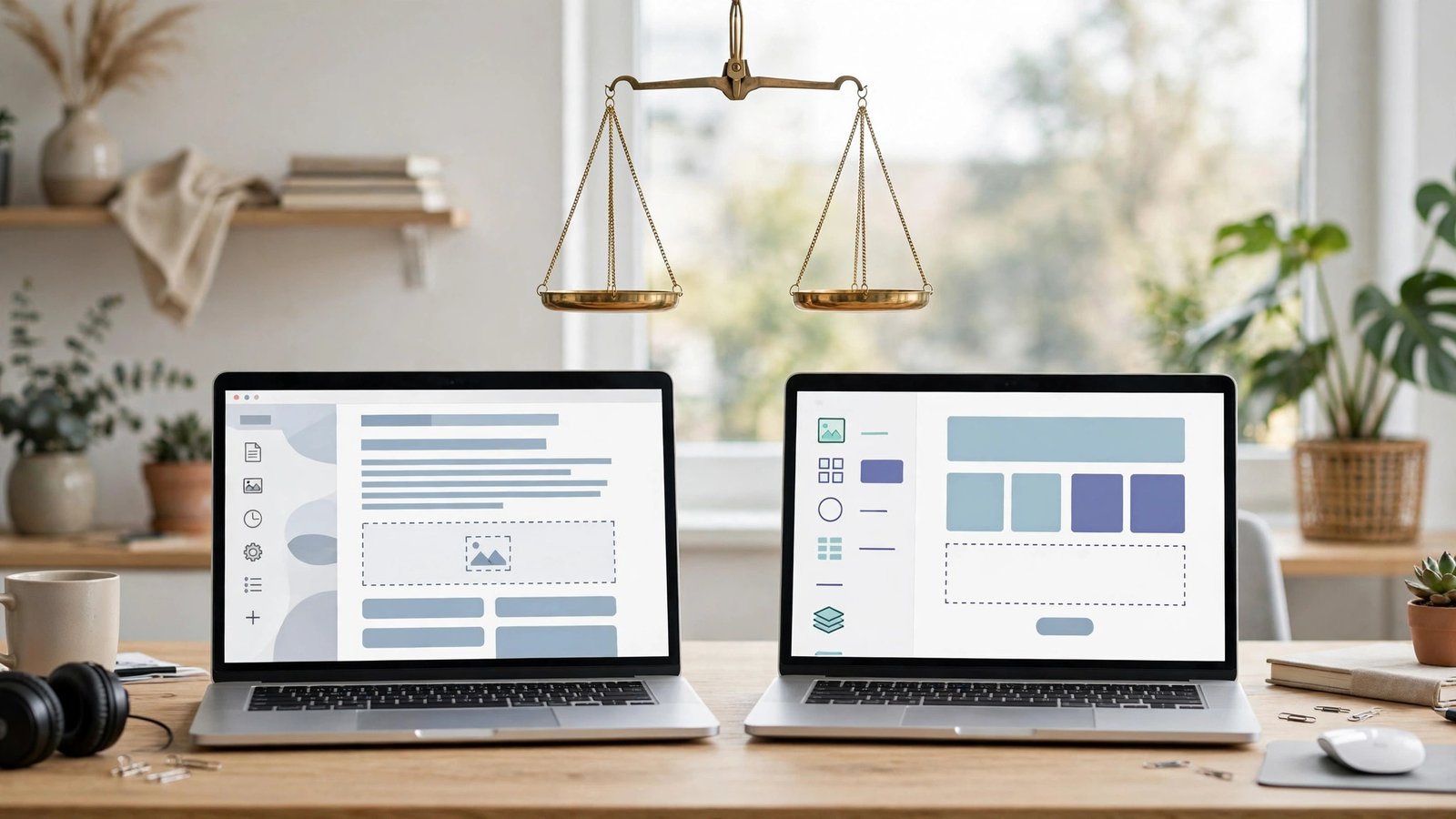
WordPress and Wix are the two biggest names in website building, but they take completely different approaches to blogging. WordPress — the open-source software from WordPress.org, and the hosted service WordPress.com — powers roughly 40% of all websites as of 2026 (W3Techs), while Wix holds about 4.2%. That gap tells you something real: WordPress dominates among publishers, while Wix owns the “get a site up today” crowd.
So which is better for blogging? The short answer: Wix is the easier start if you want a blog live this weekend with zero technical fuss. WordPress is the stronger long-term home if you plan to grow traffic, earn from ads or affiliates, and keep full control of your content. Everything below is priced from each company’s own pages as published in September 2026 — double-check before you buy, since plans change.
Quick Side-by-Side Comparison
| Factor | Wix | WordPress (self-hosted) |
|---|---|---|
| Entry price | Free plan (Wix ads, wixsite.com URL); paid from $17/mo billed annually | Free software; hosting from about $2.99/mo |
| Setup difficulty | Easiest — drag-and-drop, live in hours | Moderate — hosting, domain, theme setup |
| Themes/templates | 800+ templates | 10,000+ free themes plus premium options |
| Plugins/apps | 300+ Wix apps | 60,000+ plugins |
| SEO control | Built-in SEO Wiz, solid basics | Deepest control of any platform |
| Data ownership | Limited export, hard to migrate away | Full export and migration freedom |
| Maintenance | Handled by Wix | Your responsibility (updates, backups) |
| Support | 24/7 direct support | Depends on your host + community forums |
What It Costs in 2026
This is where the two platforms feel most different.
Wix charges a flat monthly fee that bundles everything — hosting, SSL, templates, support. As of September 2026, the published plans billed annually are: Light at $17/month, Core at $29/month, Business at $39/month, and Business Elite at $159/month. A free plan exists, but it shows Wix ads on your site and sticks you with a wixsite.com subdomain — not something you want on a blog you’re building for an audience. Wix backs paid plans with a 14-day money-back guarantee, and notes that prices can vary by location.
WordPress comes in two flavors, and confusing them is the number-one beginner mistake:
- WordPress.com is a hosted service (run by Automattic). Recent 2026 pricing shows Personal at $4/month for the first year (renewing at $5), Premium at $8 ($9 renewal), Business at $25 ($28 renewal), and Commerce at $45 ($50 renewal). Budget on the renewal price, not the teaser.
- WordPress.org is the free, open-source software you install on your own hosting. The software costs $0. You pay a host — plans commonly start around $2.99 to $23.99/month for shared hosting — plus a domain name (roughly $10–15/year). Premium themes and plugins are optional add-ons.
Bottom line on cost: a basic self-hosted WordPress blog typically runs you under $100/year for year one. Wix starts at $204/year for its cheapest usable plan ($17 × 12). WordPress wins on raw price, but remember you’re trading money for maintenance time.
Ease of Use: Getting Your First Post Live
Wix is the clear winner here, and it’s not close. You sign up, pick one of 800+ templates, drag elements around, and publish. Most people have a decent-looking blog within an afternoon. Wix also folds in AI-assisted site building — its AI Website Builder can generate a starting site from a short prompt — which helps if you stare at a blank template and freeze.
WordPress.org asks more of you: buy a domain, pick a host, install WordPress (most hosts offer one-click install), choose a theme, and configure the basics. It’s not rocket science — plenty of non-technical bloggers do it — but expect a weekend of setup rather than an hour. Once it’s configured, the actual writing experience is excellent: the block editor (Gutenberg) is genuinely pleasant for composing posts.
Winner for beginners who want zero friction: Wix.
Blogging Tools and Content Management
WordPress was born as a blogging platform in 2003, and it still shows. Categories, tags, archives, custom post types, scheduled publishing, post revisions, media library management, author roles — it’s all there, refined over two decades. If you plan to publish hundreds of articles and organize them into a real content library, WordPress’s content management is in a different league.
Wix’s blogging tools are good enough for most hobbyists and small businesses: posts, categories, scheduling, basic author settings. But you’ll feel the ceiling when you try to do something ambitious — custom content types, complex archives, bulk editing — things WordPress handles natively.
Winner for serious publishing: WordPress.
SEO in 2026: Can Wix Compete?
This used to be a knockout for WordPress, but the gap has genuinely narrowed.
Wix now ships with built-in SEO features: structured data markup, server-side rendering, URL customization, auto-generated meta tags, XML sitemaps, and a CDN. HTTP Archive’s 2025 data (cited in 2026 comparisons) shows Wix scoring a perfect 100 on Lighthouse SEO and passing Core Web Vitals on 71–74% of sites — better than WordPress’s 45% pass rate. Google’s John Mueller has said there’s no ranking boost for using WordPress specifically, and that Wix is fine for SEO if it meets your needs.
But “fine” isn’t “best.” WordPress offers the deepest SEO control of any platform: Yoast SEO (13+ million installations) and Rank Math (3+ million, with schema types, redirects, and keyword tracking in a generous free tier) give you levers Wix doesn’t expose. In competitive niches — site architecture, advanced schema, redirect patterns — WordPress remains the tool serious publishers choose.
Winner: Wix for casual blogs (it just works); WordPress for competitive SEO.
Design Flexibility and Extensibility
Wix gives you 800+ polished templates and a drag-and-drop editor that makes pixel-level tweaks easy — within the template. You can’t switch templates after launch without rebuilding, and custom code is limited to Wix’s Velo framework. Third-party integrations live in Wix’s app market (300+ apps), which is fine but small.
WordPress offers 10,000+ free themes (Astra, GeneratePress, and Kadence are popular starting points) plus thousands of premium ones, and 60,000+ plugins covering everything from email marketing to membership sites to advanced analytics. You can edit HTML, CSS, PHP, and JavaScript directly. Page builders like Elementor and Divi bring drag-and-drop to WordPress if you want Wix-style editing with WordPress’s backend.
Winner: WordPress, comfortably.
Ownership and Portability
This one matters more than most beginners realize. With self-hosted WordPress, your content, database, and files are yours. You can back them up, move them to any host, and leave whenever you want.
Wix is a closed platform. Exporting your blog content to move elsewhere is limited and painful — it’s one of the most common complaints from longtime Wix users who outgrow the platform. If your blog becomes a real asset (and that should be the goal), being locked into one vendor’s ecosystem is a real cost.
Winner: WordPress.
Security and Maintenance
Here’s the payback for Wix’s lock-in: security, updates, backups, and SSL are all handled in the background. You never patch anything.
WordPress puts it on you (or your host). The software itself is solid, but plugins are the weak link — one 2026 security roundup logged over 11,000 WordPress vulnerabilities in a single year, with 91% coming from plugins. Managed hosts and security plugins like Wordfence help, but you still need to keep everything updated. It’s a 15-minute-a-week habit, not a full-time job — but it is a habit.
Winner: Wix for hands-off; WordPress if you don’t mind light upkeep.
Monetizing Your Blog
Both platforms let you run ads, affiliate links, and sponsored content — Google doesn’t care where your site is hosted. But WordPress’s plugin ecosystem gives you more options: ad-insertion plugins, affiliate link managers, membership tools, and digital product delivery via WooCommerce all run natively.
One heads-up either way: ad networks have standards. If display ads are the goal, review the Google AdSense approval requirements for 2026 before you invest months in content — meeting the bar is easier when you build for it from day one. And if social traffic is part of your plan, check how Facebook’s content monetization works alongside a blog.
The Verdict: Which Should You Pick?
Choose Wix if: you want a blog live fast, you have no interest in anything technical, your site will stay small, and you value predictable pricing with everything handled. It fits portfolio sites, hobby blogs, and small business blogs where content supports the business rather than being the business.
Choose WordPress if: blogging is the business (or will become one), you want to rank in competitive search results, you plan to scale to hundreds of posts, you want to monetize seriously, or you simply refuse to be locked into a closed platform. The learning curve is real but shallow, and the ecosystem — 60,000 plugins, millions of tutorials, and a community that has answered every question you’ll ever have — is unmatched.
My take for 2026: Wix is a better product than it gets credit for, and its SEO and performance are genuinely competitive now. But if you’re building an asset rather than a hobby, WordPress is still the answer. Prices and features shift every year, so verify current plans on wix.com and wordpress.org before you commit.
Frequently Asked Questions
Is WordPress free?
The WordPress.org software is free and open source, but you pay for hosting (from about $2.99/month) and a domain (roughly $10–15/year). WordPress.com, the hosted alternative, starts around $4/month for the first year.
Can I switch from Wix to WordPress later?
Yes, but it’s painful. Wix’s export tools are limited, so you usually move content manually and rebuild the design — a strong argument for starting with WordPress if your blog will grow.
Does Google rank WordPress sites higher than Wix sites?
No — Google has said there’s no platform-based ranking boost. What matters is your content, site speed, and technical SEO. That said, WordPress gives you more control over the technical SEO details that can make a difference in competitive niches.
Which is better for a complete beginner with no tech skills?
Wix. You can have a good-looking blog online in an afternoon without touching a setting you don’t understand. WordPress is learnable, but it asks you to understand hosting, themes, and updates.
Can I make money with a Wix blog?
Yes. Wix blogs can run ads, affiliate links, and sponsored posts just like any other site. The platform doesn’t limit your monetization options — though WordPress offers more plugins for managing ads and affiliate programs at scale.
Do I need coding skills for WordPress?
No. Most bloggers never touch code. Themes and page builders handle the design, and plugins handle functionality. Basic familiarity with dashboards and settings is enough — you’ll just need to spend some time learning where things live.