
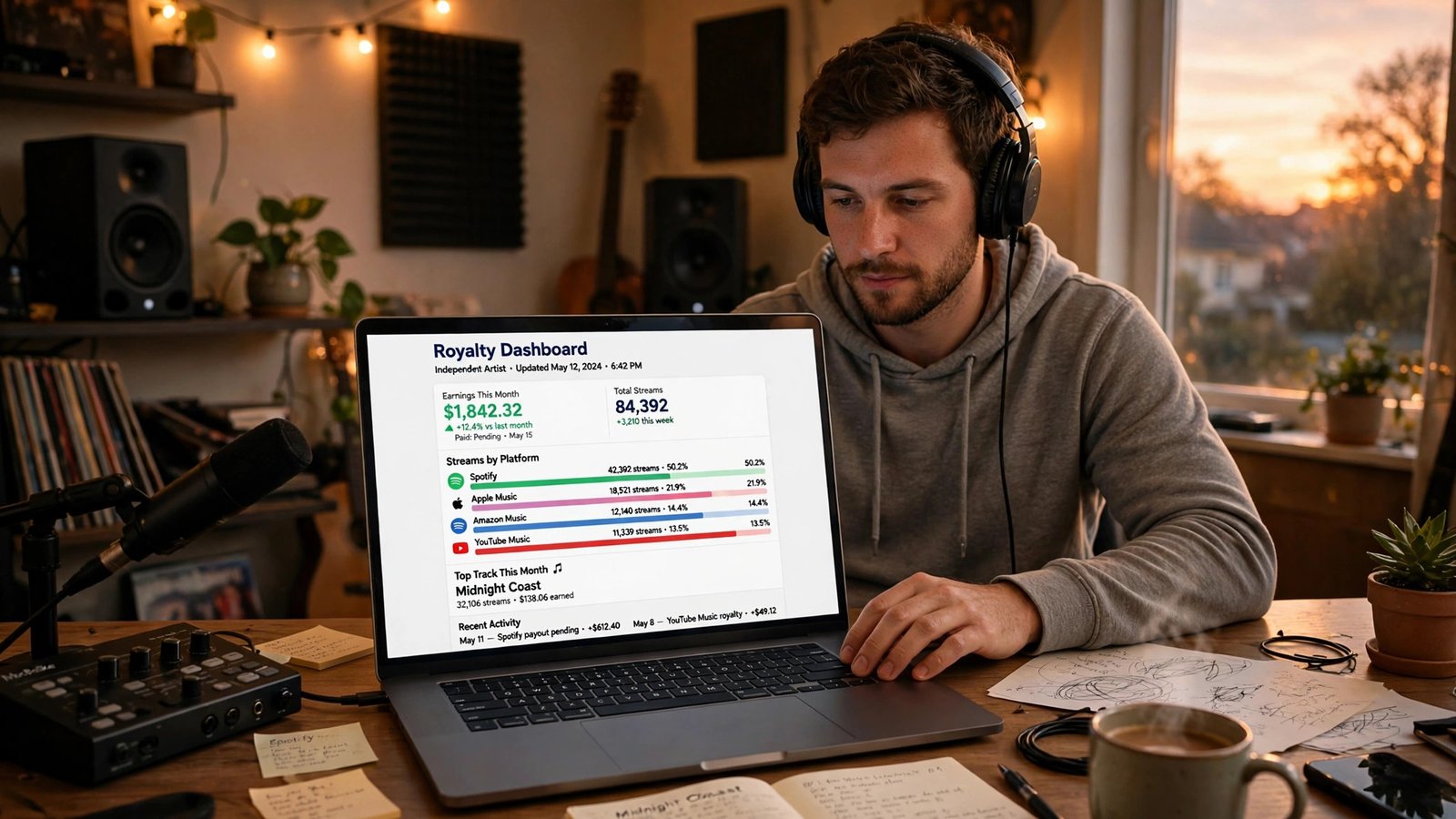
DistroKid Publishing is live. On November 11, 2026, DistroKid launched its publishing administration service in partnership with Kobalt, the world’s largest independent music publisher, and the terms are refreshingly simple: pay $75 once, keep 80% of the publishing royalties DistroKid collects for you. If you write your own songs and already distribute through DistroKid, this is the money your streaming payouts have never included — and until now, collecting it yourself meant registering with a dozen societies around the world or paying a separate administrator.
But “simple” doesn’t mean “right for everyone.” The $75 is per songwriter, the first payment takes six to nine months to arrive, and the service only makes sense if your songs actually generate publishing royalties worth collecting. This article works through the real numbers — what $50 of streaming revenue means in streams, how much publishing income you need before the $75 pays for itself, and how DistroKid’s deal stacks up against Songtrust and TuneCore — so you can decide with math instead of hype.
What DistroKid Publishing actually is
Publishing administration is not distribution. When you upload a song to DistroKid, it handles the recording side: it gets your track onto Spotify, Apple Music, and 150+ other stores, and it passes you 100% of the streaming royalties for the recording. That’s the master side.
Publishing is the songwriting side. Every time your song is streamed, downloaded, played on the radio, or used in a video, a separate set of royalties is generated for the composition — the melody and lyrics you wrote. Those royalties go to whoever is registered as the publisher of the song. If nobody is registered, the money sits uncollected. DistroKid Publishing registers your songs with collection societies around the world and chases that money down for you.
That distinction matters because a lot of independent artists think their distributor already collects everything. It doesn’t. As DistroKid’s own help center puts it, it can only collect your composition royalties if you sign up for DistroKid Publishing, because composition royalties can only be collected by a publisher, a publishing administrator, or the songwriter directly.
DistroKid first unveiled the service in a blog post on October 5, 2026, with eligibility rolling out gradually. The full launch on November 11 made it available to every eligible DistroKid user. Music Business Worldwide’s launch report confirms the same terms: $75 once, 80% to the songwriter, and the $50-in-12-months eligibility bar. DistroKid president Phil Bauer called collecting publishing revenue “the top request we’ve been getting from DistroKid members,” which rings true — this is the single most common “am I leaving money on the table?” question in independent music.
The terms, in plain English
Here is everything that matters, verified against Music Business Worldwide’s November 11 launch report and DistroKid’s own pages:
| Term | What it means |
|---|---|
| One-time setup fee | $75 per songwriter (US pricing; other currencies may show a different amount at checkout) |
| Your share | You keep 80% of publishing royalties collected; DistroKid keeps 20% |
| Eligibility | At least one release distributed through DistroKid, and more than $50 in streaming revenue over the past 12 months |
| Eligible songs | Original songs only, including co-writes where you own a share |
| Excluded | Covers, remixes, mash-ups, and fully AI-generated tracks |
| Commitment | None — leave any time |
| First payment | Roughly 6–9 months after your publishing earnings pass $10, then quarterly |
| Payout destination | Your DistroKid Bank account |
| Ownership | You keep full copyright ownership of your compositions |
| What it collects | Mechanical royalties (streams, downloads), public-performance royalties, and other eligible composition income |
A few of those lines deserve unpacking.
The $50 eligibility bar is lower than it sounds. More than $50 in streaming revenue over 12 months is the gate. At the commonly reported Spotify benchmark of roughly $0.003 to $0.005 per stream — about $3 to $5 per 1,000 streams, based on distributor payout statements, since Spotify publishes no official per-stream rate — $50 works out to roughly 12,500 streams at $0.004 each, or up to about 16,700 at $0.003. That’s a real bar, not a token one: a track also needs 1,000 streams in a rolling 12-month window before Spotify pays recording royalties on it at all. But if you’ve had even one song do modest numbers, you probably clear it.
The $10 threshold plus the 6–9 month wait is the honest catch. Your publishing earnings have to pass $10 before the clock even starts, and then the first payment takes roughly six to nine months because registrations and collection processing are slow. If you sign up in November 2026, don’t budget for publishing money before mid-2027. This is not a DistroKid flaw — every publishing administrator works on society timelines — but it means the $75 is a long-game bet, not a quick payout.
You still need a PRO. A compatible performing-rights-organization affiliation (ASCAP, BMI, or SESAC in the US) is required to collect the songwriter’s share of public-performance royalties. DistroKid Publishing registers your compositions and collects the publisher’s share and the mechanicals; your PRO handles the writer’s share of performance income. If you’re not affiliated with a PRO yet, that’s a free or nearly free step to take before or alongside signing up — ASCAP charges a one-time $50 writer membership fee, BMI is free for songwriters.
The AI exclusion is explicit. DistroKid says fully AI-generated tracks don’t qualify. If you use AI tools as part of your songwriting — a Suno draft you rewrote, AI-assisted production around a song you wrote — the line gets blurrier, and DistroKid’s own help pages are the place to check your specific case. Pure AI-generated tracks are out, full stop.
The money most songwriters are leaving on the table
Here’s the part that makes the $75 make sense — or not. Your streaming payout is only half the money a song generates. The other half is publishing, and for most small independent artists it has been sitting uncollected for years.
Think of it this way: when someone streams your song on Spotify, two things are being used at once. The recording — the actual audio file — earns recording royalties, which your distributor pays you. The composition — the song underneath the recording — earns publishing royalties, which go to the publisher. If you wrote the song and nobody is acting as your publisher, the composition side of every stream is money nobody claims.
How big is that second slice? It varies a lot by territory, by whether the listener is on a paid or free tier, and by which societies are involved — which is exactly why nobody can give you a single clean number. What I can say honestly is that it’s a separate, smaller slice than the recording royalties, and it adds up over a catalog. A songwriter with ten songs each doing a few thousand streams a month is leaving a real, if modest, amount uncollected every year.
That’s the real pitch for DistroKid Publishing, and it’s a fair one: uncollected publishing royalties are $0. Anything DistroKid collects for you, minus its 20% cut and the $75 fee, is money you weren’t getting.
The break-even math
Let’s do the arithmetic properly, because the launch coverage mostly doesn’t.
Step 1: Can you even get in? You need more than $50 in streaming revenue in the past 12 months. Using the reported Spotify benchmark of about $0.004 per stream (US listeners, blended Premium and free):
- $50 ÷ $0.004 = 12,500 streams
- At the lower $0.003 end of the range: $50 ÷ $0.003 = ~16,700 streams
- At the higher $0.005 end: $50 ÷ $0.005 = 10,000 streams
So the eligibility bar is roughly 10,000–17,000 Spotify streams in a year, or the equivalent revenue spread across platforms. If you’re there, you’re in.
Step 2: When does the $75 pay for itself? The fee is a flat $75. You keep 80% of whatever DistroKid collects. The fee is covered the moment DistroKid has collected $93.75 in publishing royalties for you — because 80% of $93.75 is $75. After that point, every dollar collected is 80 cents in your pocket that you weren’t getting before.
But here’s the honest framing: that $93.75 is publishing royalties collected, not streaming revenue. Publishing royalties per stream are much smaller than recording royalties per stream. You will need substantially more streams to generate $93.75 in publishing income than to generate $93.75 in streaming income. DistroKid doesn’t publish the ratio, and it varies by territory, so I won’t invent one. The practical takeaway: if your catalog earns $50 a year in streaming revenue — the minimum to qualify — your publishing income will be a fraction of that, and it could take years to clear $93.75 in collections. If your catalog earns $500 or $1,000 a year in streaming revenue, the math flips fast.
Step 3: The worked example. Take a songwriter with 100,000 Spotify streams a year — a realistic number for a small artist with a few songs gaining traction:
- Recording royalties at ~$0.004/stream: roughly $400 (paid through DistroKid, 100% to the artist)
- Publishing royalties: a separate, smaller amount — if it came to even a quarter of the recording side, that’s ~$100 a year
- DistroKid’s 20% cut of $100: $20. You keep $80
- Year one: $80 collected minus the $75 fee = roughly $5 ahead — and the first payment doesn’t arrive for 6–9 months
- Year two onward: $80 a year, no further fee, minus nothing — pure found money
Now scale it. At 500,000 streams a year, the same rough proportions give you ~$2,000 in recording royalties and maybe ~$500 in publishing. You keep $400 of that after DistroKid’s cut, and the $75 fee is a rounding error. At 10,000 streams a year — below the eligibility bar — you can’t sign up at all, and that’s the point: the service is built for artists who are already earning.
The honest bottom line: the $75 is cheap for anyone with real traction and a slow payback for anyone just above the eligibility line. Neither fact makes it a bad deal — it makes it a deal you should time correctly.
DistroKid Publishing vs the alternatives
DistroKid isn’t the first company to offer this. Here’s how the established options compare, using terms reported in 2026 comparisons (confirm the live terms before you pay — these change):
| Service | One-time fee | Commission | Notes |
|---|---|---|---|
| DistroKid Publishing | $75 per songwriter | 20% (you keep 80%) | Requires DistroKid distribution + $50/12 months streaming revenue |
| Songtrust | $100 per writer | 15% performance / 20% non-performance | Standalone — works with any distributor; 350,000+ songwriters |
| TuneCore Publishing | $75 signup (reported) | 15% | Works with TuneCore distribution; admin handled by Sentric |
| Sentric | $0 | 20% | No signup fee; higher commission; rolling 28-day term |
| CD Baby Pro | Retired in 2023 | — | Replaced by CDB Boost ($39.99/release, US collection only) |
| DIY (PRO + The MLC) | Free to join | 0% | You register everything yourself; your time is the cost |
A few things jump out. First, DistroKid’s 20% commission is the high end — Songtrust and TuneCore take 15% on performance royalties. On $500 of publishing royalties, that’s the difference between keeping $400 (DistroKid) and $425 (Songtrust). Second, DistroKid’s $75 fee is $25 cheaper than Songtrust’s $100. The fee gap roughly cancels the commission gap at low volumes and favors the 15% services as your income grows. Third, Sentric’s $0 signup fee with a 20% commission is the cheapest way in if you’re testing the waters — but you do the same 20% trade-off forever.
The real differentiator isn’t price, it’s friction. If you already distribute through DistroKid, signing up for its publishing service is a few clicks inside an account you already use, with payouts landing in DistroKid Bank alongside your streaming money. Songtrust or TuneCore mean a second account, a second dashboard, and a second payout pipeline. For a songwriter earning a few hundred dollars a year in publishing, that convenience is worth more than the 5% commission difference. For a songwriter earning thousands, the 15% services start to win on math.
And the DIY route deserves a real mention. In the US, you can register with a PRO (ASCAP/BMI) for free or $50 and register your songs with The MLC for free, and collect the domestic mechanicals and performance royalties yourself at 0% commission. What you give up is the international collection — the societies in dozens of other countries that a publishing administrator registers with on your behalf. If your audience is almost entirely American, DIY is genuinely competitive. If your streams come from everywhere, an administrator earns its cut.
For the full distribution comparison behind these numbers, see our DistroKid vs CD Baby vs TuneCore vs Ditto vs RouteNote breakdown.
Who should sign up — and who shouldn’t
Sign up now if:
- You already distribute through DistroKid and cleared $50 in streaming revenue in the past year
- You write your own songs (or co-write them) and haven’t registered with a publishing administrator
- Your catalog is growing — even slowly — and you expect to still be releasing in two years
- You have songs with international streams, where DIY collection gets complicated fast
- You’d rather pay $75 once than spend weekends registering songs with foreign societies
Wait if:
- You’re below the $50 bar — you can’t sign up yet anyway; focus on growing streams first
- Your songs are covers, remixes, or fully AI-generated — they don’t qualify
- Your entire audience is in the US and you’re willing to register with the MLC yourself for free
- You need the money soon — the first payment is 6–9 months away at best
Skip it if:
- You don’t write the songs you release (a vocalist singing other people’s songs, a beatmaker selling beats without songwriting credit — publishing isn’t your money to collect)
- Your streaming income is tiny and flat — the $75 will take years to earn back, and that $75 buys a year of DistroKid’s Musician Plus plan instead
How to sign up
- Log in to your DistroKid account and open the DistroKid Publishing section (it appears in your dashboard if you’re eligible).
- Confirm you meet the bar: at least one release distributed through DistroKid and more than $50 in streaming revenue over the past 12 months.
- Pay the $75 one-time setup fee per songwriter. If you co-write with someone who also wants their share administered, each songwriter signs up separately.
- List your original songs — DistroKid registers the compositions with collection societies. Covers, remixes, mash-ups, and fully AI-generated tracks stay out.
- Make sure your PRO affiliation is in place (ASCAP, BMI, or SESAC) so the writer’s share of performance royalties has somewhere to go.
- Wait. Your publishing earnings need to pass $10 before the payout clock starts, and the first payment lands roughly 6–9 months later, paid quarterly after that into DistroKid Bank.
One practical note from the rollout: DistroKid first showed the service to some users in October, before the full launch, and a few early reports described different eligibility details. The terms in this article are the November 11 launch terms, confirmed by Music Business Worldwide and DistroKid’s own pages. If your dashboard shows you something different, trust your dashboard — and check the live terms before paying.
The UMG lawsuit — does it change anything?
You may have seen that Universal Music Group sued DistroKid on September 15, 2026, in federal court in Delaware. The suit alleges DistroKid distributed undisclosed mass AI-generated tracks and unlicensed sped-up or altered copies of UMG recordings. DistroKid says it strongly disagrees.
Here’s what that means for DistroKid Publishing: nothing announced, so far. The lawsuit is an allegation, not a ruling, and it concerns distribution — not the new publishing service. No announcement has changed the $75 fee, the 80% split, or the Kobalt partnership. If the case produces a ruling or a settlement that affects artists, that’s a follow-up story. For now, it’s context, not a reason to hold off — but it’s also a reason to keep your own house in order: release only music you have the rights to, and keep your songwriter credits accurate.
For the full background, see our earlier piece on UMG’s takedowns and what they mean for independent artists.
The catches, collected in one place
Every new service has fine print. Here’s all of it, without the marketing gloss:
- $75 per songwriter, not per account. A duo that co-writes everything pays $150 if both sign up.
- The 6–9 month wait is real. Registration, society processing, and collection all take time. Budget for mid-2027 money, not Christmas money.
- The $10 earnings threshold gates the first payment. Small catalogs may take a while to cross it.
- 20% is the high end of admin commissions. Songtrust and TuneCore charge 15% on performance royalties.
- You still need a PRO. DistroKid Publishing doesn’t replace ASCAP, BMI, or SESAC — it works alongside them.
- No covers, no remixes, no fully AI-generated tracks. If a big chunk of your catalog is in those categories, it stays outside the service.
- Terms can change. The October rollout and the November launch already differed in eligibility details. Check the live terms in your dashboard before paying.
None of these is a dealbreaker. Together, they’re the difference between signing up with clear eyes and signing up surprised.
The verdict
DistroKid Publishing is a good deal for the artist it’s built for: a songwriter already distributing through DistroKid, already earning real streaming revenue, who hasn’t collected publishing royalties before. The $75 is a one-time fee for a permanent new income stream, the 80% split is fair even if it’s not the cheapest in the market, and the Kobalt partnership gives the service credibility that a startup admin wouldn’t have. The 6–9 month wait is the price of the society system, not a DistroKid quirk.
The artist it isn’t built for is the one just above the $50 line with a flat catalog. If that’s you, the math says wait — grow the streams first, and sign up when the publishing income will clear the $75 in a year rather than in three.
Either way, the important thing is the question itself. If you write songs and stream them, there is a second pile of money with your name on it. Before November 11, collecting it meant a separate service, a separate signup, and a separate dashboard. Now it’s a checkbox inside the account you already have. For most independent songwriters on DistroKid, that’s the right trade — $75 once, 80% forever, and money that was $0 before.
If you distribute through DistroKid and want to try it, you can start from your DistroKid dashboard — and if you’re new to DistroKid entirely, you can sign up through our referral link (affiliate link — we may earn a commission at no extra cost to you). Our original coverage of the October unveiling is here: DistroKid Publishing royalties — the new feature explained.
Frequently Asked Questions
How much does DistroKid Publishing cost?
A one-time setup fee of $75 per songwriter in the US, with no annual renewal. DistroKid then keeps 20% of the publishing royalties it collects, and you keep 80%. There is no long-term commitment — you can leave at any time.
Who is eligible for DistroKid Publishing?
You need at least one release distributed through DistroKid and more than $50 in streaming revenue over the past 12 months. Only original songs qualify, including co-writes. Covers, remixes, mash-ups, and fully AI-generated tracks are excluded.
What royalties does DistroKid Publishing collect?
It collects publishing (composition) royalties: digital mechanical royalties from streams and downloads, public-performance royalties, and other eligible composition income, worldwide, through its partnership with Kobalt. It does not collect your recording royalties — DistroKid’s distribution already pays those at 100%.
When will I get my first DistroKid Publishing payment?
Roughly six to nine months after your publishing earnings exceed $10, with payments quarterly after that, sent to your DistroKid Bank account. The wait reflects how long collection societies take to register songs and process royalties.
Do I still need ASCAP or BMI if I use DistroKid Publishing?
Yes. A compatible PRO affiliation is required to collect the songwriter’s share of public-performance royalties. DistroKid Publishing handles registration and collection on the publishing side; your PRO handles the writer’s share of performance income.
Is DistroKid Publishing worth it for a small artist?
It depends on your streaming volume. The $75 fee is covered once DistroKid collects $93.75 in publishing royalties for you (80% of $93.75 = $75). If your catalog earns well above the $50 eligibility minimum and is growing, it’s cheap found money. If you’re barely above the minimum with a flat catalog, the payback takes years — grow your streams first.