
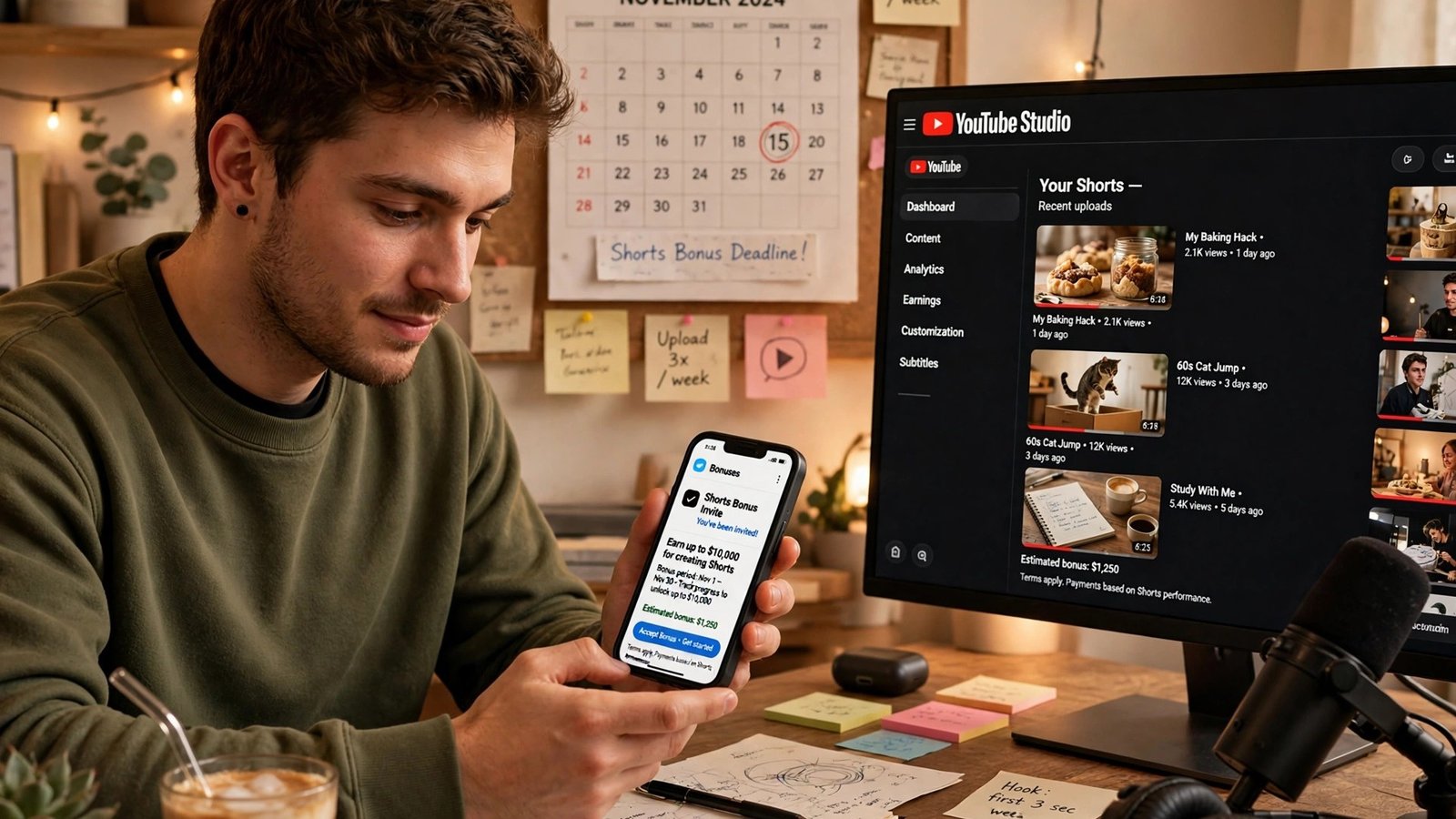
If you got a YouTube Shorts Bonus invite this fall, there’s a date sitting on it that matters more than the dollar figure. Accept by November 15, 2026, and November counts. Accept on November 16, and November is gone — your activity starts counting from December instead.
That’s not a penalty or a glitch. It’s how the program works. The accept-by date is the 15th of the month, every month, and the month you accept in is the first month that counts. Miss it by a day and you lose a whole month of bonus pay, even if you upload every Short you were asked for.
This article covers what the bonus actually pays, how the quota works, what happens if you accept late, and how to decide whether the quota is worth chasing — especially if you’re a smaller channel and November is already half gone.
What the YouTube Shorts Bonus actually is
The YouTube Shorts Bonus is an invite-only pilot that YouTube announced on October 15, 2026. It’s open to YouTube Partner Program channels in the US, UK, Germany, Brazil, Japan, and South Korea. There is no application form, no waitlist, and no way to ask your way in. Invites arrive by email or in YouTube Studio under Earn, then Active bonuses. Creator Support cannot manually invite anyone, so if you haven’t received one, there’s nothing to apply for — and if you have received one, don’t let it sit unread.
If you want the full background on how the pilot is structured, the site’s earlier explainer covers it in detail: YouTube Shorts Bonus Program Test 2026. This article doesn’t repeat that explainer. It focuses on the one thing that can cost you money right now: the deadline, and the math around it.
The bonus has two parts, and the difference between them is the whole story. YouTube’s own help page describes them this way:
- Promotional Offer Payment — a minimum amount set in your invitation. You earn it by uploading at least the invite’s number of public Shorts each calendar month.
- Promotional Bonus — an amount based on your valid engaged Shorts views that month. This part is not guaranteed. YouTube’s wording is plain: “You are not guaranteed receipt of a Promotional Bonus.”
That second sentence is the one most creators skim past. The minimum is the floor, and it’s tied to hitting your upload quota. The bonus on top of it depends on how your Shorts actually perform — and only on valid, engaged, organic views. Ad-sourced views don’t count toward it.
There’s one more condition that catches people off guard. You must still be monetized at the end of the month to be paid. If your channel drops out of the Partner Program mid-month, the bonus doesn’t follow you out the door. When you are paid, the money arrives with your normal YouTube earnings, typically between the 21st and 26th of the following month, via AdSense. So November’s bonus, if you earn it, would land in that late-December window — the same payout rhythm as your regular earnings, which is why it’s worth understanding how the YouTube $20 payout threshold interacts with smaller balances.
The November 15 rule, in plain English
Here’s the rule, stripped of fine print: accept by the 15th of a month for that month to count. Accept on the 16th or later, and your activity counts from the next month.
For November 2026, that means:
- Accept by November 15, 2026 — November counts. Every public Short you upload in November counts toward your November quota, and your November views count toward your November bonus.
- Accept on November 16, 2026 or later — November doesn’t count. Your uploads and views start counting from December. Nothing you did in November carries over.
Shared invites circulating this month say to join by November 15, 2026 to earn for November. That’s consistent with the rule, but your own invite is the one that matters. Go by the date in your invitation, not by what someone else’s invite said. Terms are individual, and the date printed on yours is the date that governs your account.
The numbers in real invites — and why they’re not “the rates”
You’ve probably seen screenshots of invite terms floating around. Here’s how to read them without getting misled.
Reported invite terms are individual offers, not YouTube-published rates. One creator shared terms of 16 Shorts per month for a $300 minimum, up to $2,000. Others shared 12 or more Shorts up to $1,000, and 12 Shorts up to $1,000. Those are real screenshots from real creators, but they are not a rate card. Your invite may offer different numbers, a different minimum, or a different ceiling.
Treat 16 Shorts a month as a planning number, not a rule. It’s the figure that shows up most often in shared invites, so it’s useful for planning — but it’s not a promise that your invite says 16, and it’s not a promise that hitting 16 guarantees any particular payout beyond the minimum your own invite sets.
The honest way to think about it is this: the minimum is the only number YouTube commits to in your invite, and it’s conditional on the quota. The bonus above the minimum is performance-based and explicitly not guaranteed. Any article or video that states a payout figure as YouTube’s own rate is overstating what YouTube has published. Don’t plan your month around someone else’s screenshot.
The countdown: what each accept date really means
This is where the deadline stops being abstract and starts being a schedule. The quota resets with the calendar month, and November has 30 days. Here’s what your remaining runway looks like depending on when you accept, using 16 Shorts as the planning number:
Accept November 9: 22 days left
You have November 9 through November 30 — 22 days — to upload 16 public Shorts. That’s about five a week, or roughly one every day and a half. That’s manageable for most channels, especially if you already have long-form videos to clip from.
Accept November 12: 19 days left
Nineteen days for 16 Shorts is just under one a day. The slack is thinning. A sick day, a travel day, or a video that needs a re-edit starts to matter. Batching becomes less optional and more necessary.
Accept November 15: 16 days left
This is the last day November counts, and it’s the tightest version of the plan. Sixteen days, 16 Shorts, about one a day with no slack at all. Miss one day and you have to double up the next. There’s no room for a video to flop in editing, no room for a day off, and no room for an upload snag. It’s doable — but only if you start immediately and treat it like a daily deadline, not a weekly goal.
Accept November 16: November is gone
One day later, and the math changes completely. November doesn’t count. Your uploads in November don’t count toward any quota, and your November views don’t count toward any bonus. Your first counting month is December, with a fresh quota and a full 31 days to hit it. That’s not a disaster — December is a full month, and it’s a better runway than a squeezed November — but it’s a month of bonus pay you didn’t have to lose.
The day-by-day calendar for a November 15 accept
If you’re accepting on the last day, here’s what the back half of November looks like at one Short a day:
- Nov 15 — Accept the invite. Upload Short 1 the same day. Don’t wait until tomorrow; tomorrow is already Short 2.
- Nov 16–20 — Shorts 2 through 6. One a day. Clip from existing long-form videos if you can; original clips beat rushed new recordings.
- Nov 21–22 — Shorts 7 and 8. Use the weekend to batch two or three ahead if your schedule allows it. A small buffer here is worth more than a perfect video later.
- Nov 23–27 — Shorts 9 through 13. This is the stretch where fatigue hits. Keep the format simple and repeatable so you don’t stall on production.
- Nov 28–30 — Shorts 14, 15, and 16. The last three days are your finish line. If you’ve banked a buffer earlier, these days are easy. If you haven’t, they’re a sprint.
That calendar works, but notice how fragile it is. One missed day anywhere in the middle means a double-upload day somewhere else. Two missed days means you’re uploading three in a day to catch up, and that’s where quality starts to slip — which matters, because only public Shorts count toward the quota, and only organic engaged views count toward the bonus.
Is the quota worth it for a small channel?
This is the question most coverage skips, and it’s the one that matters most if your channel is small. The bonus has a guaranteed floor (the minimum in your invite, if you hit the quota) and an unguaranteed upside (the performance bonus, if your views cooperate). For a small channel, the floor is the real prize and the upside is a lottery ticket. So the decision comes down to one comparison: what does hitting the quota cost you, versus what does the floor pay you?
The cost side
Sixteen Shorts in 16 days is a real workload. At an hour each to clip, caption, and upload, that’s 16 hours in just over two weeks. At 30 minutes with a repeatable format, it’s 8 hours. Clipping from existing long-form videos with a template, you might get it down to 15–20 minutes each, which is 4–5 hours total. The cost isn’t the number of Shorts. It’s the minutes per Short, multiplied by 16, inside a deadline that doesn’t move.
The payout side
The only payout you can count on is the minimum in your own invite — and only if you hit the quota and stay monetized through the end of the month. Everything above that minimum depends on valid engaged views, which a small channel can’t predict.
So run the math honestly. If your invite’s minimum is $300 for 16 Shorts, that’s $18.75 per Short if you hit the quota and earn nothing above the minimum. That’s a solid rate for a clipped Short that takes 20 minutes. It’s a poor rate for a fully produced Short that takes three hours. If your invite’s minimum is lower, or your per-Short production time is higher, the math gets worse fast.
When it’s worth it
The quota is worth chasing when three things are true:
- You can clip, not create. You have long-form videos with moments that work as standalone Shorts. Clipping is fast, and the Shorts are genuinely good because the source material is already good.
- Your per-Short time is low. You have a template, a format, or a workflow that gets a Short out in under 30 minutes without a quality drop.
- The minimum justifies the hours. You’ve done the division — minimum divided by 16, compared against your time — and the answer is yes.
When it’s not worth it
Skip the November sprint, and aim for December instead, when any of these are true:
- You’d have to create 16 original Shorts from scratch. That’s a different job from clipping, and 16 days isn’t enough to do it well.
- Your Shorts don’t get engagement. If your Shorts routinely earn a few hundred views with low watch time, the bonus above the minimum will be small or zero, and you’re working for the floor alone.
- The sprint would wreck your long-form schedule. A missed long-form video costs you more than the Shorts bonus pays. Don’t trade a growing asset for a one-month pilot payment.
December is a full month with 31 days. If November’s runway is too short, December is the better bet — and accepting in December still gets you the December bonus if you hit December’s quota.
How to hit the quota by clipping your own long-form videos
If you decide the quota is worth it, clipping your own long-form videos is the fastest honest way to get there. It’s also the safest, because of a change YouTube made on October 1, 2026: the platform cut reach for low-effort and re-uploaded Shorts under an original-content rule. Re-uploading someone else’s clips, or re-posting the same Short with a new caption, won’t help you hit the quota safely. Clipping your own videos is original content — it’s your footage, your voice, your ideas — and it’s the intended way to repurpose.
Here’s a practical plan that works inside a 16-day window.
Step 1: Audit your catalog for clip-worthy moments
Go through your last 10–20 long-form videos and mark moments that stand alone: a strong opinion, a surprising fact, a funny exchange, a clear how-to step, a before-and-after. You’re looking for 30–60 second segments that make sense without the rest of the video. A good test is whether you can describe the clip in one sentence without referencing the full video. If you can’t, it’s not a standalone Short.
Aim for 20 candidate moments, not 16 — you’ll discard a few when you see them out of context, and spares mean you never stall on what to post today.
Step 2: Build one repeatable format and don’t deviate
Pick one format and use it for all 16. That might be a face-to-camera hook followed by the clip, or a captioned clip with a text hook on screen, or a quick intro (“Here’s the part nobody talks about”) and then the moment. The point isn’t which format you choose. It’s that you choose once and stop deciding. Every decision you eliminate is time you get back, and in a 16-day sprint, decision fatigue is the real enemy.
Set up a template in your editor — same captions style, same hook placement, same end screen — and reuse it. The first Short takes an hour. The fifth takes 30 minutes. By the tenth, you’re under 20.
Step 3: Batch in blocks of four
Don’t edit one Short a day. Edit four in one sitting, then schedule them. Batching works because the setup cost — opening the project, finding the clips, getting into the rhythm — is paid once per batch instead of once per Short. Four batches of four gets you to 16 with four editing sessions instead of sixteen.
Step 4: Publish public, and check that they stay public
Only public Shorts count toward the monthly quota. That sounds obvious, but it’s easy to leave a Short as unlisted or scheduled and assume it counted. After each upload, check the visibility in YouTube Studio. A Short sitting in drafts or scheduled for next month doesn’t help your November quota.
Step 5: Don’t chase views with tricks that disqualify them
Only organic engaged views count toward the bonus. Ad-sourced views don’t count. That means buying views, running ads to your Shorts, or using engagement tricks doesn’t move the bonus — it just spends money or risks your standing. The views that matter are the ones from real people who watched because the Short was worth watching.
Two things not to confuse this pilot with
The Shorts Bonus pilot is new, and it’s easy to mix it up with two other things that sound similar. Getting them straight matters, because the rules are different.
First, don’t confuse this pilot with the older, separate “Shorts upload bonus” that ran from September 1 to November 30, 2026, at 10 Shorts a month. That’s a different program with different terms. If you saw coverage of a 10-Shorts bonus this fall, that wasn’t this pilot.
Second, don’t confuse the pilot with the bigger monetization change coming in 2027. From February 1, 2027, Shorts ad and subscription revenue sharing will require 10 million qualified Shorts views in a rolling 90 days. That’s a threshold for ongoing revenue sharing, not a bonus program, and it has nothing to do with the November 15 accept-by date.
And one more thing worth knowing: Google can change, cancel, or suspend the program with 30 days’ notice, or immediately for legal, security, or abuse reasons. That’s standard language for a pilot — but the November 15 deadline in your current invite is the date that matters right now.
What to do today
If you have an invite, here’s the short version of everything above, in the order you should do it:
- Open your invite and read the actual date. Don’t go by screenshots or articles. Your invite’s accept-by date and your invite’s quota are the ones that govern your account. If it says November 15, 2026, that’s your deadline.
- Read the minimum and the quota together. The minimum is what you earn for hitting the quota. Divide it by the number of Shorts. Decide whether that per-Short rate is worth your time.
- Count your runway. If you’re reading this on November 9, you have 22 days. If you’re reading it on November 15, you have 16 days and no slack. If it’s November 16, November is gone — plan for December instead.
- Audit your catalog before you accept. If you can find 20 clip-worthy moments in your existing videos, you can hit the quota by clipping. If you can’t, December’s full month is the better target.
- Accept, then upload the first Short the same day. The quota counts uploads in the calendar month. Every day you wait after accepting is a day you don’t get back.
The YouTube Shorts Bonus isn’t a windfall. It’s a pilot with a floor, an uncertain upside, and a deadline that doesn’t forgive a day’s delay. For the right channel — one with a back catalog to clip, a fast workflow, and an invite minimum that justifies the hours — it’s real money for work you’re mostly already doing. For the wrong channel, or the wrong week, it’s a sprint that costs more than it pays. Either way, you have to decide by November 15 if you want November to count. After that, the calendar decides for you.
For the deeper background on the pilot itself, see the site’s pilot explainer: YouTube Shorts Bonus Program Test 2026. For independent coverage of the program terms and the November deadline, see Upstream’s breakdown of the Shorts Bonus program and SMM Toolbox on the November deadline.
Frequently Asked Questions
What happens if I accept the YouTube Shorts Bonus on November 16, 2026?
November doesn’t count. Accept by the 15th of a month for that month to count, so accepting on November 16 means your activity starts counting from December. Your November uploads and views won’t count toward any quota or bonus. Your first counting month would be December, with a fresh quota and 31 days to hit it.
How many Shorts do I need to upload each month?
It depends on your individual invite. Reported invites have asked for 16 Shorts a month or 12 Shorts a month, but those are individual offers, not YouTube-published rates. Only public Shorts count toward the quota, and the quota resets with each calendar month. Check your own invitation for your exact number.
Is the bonus above the minimum guaranteed?
No. YouTube’s own help page says, “You are not guaranteed receipt of a Promotional Bonus.” The minimum in your invite is earned by hitting your monthly upload quota. The bonus on top of it is based on your valid engaged Shorts views that month, and only organic engaged views count. Ad-sourced views do not count.
When will I get paid for November’s bonus?
The bonus is paid with your normal YouTube earnings, typically between the 21st and 26th of the following month via AdSense. So a November bonus would normally arrive in that late-December window. You must still be monetized at the end of November to be paid.
Can I hit the quota by re-uploading old Shorts or other creators’ clips?
No. Only public Shorts count toward the quota, and on October 1, 2026, YouTube cut reach for low-effort and re-uploaded Shorts under an original-content rule. Clipping your own long-form videos is the safe way to hit the quota — it’s your footage and your content. Re-uploads won’t help you safely, and they can hurt your reach.
I didn’t get an invite. Can I apply or ask Creator Support to invite me?
No. The program is invite-only, there is no application, and Creator Support cannot manually invite anyone. Invites arrive by email or in YouTube Studio under Earn, then Active bonuses. If you haven’t received one, there’s no way to request it — but keep an eye on Studio, since invites roll out over time.