
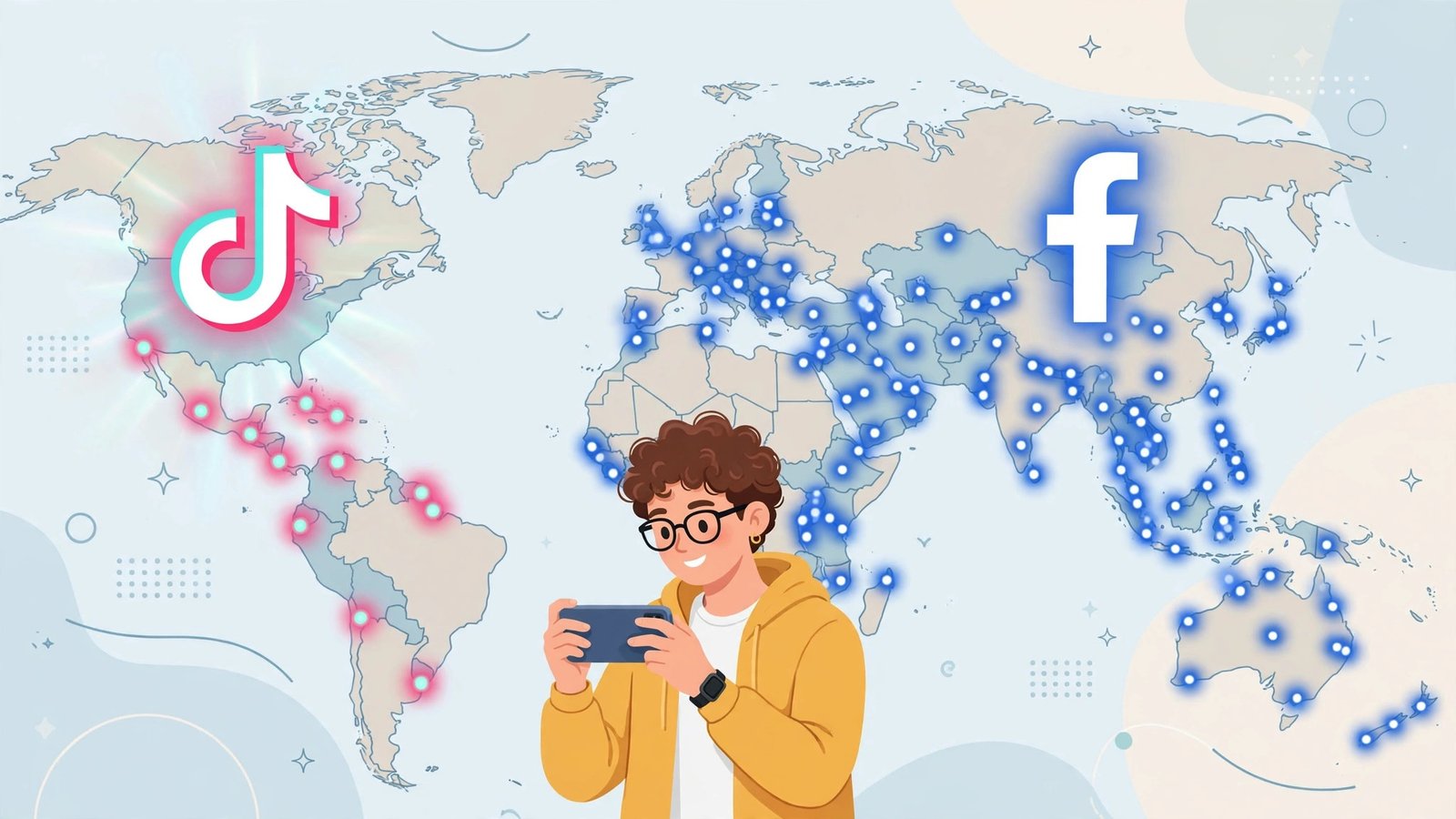
TikTok pays creators directly in 8 countries. Facebook’s Content Monetization program is reported to reach about 70. If you create in one of the 62 countries in that gap, this asymmetry decides whether your views turn into money — and if you create in the US or UK, it still decides which platform deserves your best content first.
The strategy is simple to state and easy to get wrong: use TikTok for audience, use Facebook for money, and never let either platform catch you re-uploading the other’s watermarked video. This article lays out the exact rules of both programs, the two-platform workflow that keeps you eligible on both, and the mistakes that get creators demonetized.
TikTok Creator Rewards: 8 countries, strict rules, real money
TikTok’s Creator Rewards Program is the platform’s current system for paying creators for organic video performance. It replaced the old Creator Fund, which paid from a fixed shared pool that thinned out as more creators joined. Creator Rewards pays per video based on qualified views and content quality, with no shared-pool ceiling.
Here is the part that stops most creators cold: the program is available in only 8 countries as of 2026 — the United States, United Kingdom, Germany, France, Japan, South Korea, Brazil, and Mexico. If your account is registered outside those eight, clearing every other threshold will not unlock the program. TikTok ties your account location to signals like your SIM card country and IP address at registration, not just the country shown in your settings, so changing a display setting does not make an ineligible account eligible.
The eligibility checklist
To join Creator Rewards, you need all of these:
- 10,000 followers
- 100,000 video views in the last 30 days (a rolling window, not a one-time milestone)
- 18 years or older (19 in South Korea)
- A Personal account — Business accounts are not eligible and must be switched before applying
- An account in good standing, with no active policy violations
- Registration in one of the 8 eligible countries
Meeting the account requirements gets you enrolled. Meeting the video requirements is what actually generates income, and they are stricter than most creators expect. A video only earns from Creator Rewards if it is over 1 minute long, original, has at least 1,000 For You feed views, and is not a Duet, a Stitch, Photo Mode content, or paid promotion. Videos posted before you were accepted do not earn — only new posts after enrollment count.
The 1-minute threshold is the single biggest payout multiplier in the program. Sub-60-second videos qualify only for lower legacy-tier rates. TikTok also added an Additional Reward system in spring 2025 that rewards well-crafted, engaging, and specialized content rather than raw view count alone — another reason a thoughtful 90-second explainer can out-earn a viral 15-second clip.
What TikTok actually pays
TikTok publishes no fixed rate per 1,000 views. Rewards are calculated with a formula that weighs originality, play duration, search value, audience engagement, and account ad value. Creator guides report typical US-English RPMs in the rough range of $0.40 to $2.00 for qualifying 60-second-plus content, with niche, watch-time, and search-value driving the variance. Treat any specific dollar figure you see quoted as one creator’s experience, not a promise — your own RPM shows up in your TikTok Creator dashboard.
Payouts run monthly, on the 15th, once your balance hits the $50 minimum threshold. That threshold matters for smaller creators: at the low end of reported RPMs, you need a lot of qualified views before anything lands in your account. TikTok has also been experimenting with faster payout rails — see our breakdown of TikTok One Pay’s 30-day creator payouts with no fees for how that compares.
Facebook Content Monetization: invite-only, much wider, and a different game
Facebook’s Content Monetization Program is the unified system Meta completed on August 31, 2025, folding the old In-stream Ads, Ads on Reels, and Performance Bonus programs into one program. If you want the backstory on that transition, our guide to Facebook’s shift from in-stream ads to Content Monetization covers what changed for creators who were already earning. Eligible content includes public Reels, photos, Stories, and text posts on a Facebook Page or a profile in Professional Mode. Reels must be at least 10 seconds long, and content watched under five seconds generally does not count toward earnings.
The program is invite-only. You cannot apply the way you apply to TikTok’s program. Meta sends invitations through official channels — in-app prompts, email, Meta Business Suite, or the Professional Dashboard — and there is an “Express interest” option in the Professional Dashboard that signals you want in without promising acceptance. Ignore any random Messenger link or “guaranteed invite” offer: those are scams, and Meta has said invites arrive only through official channels.
Reporting puts the typical invite criteria at roughly 10,000 followers and around 600,000 total watch-minutes across videos in the preceding 60 days, plus residency in an eligible country and a clean compliance record. Meta does not publish a single official public list of eligible countries for Content Monetization, which is why you will see different numbers floating around. A country-by-country tracker updated in October 2026 puts Facebook’s coverage at roughly 70 countries, including India, the Philippines, Indonesia, Nigeria, Bangladesh, Egypt, and Kenya (source). Treat that figure as reported coverage, not a Meta press release — the practical check is always your own Professional Dashboard, which shows whether the program is available for your account.
Like TikTok, Facebook pays no fixed rate per 1,000 views. Meta shows creators an Earnings Rate — an estimate of what they earn per 1,000 qualified views — and the actual rate varies with content performance. For a sense of what those rates look like in practice, see our analysis of Facebook creator RPMs for informative content. Facebook reported nearly $3 billion in payouts to creators in 2025, with 60% of monetization payouts going to Reels, which tells you where the money concentrates.
The 62-country gap is where the real story is
If you live in the United States, the UK, Germany, France, Japan, South Korea, Brazil, or Mexico, you can earn from both platforms. Everywhere else, the two platforms split: TikTok gives you reach but no direct view-based pay, while Facebook may give you both.
That gap is not theoretical. In South Africa, Communications Minister Solly Malatsi has publicly pressed TikTok to open Creator Rewards to local creators, calling the exclusion “a form of economic exclusion that we’re trying to fight against” and arguing for “the same equal treatment of content creators in South Africa, as they do in the US, as they do in the UK” (IOL). South African creators can rack up millions of views that qualify for nothing from TikTok directly, and TikTok’s answer so far has been its TikTok One Creator Marketplace — brand deals, not ad-revenue sharing. Sri Lanka tells the other half of the story: local creators there were long shut out of direct platform monetization, but Facebook Content Monetization has since opened to them, giving them a payout path TikTok still does not.
The honest caveat: Facebook rates in those 62-gap countries are generally low, because advertiser spending there is lower than in the US or UK. A million views from a low-ad-spend market pays far less than a million US views on either platform. Volume plus US-viewer targeting still matters — which is exactly why the cross-posting strategy below focuses on making content that travels.
The cross-posting strategy: clean masters, platform-native cuts
The single most common mistake creators make with two-platform monetization is downloading a TikTok video with its watermark and uploading it to Facebook. Meta explicitly classifies content with visible third-party platform watermarks, downloaded and re-uploaded, as unoriginal. Accounts that repeatedly post mostly unoriginal content first lose reach across all their posts, then lose monetization eligibility for a period, and can eventually be classified as non-recommendable. One lazy cross-post can cost you the Facebook income you were cross-posting to get.
Here is the workflow that keeps you safe on both platforms:
1. Shoot and edit a clean master. Record and edit in your camera app or an editor like CapCut, and export a watermark-free master file. Never let TikTok’s in-app download button be your distribution method. The master is your asset; each platform gets its own cut from it.
2. Cut two versions, not one file twice. The TikTok cut should run over 1 minute to qualify for Creator Rewards’ higher-paying tier — aim for 60 to 120 seconds of dense, search-driven content. The Facebook cut can be the same video, but re-export it from the master rather than re-uploading the TikTok file, and make sure it clears Facebook’s 10-second minimum with room to spare. A 60-second-plus cut works fine on both, which keeps your workflow to one real edit.
3. Post natively on each platform. Upload the TikTok cut inside TikTok and the Facebook cut inside Facebook. Native uploads preserve quality, keep metadata clean, and avoid every watermark problem at once.
4. Write platform-native captions and hooks. TikTok rewards search value — the Additional Reward system explicitly favors content people search for — so your TikTok caption should carry the question your video answers. Facebook rewards engagement and watch time across Reels, photos, Stories, and text, so the same idea can also become a text post or a photo carousel that earns under Content Monetization. One idea, three Facebook formats, one TikTok video: that is how you multiply a single shoot.
5. Post in the order that protects you. Publish the TikTok version first if TikTok is your primary growth engine, but the order matters less than the source file. What matters is that neither platform ever receives the other’s branded export.
6. Target US viewers on purpose. On both platforms, US, UK, and other high-ad-spend audiences pay multiples of what developing-market audiences pay. That does not mean faking your location — it means choosing topics, language, and posting times that attract those viewers honestly: US-facing questions, American English, and topics US advertisers bid on, like finance, tech, education, and home content.
What not to do
Don’t spoof your location. TikTok checks SIM and IP signals at registration, and Meta’s account-integrity systems flag the same behavior. A creator in an ineligible country who fakes a US presence risks losing the account entirely — including any Facebook monetization they had legitimately earned.
Don’t buy a “guaranteed invite.” Facebook invites come only through Meta’s official channels. Anyone selling an invite is selling a scam, and the accounts involved often end up flagged.
Don’t re-upload watermarked videos. This one deserves repeating because it is the most common way creators lose Facebook monetization. If a video has a TikTok watermark on it, it does not go on Facebook. Ever.
Don’t assume TikTok will add your country soon. Claims that TikTok will expand Creator Rewards to new countries “by end of 2026” do not match TikTok’s official list. The eligible-country list has expanded before and may expand again, but there is no published timetable. Build your strategy on the platforms that pay you today.
The math: what this actually earns
Take a creator posting search-driven 90-second videos, four times a week, averaging 100,000 qualified views per video. That is roughly 1.6 million qualified views a month. On TikTok, at the reported $0.40–$2.00 RPM range, that works out to roughly $640 to $3,200 a month — a wide band, because RPM varies enormously by niche and audience geography. On Facebook, the same content re-cut natively earns at Meta’s variable Earnings Rate, which for most creators lands in a similar or lower band unless their audience skews heavily toward US viewers.
Now take the same creator living in a 62-gap country. TikTok pays them nothing directly, no matter how many views they get. Facebook pays them something — often at a lower rate than a US creator would see — plus whatever brand deals and affiliate income their TikTok audience generates. The gap between “nothing from TikTok” and “something from Facebook” is the whole reason the two-platform strategy exists. It is also why creators in those countries should treat TikTok as an audience engine and Facebook as the cash register, not the other way around.
A realistic expectation for a small creator in a gap country: Facebook earnings in the first months are usually modest — tens to low hundreds of dollars — and they grow with consistent posting and US-viewer share. Anyone promising thousands in month one is selling a course, not a strategy.
Your 7-day action plan
Day 1: Check eligibility in both apps. On TikTok: Creator Tools → Creator Rewards. On Facebook: Professional Dashboard → Monetization. Write down what each one says — that is your ground truth.
Day 2: If Facebook shows “Express interest,” tap it. If TikTok shows you are in an eligible country and you meet the thresholds, apply. If you are in a gap country, skip the TikTok application entirely and put that energy into Facebook.
Day 3: Build your clean-master workflow. Pick your editor, set up an export preset, and film one test video end to end: master → TikTok cut → Facebook cut.
Day 4–6: Publish three videos using the workflow. Write search-driven TikTok captions and engagement-driven Facebook captions for each.
Day 7: Check both dashboards. Note which videos earned qualified views, which earned nothing, and why. Adjust next week’s topics toward the ones that earned.
The platforms will keep changing their rules — TikTok’s country list, Facebook’s invite criteria, both payout formulas. The workflow does not change: own your masters, post natively, keep every video original, and let each platform pay you for the audience it actually reaches.
Frequently Asked Questions
Can I earn from TikTok Creator Rewards if I live outside the 8 eligible countries?
No. Creator Rewards is geo-locked to the US, UK, Germany, France, Japan, South Korea, Brazil, and Mexico. Creators elsewhere can still earn on TikTok through Live Gifts, TikTok Shop affiliate commissions in Shop-live markets, Series paid content, and brand deals — but not from the Creator Rewards view-based pool.
Is Facebook Content Monetization really available in 70 countries?
A country tracker updated in October 2026 puts coverage at about 70 countries, including India, the Philippines, Indonesia, Nigeria, Bangladesh, Egypt, and Kenya. Meta does not publish a single official public list, so verify in your own Professional Dashboard under Monetization — that is the only answer that matters for your account.
Will Facebook penalize me for posting my TikTok videos there?
Facebook penalizes watermarked re-uploads, which it classifies as unoriginal content. Posting a clean, watermark-free cut exported from your own master file is fine. The problem is the TikTok watermark and the download-and-re-upload path, not the fact that the same video exists on TikTok.
Do Duets and Stitches earn money on TikTok Creator Rewards?
No. Duets and Stitches are excluded from Creator Rewards payouts, along with Photo Mode content and paid promotion. Only original videos over 1 minute with at least 1,000 For You feed views qualify.
How much does Facebook pay per 1,000 views?
There is no fixed rate. Meta shows creators an Earnings Rate per 1,000 qualified views that varies with content performance, audience geography, and advertiser demand. US-viewer-heavy content generally earns more than content viewed mostly in low-ad-spend markets.
Can I use a VPN to join TikTok Creator Rewards from an ineligible country?
Do not try it. TikTok ties account location to SIM card country and IP signals at registration, and location spoofing risks losing the account — including any legitimate monetization you hold elsewhere. Build on the platforms that pay you in your actual market.