
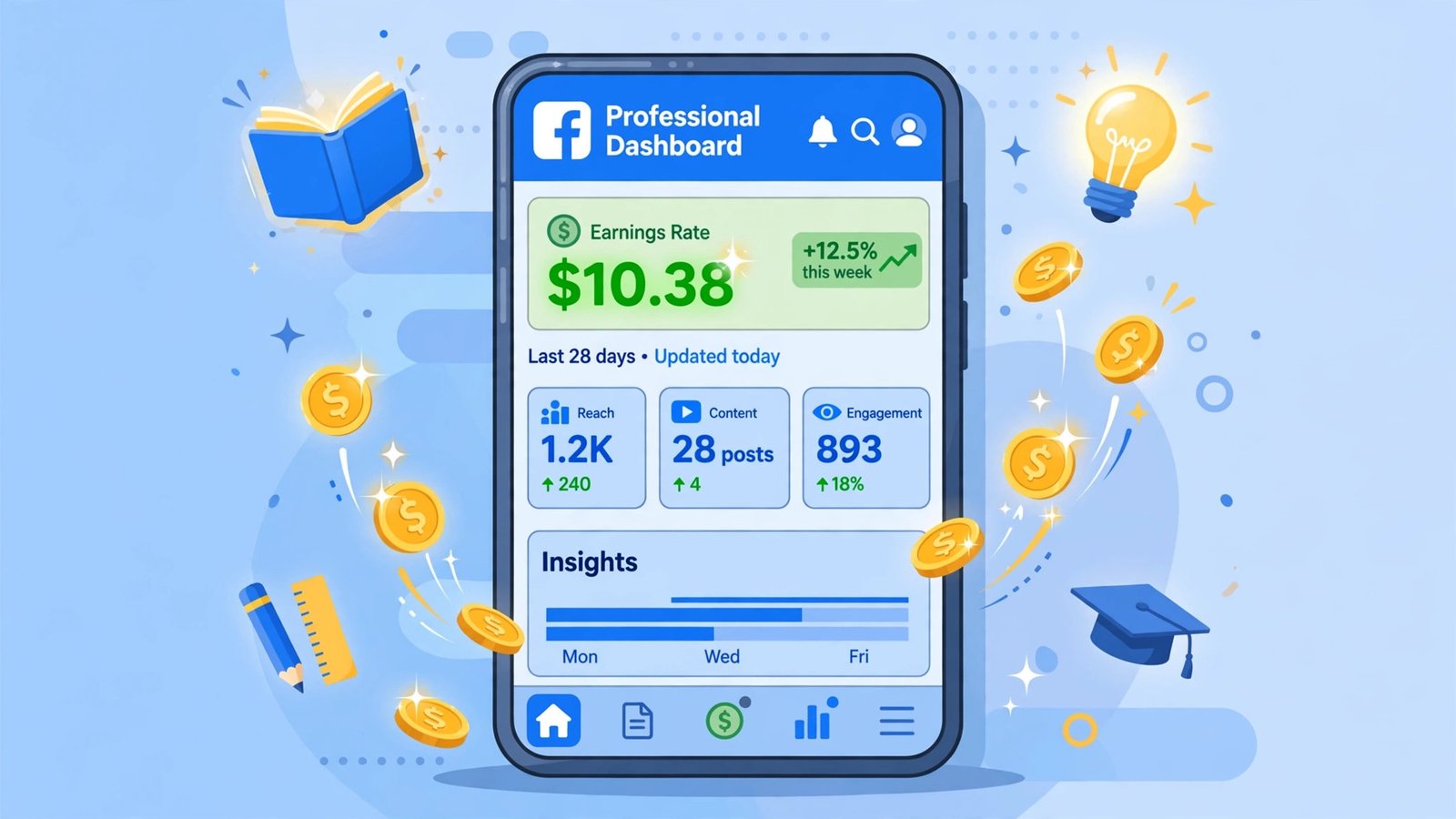
Every so often, a single screenshot settles an argument the whole creator economy has been having for years. This week, a creator shared her Facebook Professional dashboard with a number that made jaws drop: $10.38 earnings rate per 1,000 qualified views — her words: “This is my highest RPM to date! $10.38 is crazy!”
The post earned $29.12 across its lifetime on just 2,805 qualified views. And her takeaway was blunt: “I keep trying to tell yall informative content makes the most money.”
She’s right. And the math proves it.
The numbers, verified
Let’s do what most viral screenshots never get — check the arithmetic. Facebook’s payout formula, since Meta’s March 2026 metrics update, is:
Estimated earnings = qualified views ÷ 1,000 × earnings rate
Run her numbers: 2,805 ÷ 1,000 × $10.38 = $29.12. To the cent. The screenshot is internally consistent — this isn’t a typo, a glitch, or a misunderstood metric. It’s a real payout at a real rate.
For context on how extraordinary that rate is: most Facebook Reels creators see earnings rates between $0.10 and $5 per 1,000 qualified views. General entertainment content sits around $0.30–$1.50. Finance and business content — the top of the normal range — earns roughly $2–$5. Her $10.38 sits near the very top of what’s been reported anywhere, inside the $3–$12 band that US/UK/Canada/Australia audiences with premium niches can command.
One honest caveat before we go further: this is one creator’s report from one post, not a promise. Your rate will depend on your niche, your audience’s geography, and your content. But the mechanism behind her number is universal — and that’s what matters.
The detail everyone missed: weeks at zero, then the spike
Look at the second half of her screenshot — the “Earnings rate history” graph for the last 28 days. From September 14 through early October, her line sits flat at essentially $0. Then, almost vertically, it spikes past $10.
That graph tells a second story most people scroll past. She didn’t wake up one morning with a $10.38 rate. She posted for weeks earning nearly nothing — the flat line is the graveyard of content that didn’t land — and then one informative post broke through. This is how Facebook monetization actually works for most creators: a long flat stretch, then a spike when the right content meets the right audience.
If you’re in the flat part of that graph right now, her screenshot isn’t a taunt. It’s a preview.
Why informative content earns the highest rates
Her claim — “informative content makes the most money” — isn’t just her opinion. It’s how the advertising market works, and it comes down to four things:
1. Advertisers pay for valuable attention. A viewer watching a budgeting tutorial is a person thinking about money — exactly the moment a bank, an investing app, or a tax software company wants to reach them. A viewer watching a dance trend is… watching a dance trend. Advertisers bid far more for the first audience than the second, and your earnings rate is downstream of those bids. Finance, business, and tech content consistently earns $2–$5+ per 1,000 views while entertainment earns a fraction of that, for this exact reason.
2. Informative content attracts premium geographies. Educational content in English, posted on US time zones, about money, business, or skills, disproportionately reaches US, UK, Canadian, and Australian viewers — the $3–$12 per 1,000 views band. Geography is the single biggest lever on your rate: the same content watched in different countries can pay 50 to 100 times differently. Teaching content naturally skews toward the high-paying side of that map. (We broke down exactly how view geography crushes or crowns your RPM — it’s the most important article on this site if you only read one.)
3. Watch time and retention are higher. People watch tutorials to the end because they need the answer. They swipe past entertainment in two seconds. Longer watch time means more of your views become qualified views — and qualification is half the formula. A million shallow views can pay less than 100,000 deep ones.
4. It compounds. An entertainment Reel is disposable — funny today, forgotten tomorrow. A good tutorial gets saved, shared in DMs, and resurfaced by the algorithm for months. Informative content has a longer earning tail, which is exactly what her “across this post’s lifetime” $29.12 represents.
What “informative” actually means (it’s broader than you think)
You don’t need to be a finance guru to make informative content. The highest-earning educational niches on Facebook include:
- Personal finance and money — budgeting, credit scores, side hustles, tax basics (the top of the rate table)
- Business and marketing — how to start, how to grow, what actually worked
- Tech and AI tools — tutorials, comparisons, workflows (huge demand, underserved)
- Career and skills — resume tips, interview prep, Excel tricks, certifications
- Health and fitness explainers — science-backed, not hype (careful with medical claims)
- How-to and DIY — cooking techniques, home repair, car maintenance
The common thread isn’t the topic — it’s the promise. Every one of these tells the viewer: “watch this and you’ll know something useful.” That promise is what advertisers pay a premium to sit next to.
And here’s the part that should encourage you: you don’t need credentials, just competence. The creator in this story put it plainly — she doesn’t even particularly enjoy making content. “I don’t like making content, I’m just good at it because I like problem solving.” Teaching is problem-solving in public. If you’re the person friends ask for help, you already have the raw material.
What $10.38 means at scale (this is the part that should excite you)
$29.12 from one post won’t change anyone’s life. But rates compound with volume, and that’s where this number gets interesting. Run her rate against bigger numbers:
- 10,000 qualified views at $10.38 → $103.80
- 100,000 qualified views at $10.38 → $1,038
- 1,000,000 qualified views at $10.38 → $10,380
Now compare that to the same views at a typical entertainment rate of $0.50: one million qualified views pays $500. The rate did 20x more work than the views did. This is the single most misunderstood equation in the creator economy — everyone chases views, but the rate is the multiplier that actually moves the money.
And here’s the encouraging part: you don’t need a million views to feel the difference. At her rate, just 10,000 qualified views — a modestly successful post — pays over $100. At a $0.30 entertainment rate, you’d need nearly 350,000 qualified views to earn the same. Picking the right lane is worth more than going viral in the wrong one.
There’s a second compounding effect, too. High-rate content tends to attract followers who stay for the teaching — and followers are the audience for your next post, your digital products, your affiliate links, your brand deals. The $29.12 is the smallest part of what that post earned her. The audience it built is the real asset.
The part of her dashboard that predicts your future
Scroll back to the bottom of her screenshot: “Top reasons for non-qualified views — as a % of total views for the last 28 days.” Most creators never open this panel. It’s the most actionable screen in the entire Professional dashboard, because it tells you exactly why money is leaking.
Common reasons views don’t qualify: the viewer watched for under a second, the content was flagged as unoriginal, the viewer is in a region where ads can’t serve, or the account has a policy issue. Each one maps to a fix. Short watch time? Your hook needs work. Unoriginal flags? Stop reposting. Region mismatch? Shift your posting hours and language toward your target geography.
Her post qualified 2,805 views — we don’t know the total view count, but the fact that the payout landed cleanly suggests strong qualification. That’s the signature of informative content: people who click a tutorial tend to actually watch it, which is precisely what the qualification system rewards.
Make this a monthly habit: open that panel, find your biggest leak, fix one thing. Repeat. That’s the entire “algorithm hack” — there isn’t a secret, there’s just a dashboard most people ignore.
Her deeper point — and why it matters for consistency
She was candid about her motivation too: “I’m making content out of my obedience to God. That’s my honest truth. God gifted me the ability to know how to make content and to teach it to other people.”
Whatever your own beliefs, there’s a practical lesson buried in that statement: she has a reason to keep posting through the flat part of the graph. Remember that earnings-rate history — weeks near zero before the spike. Most creators quit during the flat stretch. The ones who survive it almost always have a motivation deeper than money: faith, mission, obsession with the craft, or a genuine desire to help people.
Ironically, that non-financial motivation is often what produces the financial result. Content made to serve an audience tends to be informative. Informative content earns the highest rates. The creators chasing only money tend to make the low-earning entertainment content — and then wonder why the payout is pennies.
The honest caveats
Because this site doesn’t do hype, the fine print:
- $10.38 is exceptional, not typical. It’s near the top of reported rates. Treat it as proof of what’s possible, not a forecast of your earnings.
- Niche and geography do the heavy lifting. An educational post aimed at a US audience earns multiples of the same effort aimed elsewhere. The rate follows the advertiser, not the creator’s effort.
- One post isn’t a business. Her $29.12 came from a single breakout. Sustainable income needs a catalog of such posts compounding over months.
- Facebook’s program is invite-only. Content Monetization has no public application — consistent original posting in professional mode is how invites happen. (Here’s how the waitlist reality works.)
None of that diminishes her screenshot. It just places it correctly: a real data point at the frontier of what’s possible, earned by teaching.
How to chase this (the practical version)
If you want your own version of that spike, the playbook is straightforward:
- Pick a lane you can teach. Not what you think is profitable — what you actually know. Authenticity survives the flat stretch; trend-chasing doesn’t.
- Make it problem-first. Every post should answer a question someone actually Googles at 11pm. “How do I…” beats “Watch me…” every time.
- Post in English, on US hours, about valuable topics. You’re not gaming the system — you’re positioning where the advertisers are.
- Watch your qualified views, not your view count. Since the March 2026 update, your dashboard shows qualified views, your earnings rate, and why views didn’t qualify. A post with 50,000 views and 40,000 qualified beats a viral post with 500,000 views and 20,000 qualified. (The full formula breakdown is here.)
- Stay original. Reposted and unoriginal content gets filtered out of qualification first. The March 2026 update made this explicit.
And if you want the video version of which niches carry the highest RPMs on Facebook right now, this breakdown is solid:
Frequently asked questions
Is a $10.38 earnings rate on Facebook real?
The screenshot’s math checks out: 2,805 qualified views ÷ 1,000 × $10.38 = $29.12, matching the reported earnings exactly. It’s an exceptional rate — near the top of what’s been reported — but it’s consistent with premium US audiences in high-value niches, where $3–$12 per 1,000 qualified views is the documented range.
What is an earnings rate on Facebook?
Since Meta’s March 2026 metrics update, your Professional dashboard shows an earnings rate: your approximate revenue per 1,000 qualified views. It’s personal to your account, niche, and audience — not a platform-wide fixed number.
Why does informative content earn more than entertainment?
Advertisers bid more to reach people in a learning mindset (thinking about money, business, skills) than people passively scrolling entertainment. Higher bids + better watch time + premium-geography audiences = higher earnings rates. Finance and business content typically earns $2–$5+ per 1,000 views versus $0.30–$1.50 for general entertainment.
Can I get a $10+ earnings rate too?
Possibly, but treat it as a frontier, not a forecast. The creators who reach it combine an informative niche, a US/UK-heavy audience, high watch time, and original content. Most creators earn far less — and that’s normal.
How long does it take to get monetized on Facebook?
Facebook Content Monetization is invite-only with no public application or fixed timeline. Consistent original posting in professional mode, typically over 30+ days, is how creators report receiving invites. Minimum payout is $100.
Do I need to show my face to make informative content?
No. Screen recordings, voiceover tutorials, text-on-screen explainers, and animations all work — the algorithm rewards retention and originality, not faces.