
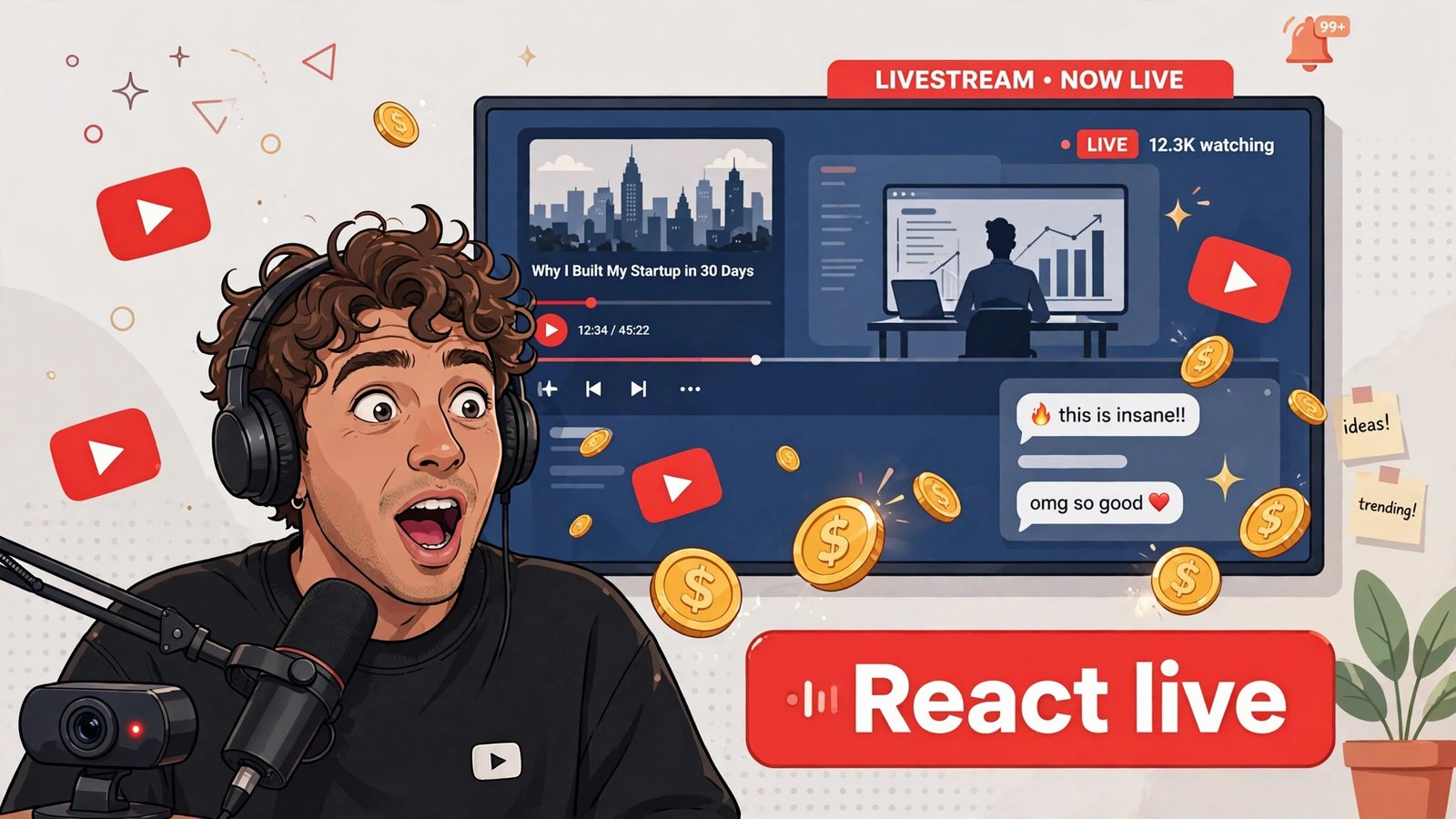
Reaction content just went from YouTube’s most legally awkward genre to an official, monetizable feature. At Made on YouTube on September 23, 2026, YouTube announced it is expanding Watch With — the tool that lets creators react live to other creators’ content — from livestreams to all eligible long-form videos across the platform. A new “React live” button will let any creator pull someone else’s video into their own livestream, react to it in real time, and keep the money the stream earns.
Here’s the part that has the creator economy arguing: the person who made the video gets no cut of the reaction stream’s revenue.
What Watch With actually is
Watch With isn’t brand new. YouTube first piloted it in 2024 around major live events — think creators reacting alongside big tentpole broadcasts — and earlier this year it began testing reactions between creators’ own livestreams. The concept was simple: instead of every reactor cobbling together a janky screen-share setup, YouTube built the format into the platform.
The September expansion takes it much further. “Whenever inspiration strikes, you can tap ‘React live’ on any eligible long form video or livestream to jump right into the conversations happening across the platform,” YouTube Live product lead Barbara Macdonald wrote in the official announcement. In YouTube’s demo, the original video sits above the reactor’s camera feed — your face, their video, one stream.
The rollout starts later in 2026. That’s the timeline YouTube committed to — not “coming soon” vagueness, but an actual window.
The money split: who gets what
This is the part worth reading twice, because it’s genuinely unusual. YouTube designed two completely separate deals for the two creators involved:
The reacting creator keeps:
– Live ad revenue earned during the reaction stream
– Fan funding — Super Chats, Super Stickers, channel memberships, gifts
– Views on their own stream
The original creator gets:
– Clear attribution (their video is credited on-screen)
– Added view credit in YouTube Studio
– Full control over which of their videos can be reacted to — a veto
– No share of the reaction stream’s ad revenue or fan funding
Read that last line again. Someone can take your video, stream themselves reacting to it for two hours, collect ad money and Super Chats the entire time — and you, the person who made the thing being watched, get credit and a view count bump. Not a dollar of their stream’s earnings.
YouTube’s framing: “We’ve designed the feature with creators on both sides in mind.” The reacting creator keeps what their stream earns; the original creator “still earns whatever their original video brings in” plus the extra exposure. Whether that feels balanced depends entirely on which side of the screen you’re on.
Why this is a huge deal for reaction creators
For years, reaction content lived in a gray zone. Creators built entire channels around reacting to videos, and the economics were a mess: copyright claims, demonetization, takedowns, and constant fights over whether a reaction was “transformative” enough. YouTube itself warned in July 2025 that reaction content with little original insight could lose monetization.
Watch With flips that on its head. A built-in “React live” button that pays the reactor is YouTube officially blessing the genre — with a revenue model attached. No more screen-recording workarounds. No more wondering if the video will get claimed mid-stream. The format is now first-class, and the money flows to the person doing the reacting.
It also solves the discovery problem reaction creators have always had. Instead of hunting for something worth reacting to, you can tap a button on any eligible video the moment it’s trending and go live around it. The stream rides the original video’s momentum while it’s hot.
The uncomfortable side: original creators get exposure, not money
Now the other side. Imagine you spend three weeks producing a documentary-style video. It blows up. And then a bigger streamer taps “React live” on it, streams a two-hour reaction to 50,000 concurrent viewers, and pockets every ad dollar and Super Chat — while you get an attribution line and some extra views in Studio.
Is that fair? YouTube’s answer is essentially: you got paid for your video through your own monetization, the reaction gives you free promotion, and you can veto any video you don’t want reacted to. The veto is real power — full control over which videos are eligible.
But several things remain genuinely unanswered, and the press covering this has been right to press on them:
- What does “added view credit” actually convert into? YouTube hasn’t said whether reaction-driven views generate AdSense revenue for the original creator or just inflate a Studio metric. If the views don’t pay, the “compensation” is exposure — the oldest and least spendable currency on the internet.
- Is a reaction view a full view? Tubefilter asked whether the original creator gets one full view per reaction viewer or some fraction. With YouTube’s recent change to count views from the first frame, this matters for algorithmic velocity.
- What makes a video “eligible”? The announcement never spelled out eligibility criteria. Content with third-party copyrighted material inside it — music, clips, footage — could turn a reaction stream into a claims minefield.
- Opt-in or opt-out? YouTube hasn’t said whether catalogs start opted in or opted out. In the live-to-live tests, streams were reportedly opted in by default. If your back catalog wakes up opted in, that’s a very different proposition than choosing video by video.
These aren’t nitpicks. They’re the difference between “great exposure deal” and “someone monetizes your work while you watch.”
Why YouTube is doing this now
The numbers explain the urgency. In August 2026, more than 600 million logged-in viewers watched live content on YouTube on an average day (including archived streams). Over 40% of live watch time comes from viewers outside the creator’s home country. Live is not a side format anymore — it’s one of YouTube’s biggest surfaces, and reaction content is one of live’s most reliable engines.
There’s also a competitive logic. TikTok baked reaction-style formats (duets, stitches) into its DNA years ago and turned them into engagement machines. YouTube watched an entire generation of creators build reaction businesses off-platform or in gray zones, and Watch With is the platform reclaiming that behavior — keeping the watch time, the ad inventory, and the Super Chats inside YouTube’s walls.
And it’s part of a much bigger live push. The same announcement included creator matchmaking for co-streams (early 2027), Live Showdown competitions (2027), and live auto-dubbing that translates a streamer’s voice in real time (early 2027). YouTube is clearly betting that live — not just video-on-demand — is where the next wave of creator revenue lives.
What to do now: the playbook for both sides
If you’re a reaction-style creator (or want to be):
- Start building the muscle now. The format rewards people who can react well — commentary, jokes, analysis that makes the reaction worth watching on its own. The creators who’ll win when the button goes live are the ones already good at the craft, not the ones who start practicing in December.
- Think in niches, not in trends. Reacting to whatever’s viral is a commodity play. Reacting within a niche where your commentary adds real expertise — finance creators reacting to market news, chefs reacting to cooking videos, lawyers reacting to courtroom footage — is where the audience loyalty (and Super Chats) live.
- Remember the July 2025 warning still exists. YouTube demonetizes reaction content with little original insight. A built-in button doesn’t exempt you from that standard — if anything, it raises the bar, because now there’s an official “right way” to do it.
If you’re an original creator worried about being reacted to:
- Audit your catalog before rollout. Decide now which videos you’d want eligible and which you wouldn’t. Your tentpole, high-effort pieces are the ones most likely to attract big reactors — and the ones where “exposure” feels thinnest as compensation.
- Watch the opt-in default like a hawk. When the feature rolls out, check your Studio settings immediately. If YouTube defaults your catalog to opted in, that’s a decision the platform made for you — make your own deliberately.
- Consider the upside honestly. A reaction from a creator 10x your size is genuinely valuable distribution. Some creators will find that the attribution + view credit + new subscribers outweigh the missing revenue share. The veto means you can say yes to the reactors who grow your audience and no to the ones who just farm it.
The TikTok parallel: YouTube is copying the duet playbook
None of this is happening in a vacuum. TikTok figured out years ago that reaction formats — duets, stitches — are engagement machines, and built them directly into the app so the behavior stays on-platform. YouTube watched an entire generation of creators build reaction businesses in gray zones and is now doing the same thing: formalizing the format, keeping the watch time inside YouTube, and taking its usual cut of the ad inventory.
The difference is the money. TikTok’s duets never had a real revenue split — they were about reach. YouTube is attaching actual dollars (live ads, Super Chats, memberships) to the reaction itself, which makes Watch With less a discovery feature and more a new income stream. For creators who already understand YouTube’s monetization requirements, the math is familiar: the reactor’s stream is monetized like any other eligible livestream — the novelty is whose content fills the screen.
It also continues a pattern from this year’s Made on YouTube, where the platform has been aggressively adding creator tools — we covered the AI announcements from the same event when they dropped. Watch With is the live-streaming half of that same strategy: give creators more native formats so they stop building audiences on workarounds.
Turning reactions into revenue (even as the original creator)
If you’re on the original-creator side and the “no cut” part stings, there’s a more strategic read: a reaction stream is free distribution with your name on it. Creators who play this well can convert it:
- Make your videos reaction-friendly. Clear hooks in the first 30 seconds, quotable moments, strong opinions — the same things that make a video shareable make it reactable. If reactors are going to come anyway, give them material that sends viewers back to your channel.
- Engage with your reactors. Comment on the reaction stream, clip the best moments, collaborate. A reactor with an audience becomes a distribution partner the moment you treat them like one instead of a threat.
- Use the veto surgically, not emotionally. Blocking every reaction is your right, but it’s also leaving money and exposure on the table. Reserve the veto for low-effort farm channels and bad-faith edits; say yes to reactors whose audiences overlap with yours.
And keep perspective on platform payouts generally — Facebook’s creator payouts work on completely different math than YouTube’s, which is why diversifying across platforms still beats depending on any single revenue split, however it’s structured.
For the full walkthrough of the announcement — including the demo of how the React live button works — YouTube’s Creator Insider covered all four new live tools here:
Frequently asked questions
What is YouTube Watch With?
Watch With is YouTube’s built-in feature that lets creators react live to other creators’ content. It was piloted in 2024 for major live events, tested for creator-to-creator livestream reactions earlier in 2026, and is now expanding to all eligible long-form videos with a rollout starting later in 2026.
Do original creators get paid when someone reacts to their video?
Not from the reaction stream itself. The reacting creator keeps the live ad revenue and fan funding. The original creator gets attribution, added view credit in YouTube Studio, and control over which videos are eligible — but YouTube has not confirmed any revenue share from the reaction stream, or whether the “view credit” converts to AdSense earnings.
Can I stop people from reacting to my videos?
Yes. YouTube says original creators have full control over which of their videos can be used for Watch With. You’ll be able to manage this in YouTube Studio settings — though YouTube hasn’t yet confirmed whether videos start opted in or opted out.
When does the Watch With expansion launch?
YouTube says the rollout to eligible long-form videos starts later in 2026. No exact date has been announced.
How is this different from regular reaction videos?
Regular reaction videos are uploaded as VODs and live under standard copyright and monetization rules (including the July 2025 warning about low-insight reactions). Watch With is a live format with a dedicated “React live” button, built-in attribution, and a defined revenue split where the reactor keeps the stream’s earnings.
What else did YouTube announce for live creators?
Alongside Watch With: creator matchmaking for co-streams (early 2027), Live Showdown fan-funding competitions (2027), and live auto-dubbing for real-time translation (early 2027). YouTube reported 600M+ daily logged-in live viewers in August 2026.
Does Watch With affect my video’s copyright?
The feature operates within YouTube’s systems with the original creator’s consent via eligibility controls. However, complications can arise if the original video itself contains third-party copyrighted material. YouTube hasn’t fully detailed how claims work on reaction streams yet — worth watching as rollout approaches.