
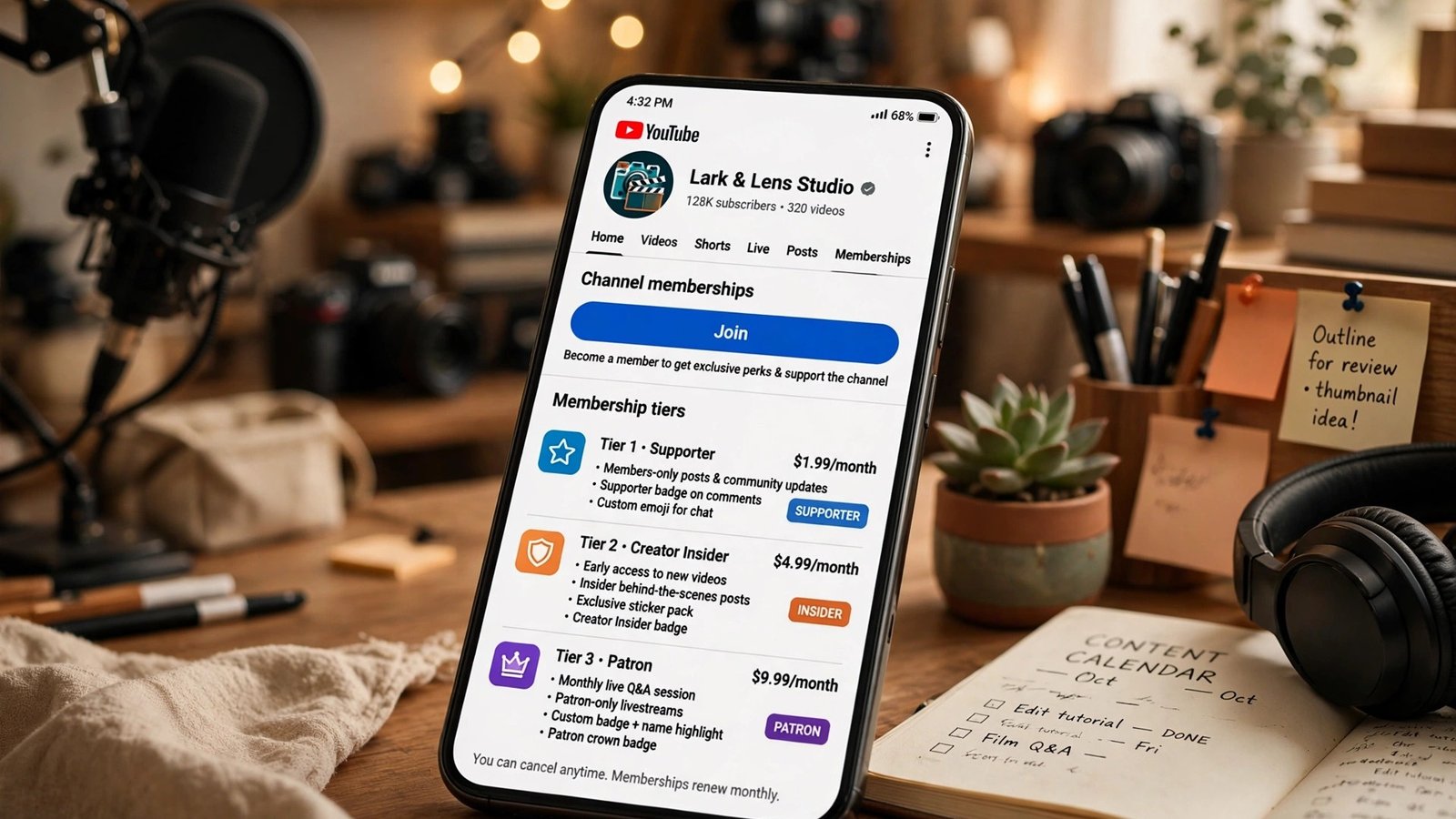
YouTube quietly dropped a number this month that should make every small creator rethink their income mix: channel memberships have paid creators more than $1.5 billion over the last five years. That’s not ad money. That’s viewers paying creators directly, month after month.
And it landed at exactly the right moment. YouTube just announced it’s doubling the Partner Program ad threshold — new applicants will need 8,000 qualified watch hours (up from 4,000) or 20 million qualified Shorts views (up from 10 million) starting February 1, 2027. Ad revenue is getting harder to reach, and harder to keep. Memberships, on the other hand, unlock at just 500 subscribers.
This is the plan B that doesn’t require going viral. Here’s how it actually works in 2026.
What changed this month
YouTube’s October 1, 2026 announcement for news publishers confirmed the $1.5 billion figure and rolled out three upgrades to memberships: a dedicated in-app hub where members find exclusive content, video previews so prospects can sample a members-only video before joining, and members-only communities — private spaces where paying supporters can post and interact separately from regular comments, discoverable through a new channel-memberships discovery page.
That’s a meaningful shift. Memberships used to be a button under your videos. Now they’re becoming their own product surface — something YouTube is actively pushing toward viewers, not just something creators set and forget.
The timing isn’t accidental. With the February 2027 YPP changes pushing ad revenue further out of reach for new creators, YouTube needs a credible “you can still earn here” story. Memberships are that story.
The honest math: what you actually keep
Let’s not dance around the numbers. YouTube keeps 30% of membership revenue and you keep 70% — and YouTube covers the payment processing fees on web sign-ups. Compare that to Patreon, which moved new creators to a flat 10% platform fee in 2026 (plus Stripe processing around 2.9% + 30¢ per transaction).
On a $5/month membership, YouTube hands you roughly $3.50. Patreon hands you roughly $4.35 on the same tier. Patreon wins on the fee math — but that ignores the biggest variable: friction. On YouTube, the viewer is already watching your video when the Join button appears. On Patreon, you have to send them somewhere else entirely. Creators who’ve tried both usually land on the same conclusion: run memberships for casual supporters who convert inside YouTube, and use Patreon or a dedicated platform only if you want deeper customization later.
One watch-out: if a viewer joins inside the iOS or Android app instead of on the web, Apple or Google takes its app-store cut first, which shrinks your share. It costs nothing to nudge people toward joining from a browser — mention it in your welcome video.
Who can turn this on (it’s lower than you think)
Memberships unlock at the Partner Program’s fan-funding tier, not the full ad tier. As of 2026, that’s:
- 500 subscribers (not 1,000)
- 3 valid public uploads in the last 90 days
- 3,000 qualified watch hours in the last 12 months or 3 million qualified Shorts views in the last 90 days
- Channel owner 18+, no active Community Guidelines strikes, not set as “Made for Kids”
This is the detail most small creators miss. You can be nowhere near ad revenue — and still earn recurring income from memberships. That’s exactly why the $1.5 billion figure matters more in 2026 than it would have in 2024: the ad door is narrowing while the membership door stays wide open.
How to set it up (the version that actually converts)
The setup itself takes an afternoon. The strategy is what separates channels earning pocket change from channels earning rent money.
Pick 2–3 tiers, not six
YouTube allows up to 6 tiers priced between $0.99 and $499.99, with higher tiers automatically including the perks below them. Don’t use all six. Most converting channels run two or three tiers — a low-friction entry ($1.99–$2.99), a core tier ($4.99), and one premium tier ($9.99+) for your superfans. Each extra tier is a decision your viewer has to make, and every decision is a chance to bounce.
Since June 2026, membership prices have been set as exchange-rate-based recommended rates per country. If you joined members at an older price, they keep it — only new members pay the updated rate. Good to know if you’re advising your existing audience.
Sell the community, not the badge
The channels that do well here aren’t selling loyalty badges and custom emojis — those are the garnish. What sells is belonging: members-only livestreams, early access to videos, a private community where you actually show up, behind-the-scenes content. The October updates made this easier to deliver (members-only communities with a discovery page), so take advantage of the new surface.
A practical rule from creators who’ve tested it: your members-only content should be something your regular viewers can see the edges of — the new video previews feature is built for exactly this. Let free viewers taste it, then join to get the meal.
Treat it like a business metric
Memberships have a churn problem nobody talks about: viewers can cancel anytime, and they do. Track your member count monthly the way you’d track ad revenue. A common failure pattern is launching tiers, promoting them once, then letting perks go stale — unhappy members cancel, and that’s the end of your recurring income. If you can’t deliver at least one real perk every month, wait until you can.
What memberships can’t do
Honesty matters here. Memberships won’t save a channel with no audience — 500 subscribers is the minimum to unlock the feature, but you need real engagement on top of that. At very small sizes, expect your first members to be counted in dozens, not hundreds. That’s fine. A dozen members at $4.99 is ~$42/month after YouTube’s cut — small, but it’s recurring income that doesn’t depend on the algorithm, and it grows with your channel instead of resetting to zero every month like ad impressions do.
Also: you don’t own the relationship. YouTube owns member data, you can’t export your paying members, and you can’t adjust pricing freely (one price change per tier per year). If you ever want a real membership business with apps and owned data, memberships are the starting point, not the destination. For most creators in 2026, though, the starting point is exactly what they need.
The bottom line
YouTube just told us two things at once: memberships have moved $1.5 billion to creators in five years, and the ad threshold is doubling in February 2027. Read those together and the message is obvious — the platform is steering small creators toward direct audience income. The creators who set up memberships in the next four months will have a head start on the ones who wait until the new thresholds land.
If you’re at or near 500 subscribers, this is the single highest-leverage thing you can do this quarter. Set up two tiers, promise one real perk a month, and point every new video at the Join button. Your future self — the one who doesn’t qualify for ad revenue under the new rules — will thank you.
Frequently Asked Questions
How much does YouTube take from channel memberships?
YouTube keeps 30% and you keep 70% of membership revenue, with YouTube covering payment processing on web sign-ups. If a member joins through the iOS or Android app, Apple or Google takes an additional app-store commission first, so encourage web sign-ups.
Can I get YouTube channel memberships with 500 subscribers?
Yes. Memberships unlock at the Partner Program’s fan-funding tier: 500+ subscribers, 3 valid public uploads in the last 90 days, and either 3,000 qualified watch hours in 12 months or 3 million qualified Shorts views in 90 days. The 1,000-subscriber requirement applies to ad revenue, which is a separate tier.
How much can I earn from YouTube memberships?
It depends entirely on your conversion rate and tier pricing — there’s no reliable average by channel size. What you can calculate is straightforward: members × tier price × 70%, minus local sales tax. A channel with 50 members at $4.99 keeps roughly $175/month after YouTube’s cut.
Is YouTube memberships better than Patreon in 2026?
Patreon is cheaper on fees (10% flat for new creators plus processing vs. YouTube’s 30%), but YouTube memberships convert better for most creators because viewers join inside YouTube without leaving. Many creators run both: YouTube for casual supporters, Patreon for deeper community tools and owned data.
Can I change my membership prices later?
Yes, but only once per tier per year. Existing members stay locked at the price they joined at — only new members pay the updated price. Since June 2026, prices are set as exchange-rate-based recommended rates that vary by country.
What perks should I offer on YouTube channel memberships?
The perks that convert are community and access: members-only livestreams, early access to videos, exclusive behind-the-scenes content, and the new members-only community spaces. Badges and custom emojis are nice extras, not the selling point — and the new video-preview feature lets prospects sample members-only content before joining.