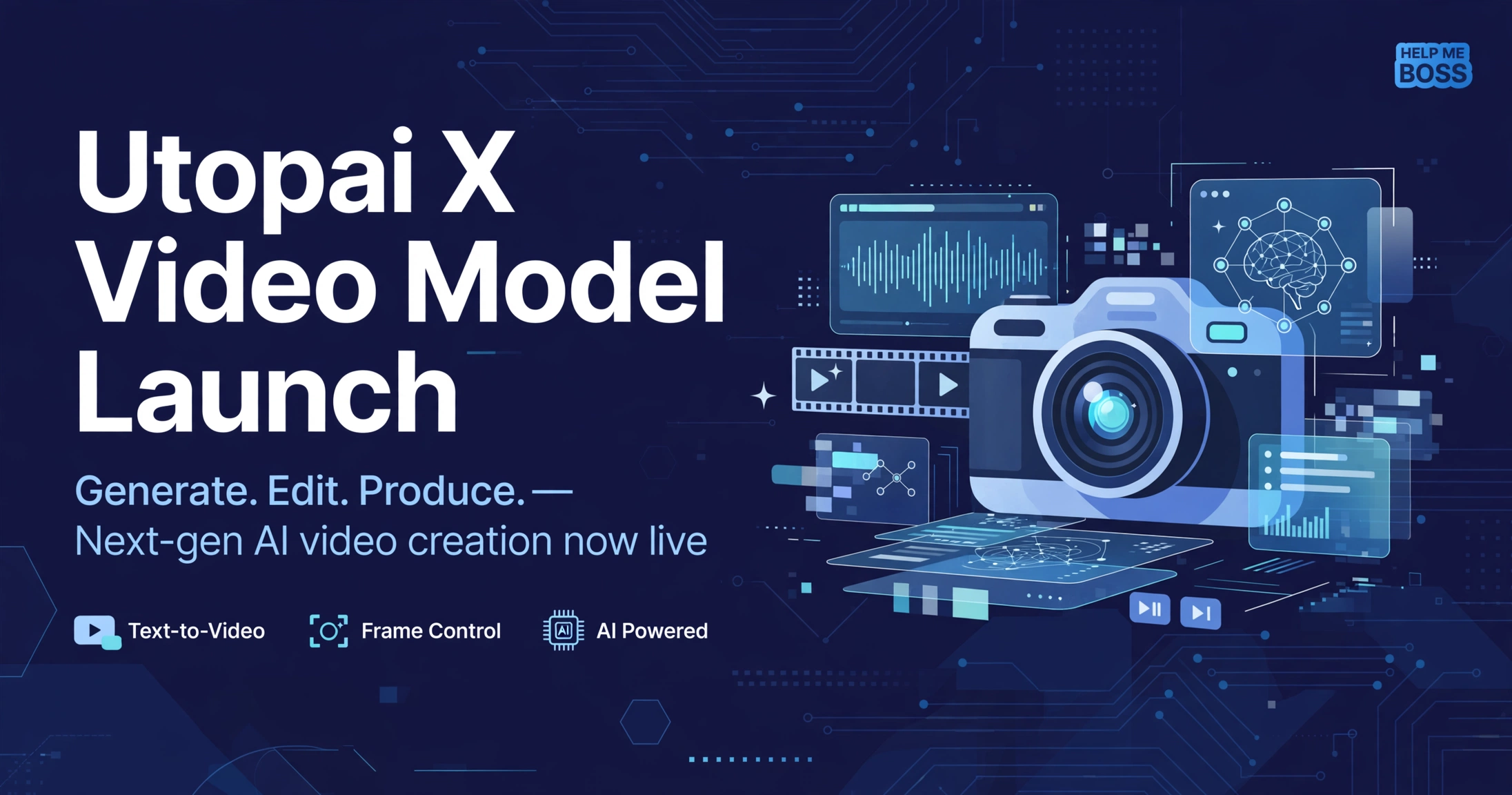
Most AI video tools hand you a prompt box and a render button. Utopai Studios just launched something different: PAI, a full production platform that carries a film’s screenplay, characters, locations, and visual references from script to finished shot — powered by Utopai X, a video model that now ranks No. 2 in the world on the leading independent benchmark.
Announced October 1, 2026, this isn’t another consumer toy. It’s built inside a working film and TV studio, for professional production. Here’s what launched and why creators should pay attention.
What PAI Actually Is
PAI stands for Production Assistive Intelligence. Instead of generating isolated clips, the platform keeps your entire production connected: the screenplay breaks into scenes and shots, an AI “production assistant” proposes shot plans and visual iterations from that material, and the filmmaker decides what gets made, kept, and revised. Previous versions stay available as the project develops.
The workflow mirrors how real productions run — plan shots, develop assets, generate footage, review takes, manage revisions — except the generation layer is AI. Finished footage can move into an editing timeline and export to Adobe Premiere and DaVinci Resolve, so it slots into existing post-production pipelines rather than replacing them.
PAI is already in use on The Most Serious Fart, an animated feature written and directed by Mike Bender — a real production, not a demo reel.
Utopai X: The Model Behind It
Utopai X supplies the generation inside PAI, and its numbers are striking. On Artificial Analysis’ Text-to-Video Leaderboard With Audio (September 29, 2026 results), Utopai X sits at No. 2 globally with an Elo of 1,150 — just nine points behind the top-ranked Wan 3.0. That also makes it the highest-ranked model from a US-based company on the board.
Artificial Analysis scores models through blind human-preference testing — viewers compare outputs without knowing which model made them — so the ranking reflects what actual humans prefer, not a lab metric.
The studio says Utopai X is built on an existing video foundation model, developed further against its own production needs. Its claimed strengths are the details that decide whether a shot holds together as complexity grows: reflections, caustics, and spatial consistency — the way light behaves on water and glass, and the way characters and objects stay coherent when the camera moves.
Why This Launch Matters
The AI video race has mostly been about single clips: who generates the prettiest 10 seconds. Utopai is attacking the harder problem — consistency across a production. Anyone who’s tried to make a multi-scene AI video knows the pain: faces drift, rooms rearrange, props change color between shots. A platform that tracks characters, locations, and creative decisions across every shot is aimed directly at that failure mode.
It’s also a sign of where the industry is heading. The Mountain View studio developed PAI inside its own productions, which means it’s shaped by real filmmaking constraints — revision workflows, editorial handoff, director control — rather than tech-demo aesthetics. As the studio’s chief scientific officer put it, the goal is giving filmmakers more control over their ideas: explore more possibilities, iterate faster, and make creative decisions with intention.
For independent creators, the near-term takeaway is practical: the consistency problem is being solved at the platform level, which means the multi-shot AI workflows that are painful today — like the ones in our faceless YouTube video guide — are about to get dramatically easier.
PAI in Practice: The Filmmaker’s Workflow
Here’s how a production actually moves through PAI, based on the launch details:
- Script intake — the screenplay is broken into scenes and shots inside the platform, carrying characters, locations, and visual references with it
- AI-assisted shot planning — the production assistant agent proposes shot plans and visual iterations from the script material
- Filmmaker review — the director decides what gets made, kept, and revised; nothing generates without approval
- Take management — selected takes are kept, previous versions stay available, and revisions build on the production’s connected context
- Editorial handoff — finished footage exports into Adobe Premiere or DaVinci Resolve timelines
The key design choice: the AI proposes, the filmmaker disposes. That’s a deliberate contrast with fully-automated video tools — PAI is built for productions where creative control is non-negotiable.
The Benchmark Landscape
Utopai X’s No. 2 ranking deserves context. Artificial Analysis’ Text-to-Video Leaderboard With Audio uses blind human-preference testing — real people comparing unlabeled outputs — which makes it one of the harder leaderboards to game. The September 29, 2026 board had Utopai X at Elo 1,150, nine points behind Wan 3.0 at the top.
Two things make that notable. First, it’s the highest-ranked model from a US-based company, which matters in a field where the top spots have increasingly gone to Chinese labs. Second, rankings in this space move fast — a nine-point gap is genuinely close, and the board re-dates with every round of testing. For creators evaluating tools, the takeaway isn’t “Utopai X is the best” — it’s that the quality gap between the top models has compressed to the point where workflow and consistency matter more than raw generation quality.
What to Watch Next
Three things will decide whether PAI matters beyond studio press releases: whether the platform opens to independent creators or stays enterprise-only, whether the consistency gains survive contact with real-world production chaos (tight deadlines, client revisions, mixed pipelines), and how fast competitors copy the production-platform model. The benchmark crown is nice, but in AI video the workflow always beats the demo. If PAI ships the workflow it promises, every other video tool will need an answer for it.
Related: Kling 3.0 vs Veo 3.1: Which AI Video Costs Less? (2026)
Frequently Asked Questions
What is Utopai’s PAI platform?
PAI (Production Assistive Intelligence) is Utopai Studios’ production platform for film and television. It connects screenplay, characters, locations, assets, and creative decisions through shot planning, AI footage generation, take review, and revision management.
How good is the Utopai X video model?
It ranks No. 2 globally on Artificial Analysis’ Text-to-Video Leaderboard With Audio with an Elo of 1,150 (September 2026), nine points behind Wan 3.0 — and it’s the highest-ranked model from a US-based company.
Is PAI available to individual creators?
It’s designed for professional film and television production rather than casual consumer use. The launch announcement focuses on studio workflows, Premiere/DaVinci export, and feature-film use cases.
What makes Utopai X different from other AI video models?
Its strengths are production-critical visual behaviors — reflections, caustics, and spatial consistency — plus a platform (PAI) that maintains character and location continuity across an entire production instead of generating isolated clips.
Where can I read the official announcement?
Utopai Studios published the launch via Business Wire on October 1, 2026, and industry press including Advanced Television covered the details the same day.