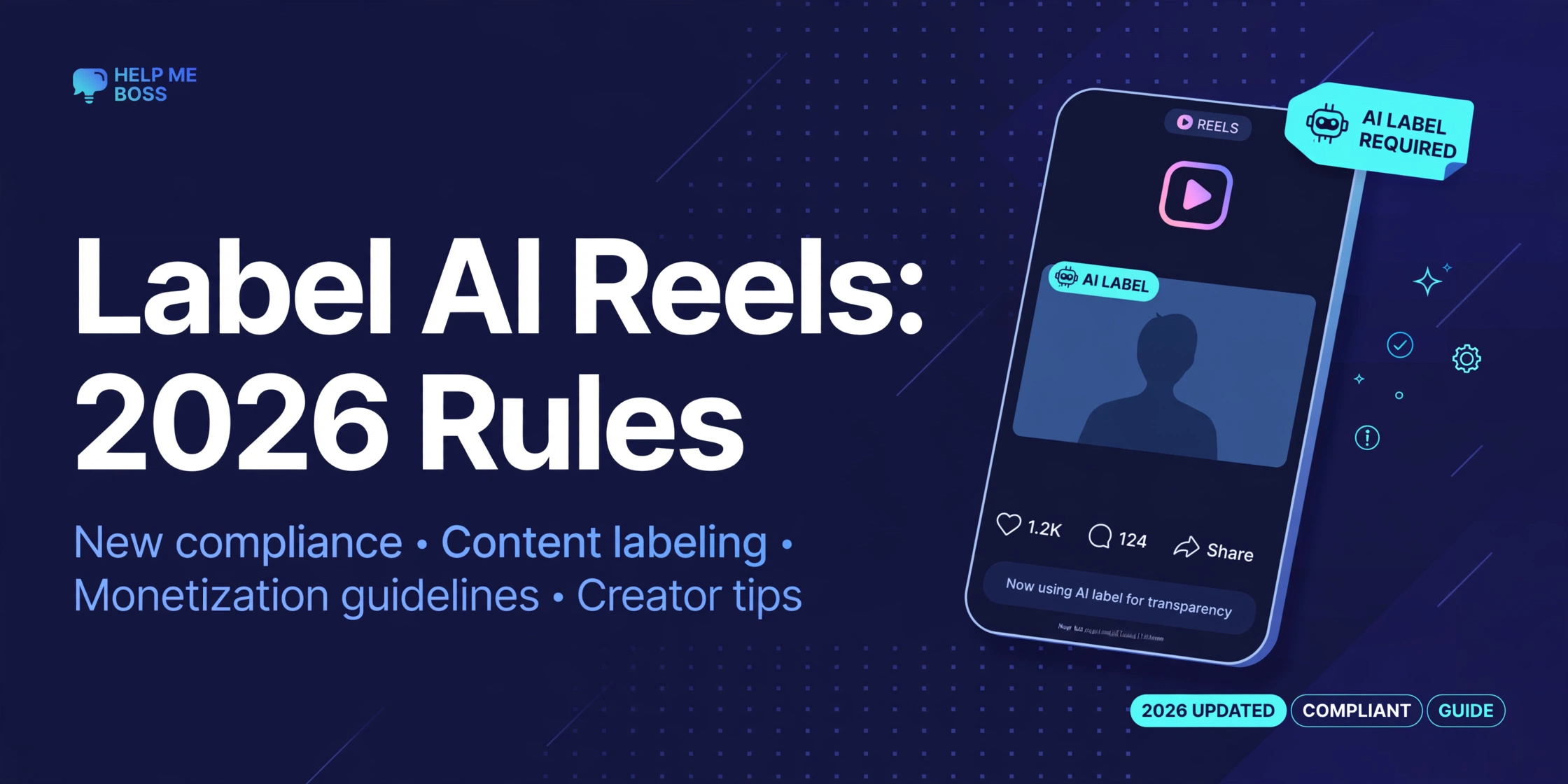
Short answer: yes — if your reel looks realistic and AI made or meaningfully altered it, you have to say so. In 2026, Meta, YouTube, and TikTok each require disclosure at upload, and the rule isn’t about whether you used AI. It’s about whether the result looks real.
This trips up a lot of creators, because the systems don’t talk to each other and the penalties differ. Here’s the full picture.
Meta’s rule: disclose photorealistic AI video and audio
Meta requires you to disclose when you post organic content with photorealistic video or realistic-sounding audio that was digitally created or altered. You do this with the disclosure tool at upload, and Meta attaches an “AI info” label.
Meta also tries to detect AI content itself through three parallel paths:
- Provenance signals — embedded metadata like C2PA manifests and IPTC Digital Source Type in the file header. If your AI tool writes these (many now do), Meta can read them.
- Classifiers — Meta’s own models that infer AI origin from the content itself.
- Your disclosure — the manual toggle at upload.
Here’s the catch: these paths don’t interoperate perfectly. The same file can get labeled on one surface and not another. Explicit self-disclosure at upload is the only control you fully own — don’t rely on Meta detecting it for you.
What about ads? The rules are stricter. Meta automatically labels ad creative made or significantly edited with its own generative AI tools (Background Generation, Image Generation, Add Animation), and detects third-party AI tools via C2PA. Advertisers using third-party tools must disclose manually.
What happens if you skip it: Meta can apply penalties for undisclosed AI content, and for high-risk deceptive synthetic media it can add a more prominent label or reduce distribution. After the Oversight Board’s September 2026 ruling, expect enforcement to tighten — the Board called Meta’s safeguards “fundamentally inadequate” and demanded lower thresholds for “High Risk” labels and tougher penalties for repeat offenders.
YouTube’s rule: the “altered content” setting
YouTube requires creators to disclose when they’ve created altered or synthetic content that appears realistic — including realistic scenes, people, or events that didn’t happen. You set this in the upload flow (“Altered content” → Yes), and YouTube adds a label to the video.
Penalties for skipping: YouTube can apply the label itself, remove the content, or suspend repeat offenders from the YouTube Partner Program. For a monetized channel, that’s real money at stake — see YouTube Shorts monetization requirements for what’s on the line.
TikTok’s rule: label AI-generated realistic content
TikTok requires the AI-generated label on content that shows realistic scenes or people and was AI-generated or significantly edited. TikTok says content that skips required labeling “may be removed, restricted, or labeled by our team.”
What does NOT need a label
This is where creators over-worry. Across all three platforms, routine AI-assisted production doesn’t trigger disclosure:
- Color grading, upscaling, object cleanup, noise removal
- AI-generated captions or subtitles
- AI-assisted script writing or idea brainstorming
- Beauty filters and standard editing effects (within reason)
The trigger is always the same: would a viewer mistake this for a real person, place, or event? A talking-head video of your real self with AI-cleaned audio needs no label. A photorealistic AI avatar presenting as you does.
The law is now separate from platform policy
In 2026, disclosure isn’t just a platform rule — it’s law in places:
- New York requires conspicuous disclosure in advertisements containing an AI-generated human performer when you have actual knowledge of it. First violation: $1,000; subsequent violations: $5,000 each.
- The EU AI Act’s transparency obligations took effect August 2, 2026, requiring AI-generated content to be clearly labeled.
Platform policy costs you distribution. The statute costs you money. Neither asks whether you used AI — both ask whether the result looks real.
A practical disclosure workflow for reels
- At creation: decide honestly — could a viewer mistake this for real? If yes, plan to disclose.
- At upload: use each platform’s disclosure toggle (Meta’s disclosure tool, YouTube’s altered-content setting, TikTok’s AI label). Don’t rely on auto-detection.
- In the caption: for extra safety on branded or sensitive content, add a plain-language line like “Created with AI.” It costs nothing and preempts complaints.
- Keep records: note which tool made what, especially for client or ad work. If a platform or regulator ever asks, you’ll have the answer.
Labeling doesn’t hurt honest creators. Unlabeled AI influencer profiles are the ones losing reach — the label itself isn’t the penalty, hiding is.
Finding the disclosure toggle on each platform
Knowing the rule is half the battle; finding the switch is the other half. Here’s where each platform puts it:
Facebook/Instagram: In the post or Reel composer, look for the AI disclosure option before publishing — typically under advanced settings or a dedicated “AI-generated content” prompt. For ads, Ads Manager includes a disclosure control you must use when creative contains AI-generated or manipulated content. Meta also auto-detects C2PA metadata, but treat that as a backup, not your compliance plan.
YouTube: In YouTube Studio’s upload flow, the Details tab includes an “Altered content” section. Select “Yes” when your video contains realistic AI-generated or synthetically altered content. YouTube then displays a label on the video. This applies to Shorts too.
TikTok: In the post composer, apply the “AI-generated” label to the post when it shows realistic AI-generated or significantly edited scenes or people. TikTok also auto-labels content carrying C2PA credentials, but again — disclose manually rather than hoping detection catches it.
A useful habit: make disclosure part of your export checklist, right next to captions and thumbnails. The creators who get in trouble are the ones who “meant to” disclose and forgot in the rush to publish.
Official source: Meta
Frequently Asked Questions
Do I need to label AI music in my reels?
If the audio is AI-generated and realistic-sounding (like a synthetic voice), Meta’s rule covers realistic-sounding audio too. Background AI music beds are a gray area — disclosing costs nothing and keeps you safe.
What if Meta auto-labels my content incorrectly?
Detection isn’t perfect. If a label is wrongly applied, you can appeal through the platform’s usual channels. Keep your creation records to support the appeal.
Does labeling reduce my reach?
No — the label itself isn’t a ranking penalty. What’s penalized is undisclosed deceptive synthetic media and unoriginal content generally.
Do I need to disclose if I only used AI for the script?
No. AI-assisted writing, brainstorming, and editing don’t trigger disclosure on any major platform. The test is whether the final video or audio appears realistic and was AI-generated or meaningfully altered.
What about political or election content?
Stricter rules apply everywhere. Meta requires disclosure of AI-altered content in political ads including third-party AI usage, and several jurisdictions have specific election-deepfake laws. When in doubt, disclose prominently.