
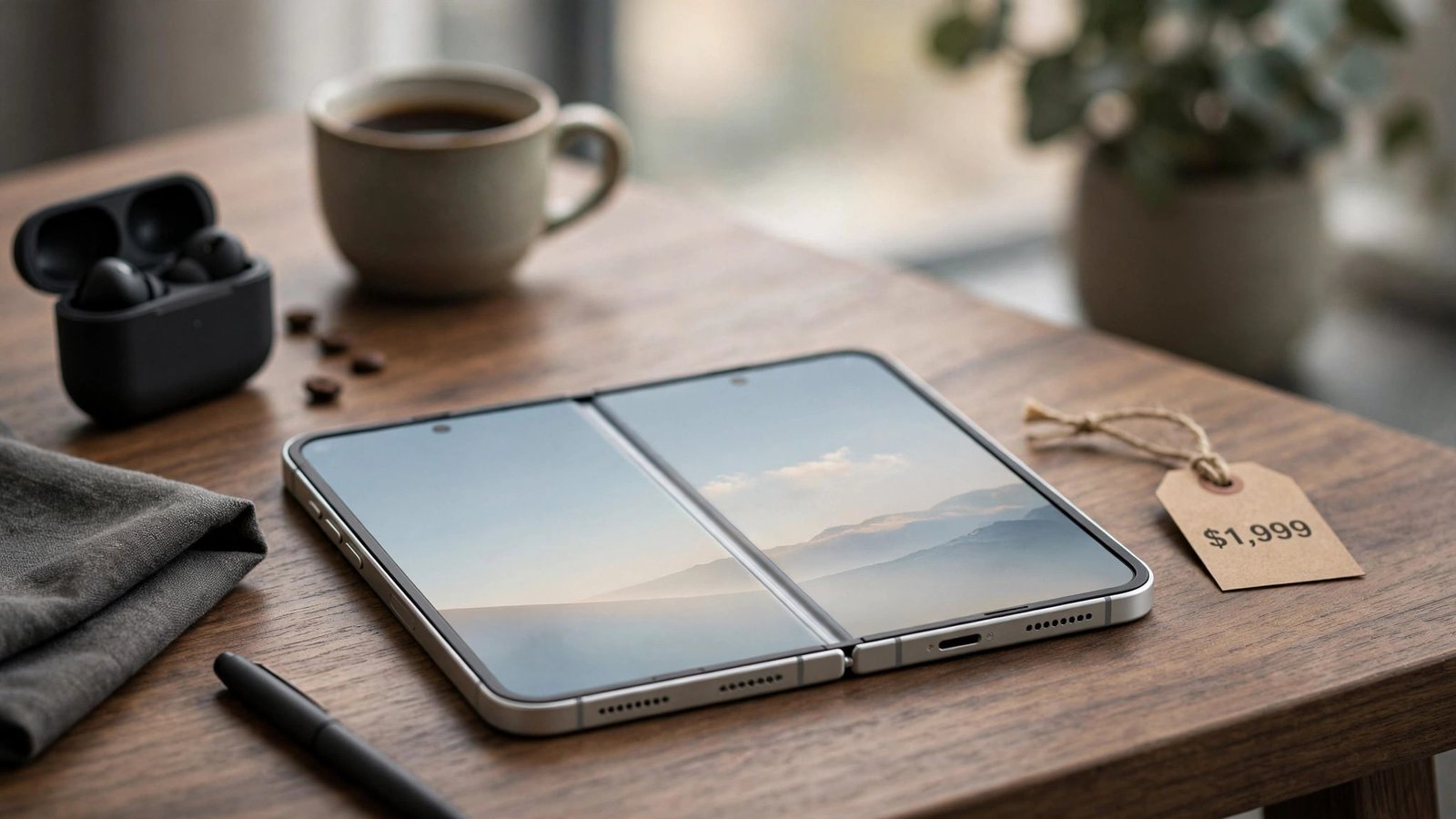
Apple’s first foldable, the iPhone Duo, opened pre-orders on October 16, 2026, and launches October 23 at a starting price of $1,999 for 256GB. So here’s the straight answer: buy now only if you’ll unfold that 7.6-inch inner display every single day and you can lock in a real carrier deal; wait if cameras, durability proof, or a thinner second generation matter more to you. That $1,999 isn’t really a phone price — it’s a decision about whether you want to be the one paying for Apple’s first year of foldable experience.
I’ll be honest with you: this isn’t a specs article. You can get the spec sheet anywhere. What you need is the math — the buy-vs-wait math that tells you whether that two grand is a smart move for your specific situation, or whether waiting costs you nothing and saves you a lot.
What you’re actually paying for (the facts, verified)
Let’s get the confirmed facts on the table first, all verified from launch-week reporting, then we’ll do the interesting part:
| Fact | Verified detail |
|---|---|
| Price tiers | $1,999 (256GB) / $2,199 (512GB) / $2,599 (1TB) / $3,199 (2TB) |
| Pre-orders | Opened October 16, 2026, 5 a.m. PT |
| Launch date | October 23, 2026 (70+ countries); 28 more countries on October 30 |
| Colors | Star White, Night Sky |
| Displays | 7.6-inch inner / 5.4-inch outer, both Super Retina XDR OLED, ProMotion to 120Hz |
| Chip | A20 Pro (2nm) |
| Cameras | Dual 48MP (main + ultra-wide), no telephoto, 12MP Center Stage front |
| Security | Touch ID in the side button (no Face ID) |
| Build | Grade 5 titanium frame, IP68 rated, 254 grams, 5.2mm open / 11.3mm closed |
| Software | Ships with iOS 27.1; Split View multitasking on iPhone for the first time |
| Connectivity | eSIM only, worldwide |
| Apple financing | $83.29/month for 24 months on the base model |
| Apple Trade In | Up to $885 (iPhone 17 Pro Max); starts around $175 for an iPhone 13 |
| Accessories | Duo Case $79, Duo Folio with Kickstand $129 |
Sources: MacRumors’ pricing and pre-order coverage, WhistleOut’s iPhone Duo guide, and Apple’s iPhone Duo announcement.
One more fact that matters a lot for your decision: pre-orders sold out within about half an hour. Apple’s US online store started quoting January 25, 2027 for every configuration shortly after pre-orders opened — roughly a 14-week wait, which Morgan Stanley noted is the longest recorded wait for a new iPhone in a decade. Bloomberg’s Mark Gurman even called the pre-order timing a “major mistake,” saying Apple knowingly launched with “severe supply constraints” rather than waiting to build inventory. Translation: even if you decide to buy today, you may not hold one until February.
The buy-or-wait decision, worked three ways
Most foldable-buying advice stops at “it’s $1,999, is it worth it?” That’s the wrong question. There are three separate decisions hiding inside it, and your answer to each one is different. Let’s work them.
Scenario 1: iPhone Duo vs. the iPhone 18 Pro Max (the $700 question)
This is the comparison that decides it for most people, because most of you are coming from a regular iPhone, not from an Android foldable.
Apple’s iPhone 18 Pro starts at $1,199 and the 18 Pro Max at $1,299. Against the Pro Max, the Duo’s $1,999 costs you $700 more. What does that $700 buy?
- A 7.6-inch folding inner display vs. a conventional slab screen
- Touch ID instead of Face ID
- One fewer camera lens — the Duo has dual 48MP and no telephoto; the 18 Pro gets a variable-aperture main camera and a real telephoto
- A heavier phone: 254 grams vs. a conventional flagship
- A first-generation hinge that nobody outside Apple has tested for more than a few days
Here’s the uncomfortable arithmetic: you’re paying $700 extra and losing camera capability. That’s fine if the folding screen changes your daily life. It’s a terrible deal if you just wanted “the best iPhone.”
My rule of thumb: the Duo earns its $700 only if you answer yes to at least two of these. Do you read long articles or documents on your phone daily? Do you run two apps side by side (maps + messages, spreadsheet + browser) and hate switching? Do you regularly watch video on your phone and want a bigger canvas? Do you carry a phone and a small tablet and wish you didn’t? If that’s two yeses, the $700 buys something real. If not, the iPhone 18 Pro Max is the better phone for $700 less, full stop.
One more cost people forget: repairs. MacRumors notes some Duo repair fees reach $1,499 without an AppleCare plan, and one detailed report puts an inner-screen repair at $999 outside warranty. A folding display is the most expensive phone component ever sold to consumers, and it will be the most expensive to fix. Factor an AppleCare plan into your budget, or price out what a cracked inner screen means for you. Either way, don’t let the repair number surprise you later.
Scenario 2: iPhone Duo vs. Samsung’s Galaxy Z Fold 8 (the ecosystem question)
If you’re cross-shopping, Samsung’s Galaxy Z Fold 8 is the direct rival. It launched July 22, 2026, and its numbers are straightforward: $1,899 for 256GB — exactly $100 under the Duo at every comparable storage tier (512GB at $2,099, 1TB at $2,499).
But list price isn’t street price, and this is where it gets interesting for you. The Fold 8 has been on sale since August, and it’s already been discounted to as low as $1,549 at some retailers in recent promos. That’s $450 less than the Duo’s starting price, and the Duo — launching October 23 with pre-orders sold out into 2027 — won’t see a discount for months.
So the real-world comparison looks like this:
| iPhone Duo | Galaxy Z Fold 8 | |
|---|---|---|
| List price (256GB) | $1,999 | $1,899 |
| Recent street price | $1,999 (no deals yet) | As low as ~$1,549 in promos |
| Inner display | 7.6-inch Super Retina XDR | 7.6-inch Dynamic AMOLED 2X |
| Weight | 254g | 201g (53g lighter) |
| Chip | A20 Pro | Snapdragon 8 Elite Gen 5 for Galaxy |
| Cameras | Dual 48MP | Dual 50MP |
| Foldable maturity | First generation | Eighth generation |
| Repair risk | $999–$1,499 inner-screen repairs reported | Years of Samsung repair pricing data |
Two notes on that table. First, the Fold 8 is also a phone — don’t buy it if you’re deep in the Apple ecosystem unless you genuinely want to switch; the migration cost (new apps, accessories, iMessage threads, Apple Watch) is real and worth more than $450 for most people. Second, neither phone has a telephoto lens, so don’t expect zoom versatility from either $2,000 device.
The honest cross-shop verdict: if you want a folding phone and the ecosystem doesn’t tie you down, the Fold 8 is the value play — cheaper, lighter, and eight generations of Samsung hinge refinement behind it. If you’re in Apple’s ecosystem and want to stay, the Duo is the only game in town, and that’s exactly why Apple priced it where it did.
Scenario 3: iPhone Duo vs. waiting for Duo 2 (the first-gen checklist)
This is the decision most people should take seriously, because history is loud on this one. Apple’s first-generation products follow a pattern — the original iPhone, the first Apple Watch, the Vision Pro, even the iPhone Air — where the second generation is meaningfully better and often cheaper.
Here’s your “wait for gen 2” checklist. If any of these would change your purchase, wait:
- Durability is unproven. No reviewer has lived with the Duo’s hinge for months. Apple says the hinge has more than 100 parts and the inner display uses a nano-texture finish that reduces the visible crease, and early hands-on reactions have been positive. But “positive after an hour” is not “survived 18 months of daily folding.” Gen 2 will have owner data.
- The crease question is open. Apple’s design — adhesives that let display layers glide as the phone folds — is genuinely clever engineering. Every reviewer notes that every folding display has some crease. Independent long-term reviews, due to land after the October 23 launch, will settle how visible it really is.
- It’s heavy. 254 grams is a lot. For reference, that’s heavier than most Pro Max phones by a wide margin, and foldable buyers consistently report weight fatigue as a top annoyance. Apple’s second generation will almost certainly slim down.
- App optimization is day one. iOS 27.1 adds Split View and foldable-specific developer tools, but third-party apps need time to adapt to the Duo’s two screens. Buy now and you’re paying full price to beta-test the app ecosystem. The app side is in flux for developers in more ways than one — Apple has also tightened its App Store policies on AI-generated content, which any Duo-optimized app has to comply with. Buy later and the apps arrive polished.
- The camera will improve. No telephoto at $1,999 is a genuine compromise — the 18 Pro at $1,199 out-shoots it. Gen 2 may well close this gap.
- You’ll actually get one. With delivery estimates already pushed to January 2027, an early-2027 buyer may get a Duo with fresher manufacturing (early assembly yields were reportedly just above 60%) and more honest reviews — without paying a premium.
- The price will fall. Foldable prices always compress once the second generation arrives. Apple’s $1,999 was already lower than the $2,400–$2,500 many analysts expected, according to analyst Anshel Sag — but gen 2 will put real downward pressure on it.
Here’s my honest take: the Vision Pro comparison floating around Reddit is worth remembering. Apple’s last two bold hardware bets drew technical admiration and modest sales. If the Duo’s demand ends up being supply-shortage excitement rather than sustained sales, waiting six to twelve months costs you nothing and buys you certainty.
The carrier deal fine print (this is where the math gets real)
Carriers are offering real money on the Duo — but every dollar of it comes with strings. I pulled the actual terms as they read on pre-order morning, October 16, 2026. Read this before you sign anything.
| Carrier | Headline deal | The actual terms |
|---|---|---|
| AT&T | Up to $1,200 off | 36 monthly bill credits. Requires an installment plan on Premium 2.0 plan or higher ($100+/month before discounts), a trade-in worth $230+, and 36 months of service. Lower tiers: up to $930 on Extra 2.0, up to $500 on Value 2.0. $35 activation/upgrade fee. Credits stop if you cancel — you owe the remaining balance. |
| T-Mobile | Up to $1,000 off | 36 monthly bill credits on Experience Beyond (or Go5G Next), a $100+/month plan with AutoPay. Accepts trade-ins in any condition. $35 device connection charge. Credits end if you pay the phone off early or cancel. |
| Verizon | Up to $1,000 off new lines / $840 existing | Only via Apple’s store listing at launch. Unlimited Ultimate ($95+/month with AutoPay): up to $1,000 for a new line, up to $840 for existing customers, on 36-month installments. Lower tiers on cheaper plans. |
| Apple (no carrier) | $83.29/mo for 24 months; trade-in up to $885 | 0% APR financing. Trade-in credit applies immediately if you pay monthly or in store. Klarna lease program starts at $57.99/month on a 24-month term. |
Now let’s do the arithmetic that matters. AT&T’s “up to $1,200 off” works out to $33.33/month in credits over 36 months. If you qualify for the full tier, your effective device cost is $1,999 − $1,200 = $799. That’s a genuinely good number — less than a standard iPhone 18 Pro.
But watch the gotchas, because they’re expensive:
- You pay sales tax on the full $1,999 at checkout. Depending on your state, that’s $160–$180 out of pocket on day one, not $0.
- The credits don’t start immediately. AT&T’s credits begin within three bills. You’ll pay the full installment for the first couple of months.
- 36 months is a lock-in. Cancel, switch carriers, or upgrade early, and the credits stop instantly while the remaining device balance comes due. A “deal” that requires you to stay put for three years isn’t a discount — it’s a contract.
- T-Mobile ends credits if you pay off early. That sounds backwards, but it’s designed to keep you on the installment treadmill. If you like owning your phone outright, the deal punishes you for it.
- The top tiers require top plans. AT&T’s full $1,200 needs a plan that costs $100/month before discounts; T-Mobile’s $1,000 needs a $100/month plan with AutoPay. If you’re currently on a cheaper plan, switching up can wipe out a chunk of the “savings” — $40/month more in service over 36 months is $1,440, which is more than the discount.
Here’s a quick sanity check. Take the AT&T deal: $799 effective device cost + $35 fee + ~$170 sales tax = roughly $1,004 out of pocket over three years, plus three years of a $100+/month plan you might not otherwise buy. If you were going to be on that plan anyway, it’s a great deal. If you weren’t, you just traded a device discount for a service contract. Neither is wrong — just do the math with your own plan first.
A note on timing: these promotions were live on pre-order morning and carriers change them constantly — new tiers, new trade-in values, new plans. Whatever you read here, re-check the carrier’s current offer page before you order. Prices and promotions change; check current terms.
The video walkthrough worth your 8 minutes
One of the most useful Duo resources right now isn’t an article — it’s this deal-comparison video breaking down Apple vs. AT&T vs. T-Mobile vs. Verizon, deal by deal, with the credit math spelled out: iPhone Duo Deals | Apple vs AT&T vs T-Mobile vs Verizon (YouTube). It’s dated October 14, 2026, so cross-check anything against the carrier pages before you buy, since offers change.
The true cost of owning an iPhone Duo
The sticker is $1,999. The ownership number is higher, and nobody runs this number at launch:
- Device: $1,999 (256GB)
- AppleCare+: factor it in — with inner-screen repairs reportedly running up to $999 for the display alone and $1,499 for some repairs without coverage, self-insuring a folding display is a gamble I’d never take
- Case: Apple’s Duo Case is $79; the Folio with Kickstand is $129. A $2,000 phone with a moving hinge needs a purpose-built case, not a $15 generic
- Apple Pencil: support arrives “later this year” via software update, not at launch — budget for it only if the eventual stylus support is the reason you’re buying
- Sales tax: $160–$180 on the full retail price at purchase
- Carrier plan delta: if a deal nudges you to a pricier plan, that delta times 36 months is part of the price
Realistic first-year total for a careful buyer: $2,400–$2,600 before the monthly plan. Know that number before you decide, not after.
Who should buy now vs. wait — the decision framework
Let me boil all of this down to who you actually are.
Buy the iPhone Duo now if you are:
- A folding-screen power user who will open the 7.6-inch display daily — Split View work, reading, travel, multitasking — and can name the task it changes
- On AT&T or T-Mobile with a qualifying plan and trade-in, where the deal math brings your effective cost under $1,000
- Comfortable being an early adopter: you know the crease, weight, and app gaps are first-gen realities, and you’re paying to have the thing now, not to have it perfect
- Someone who already sells or upgrades iPhones annually — the 2027 wait-list means your Duo will hold resale value well into next year
Wait for gen 2 (or at least the reviews) if you are:
- A camera-first buyer — the iPhone 18 Pro at $1,199 or Pro Max at $1,299 out-shoots the Duo for $700 less
- A four-or-five-year phone keeper — you need durability data that doesn’t exist yet
- Sensitive to weight — 254 grams with a moving hinge is a commitment your hand will feel by week two
- Waiting on specific app support, stylus workflows, or tablet-replacement duty — the app ecosystem needs six months
- Price-sensitive enough to want the first price drop — it’s coming with gen 2, and possibly with the holiday season
- The kind of person who needs independent reviews before spending two grand — that’s not hesitation, that’s sense; reviews land after October 23
Consider the Galaxy Z Fold 8 instead if: you’re ecosystem-flexible, want a foldable now, and value eight generations of hinge refinement and a street price as low as ~$1,549. The $100 list-price gap between Samsung and Apple is noise; the $450 street-price gap is signal.
One thing I’d actually recommend against: buying the Duo because $83.29/month sounds manageable. That number is designed to make $1,999 feel small. It’s still $1,999, plus tax, plus case, plus AppleCare, plus whatever plan you need to keep your carrier deal alive.
What real buyers are saying
The Reddit discussion around the Duo has been refreshingly unsentimental, and it’s worth a minute. As collected in a roundup of the Reddit conversation, the dominant mood isn’t excitement — it’s calibrated patience. One commenter captured the industry reality bluntly: “When Apple does it, that becomes the effing standard. I hate this industry.” Another connected the dots to Apple’s recent hardware record: “Apple is not infillible [sic] especially when it comes to first revision hardware and high price. Vision Pro isn’t a hit. iPhone Air isn’t a runaway hit.” And the most-shared sentiment was essentially this article’s thesis, in one line: “Funny or not, like it or not, this iPhone folding phone will bring a new era to the folding industry just for being Apple.”
Reddit’s aggregate position is the same one I’d give you: impressed by the hinge and the engineering, in no rush to spend $1,999 on it. Admire it now, buy the Duo 2 later. If you want a second data point on how first-generation premium hardware bets are actually landing, our review of Meta’s Ray-Ban Display glasses breaks down whether early-adopter tech delivers on its price.
Frequently Asked Questions
How much does the iPhone Duo cost?
$1,999 for 256GB, $2,199 for 512GB, $2,599 for 1TB, and $3,199 for 2TB in the US. It comes in two colors: Star White and Night Sky. Apple financing runs $83.29/month for 24 months on the base model at 0% APR.
When can I actually get an iPhone Duo?
Pre-orders opened October 16, 2026, and the phone launched October 23. But pre-orders sold out within about 30 minutes, and new orders are now showing delivery estimates around late January 2027. With only days until the October 23 store launch, Apple’s retail stores will have very limited walk-in stock — MacRumors reports staff have been told to warn customers there will likely be none.
Is the iPhone Duo worth $1,999?
It’s worth it if the 7.6-inch folding display changes what you do all day — Split View work, reading, travel, multitasking — and you keep a phone long enough for a folding screen to matter. It’s poor value as a camera (the $1,299 iPhone 18 Pro Max shoots better for $700 less) and as an impulse upgrade ($83.29/month is still $1,999 plus tax and AppleCare).
Can I get the iPhone Duo cheaper through a carrier?
Yes, but read the fine print. AT&T offers up to $1,200 off and T-Mobile up to $1,000 off, both as 36 monthly bill credits requiring top-tier plans ($100+/month), eligible trade-ins, and three years of service. Miss any condition and you drop to a lower tier. Cancel early and the credits stop while the remaining balance comes due. These deals change often — verify the current terms on the carrier’s site before ordering.
Should I wait for the iPhone Duo 2?
If any of these would change your purchase, wait: you want proof of hinge and crease durability, you keep phones for four or five years, the camera gap bothers you, 254 grams sounds heavy, or you need specific app support for the folding screen. Apple’s second generations historically improve the design and drop the price. You’ll also skip the current January-2027 delivery backlog.
Does the iPhone Duo have Face ID?
No. Touch ID is built into the side button and works whether the phone is open or closed. It also lacks a dedicated telephoto camera, it’s eSIM-only worldwide, and Apple Pencil support arrives later in the year via a software update rather than at launch.