
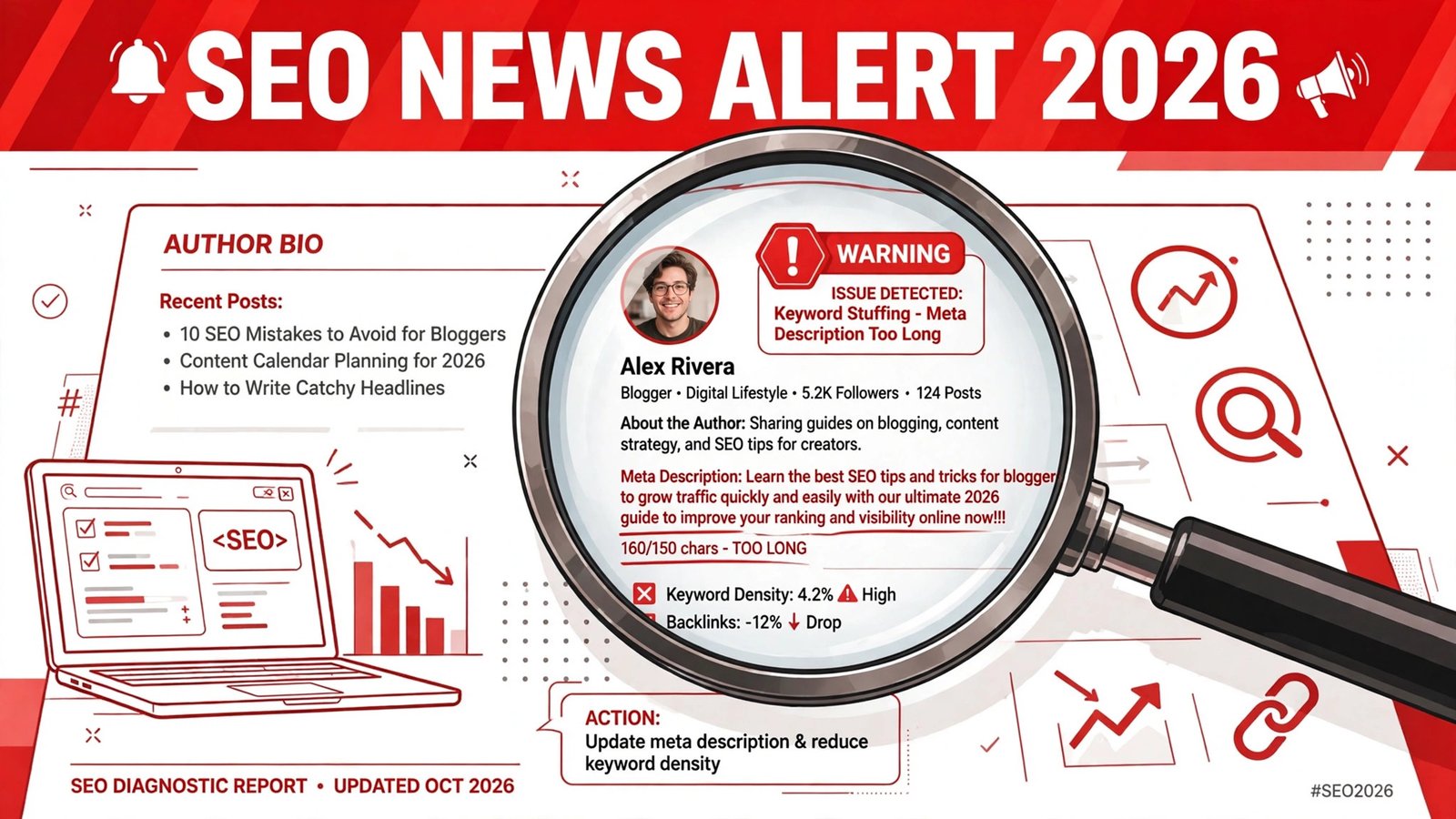
Google’s October 2026 documentation update calls fabricated author profiles — AI-generated headshots, invented names, false credentials — “a form of deception” and “a signal of a low-quality page.” In the same update, Google defined what it means by “main content” and named the four traits its quality raters look for: effort, originality, talent or skill, and accuracy. This is documentation, not a new algorithm — but it tells you exactly where to put your work this month. Here’s the audit I ran on my own thinking, turned into a checklist you can finish in an hour.
What Google actually changed in early October 2026
Two Search Central pages changed on consecutive days, and a related paragraph on authorship landed days later. Let me be precise, because the dates matter if you ever need to explain this to a client or a boss.
October 1: the generative AI guidance page. Google’s “Guidance on using generative AI content on your website” was updated with one unmistakable instruction: “It is critical to manually factcheck and review all AI-generated content for accuracy and trustworthiness before publishing.” The reasoning is worth remembering, because it’s Google admitting how the tools work: language models “don’t retrieve facts, but predict a likely sequence of words based on their training data” — which means output can contain hallucinations. And here’s the detail that stung a lot of SEOs: the review requirement explicitly applies to metadata too — title elements, meta descriptions, structured data, and image alt text. Search Engine Journal counted three added sentences since the December 10, 2025 version. (We covered this half of the update separately in our piece on Google’s AI content fact-check guidance — that’s all I’ll say about it here.)
October 1–2: the helpful content page. The “Creating helpful, reliable, people-first content” guide gained a new “Main content” section. Google defines main content as “any part of the webpage that directly helps the page achieve its purpose” — and that’s broader than most people expect. It covers your primary text and images, but also interactive tools like calculators, user-generated contributions such as comments and reviews, tabbed or expandable sections, page titles, and headings. The guidance says the quality of that content, and how well it lets the page do its job, is a critical factor in judging page quality.
Then come the four attributes that Search Quality raters are trained to evaluate in main content:
- Effort — how much human work went into the content, or into the system behind it.
- Originality — information or views that go beyond what’s already on other sites.
- Talent or skill — clear writing and a page that actually works for the reader.
- Accuracy — the facts are right, with extra care for topics touching money, health, or safety.
October 6: the fake-author warning. Reported by Search Engine Roundtable and Search Engine Land, a new paragraph under the “Who” section of the people-first page tells site owners to “avoid using deceptive authorship information.” This is the one that got everyone’s attention, and it’s the main subject of this article.
Why Google used the word “deception”
Here is the sentence, reported by Search Engine Roundtable and Search Engine Journal from the live page:
“However, avoid using deceptive authorship information. Fabricating creator profiles (such as by using AI-generated headshots, made-up names, or false credentials to make content appear as if it was written by human experts) is a form of deception. Any form of deception makes a page untrustworthy to both users and our automated quality systems, and is a signal of a low-quality page.”
That’s not “best practice” language. That’s moral language. And it’s deliberate: the same concept already existed in the Search Quality Rater Guidelines (section 4.5.3), where AI-generated content paired with made-up author profiles — including AI-generated images and deceptive bios, or profiles falsely claiming credentials like posing as a medical professional — is an example of deception, and raters are instructed to give such pages the Lowest rating. What’s new is that this language moved out of the rater handbook and into guidance written directly for site owners. As Search Engine Land’s report put it, Google is now warning site owners directly not to fake author information.
A few honest caveats, because accuracy is literally one of the four traits now:
- This is not a new ranking factor or a penalty. Google did not announce that any algorithm changed. SEO consultant Marie Haynes, who flagged the main-content edits in a video on October 2, 2026, reads the update as describing what Google’s systems are built to approximate — possible groundwork for future changes, not a switch that flipped.
- Quality raters do not rank pages. Google’s own page says raters “have no control over how pages rank” and that rater data “is not used directly in our ranking algorithms.”
- Bylines themselves are not a ranking signal. Google’s Search Liaison said back in January 2024 that bylines don’t help pages rank better. What changed is that fabricating them is now named as untrustworthy.
Want the full picture from Haynes herself? Her October 2 walkthrough is below — it’s 27 minutes and worth it if this is your livelihood.
The four traits, translated for a real blog
Most coverage of this update stays abstract. Here’s how I read each trait if you’re running a WordPress blog and publishing with AI help — which, let’s be honest, describes most of the people reading this.
Effort
Google gives two examples of low effort. One is pages generated automatically from feeds. The other is “using generative AI to produce large amounts of text without manual oversight or curation.” Then comes the line that should make half the internet nervous: giving credit to other sources does not replace the need for original effort.
Read that again. A post that rewrites a news story and links to the source is not high-effort just because it’s polite. Effort is visible work: you ran the steps, built the table, took the screenshots, answered the question from your own experience. On a practical level, effort is what separates a post that took 25 minutes of prompting from one that took a morning of doing.
Originality
Originality means information or perspectives that aren’t already on other sites. It doesn’t mean you need a scoop. It means one of these:
- A number from your own site (your click data, your test result, your bill).
- A lesson from a mistake you actually made.
- A decision framework nobody else built (a table that helps the reader choose beats three more paragraphs of advice).
This is also the trait that connects most directly to our daily engine: Google’s AdSense team rejected our site in October 2026 for “low value content,” and the fix we’re executing — every article must contain something original — is now also what the search documentation describes. Two Google systems, same demand.
Talent or skill
This one’s the least scary: clear writing, a page that works for the reader. Descriptive headings, tables that help, short paragraphs, answers you can find. Google’s own example of acceptable content is wonderfully low-key: a person sharing their own experience clearing snow from a driveway. You don’t need a degree. You need clarity.
Accuracy
The most operational trait of the four, because there’s now a named step attached to it: manual review before publishing. For money, health, and safety topics — and if you run a finance or monetization blog, that’s you — accuracy must match established expert consensus. Trace every figure to an official source you actually opened, and say when you last checked it.
The 60-minute blog audit (my checklist)
This is the part I built for myself and now run on every site I touch. It converts the four traits and the authorship warning into something you can finish in one sitting. Google doesn’t ship a scorecard, so this is mine — honest label, not a Google tool.
Step 1: The byline sweep (15 minutes). Open every author profile on your site. For each name, ask three questions:
- Does this person exist? Can you find them on one other real site — a LinkedIn, an X account, another publication?
- Is the photo real? If you generated the headshot, replace it today.
- Do the credentials hold up? Strip anything you can’t verify. “Has written about personal finance for three years” is fine if true; “certified financial analyst” is not, if they aren’t.
If the answer to any question is no, you have three honest options: attach a real person, publish under a company name with a real team page, or — for opinion pieces — be transparent about AI assistance. What you can’t do is keep an invented expert.
Step 2: The disclosure check (10 minutes). Google’s “How” question says that where readers might wonder how a piece was made, a short disclosure about automation or AI helps. It doesn’t require a label on every post. A one-line note at the bottom of AI-assisted posts is enough — as long as it’s true. Write one disclosure line and add it to your publishing template so you never forget.
Step 3: The metadata spot-check (10 minutes). Remember: the fact-check instruction covers titles, meta descriptions, structured data, and alt text. Pull your ten highest-traffic posts and read their titles and meta descriptions as a fact-checker would. Kill the exaggerations — Google’s page asks whether a title avoids overstatement. If your title promises more than the post delivers, fix the title or the post.
Step 4: The effort test (15 minutes). Open your top 10 posts and score each 0–2 on each trait (0 = missing, 1 = partly there, 2 = clearly there). Total out of 8:
- 0–3: Rewrite with your own work, or merge the post into a stronger one on the same topic.
- 4–6: Improve only the weakest trait. Don’t rewrite the whole thing.
- 7–8: Leave it alone. Recheck facts every few months.
The fastest way to gain two points on most posts: add one tested screenshot or one real number that’s yours. That’s usually a 15-minute fix.
Step 5: The freshness warning (5 minutes). Do NOT respond to this update by bulk-deleting posts or changing dates to look fresh. Google’s own page lists changing dates without real changes, and adding or removing lots of content just to seem fresh, as warning signs. Improve a post for real, or leave it alone.
What Google did NOT say (the honest half)
Because SEO Twitter loves panic, let me close the loop on the questions I’ve seen asked:
- No, you don’t need a named author on every page. Google didn’t say that. The section still encourages accurate bylines where readers would expect one. A company site where every page plainly comes from the company — Haynes used IBM as the example — may not need individual bylines at all.
- No, pen names aren’t banned. The wording targets profiles made to look like human experts with invented credentials. Rater guidelines accept aliases with a legitimate reason. Keep the pen name free of invented credentials and AI-generated faces.
- No, “Staff” bylines aren’t a problem. Rater guidelines define a content creator as an individual or an organization. Link the byline to a page that says who the team is.
- No, Google didn’t tie this to the September spam update. The spam update ran September 24 to October 8, 2026, but Google didn’t connect the two. Don’t assume a recent traffic drop came from this guidance change.
The bottom line
Google just wrote down, in its owner-facing documentation, what it considers the anatomy of a quality page: main content a reader can point to, four traits — effort, originality, talent or skill, accuracy — and a real human behind the byline. Nothing here bans AI assistance. Everything here bans shortcuts.
For independent bloggers, this is actually good news. The things Google is asking for — your test, your numbers, your honest name — are the things big content farms can’t produce at scale. You were never going to out-publish them. You can out-know them. Run the audit, add one thing that’s yours to your top ten posts, and you’re already ahead of most blogs on the internet.
Frequently Asked Questions
What exactly did Google change on October 1–2, 2026?
Two Search Central pages were updated. The generative AI content guidance added a requirement to manually fact-check and review all AI-generated content — including metadata like titles, meta descriptions, structured data, and alt text. The “Creating helpful, reliable, people-first content” page gained a definition of main content and the four attributes (effort, originality, talent or skill, accuracy) that raters evaluate. A paragraph warning against fabricated creator profiles was reported around October 6.
Are AI-generated headshots on author profiles really a problem?
According to Google’s new wording, yes. The guidance names “AI-generated headshots, made-up names, or false credentials to make content appear as if it was written by human experts” as a form of deception and “a signal of a low-quality page.” Replace generated faces with real photos, or publish under a company byline with a real team page.
Is there a penalty if my site has fake authors?
Google did not describe a specific ranking penalty. It says deception makes a page untrustworthy to users and to its automated quality systems, and calls it a signal of low quality. In the rater guidelines, deception earns the Lowest rating — but raters don’t set rankings directly. The safest move is to fix authorship before it becomes a site-quality problem.
Can I still use AI to write my drafts?
Yes. Google’s guidance targets mass-produced AI text “without manual oversight or curation,” which it calls little to no effort. AI for research, outlining, and drafting is fine — as long as a person fact-checks the result, adds something original, and stands behind it with a real name.
Do I need a byline on every post now?
No. Google encourages accurate authorship where readers would expect it, but didn’t require bylines everywhere. Organization bylines like “Staff” are fine if they link to a page describing the real team. What changed is only that inventing experts is now explicitly called deception.
What about pen names?
Google’s new text targets profiles fabricated to look like human experts. The rater guidelines accept aliases and anonymity with a legitimate reason. Keep any pen name free of invented credentials and AI-generated photos, and it’s within the safe zone.