
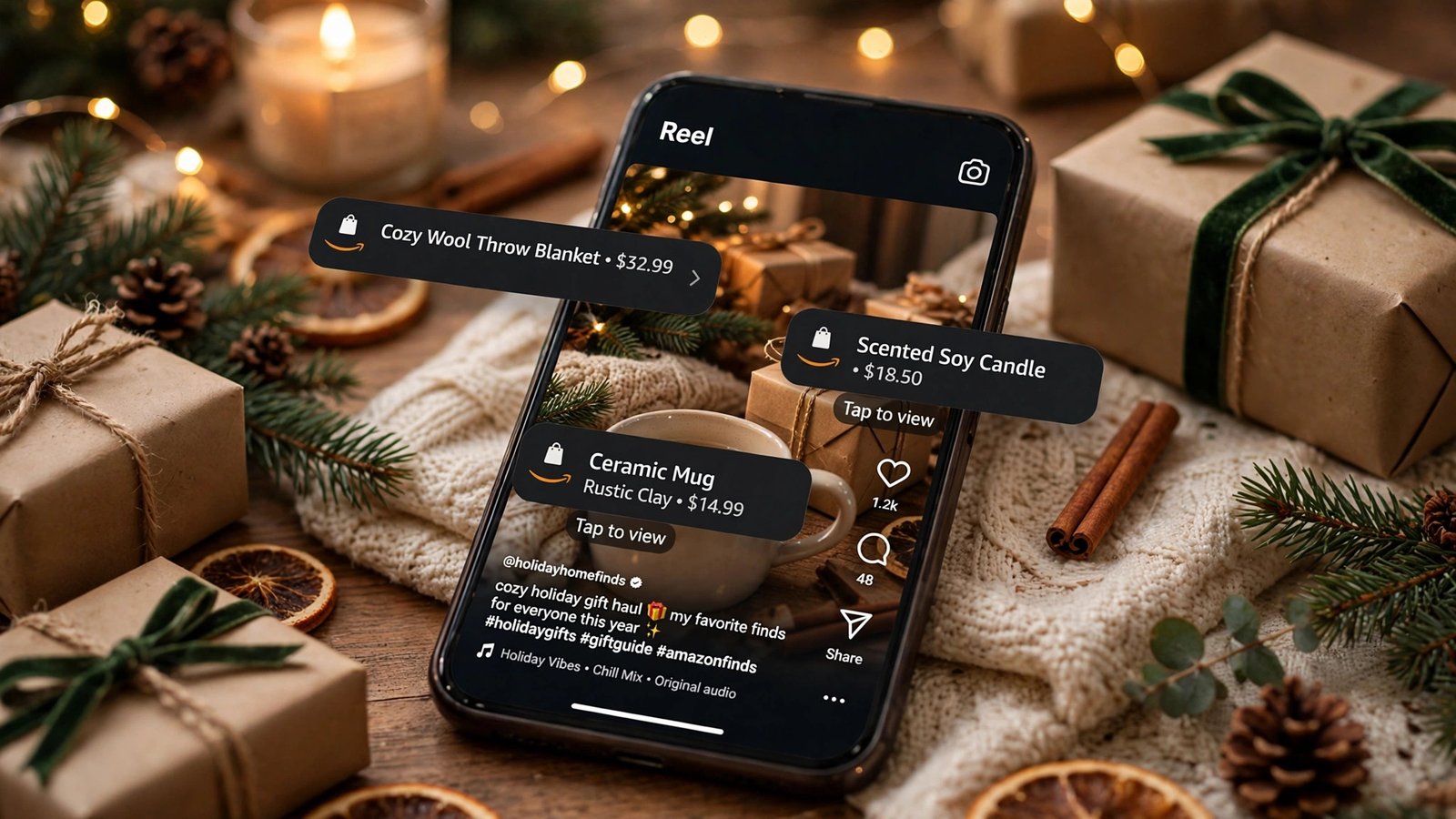
On Monday, November 16, 2026, Instagram let US creators do something they’d been asking for for years: put Amazon affiliate links directly inside Reels and feed posts. No more “link in bio.” No more sending followers to a story that disappears in 24 hours. You can now tag up to 30 Amazon products in a single Reel and up to 20 in a feed post, see each product’s estimated commission before you publish, and keep all of it — Instagram says it takes no cut.
The timing is not an accident. Amazon’s Black Friday Week starts today, November 19, and runs through Cyber Monday, November 30. Instagram opened this door three days before the biggest shopping window of the year. If you make product content — gift guides, desk setups, kitchen finds, “what’s in my bag” videos — this is the most direct way Instagram has ever given you to turn a view into a sale.
Here’s the full picture: who qualifies, how the setup actually works, what the commissions really pay, and a 12-day posting plan for Black Friday Week.
What Instagram actually launched on November 16
Instagram head Adam Mosseri announced the change on the company’s creators blog on Monday, November 16, 2026. His framing was simple: “A lot of creators make money with affiliate links, but you’ve mostly had to share them in stories or bio. Starting today, you can add Amazon affiliate links directly in your feed posts, carousels, and reels.”
Net Influencer’s report on the announcement confirms the 30-product Reel limit, the 20-product feed-post limit, and the LTK and ShopMy collections added in the same update.
Here’s what changed, in plain terms:
- Amazon links now live inside the content. Eligible US creators connect their Amazon Influencer Program account and tag Amazon products directly in Reels and feed posts. A clickable product link appears in the bottom left of the post, and tapping it opens the Amazon Shopping app.
- Up to 30 products per Reel, 20 per feed post or carousel. You can earn from several products through a single post, not just one hero item.
- No Meta commerce-catalogue step. Until now, tagging products generally meant routing through Meta’s commerce catalogue. For Amazon’s full selection, that step is gone — connect the account, tag the product, publish.
- You see the money before you post. Instagram shows each product’s estimated commission rate before you add it, so you can decide whether a product is worth tagging at all.
- Instagram takes nothing. “We don’t take any cut of what you earn,” Mosseri wrote. Adding products is free, and Instagram charges no transaction fees. Amazon pays the commission under its own program terms.
Two other additions came in the same announcement: creators can now add full LTK and ShopMy collections to their posts, and general product linking is now live in 26 countries and regions. The Amazon connection itself is US-only for now, and Meta has not said when — or whether — it will expand beyond the US.
This is also Instagram’s second attempt at in-feed affiliate shopping. The platform relaunched affiliate product tagging in Reels back in April 2026, when creators could already paste affiliate URLs and tag up to 30 products. The November change is different in one important way: it removes the catalogue step for Amazon’s entire selection and wires the commission estimate directly into the composer. That’s the difference between a feature that exists and a feature you’ll actually use every day.
Who can use it — and the 1,000-follower question
The eligibility list is short, but one item on it is disputed, so let’s separate what’s confirmed from what’s reported.
Confirmed requirements:
- You must be based in the United States.
- You must be 18 or older.
- You must have a professional Instagram account (Creator or Business).
- You must be a member of the Amazon Influencer Program, and you connect that account through Instagram’s Professional Dashboard.
The 1,000-follower question: WIRED reported on November 16 that participants need a professional account with over 1,000 followers. TechCrunch and Engadget, reporting the same announcement, do not mention any follower minimum at all. Treat the 1,000 figure as WIRED-reported rather than an official rule until Instagram confirms it. If you’re under 1,000 followers, don’t assume you’re locked out — try connecting your account and see what the dashboard says.
What about an Associates-only account? This is the other open question. Connecting an Amazon Associates account is a separate, supported step: it’s what makes affiliate attribution apply automatically when you paste a regular product URL. But the sources I’ve read do not establish that an Associates account alone — without the Influencer Program — qualifies you for the integration. The Influencer Program is the basis of eligibility. If you’re in Associates but not the Influencer Program, apply for the Influencer Program first; that’s the gate that matters here.
One more honest note: Instagram told WIRED it does not expect a sudden influx of shopping content from this launch. That’s the company managing expectations. But the creators who move first — the ones with gift guides ready this week — are the ones who get the practice reps in before the feed fills up.
How to set it up: the walkthrough
The setup takes a few minutes once your Amazon Influencer Program account exists. Here’s the path, in order:
- Join the Amazon Influencer Program first. This is the part that takes time — Amazon reviews Influencer applications, and approval isn’t instant. If you haven’t applied yet, do it today, because the Black Friday window won’t wait for the review queue. You’ll need an established social presence; Amazon looks at your follower count and engagement.
- Switch to a professional Instagram account if you haven’t already. Go to Settings → Account type and tools → Switch to professional account, and pick Creator or Business.
- Open your Professional Dashboard. From your profile, tap Professional dashboard, then find the Monetization section.
- Connect your Amazon account. In the Monetization section, link your Amazon Influencer account (you can also connect an Amazon Associates account here). Instagram will confirm the connection.
- Create a Reel or feed post as normal. When you get to the tagging step, choose the Amazon products you want to feature. You can add up to 30 in a Reel or 20 in a feed post or carousel.
- Check the estimated commission for each product before you publish. This is the step most creators will skip and shouldn’t. A product at 3% and a product at 10% are not the same opportunity, even if they cost the same.
- Publish, then watch the data. Instagram surfaces click data on tagged products, so you can see which items your audience actually taps — and which ones they ignore.
A practical tip: tag products your audience can actually buy this week. A gorgeous $400 stand mixer that sells out on day one earns you nothing. A $35 gadget with deep stock and a Black Friday discount earns you commission on every order.
What you’ll actually earn: the commission table
Here’s where most coverage of this launch stops, and where the real money question starts. Instagram doesn’t set your commission — Amazon does, under its Associates Program Standard Commission Income Statement. The rates are fixed by category, not by product, and they vary more than most creators expect.
| Category | Commission rate |
|---|---|
| Luxury Beauty | 10% |
| Physical Books | 4.5% |
| Kitchen | 4.5% |
| Toys | 3% |
| Headphones | 3% |
| All other categories | 4% |
Those are category rates, not a promise for every individual product — which is exactly why Instagram showing you the estimated rate before you publish matters. Check it every time.
Now let’s do the math that actually matters, because percentages without dollar figures are useless. Say your Reel gets 50,000 views and 1% of viewers tap a product link — that’s 500 clicks. If 4% of those clicks convert into a purchase (a reasonable affiliate conversion rate for warm, in-content traffic), that’s 20 orders.
- 20 orders at $40 each in the “all other categories” bucket (4%) = $800 in sales × 4% = $32.
- 20 orders at $40 each in Luxury Beauty (10%) = $800 × 10% = $80.
- 20 orders at $150 each in Kitchen (4.5%) = $3,000 × 4.5% = $135.
Same views, same clicks, wildly different paydays — and the only difference is what you chose to tag. That’s why the category table matters more than the follower count for this feature. A creator with 8,000 followers tagging high-commission, high-ticket products can out-earn a creator with 80,000 followers tagging $12 phone cases.
A second piece of math worth doing: the click-rate claim. Meta told TechCrunch that product links placed directly on Reels and posts draw about twice as many clicks as the same links in a creator’s bio. That number comes from Meta’s own internal data, so hold it loosely — but even if the real lift is 1.5x rather than 2x, it changes the equation. Bio links were always a funnel with a leak: tap the profile, find the link, tap again, lose half your audience at each step. A tag sitting on the product in the video removes two taps. That’s the whole story of this feature — fewer taps between “I want that” and “I bought it.”
But keep one more honest number in mind: twice the clicks is not twice the money. A click is a long way from a sale. Your conversion rate — the share of clickers who actually buy — is what decides your payout, and that depends on the product, the price, and whether your audience trusts your recommendation. The feature improves the top of the funnel. It doesn’t fix the bottom.
Why the timing matters: Black Friday Week starts today
Instagram announced this on November 16. Amazon’s Black Friday Week and Cyber Monday deal events kick off at 12:01 a.m. PST today, November 19, and run through November 30 — 12 days of daily themed deal drops across toys, tech, fashion, beauty, premium gifts, and stocking stuffers, with savings of up to 60%. Black Friday itself is Friday, November 27, and Cyber Monday is Monday, November 30. For the first time, the biggest deals drop twice on each of those two days — at midnight and 8 a.m. PT (3 a.m. and 11 a.m. ET).
That calendar is your posting schedule. The creators who win this window aren’t the ones with the biggest audiences; they’re the ones whose tagged products match the day’s theme. Amazon publishes the themed drops daily, so a creator who checks the theme each morning and films that day’s products will always be more relevant than someone who filmed a generic gift guide last week.
A 12-day posting plan for Black Friday Week
Here’s a plan you can run starting today, built around how the sale actually works:
Days 1–3 (Nov 19–21): film the evergreen winners. Start with the products you already own and genuinely use — the ones you can film today without waiting for a delivery. Tag 20–30 products per Reel. Your goal this week is learning which products your audience taps, so volume and variety matter more than polish.
Nov 22–24: follow the daily themes. Check Amazon’s Today’s Big Deals each morning and build that day’s Reel around the theme. If it’s tech day, film your desk setup. If it’s beauty day, film your routine. The theme is free targeting — Amazon is already pushing that category to millions of shoppers.
Nov 25–26: the pre-Black Friday push. Thanksgiving is Thursday, November 26. People are home, scrolling, and building wish lists. Post your “best deals I’ve found so far” roundup and your “what I’m buying” list. These are the highest-intent posts of the window.
Black Friday, Nov 27: post twice. Deals drop at midnight and 8 a.m. PT. Post once for the early drop (your audience on the East Coast will see it at 3 a.m. — schedule it) and once for the 8 a.m. drop. Tag the doorbusters, but tag the in-stock alternatives too — doorbusters sell out in minutes, and a sold-out tag earns nothing.
Nov 28–29: the “still available” roundup. The weekend after Black Friday is when people buy the things they missed. A Reel titled “the deals that are actually still in stock” converts well because it solves a real problem.
Cyber Monday, Nov 30: the last call. Deals drop twice again, at midnight and 8 a.m. PT, and the event ends. Post your final roundup early in the day and a “last chance” story-style Reel in the evening.
Throughout the window, keep one discipline: only tag products you’d recommend if there were no commission at all. Your audience can tell the difference between a genuine pick and a tag stuffed in for the payout, and the algorithm can too — engagement on a post where viewers feel sold to will be worse than on one where they feel helped.
What this doesn’t do: the honest limits
A launch like this invites hype, so let’s be clear about what hasn’t changed.
Instagram still takes no cut — but that doesn’t mean Instagram gets nothing. The company makes its money on ads, and every purchase traced back to a Reel tells Meta which content, which creator, and which audience led to a sale. That data is enormously valuable for ad targeting. The zero-cut headline is real, but it’s also a strategy: Meta is buying its way into the purchase journey by giving creators the whole commission.
The 2x clicks number is Meta’s own. It comes from the company’s internal data, shared with TechCrunch. Independent verification doesn’t exist yet. The direction of the effect is plausible — fewer taps means more clicks — but treat the exact multiplier as a claim, not a fact.
It’s US-only, for now. The Amazon connection is open to eligible US creators. Meta hasn’t said whether it plans to expand beyond the US, and there’s no timeline. If you’re outside the US, you can use the general product linking (live in 26 countries and regions) and the LTK and ShopMy collections, but not the Amazon pipe.
Clicks are not sales, and sales are not guaranteed income. Affiliate earnings are volatile by nature. A product can go out of stock, a commission rate can change, and Amazon’s attribution window applies to its own rules. Treat this as a real new income channel, not a salary.
The field will get crowded fast. The Interactive Advertising Bureau published a paper on creator-retail media the same day as this launch, and its verdict was blunt: the market is in a “prove it” stage, and “integration itself is not a value proposition.” Translation: the feature alone doesn’t make you money. What makes you money is the same thing that always has — picking the right products, for the right audience, at the right moment. The integration just removes the friction that used to punish you for doing that well.
Instagram vs the old bio-link method — and vs LTK and ShopMy
If you’ve been doing affiliate marketing on Instagram until now, your workflow was probably: put the link in your bio (or a link-in-bio tool), mention it in the caption, hope people tap through. That workflow had three leaks — profile tap, link tap, product tap — and every leak cost you buyers. In-post tags collapse that to one tap. That’s the upgrade, and it’s a big one.
The same announcement also added LTK and ShopMy collection links for eligible creators in the US and Canada. Those matter because they cover the retailers Amazon doesn’t: LTK is the fashion, beauty, and home platform, with brand-set commissions that often run higher than Amazon’s flat category rates. If you create fashion content, our guide to Pinterest affiliate marketing in 2026 covers how LTK works as Pinterest’s official affiliate partner — the same LTK collections you can now drop into an Instagram post. Use Amazon for breadth and LTK or ShopMy for the categories where their rates beat Amazon’s 4%.
For the broader picture of how Instagram pays creators — Reels bonuses, subscriptions, and the rest of the monetization stack — see our guide to Instagram Reels monetization requirements in 2026. The Amazon feature slots into that stack as the shopping layer, not a replacement for it.
Frequently Asked Questions
Do I need 1,000 followers to use Instagram Amazon affiliate links?
Maybe — but it’s not confirmed. WIRED reported a 1,000-follower requirement on November 16, while TechCrunch and Engadget did not mention any follower minimum. The confirmed requirements are: US-based, 18 or older, a professional Instagram account, and membership in the Amazon Influencer Program. If you’re under 1,000 followers, try connecting your account in the Professional Dashboard and see what happens rather than assuming you’re excluded.
Does an Amazon Associates account qualify, or do I need the Influencer Program?
The Influencer Program is the basis of eligibility for this integration, according to the reporting so far. An Associates account is a separate, supported connection — it’s what makes affiliate attribution apply automatically when you paste a regular product URL — but sources do not confirm that Associates alone qualifies you for the in-post Amazon tagging. If you’re in Associates but not the Influencer Program, apply for the Influencer Program.
How much commission does Amazon pay on Instagram-tagged products?
Amazon pays under its own Associates Program rates, which are set by category: Luxury Beauty 10%, Physical Books and Kitchen 4.5%, Toys and Headphones 3%, and 4% for all other categories. Instagram shows you each product’s estimated commission rate before you publish, and Instagram itself takes no cut and charges no transaction fees.
How many products can I tag in one post?
Up to 30 products in a single Reel and up to 20 in a feed post or carousel. You can earn commissions from multiple products through one post. The practical limit is your audience’s patience — a Reel with 30 tags on products nobody cares about performs worse than a Reel with five tags on products your viewers actually want.
When does Amazon Black Friday Week 2026 run?
Amazon’s Black Friday Week and Cyber Monday deal events run November 19 through November 30, 2026, starting at 12:01 a.m. PST on November 19. Black Friday is Friday, November 27, and Cyber Monday is Monday, November 30. On both of those days, the biggest deals drop twice — at midnight and 8 a.m. PT — with savings of up to 60%.
Is this available outside the United States?
Not yet. The Amazon connection is open to eligible US creators only, and Meta has not announced a timeline for other countries. General product linking is live in 26 countries and regions, and LTK and ShopMy collection links are available to eligible creators in the US and Canada.
Do I have to disclose that my links are affiliate links?
Yes. The FTC requires clear disclosure of affiliate relationships, and Amazon’s own program rules require it too. A simple “#ad” or “affiliate link — I may earn a commission” in your caption covers it. Instagram’s own branded-content and paid-partnership tools are worth using alongside the disclosure so the platform also knows the post is commercial.