
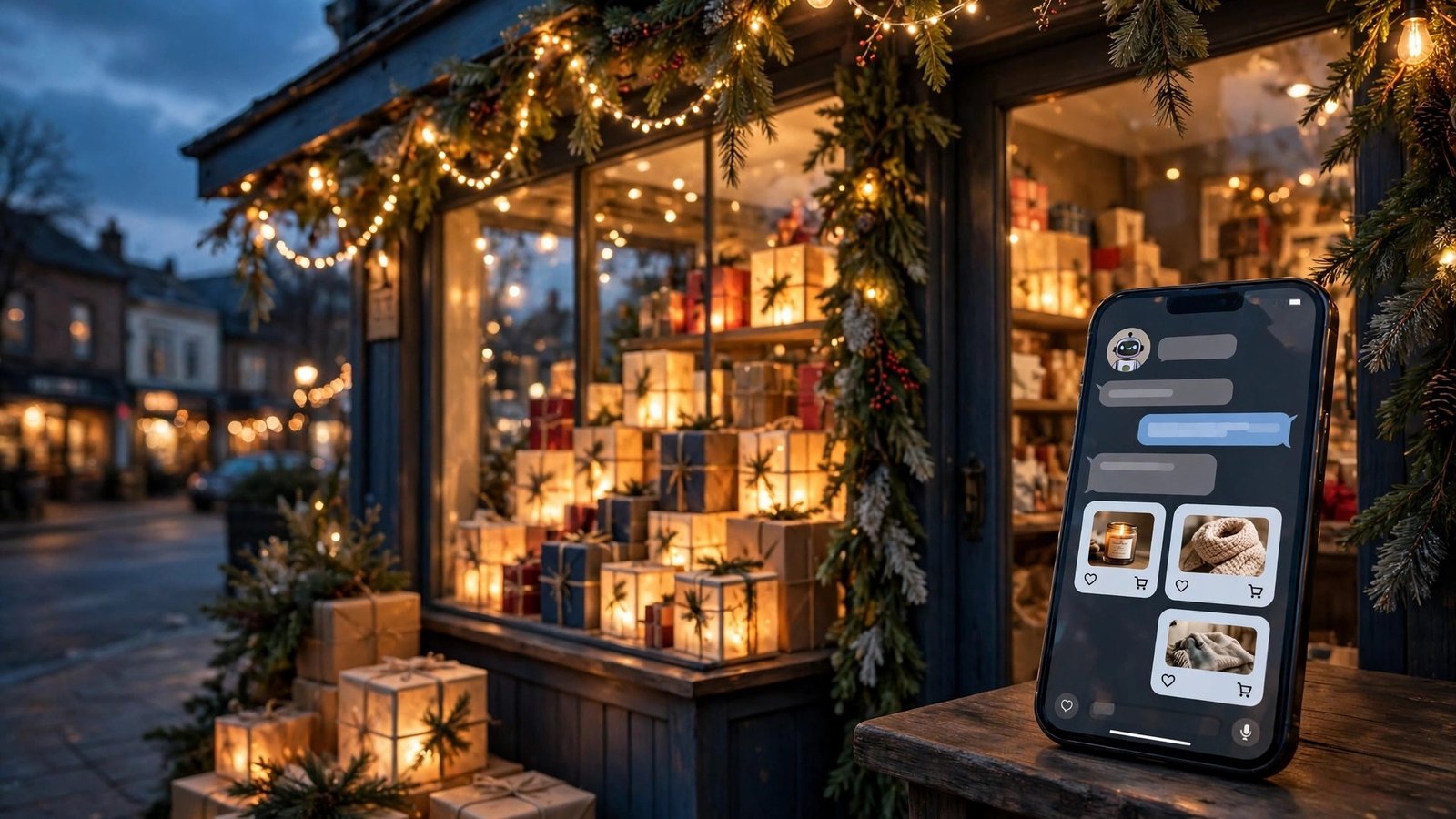
Yes, the 2026 holiday season is projected to be the first trillion-dollar one in US retail history — and for the first time, a meaningful share of the shoppers will arrive because a chatbot told them where to go. The National Retail Federation (NRF) forecasts $1.013 trillion in November and December retail sales, up 4.2% from 2025, while Adobe forecasts a record $275.1 billion online, up 6.7%. The twist that matters most if you sell online: Adobe expects traffic from AI chat and browser services to US retail sites to jump 130% year over year. If your listings are not readable by those AI tools, you are invisible to a fast-growing slice of holiday buyers.
That is the short version. The rest of this article breaks down what the forecasts actually say, where the money peaks day by day, and the concrete checklist that gets a small shop ready for AI-referred shoppers before Thanksgiving.
The trillion-dollar headline: what NRF actually forecast
On October 15, 2026, the NRF released its annual holiday forecast, projecting that retail sales in November and December will grow 4.2% over 2025, reaching $1.013 trillion. Last year’s holiday sales totaled $972 billion, up 3.1% over 2024. If the forecast holds, 2026 becomes the first season to cross the trillion-dollar line in the NRF’s measure, and the fastest growth rate since 2021, when holiday sales jumped 12.6%.
A few details matter before you celebrate. The NRF defines the holiday season as November 1 through December 31, and its number covers core retail — it excludes automobile dealers, gasoline stations, and restaurants. So this is the spending on the stuff online sellers actually sell: gifts, apparel, electronics, home goods, toys, and the rest. The forecast is built with Oxford Economics from indicators including consumer spending, disposable personal income, employment, wages, inflation, and prior monthly retail sales releases. It is a forecast, not a result, and forecasts miss — last year, for example, sales came in just under the NRF’s original range.
The NRF also expects retailers to hire between 325,000 and 375,000 seasonal workers, roughly in line with last year’s estimated 356,000 seasonal jobs. That hiring number is a useful reality check for small sellers too: the big chains are staffing up for a busy season, which means delivery networks, warehouses, and ad auctions will all be more crowded than usual.
The consumer picture underneath the headline is more cautious than the total suggests. In the NRF’s annual consumer survey, conducted October 1–7, 2026 among 8,094 US adults, 56% of holiday shoppers said the state of the economy will affect their spending plans, and 43% said they plan to start shopping before November, with about half of those early shoppers saying they want to spread purchases across their budgets. Translation: people are still planning to buy, but they are budgeting harder, starting earlier, and hunting for value. Your pricing, your shipping costs, and your discount timing all matter more this year than they did last year.
What Adobe sees online: $275.1 billion and a phone-first season
Adobe’s forecast, released September 28, 2026 and built on more than 1 trillion visits to US retail sites, 100 million SKUs, and 18 product categories, puts US online sales at $275.1 billion for November 1 through December 31, up 6.7% year over year. That is roughly one in four dollars of all retail goods spending this holiday season moving through ecommerce.
The peaks inside that total are where small sellers should focus their calendars:
- Cyber Week (the five days from Thanksgiving through Cyber Monday) is forecast at $47.5 billion, up 7.4% year over year, or 17.3% of the entire season’s online spend.
- Cyber Monday (November 30) is expected to be the biggest single online shopping day of the year at $15.1 billion, up 6.2%.
- Black Friday (November 27) is forecast at $12.9 billion, up 9.2% — growing faster than Cyber Monday, as discounts start earlier and earlier.
- Thanksgiving Day (November 26) is forecast at $6.9 billion online.
Adobe also expects October to have already been strong, with $95.8 billion online, up 8% year over year, including $9.9 billion during the October 6–7 Prime Day event. If you felt like the season started before Halloween, you were not imagining it. The practical lesson: by the time Thanksgiving arrives, a large chunk of your buyers have already been researching for weeks. Listings, photos, and pricing that go live in late November are late.
Two more Adobe numbers shape how you should build your store. Mobile is expected to account for 57.4% of full-season online spending, and a record 63% of Cyber Week spending. And buy now, pay later (BNPL) is projected at $21.3 billion for November and December, up 6.6%. If your checkout is clumsy on a phone, or you do not offer a pay-over-time option, you are creating friction at exactly the moment more than half your buyers are shopping on a small screen with a tight budget.
The real story: chatbots are sending the shoppers
Here is the number that should change how you think about holiday marketing. Adobe expects AI traffic to US retail sites — shoppers clicking a link from an AI-powered chat or browser service — to rise 130% year over year this holiday season. The spikes are even sharper on individual days: up 159% on Thanksgiving, up 95% on Black Friday, and up 88% on Cyber Monday.
Think about what that means in plain terms. A growing number of shoppers are no longer starting with a search results page or an ad. They are asking ChatGPT, Google’s AI Mode, Microsoft Copilot, Perplexity, or a similar tool something like “best personalized gift for my sister under $50” and clicking what the chatbot recommends. The chatbot becomes the storefront window. If your product cannot be understood, compared, and recommended by that chatbot, it does not matter how good your own website looks — the shopper never arrives.
Adobe’s own survey data explains why this traffic converts. In a July 2026 survey of 5,000 consumers, 77% of respondents who had used AI for online shopping said they felt more confident in their purchase, and 69% said they were less likely to return an item they bought that way. An AI-referred shopper is not a casual browser. They arrive pre-sold on a specific product, with a specific question already answered. That is a higher-quality visitor than a cold ad click, and it is exactly the kind of visitor a small shop wants — if the shop can be found.
There is an honest caveat here, and it matters. Adobe measures AI traffic as clicks from AI services to retail sites, and its 130% figure is a forecast built from its own data, not a census of all shopping. Other firms measure AI commerce differently, and their numbers differ. But the direction is not in dispute: every major tracker agrees AI-assisted shopping is growing fast, and this is the first holiday season where it is big enough to move the totals. Build for the direction, not the decimal.
Forecast calendar: Thanksgiving to Cyber Monday peaks
Here is the peak-week calendar to plan around, using Adobe’s day-level forecasts and the standard US holiday shopping dates. Note that Small Business Saturday falls on November 28, 2026 — the Saturday after Thanksgiving, and a real opportunity for independent shops to catch shoppers who are deliberately choosing small businesses that weekend.
| Date | Day | What Adobe forecasts / why it matters |
|---|---|---|
| Nov 26 | Thanksgiving | $6.9B online; AI-referred traffic up 159% YoY — the sharpest AI spike of the season. Shoppers are on phones on the couch, asking chatbots for ideas. |
| Nov 27 | Black Friday | $12.9B online, up 9.2%; AI traffic up 95%. Fastest-growing of the big days as deals start earlier. |
| Nov 28 | Small Business Saturday | No separate Adobe day total, but the day small shops own. Shoppers intentionally seek independents — make sure your shop is findable and shippable. |
| Nov 29 | Sunday | The quieter bridge day. Good for email follow-ups to browsers and cart abandoners from Friday and Saturday. |
| Nov 30 | Cyber Monday | $15.1B online, up 6.2%; AI traffic up 88%. The biggest single online day of the year. Your site and checkout must hold up under peak load. |
| Dec 1–31 | December stretch | Discounts ease to roughly 10–15% off (Adobe expects Cyber Week discounts near 30%). Shipping deadlines, not discounts, become the selling point. |
One more timing note from the forecasts: Adobe expects discounts to peak around 30% during Cyber Week, with up to 14% off in early November and 10–15% off in December. If you discount everything by 30% all season, you have nothing left for Cyber Week and you have trained your buyers to wait. A smarter shape for a small shop is a modest early-November offer, your real deal during Cyber Week, and a shipping-deadline push in December.
AI-referred traffic readiness checklist for small sellers
This is the part most holiday guides skip, and it is the part that matters most this year. A chatbot does not browse your homepage the way a person does. It reads structured facts: what the product is, what it costs, whether it is in stock, what it is made of, who it is for, and how fast it ships. If those facts are missing, vague, or contradictory across your listings, the chatbot will recommend a competitor whose facts are clean. Work through this checklist before Thanksgiving.
1. Structured product data on every listing. On your own site, make sure each product page has complete schema markup (product name, price, availability, description, images, and review data where you have it). On Etsy, Amazon Handmade, or Shopify, that means filling in every attribute field the platform gives you — materials, dimensions, colors, intended recipient, personalization options — not just the title and one photo. Chatbots pull from these fields. A listing with blank attributes is a listing the chatbot cannot describe.
2. Clear, current pricing — everywhere, identically. AI tools cross-check prices across sources. If your Etsy price, your website price, and your Google Shopping price disagree, the chatbot may quote the wrong one or skip you as unreliable. Before the season, pick your holiday prices, update every channel to match, and include shipping in the headline price where you can. Remember that 56% of shoppers say the economy is affecting their plans; a clean “$42, free shipping” beats a “$34 + $9.95 shipping” surprise at checkout.
3. Honest, live stock status. Mark items out of stock promptly and show accurate inventory on your own site. Nothing kills an AI referral faster than a shopper clicking through to a sold-out product — and chatbots learn from that, too. If a product is made to order, say so plainly and give the real production time. A “ships in 3–5 business days” that is actually true beats a “ships in 24 hours” that is not.
4. A product description written for a question, not a keyword. Shoppers ask chatbots questions in full sentences: “durable personalized leather wallet for dad under $60.” Your description should answer that sentence naturally: who the product is for, what problem it solves, what it is made of, and what makes it different. This is also just good copywriting. The old trick of stuffing a title with keywords does not help when the gatekeeper is a chatbot summarizing your page.
5. Mobile checkout that works one-handed. With 57.4% of season spending on mobile — and 63% during Cyber Week — test your checkout on an actual phone, not just a desktop browser resized. Fewer fields, guest checkout, Apple Pay and Google Pay where available, and a BNPL option all reduce abandonment. Adobe’s $21.3 billion BNPL forecast tells you that pay-over-time is no longer a nice extra; for budget-conscious holiday shoppers, it is often the difference between buying now and waiting.
6. Shipping deadlines and costs stated up front. USPS, UPS, and FedEx holiday deadlines arrive earlier than most sellers expect, and peak surcharges raise costs. State your order-by dates for Christmas delivery on the product page and in your shop banner, not buried in a FAQ. If you sell on Etsy or eBay, this is also the season to re-check your shipping math: peak surcharges can quietly eat a thin margin, and a seller who raised prices or adjusted handling in October is in a much better position than one who discovers the surcharge in December. For a detailed walk-through of this year’s surcharge picture, see our guide to the USPS 2026 holiday peak surcharge for Etsy and eBay sellers.
7. Reviews and real photos, not just renders. Chatbots weigh review signals and authentic imagery when recommending products. If you have genuine customer reviews, make sure they are visible on the product page. If you have customer photos, use them. A product with twenty honest reviews and real-world photos will beat a prettier listing with none, because the chatbot has something concrete to cite.
8. A plain-language returns and gift policy. Holiday buyers worry about returns — they are buying for someone else, and they may get it wrong. A clear, short returns policy (“30-day returns, buyer pays return shipping, exchanges free”) gives both the shopper and the chatbot confidence. Vague policies create hesitation, and hesitation is a lost sale in a season where the next recommendation is one click away.
Work through the list in order. Items 1 through 3 are the foundation: if your data is structured, your prices are consistent, and your stock is honest, you are already ahead of most small shops. Items 4 through 8 are what turn a click into a completed order.
Pricing, fees, and margins: do the math before Cyber Week
A trillion-dollar season is only good news if you keep some of it. Before you set your holiday prices, run your fee math on every channel you sell through, because marketplace fees, payment processing, advertising, and shipping surcharges stack up fast. A product that looks profitable at full price can lose money at 30% off once fees are included. This is especially true for handmade sellers choosing between marketplaces: the fee structures of Etsy and Amazon Handmade differ enough that the same product at the same price can leave you with very different margins, and Q4 is when those differences bite hardest. Our Etsy vs Amazon Handmade Q4 holiday fee math for 2026 walks through that comparison with real numbers.
Print-on-demand sellers face a parallel question. Holiday surcharges and production slowdowns hit print providers too, and the provider you choose affects both your cost and your delivery promise. If you are weighing providers before the rush, our Printful vs Printify 2026 pricing and holiday surcharge comparison breaks down where each one costs more and where each one is faster.
The broader point is simple: set your Cyber Week discount from your margin, not from what competitors are doing. If your real margin after fees and shipping is 35%, a 30% sitewide discount leaves you almost nothing for ads, returns, or mistakes. A smaller, well-timed discount on your best sellers — plus free shipping thresholds that raise average order value — usually beats a deep discount that moves units and loses money.
What the forecasts might get wrong
I want to be straight with you about the limits of all this. These are forecasts, and they come with real uncertainty. The NRF’s number is built on economic modeling, and last year actual sales came in just below its original range. Adobe’s number is built from its own analytics network, which is huge but not the whole internet. Inflation is part of why the nominal totals keep rising — the NRF’s chief economist has noted that core goods inflation, measured by the PCE price index, is expected to average 2.5% in 2026, up from 1.6% in 2025 — so some of the “growth” is higher prices, not more items sold.
There is also a timing risk. With 43% of shoppers starting before November, a seller who waits for Black Friday to launch holiday listings has already missed the research phase. And with AI traffic growing this fast, the rules of discovery are shifting under everyone’s feet at once. The sellers who win this season will not be the ones who predicted the exact total. They will be the ones whose products are findable, honestly priced, in stock, and easy to buy on a phone at 9 p.m. on Thanksgiving, when a chatbot sends a shopper their way.
Frequently Asked Questions
Is 2026 really the first trillion-dollar US holiday season?
According to the NRF’s forecast, yes — in its measure of core retail sales for November 1 through December 31. The NRF projects $1.013 trillion for 2026, up 4.2% from $972 billion in 2025. It is a forecast, not a final result, and the actual total will be confirmed after the season ends. Other forecasters use different definitions, so their totals differ, but the trillion-dollar milestone is the headline across most major forecasts this year.
How much will Americans spend online this holiday season?
Adobe forecasts $275.1 billion in US online sales from November 1 to December 31, 2026, up 6.7% year over year. Cyber Week alone is expected to drive $47.5 billion of that, with Cyber Monday at $15.1 billion and Black Friday at $12.9 billion. Mobile is expected to account for 57.4% of full-season online spending.
What is AI-referred traffic, and why does it matter for small sellers?
AI-referred traffic means shoppers who arrive at a retail site by clicking a link from an AI chat or browser service, such as ChatGPT, Google’s AI Mode, Microsoft Copilot, or Perplexity. Adobe expects that traffic to rise 130% year over year this holiday season, with a 159% jump on Thanksgiving alone. It matters because the chatbot acts as a recommender: it can only recommend products whose facts — price, availability, description, materials — it can read and trust. Small sellers with clean, complete listings can be recommended alongside big brands.
When is Small Business Saturday 2026?
Small Business Saturday 2026 is Saturday, November 28, the day after Black Friday and the day before the Sunday that leads into Cyber Monday. It is a good day for independent shops to run a small-business-focused offer, but only if your listings, stock, and shipping information are already in shape — shoppers that day are deliberately looking for small sellers, and they will move on quickly if the buying experience is broken.
Should I offer buy now, pay later this holiday season?
Adobe forecasts $21.3 billion in BNPL online spending for November and December, up 6.6%, and the NRF’s survey shows budget-conscious shoppers spreading purchases out. If your platform or payment provider offers BNPL at a reasonable cost, offering it for holiday orders is worth testing — it removes a real barrier for gift buyers. Just factor the BNPL provider’s fee into your margin math before you advertise it, and keep the option visible at checkout on mobile, where most of the spending happens.
How early should my holiday listings be ready?
Earlier than you think. Adobe recorded $95.8 billion in October online spending, up 8%, and the NRF found 43% of shoppers plan to start before November. Aim to have holiday listings, prices, photos, and shipping deadlines live by mid-October at the latest, with your Cyber Week offers and inventory locked in before Thanksgiving week. By the time the AI traffic spike hits on Thanksgiving Day, your shop should already be the finished product, not a work in progress.