
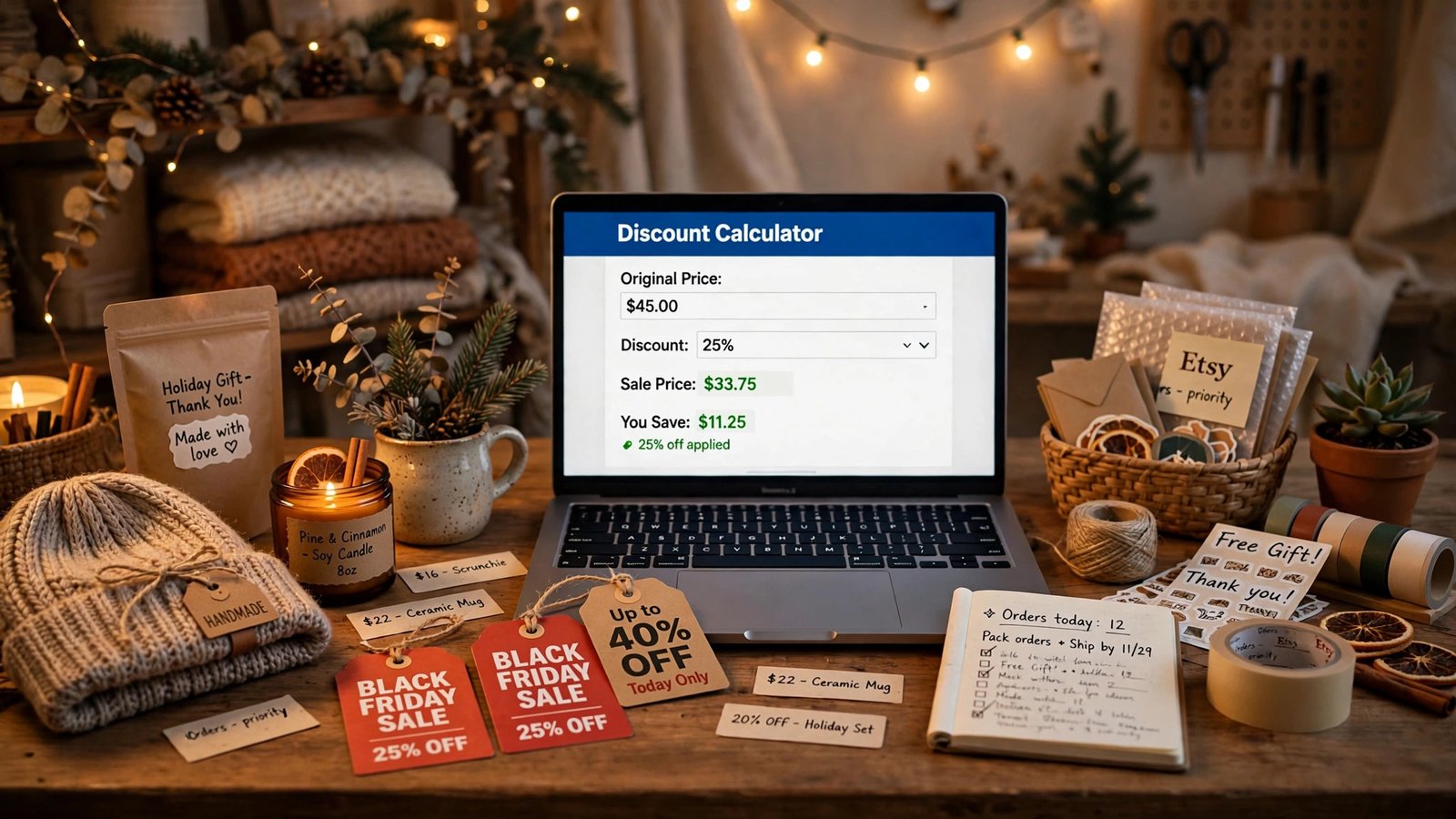
Black Friday 2026 is November 27, and Etsy’s Cyber Specials runs November 23 to December 1. If you sell on Etsy, the pressure to offer 25% off — the minimum for Etsy’s US marketing features — is real. But here’s the number that matters before you touch your prices: at a 50% margin, a 30% discount needs two and a half times your normal orders just to earn the same money. At a 30% margin, a 20% discount needs roughly fifteen times your normal orders, and a 30% discount loses money on every single sale. This guide works out the exact break-even math for your shop, using Etsy’s real 2026 fees, so you can pick a discount from your own numbers instead of copying 25% because everyone else did.
The dates that matter for Etsy sellers in 2026
Before the math, the calendar. Black Friday falls on Friday, November 27, 2026, and Cyber Monday on Monday, November 30. Etsy’s own Cyber Specials event runs from November 23 through December 1, and its US guidance asks sellers to offer at least 25% off to be considered for Etsy’s marketing features. The opt-in deadline for that marketing consideration was October 27 — if you missed it, you can still join the event from Shop Manager (Marketing → Sales and discounts → Join Etsy’s next sales event), but Etsy doesn’t guarantee a feature either way.
The stakes are genuinely big. Adobe expects US shoppers to spend $12.9 billion online on Black Friday alone this year, up 9.2% on last year, inside a $47.5 billion Cyber Week. That’s real traffic, and it’s the reason a discount feels mandatory. But traffic is only half the equation. A sale that brings twice the orders at a third of the profit per order still leaves you worse off — and with twice the packing, shipping and customer-service work.
Every fee on one Etsy order, in plain English
You can’t do break-even math without the real fee stack. For a US seller in late 2026, every Etsy sale carries these charges, confirmed against Etsy’s Fees & Payments Policy (last updated October 5, 2026):
- Listing fee: $0.20. Charged when you publish, again when the listing renews after four months, and again each time an item sells from a multi-quantity listing.
- Transaction fee: 6.5%. Charged on the price you display plus the shipping and gift wrap you charge. Not on sales tax for US sellers — but on shipping, which surprises a lot of people. The shipping you charge is fee-bearing income, not a pass-through.
- Payment processing: 3% + $0.25 per order. For US shops, charged on the total payment amount including shipping and any sales tax.
- Offsite Ads fee: 15% — or 12% once you’ve made $10,000 on Etsy in the past 365 days. Charged only on orders that came through an Etsy Offsite Ad, capped at $100 per order. And once you cross $10,000 in a year, Offsite Ads become mandatory — you can’t opt out.
Add the three always-on fees together and a typical US order costs you about 9.5% of the order total plus $0.45 before you’ve paid for the product, the packaging or the shipping label. On a $40 item with $5 shipping, that’s roughly $4.73 in Etsy fees on every single sale. The transaction fee shrinks a little when you discount, because it’s charged on the discounted price — but your product cost and your shipping label don’t shrink at all.
The break-even formula, without the jargon
Here’s the one formula worth memorizing. If your gross margin is m — the share of the selling price left after the product’s own cost — and you cut the price by d, your margin per order drops from m to m minus d. To earn the same total profit, the number of orders you need multiplies by m divided by (m minus d).
A quick example makes it concrete. Say your margin is 50%: a candle that costs $20 to make and sells for $40. A 20% discount takes your margin per order from 50% to 30%, so you need 50 ÷ 30 = 1.67 times your normal orders — 67% more orders — just to stand still. A 30% discount takes it from 50% to 20%, so you need 2.5 times your normal orders. And if your margin is only 30% and you offer 30% off, your margin per order hits zero. No number of extra orders can fix that, because every order earns nothing before fees — and loses money after them.
The most common mistake here is confusing margin with markup, and it leads sellers to over-discount by a wide margin. A candle that costs $20 and sells for $40 has a 50% margin and a 100% markup. Margin is profit divided by the selling price; markup is profit divided by the cost. When you plug markup into a discount calculation, you think you have twice the room you actually do.
The table below shows how many extra orders each discount needs before Etsy fees, at three realistic margins. Read across for your margin, down for your discount.
| Your margin | 10% off needs | 20% off needs | 30% off needs | 40% off needs |
|---|---|---|---|---|
| 30% (resale, food) | 50% more orders | 200% more orders | Never — every order loses money | Never |
| 50% (most physical goods) | 25% more orders | 67% more orders | 150% more orders | 400% more orders |
| 70% (handmade, print, digital) | 17% more orders | 40% more orders | 75% more orders | 133% more orders |
Two things jump out. First, the cost of a discount is not linear: going from 20% to 40% off doesn’t double the extra orders you need, it multiplies them three to six times. Second, the 30% margin row is the one that should scare you. If you resell goods, or your materials and production eat 70% of your price, a 20% sale needs triple your normal volume — and a 30% sale is a loss on every order, no matter how many you sell. Etsy’s 25% Cyber Specials minimum is, for that shop, a money-losing proposition by definition.
Note that this table is before Etsy fees. Fees make every number above slightly worse, because the fixed $0.45 per order (listing plus processing) doesn’t shrink with the discount. The next two sections run the full calculation with fees included, so you can see the real per-order profit.
The worked example: a $30 item at 20% and 30% off
Let’s walk through one real product, line by line, with Etsy’s US rates. The example comes from a November 2026 holiday-planning guide that checked its figures against Etsy’s Fees & Payments Policy, and I re-ran every number below — they check out exactly.
The product: a $30 item with $5 shipping, and $16 of your own costs for materials, packaging and postage.
At full price: the buyer pays $35. Etsy takes $0.20 (listing) + $2.28 (6.5% of $35) + $1.30 (3% of $35 plus $0.25) = $3.78. Your costs are $16. Profit per order: $15.22.
At 20% off the item ($24 + $5 shipping = $29): Etsy takes $0.20 + $1.89 + $1.12 = $3.21. Your costs are still $16. Profit per order: $9.79. That’s a 36% pay cut per order, so you’d need about 55% more orders to earn the same total — and you’ve done all that extra packing and shipping for the privilege.
At 30% off the item ($21 + $5 shipping = $26): Etsy takes $0.20 + $1.69 + $1.03 = $2.92. Your costs are still $16. Profit per order: $7.08. More than half your profit is gone. You’d need more than twice as many orders to earn the same money, and every one of those orders carries the same risk of a return, a damaged parcel or a difficult customer.
Notice what happened to the fees: they fell from $3.78 to $2.92 as the price dropped, which looks like a saving. It isn’t — it’s a $0.86 fee reduction against a $9.00 price cut. The discount cost you $9.00 of revenue and saved you $0.86 of fees. That’s the asymmetry at the heart of every Black Friday decision: fees scale with price, costs don’t.
The full table: $25, $40 and $50 items at 10%, 20% and 30% off
The model: product cost is 50% of the full item price, you charge $5 shipping, the label costs $4.50 and packaging $1.00. Fees are Etsy’s US rates. The “orders needed” column is how many times your normal volume you must hit to earn the same total profit.
| Item price | Full price profit | 10% off: profit / orders needed | 20% off: profit / orders needed | 30% off: profit / orders needed |
|---|---|---|---|---|
| $25 | $8.70 | $6.44 / 1.35× | $4.18 / 2.08× | $1.91 / 4.55× |
| $40 | $14.77 | $11.16 / 1.32× | $7.53 / 1.96× | $3.91 / 3.77× |
| $50 | $18.83 | $14.30 / 1.32× | $9.77 / 1.93× | $5.25 / 3.59× |
Read the $40 row as the headline, because it’s the most common Etsy price band. At full price you keep $14.77 per order. A 10% discount costs you $3.61 per order and needs a third more orders to break even — very achievable in a Black Friday week. A 20% discount costs you $7.24 per order and needs roughly double your normal volume — possible, but only if your traffic genuinely doubles. A 30% discount costs you $10.86 per order and needs nearly four times your normal volume. Ask yourself honestly: does your shop get four times its normal orders during Cyber Week? For most small shops, the answer is no — and the sale quietly loses money while feeling like a success because the order count went up.
The $25 row is the warning. At that price, a 30% discount leaves you $1.91 per order. One return, one replacement parcel or one Offsite Ads fee wipes out the profit on several sales at once. Low-priced items are the worst candidates for deep discounts, because the fixed $0.45 per order and the fixed shipping label eat a bigger share of a small price.
To use this table for your own shop, swap in your real numbers: your item price, your product cost, what you charge for shipping and what the label actually costs. The pattern will hold — the deeper the discount, the steeper the volume you need — but your exact break-even point is yours alone. Don’t copy a competitor’s 25% because it looks standard. Their margin isn’t yours.
When 25% off loses money: the thin-margin trap
Everything above assumed a 50% margin. Plenty of Etsy shops run thinner than that — resellers, print-on-demand sellers with high base costs, anyone whose materials got more expensive this year. Here’s what happens at a 30% margin on a $40 item, with the same $5 shipping and $5.50 of shipping-plus-packaging costs.
Your product cost is $28 (70% of $40). At full price: the buyer pays $45, Etsy takes $4.73, your costs are $33.50, and you keep $6.77 per order. Not generous, but positive. At 20% off, the buyer pays $37, Etsy takes $3.97, your costs are still $33.50, and you keep negative $0.47 per order. You lose money on every sale. At 25% — Etsy’s Cyber Specials minimum — the loss is worse. The harder the sale goes, the more money you lose. That’s not a failed promotion, it’s a promotion working exactly as designed against a margin that couldn’t support it.
And then there’s the fee that can flip a borderline sale into a loss after the fact: Offsite Ads. If a discounted order came through an Etsy Offsite Ad, Etsy takes another 15% of the order total (12% if you’ve made $10,000+ in the past year). Take the $30 item at 30% off from the worked example: profit per order is $7.08 — until an Offsite Ads fee of 15% on the $26 order total ($3.90) cuts it to $3.18. At 20% off it’s $9.79 minus $4.35, leaving $5.44. The fee applies to the whole order, not just your profit, and you don’t control which orders it touches. If you’re anywhere near the $10,000 annual threshold, check whether Offsite Ads are about to become mandatory for your shop before you set sale prices — that’s the subject of our separate piece on the Etsy holiday Offsite Ads trap, and it’s the fee most likely to surprise you in December.
One more stacking trap: coupon codes. A 20% sitewide sale plus a 15% welcome code plus free shipping is not “20% off.” If your sale runs alongside an active targeted offer or a first-order code, the discounts stack, and your break-even math has to use the combined discount. Turn off overlapping offers before the event starts, or your careful 20% becomes an accidental 32%.
Alternatives that protect your margin
If the math says your product can’t carry 25% off, that doesn’t mean you sit out Black Friday. It means you use a different tool. These five protect margin better than a flat percentage off everything:
1. Discount only your high-margin listings. Your digital downloads, printables and high-margin handmade pieces can carry 25–30% easily — the 70% margin row in the table needs only 75% more orders at 30% off. Your thin-margin physical goods stay at full price. A sale on part of your shop still gets you into the event; Etsy doesn’t require every listing to be discounted.
2. Bundle instead of discounting. A “buy two, get 15% off the second” or a gift set priced slightly below the sum of its parts moves more units per order without cutting the price of anything by 25%. Bundles also raise your average order value, which is the number that actually matters — a $60 bundled order at a 15% effective discount beats two $30 orders at 25% off.
3. Use a free-shipping threshold instead of a percentage. Free shipping over $35 or $50 nudges buyers to add one more item, and the shipping cost you absorb is often smaller than a 25% price cut. Just remember the transaction fee applies to the shipping you charge — if you charge $0 shipping, there’s no transaction fee on shipping at all, though you still pay the label.
4. Run targeted offers to past buyers and favoriters. Etsy’s targeted offers let you send a private discount to people who already favorited your shop or abandoned a cart. A 15% offer to a warm audience converts far better than a 25% public sale to cold traffic, and it doesn’t train your whole audience to wait for a sale.
5. Drive your own traffic through Share & Save. This is the one lever that adds margin instead of removing it. Through January 4, 2027, orders that arrive via your Share & Save link carry a 0% transaction fee instead of 6.5% — that’s $2.60 back on a $40 order, which more than pays for a 10% discount you offer to your own audience. Our guide to the Etsy Share & Save holiday boost walks through the setup. If you post your sale on social media, send the Share & Save link, not your plain shop link.
Your pre-sale checklist: five steps before November 23
Don’t set your sale prices from this article’s tables — set them from your own numbers. It takes about twenty minutes:
1. Work out your real margin per listing. Item price minus product cost (materials, production, your time if you pay yourself for it) minus packaging minus the shipping label. Divide by the item price. That’s your margin. If you don’t know your product cost to the dollar, stop here and work it out first — every number downstream depends on it.
2. Run the break-even formula. Take your margin, subtract your planned discount, and divide your margin by the result. That’s the volume multiple you need. If it’s above 2×, be honest about whether your shop has ever done double volume in a week. If it’s “never” — your margin minus your discount is zero or negative — don’t run that discount at that depth.
3. Check for fee stacking. Are you over $10,000 in the past 365 days, or about to cross it? Then Offsite Ads are mandatory and 12–15% of some orders will go to Etsy. Are any targeted offers or welcome codes live? Turn off the ones that would stack with your sale.
4. Decide listing by listing, not shop-wide. Sort your listings by margin. Discount the top half, leave the bottom half at full price, and consider a bundle for the middle. A sale on your best-margin work is a promotion; a sale on everything is a pay cut.
5. Set a kill switch. Decide in advance what you’ll do if the sale isn’t hitting the volume you need — for example, if orders are up less than 50% by the Saturday of Cyber Week, end the deep discount early and switch to a 10% offer. A sale you can stop is a test; a sale you leave running out of inertia is a leak.
One last thing worth saying plainly: there is no rule that says you must discount on Black Friday. Some shops do better with gift-ready packaging, a free gift with purchase, or simply being the shop that has stock when everyone else sells out. If your margin can’t carry a sale, the most profitable Black Friday move is a full-price shop with great listings and fast dispatch. The traffic will come either way — what matters is what you keep from it.
Frequently Asked Questions
How deep can my Etsy discount go before I lose money?
It depends entirely on your margin. The formula is: your maximum discount is your margin minus the share of the price that fees and fixed costs take. As a rule of thumb, at a 50% margin a 20% discount is usually safe and a 30% discount needs two and a half times your normal orders. At a 30% margin, a 20% discount already loses money on every order once Etsy fees are included. Run your own numbers with the formula in this article before you set a price.
What are Etsy’s fees on a sale in 2026?
For a US seller: $0.20 per listing, a 6.5% transaction fee on the item price plus shipping and gift wrap, and 3% + $0.25 payment processing on the order total including shipping and tax. Offsite Ads add 12–15% on ad-attributed orders. All together, a typical US order costs about 9.5% of the order total plus $0.45 before product and shipping costs.
When is Etsy’s Cyber Specials 2026, and what discount do I need?
Cyber Specials runs November 23 to December 1, 2026. Etsy’s US guidance asks for at least 25% off to be considered for its marketing features, and the opt-in deadline for that consideration was October 27 — but you can still join the event from Shop Manager. Meeting the discount threshold doesn’t guarantee a feature, and the 25% figure is a marketing criterion, not a profitability recommendation.
Does a discount affect the fees I pay Etsy?
Yes, but only slightly. The 6.5% transaction fee and the 3% processing fee are charged on the discounted price, so they fall a little when you discount. The $0.20 listing fee and the $0.25 processing charge are fixed and don’t change. Your product cost, packaging and shipping label don’t change at all. So a $9.00 price cut on a $30 item saves you only about $0.86 in fees — the other $8.14 comes straight out of your profit.
Should I discount my whole shop or just some listings?
Just some. Discount your highest-margin listings — digital products, printables and handmade pieces with strong margins — and leave thin-margin items at full price. A sale on part of your shop still gets you into Cyber Specials, and it keeps the discount where your margin can actually carry it. Bundles and free-shipping thresholds are often better than a flat percentage off everything.
Is Share & Save really 0% transaction fee this holiday?
Yes, for qualifying orders through January 4, 2027: orders that arrive via your Share & Save link carry a 0% transaction fee instead of 6.5%. That’s the one Black Friday lever that adds margin instead of removing it, so send your social and email traffic through your Share & Save link during the sale. Our Q4 Etsy fee math guide covers the full fee stack if you want to check your own numbers.