
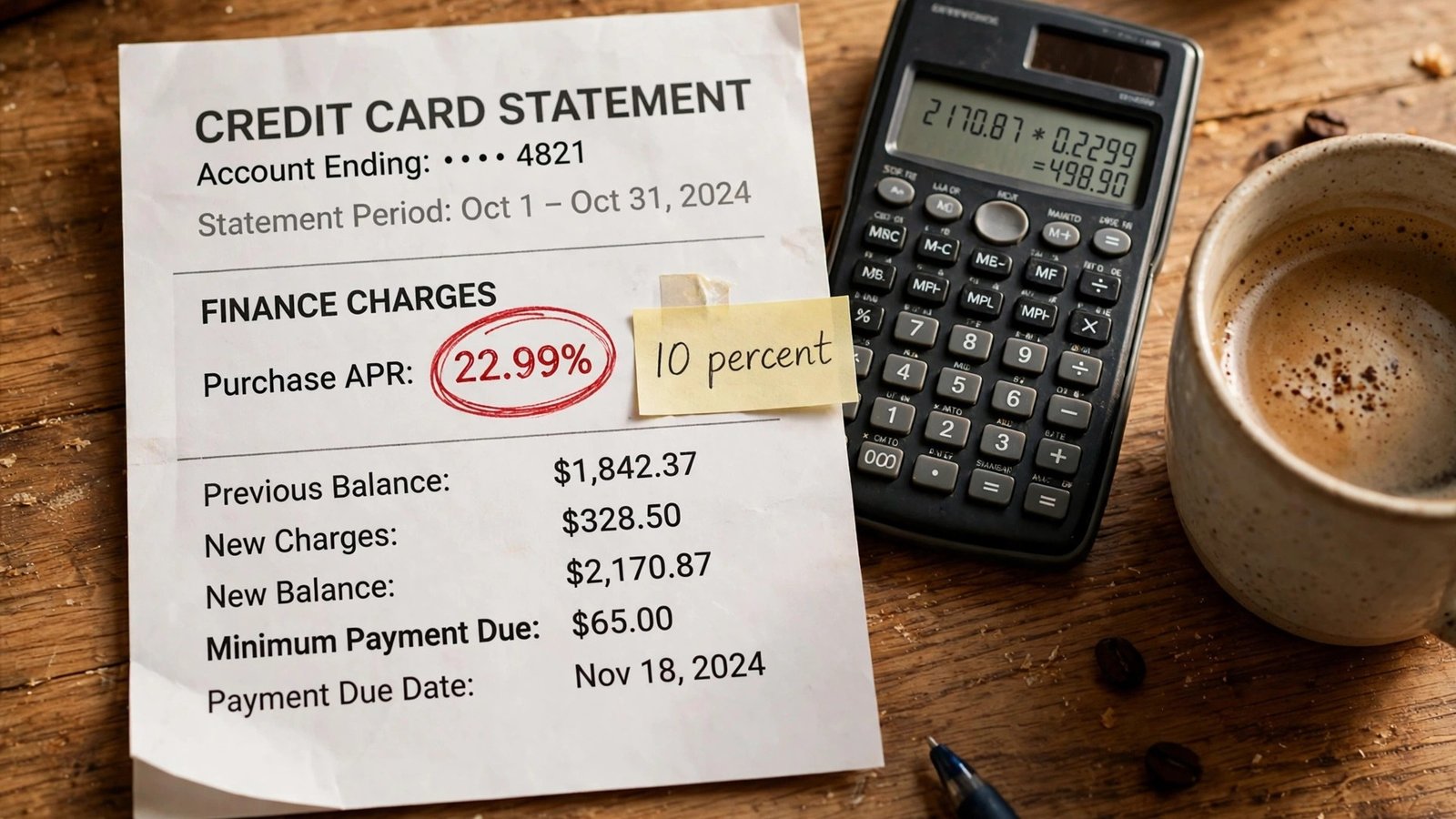
No, your credit card APR is not capped at 10% — not today, not next week, and not because the president said so on TV. On November 21, 2026, President Donald Trump told Fox News he would work with the incoming Democratic Congress to cap credit card interest rates at 10%. It’s a real promise from a real president, and it has real support in Congress. But a promise on television isn’t a law, and right now there is no law. Your card still charges whatever rate is printed on your statement, and for most Americans carrying a balance, that rate is above 22%.
That gap — between a headline that sounds like relief and a statement that still charges you about $112 a month in interest on a $6,000 balance — is what this article covers: what Trump said, where the bills stand, what a cap would save you, and what to do while Washington argues.
What Trump Actually Said on November 21
On Saturday, November 21, 2026, Trump appeared on Fox News Channel’s “Saturday in America,” where host Kayleigh McEnany asked him about a 10% cap on credit card interest lasting one year. His answer was direct: “I would do it. These credit card companies have made a lot.”
It wasn’t a new idea for him. Trump first floated the 10% cap during his 2024 campaign, then revived it in January 2026 as part of the White House’s affordability push, calling for a one-year cap that would take effect January 20, 2026. That date came and went. No general cap took effect, and the Republican-controlled Congress made little effort to pass one. The Associated Press put it plainly: Trump was hoping to fulfill a campaign promise he “couldn’t deliver on because of industry pressure and a lack of interest from his fellow Republicans.”
What’s different now is the politics around him. Democrats will control both the House and the Senate when the new Congress convenes in January 2027, and Sen. Elizabeth Warren of Massachusetts — who has said repeatedly that she wants to cap rates — is expected to chair the Senate Banking Committee. Warren responded the same day: “Let’s cap credit card interest rates and save Americans money.” She has also pointed to her own bill, the Empowering States’ Rights to Protect Consumers Act, which would let states enforce their own rate caps.
So the two sides that usually agree on nothing agree on this. That’s genuinely unusual, and it’s why the story is getting so much attention. But agreement in principle is not a bill, and a bill is not a law.
Proposal vs. Reality: Where the 10% Cap Actually Stands
If you only read headlines, you’d think a cap is right around the corner. The legislative record tells a flatter story. There are exactly two bills that would impose a 10% cap, and neither one has moved past its first step in nearly two years.
| Item | What it is | Status as of November 27, 2026 |
|---|---|---|
| Trump’s November 21 announcement | A televised pledge to work with the incoming Democratic Congress on a 10% cap | A statement, not a law. Changes nothing on your statement. |
| Trump’s January 2026 call | A one-year 10% cap “effective January 20, 2026” | Date passed. No general cap took effect. |
| S. 381 — 10 Percent Credit Card Interest Rate Cap Act | Senate bill by Sen. Bernie Sanders with Sen. Josh Hawley, introduced February 4, 2025 | Still in committee. Referred to the Senate Banking Committee on February 4, 2025, and no action since. |
| H.R. 1944 — 10 Percent Credit Card Interest Rate Cap Act | House companion by Rep. Alexandria Ocasio-Cortez with Rep. Anna Paulina Luna, introduced March 6, 2025 | Still in committee. Referred to the House Financial Services Committee on March 6, 2025, and no action since. |
| What happens next | Both bills die when the 119th Congress ends on January 3, 2027 | Any cap needs a NEW bill in the 120th Congress, a vote in both chambers, and the president’s signature. |
Read that table twice, because it’s the whole story in miniature. The bills exist. They’ve been sitting in committee for 21 months. No hearing, no markup, no vote.
Why Your APR Hasn’t Moved: A President Can’t Cap Rates by Decree
Here’s the part that trips people up, and it’s worth saying plainly because it explains the last eleven months. A president cannot cap credit card interest rates by announcing it. A binding rate limit requires legislation: a bill passed by the House and the Senate and signed by the president. The Congressional Research Service said as much in a March 2026 report — a binding cap generally requires Congress to act.
The banking industry’s opposition has been organized and consistent. In a joint statement in January 2026, the American Bankers Association, the Bank Policy Institute, the Consumer Bankers Association, the Financial Services Forum, and the Independent Community Bankers of America all came out against a cap. Their argument, repeated ever since, is that a 10% ceiling would force issuers to cancel cards for lower-income and less creditworthy customers, cut credit lines, raise fees, or gut rewards programs.
There’s one more piece of context that explains why this moment feels different. For most of 2026, the cap’s politics were upside down: a Republican president and a handful of populist Republicans for it, most Republicans indifferent or opposed, Democrats supportive but in the minority. The midterms flipped the last part. With Democrats taking both chambers and Warren expected to run the Senate Banking Committee, the bill’s sponsors will finally have a committee chair who actually wants a hearing. That doesn’t guarantee a law — it guarantees a chance the bill never had before.
What the Bills Would Actually Do
If S. 381 or H.R. 1944 ever became law, the details matter more than the headline number. Both bills would amend the Truth in Lending Act so the APR on credit obtained with a credit card could not exceed 10 percentage points, counting all finance charges — so issuers couldn’t dodge the cap by renaming interest as a “service fee.” Three other provisions are worth knowing: the cap is temporary, expiring January 1, 2031 (a five-year window, different from Trump’s one-year proposal); a lender that knowingly charges above the cap would forfeit all interest on the account; and borrowers would get a private right of action within two years. The bills also don’t preempt state laws that protect consumers more. The bills have picked up extra cosponsors — Sen. Jeff Merkley in March 2025 and Sen. Kirsten Gillibrand in October 2025 — but cosponsors don’t move bills; committee chairs do, and no chair has scheduled so much as a hearing.
One honest caveat: even if a new bill is introduced on the first day of the 120th Congress, a cap wouldn’t take effect overnight. It would still need a committee markup, floor votes in both chambers (where 60 votes are typically needed to break a Senate filibuster), and the president’s signature.
What a 10% Cap Would Save You
Enough process. Let’s talk about your money.
The Federal Reserve’s G.19 consumer credit release, published November 6, 2026, put the average credit card APR at 22.36% for accounts assessed interest — accounts actually carrying a balance and paying finance charges — based on its August survey of commercial banks. Across all accounts, including people who pay in full every month, the average was 21.19%. The figures are preliminary and predate the quarter-point increase most variable-rate cards added after the Fed’s September move. The median card rate is roughly 22.2%, according to an August survey by the Federal Reserve Bank of New York. However you slice it, the typical person carrying a balance is paying more than double the proposed cap.
Here’s the worked math on a $6,000 balance — a round number close to what many households carry — assuming interest is charged monthly at one-twelfth of the APR and you make no new purchases:
| At today’s 22.36% APR | At a 10% cap | |
|---|---|---|
| Interest in one year (balance untouched) | $1,342 | $600 |
| Interest per month | About $112 | $50 |
| Daily interest cost | About $3.68 | About $1.64 |
| Paying a fixed $300/month | About 26 months, $1,577 total interest | About 22 months, about $590 total interest |
The fixed-payment row is the one to sit up for. Same $300 a month, same $6,000 balance — but at 10%, you’re debt-free four months sooner and you keep roughly $985 that would otherwise have gone to your card issuer.
The minimum-payment trap is where the current rate really bites. Paying only a 2% minimum on that same $6,000 balance at 22.36% would take about 108 years and cost roughly $67,000 in interest, according to published calculations based on the Fed’s rate. At 10%, the minimum-payment math is still ugly — minimum payments always are — but the hole is dramatically shallower.
Scale it up to the whole country and the stakes get enormous. Researchers who studied Trump’s campaign pledge estimated that Americans would save roughly $100 billion a year in interest if card rates were capped at 10%. A September 2025 study by Brian Shearer of the Vanderbilt Policy Accelerator put the gross figure at about the same level, while also estimating that rewards would fall by about $27 billion, leaving net savings of around $73 billion across consumers.
And the balances keep growing. The Federal Reserve Bank of New York reported on November 10 that credit card balances rose by $22 billion in the third quarter of 2026 to about $1.29 trillion — $52 billion higher than a year earlier. More people owe more money, and that’s the audience for a cap.
The Catch Banks Keep Raising
If a cap would save Americans $100 billion a year, why hasn’t it happened already? Because the $100 billion doesn’t vanish — it comes out of somebody’s revenue, and the card industry has been blunt about what it would do in response. The Congressional Research Service notes that the five largest card-issuing banks earned about $120 billion in card interest income in 2025, roughly a third of their total interest income. That’s the pot a cap would shrink. The industry’s stated responses fall into three buckets:
- Less credit for riskier borrowers. Issuers say they’d tighten approvals, lower credit limits, and close accounts for people with lower credit scores. The Vanderbilt study’s own model allows for this, suggesting lending reductions for borrowers with FICO scores below 600.
- Thinner rewards. The study estimates rewards could fall by about $27 billion, with cuts concentrated among customers with FICO scores below 760. Cash back and points are largely funded by the interest paid by people who carry balances — so a cap really does put your 2% cash back and your neighbor’s interest payments on opposite sides of the ledger.
- New fees. Annual fees, late fees, and other charges could rise to replace lost interest income — though the bills’ “all finance charges count toward the cap” language is designed to limit that particular dodge.
Most academic research, according to the CRS, expects a cap to reduce access to new credit, especially for less creditworthy borrowers. The Vanderbilt paper is a minority view in arguing that a 10% to 15% cap would not reduce access.
None of this means a cap is a bad idea. It means the trade-offs are real, and anyone telling you it’s all upside — or all downside — is selling something. The honest question for Congress isn’t whether a cap has costs. It’s whether $100 billion in interest savings is worth the disruption to credit access and rewards. Reasonable people can disagree — and with a newly Democratic Congress and a Republican president who agree on the goal, the next few months are genuinely worth watching.
What to Do While You Wait: A Payoff Plan That Beats Waiting
Here’s the hard truth that matters more than any bill: even in the best case, a cap is many months away, and it may never come at all. Every month you carry a balance at 22.36% while waiting for Washington is a month you pay about $112 in interest on a $6,000 balance. The cap might save you later. A payoff plan saves you now.
Option 1: The balance transfer — if your credit is solid
If your credit score is generally good (think 670 or above), a 0% introductory APR balance transfer card is the closest thing to a personal 10% cap you can get today — better, since 0% beats 10%. You move the balance, pay no interest for 12 to 21 months, and throw every dollar at the principal. The catch is the transfer fee, usually 3% to 5% of the amount moved — that’s $180 to $300 on $6,000 — and the rate snaps back to 20% or higher the day the intro period ends. A balance transfer only works if you pay the balance off (or nearly off) before the intro period expires. If you transfer $6,000 and then keep spending on the old card, you’ve just doubled your problem. Before you apply, check whether your card’s rewards or credits are about to expire; our rundown of credit card credits expiring December 31, 2026 is worth a look before you move anything around.
Option 2: The avalanche — if a transfer isn’t available
If your credit won’t get you a 0% offer right now, the debt avalanche is your best tool. It’s simple, it’s free, and it works. List your cards by interest rate, highest first. Pay the minimum on all of them, then throw every spare dollar at the highest-rate card until it’s gone. Then roll that payment into the next-highest-rate card. You don’t need a new card, a loan, or anyone’s permission.
Run the numbers on your own balances and you’ll see why the order matters. On a $6,000 balance at 22.36%, a fixed $300 a month clears the debt in about 26 months with $1,577 of interest. Bump that payment to $350 and the timeline shrinks to about 21 months with roughly $1,250 in interest. Find $50 a month — a subscription you cancel, a takeout order you skip — and you save real money and real months.
Three moves to make this week
- Call your issuer and ask for a lower rate. Issuers lower rates for customers who ask — especially customers with a decent payment history who mention they’re considering a balance transfer. The worst they can say is no, and the call takes ten minutes.
- Set your payment above the minimum, on autopilot. Set up an automatic payment for a fixed amount — $300 on a $6,000 balance, or whatever your budget allows — and treat it like a bill that doesn’t get negotiated.
- Stop adding to the balance. A payoff plan fails the moment new purchases go on the card. If you can’t pay for it with cash this month, wait. And if you’re a small business owner paying card surcharges on top of interest, know the rules in your state — our guide to credit card surcharge rules by state lays out where surcharges are banned and where they’re legal.
One more thing: be skeptical of anyone selling you a shortcut right now. Every time a cap makes headlines, debt-relief companies buy ads promising to make your rates disappear. A law that doesn’t exist yet can’t be your plan. The avalanche and the balance transfer are boring, and boring is what actually works.
What Happens Next
Ignore the cable-news chatter and track these three milestones instead:
- January 3, 2027. The 119th Congress ends at noon. S. 381 and H.R. 1944 die with it unless enacted before then — and with no hearing scheduled, enactment before January 3 is effectively impossible.
- January 2027: the 120th Congress convenes. Watch for a new cap bill — a reintroduction of S. 381 and H.R. 1944 or a fresh bill reflecting Trump’s one-year version. The bill number will be different, and that’s how you’ll know it’s real movement rather than a re-run of the old press release.
- A hearing in the Senate Banking Committee. This is the first genuine test. If Warren, as expected chair, schedules a hearing on a cap bill, the proposal has moved further in a week than it did in 21 months. No hearing means the agreement is still just talk.
I’ll be straight with you about the odds. A cap now has something it never had before: a president and a Congress from opposite parties who both say they want it. That’s a real opening. It also has everything it had before: an industry that will spend heavily to stop it, a long legislative process with a dozen places to stall, and a Senate filibuster that means 60 votes, not 51. The promise is real. The path is narrow. And until a bill passes both chambers and gets a signature, your APR is whatever your statement says it is.
Frequently Asked Questions
Is there a 10% cap on credit card interest rates right now?
No. As of November 27, 2026, there is no federal cap on credit card interest rates. President Trump said on November 21 that he would work with the incoming Democratic Congress on a 10% cap, but no bill has passed and no law exists. The average APR on accounts assessed interest is 22.36%, according to the Federal Reserve’s G.19 release from November 6, 2026.
What are S. 381 and H.R. 1944?
They are companion bills called the 10 Percent Credit Card Interest Rate Cap Act. S. 381 was introduced in the Senate on February 4, 2025, by Sen. Bernie Sanders with Sen. Josh Hawley, and H.R. 1944 was introduced in the House on March 6, 2025, by Rep. Alexandria Ocasio-Cortez with Rep. Anna Paulina Luna. Both would cap credit card APR at 10%, counting all finance charges, with a sunset date of January 1, 2031. Both are still in committee with no hearing, markup, or vote.
Can President Trump cap credit card rates by himself?
No. A binding rate cap requires legislation passed by both chambers of Congress and signed by the president. Trump called for a one-year 10% cap effective January 20, 2026, but that date passed with no general cap in effect because no law was passed. The Congressional Research Service confirmed in a March 2026 report that a binding limit generally requires Congress to act.
How much would a 10% cap save me?
On a $6,000 balance, a 10% cap would cut a year of interest from about $1,342 to about $600 — a savings of roughly $742 a year, or about $62 a month. With a fixed $300 monthly payment and no new purchases, you’d clear the balance in about 22 months instead of 26, paying roughly $590 in total interest instead of about $1,577. Nationally, researchers estimate a cap would save Americans roughly $100 billion a year in interest, or about $73 billion after accounting for an estimated $27 billion drop in rewards.
Will a 10% cap hurt my credit card rewards or my ability to get a card?
Possibly. Issuers and most academic research expect tighter approvals and lower credit limits for borrowers with lower credit scores, and rewards would likely shrink — one study estimates a $27 billion drop, concentrated among customers with FICO scores below 760. If you pay your balance in full every month, a cap saves you nothing directly and could cost you rewards. If you carry a balance, the interest savings would likely far outweigh thinner rewards.
What should I do about my credit card debt while I wait for Congress?
Don’t wait. Call your issuer and ask for a lower rate, consider a 0% balance transfer card if your credit qualifies, or use the debt avalanche — minimums on everything, every spare dollar at the highest-rate card first. A fixed $300 a month clears a $6,000 balance at today’s average rate in about 26 months; waiting for a cap that may never come just adds interest.
This article is for general information only and is not professional financial advice. Rates, terms, and card offers change frequently — check your current card agreement and the issuer’s published terms before making any decision about your debt.
Sources: Associated Press reporting on President Trump’s November 21, 2026 Fox News interview (AP report); Federal Reserve G.19 Consumer Credit release, November 6, 2026; Federal Reserve Bank of New York household debt report, November 10, 2026; bill status and text summaries for S. 381 and H.R. 1944 (bill tracker; S. 381 on Congress.gov; H.R. 1944 on Congress.gov).