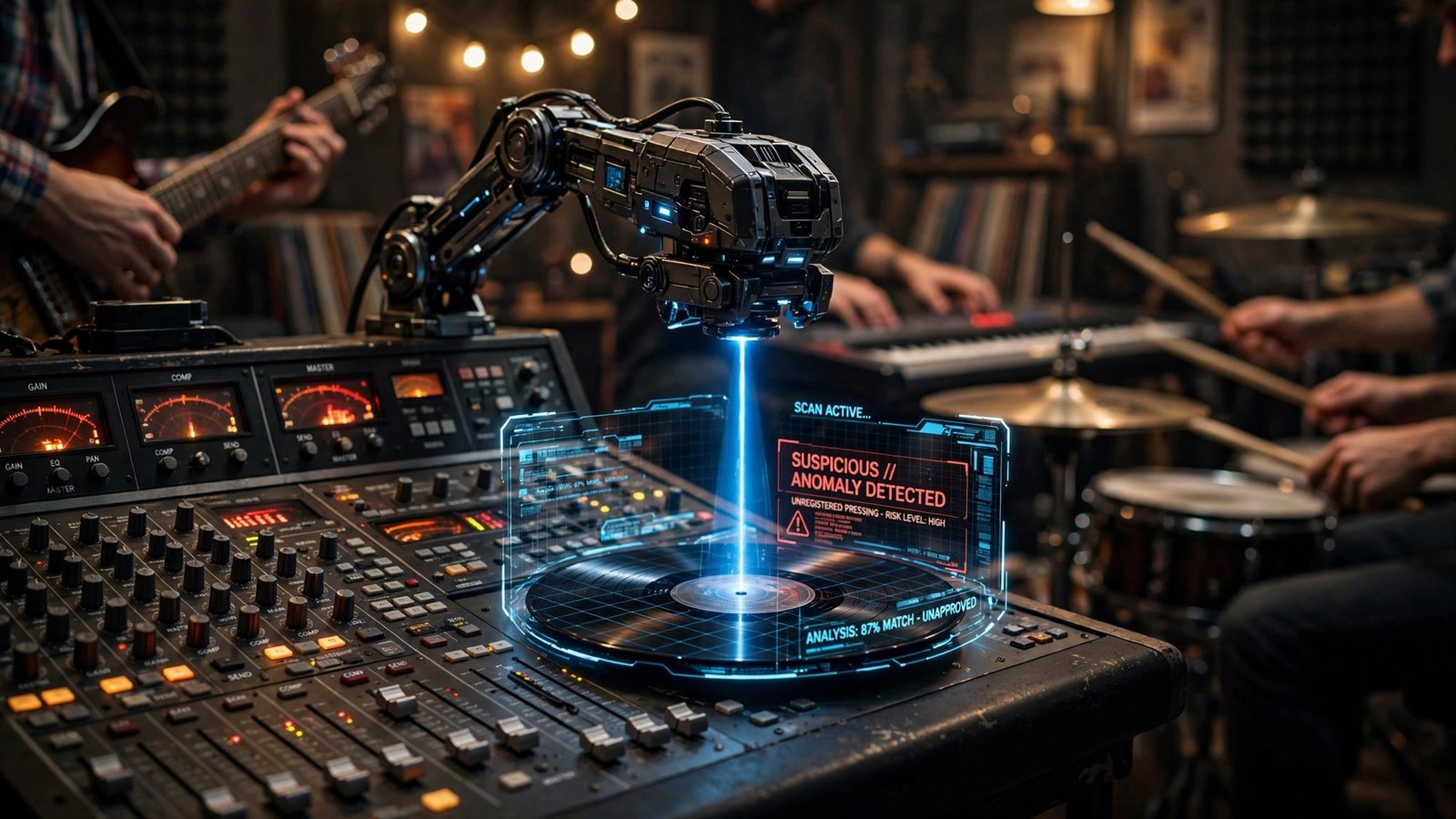
A dancehall veteran recorded a song with live musicians in a real studio. No AI at any stage of production. His distributor flagged it as AI-generated anyway.
That artist is Papa Michigan, and his story — reported by the Jamaica Gleaner — is becoming disturbingly normal. As streaming platforms pressure distributors to police AI-generated uploads, the automated screening meant to catch machine-made music is increasingly catching human-made music too.
What happened to Papa Michigan
Michigan received an email from TuneCore about a track on his So Many Roads album — “Who Can Be Against Me” — saying the release was not eligible for distribution. The reason given: indicators suggesting the use of generative AI tools relying on improperly licensed datasets.
He was shocked. He took to social media to “challenge AI,” showing the studio, the musicians who played live on the track, and emphasizing that no AI was used at any stage of production. He filed a formal appeal insisting the track was “a 100-per-cent human studio recording” and asked for review by a human moderator.
In the end, he removed the song and released So Many Roads on August 14 without it. A human artist lost a track from his own album to a false positive — and ate the delay and the stress.
Why distributors became AI gatekeepers
This isn’t TuneCore going rogue. According to Evon Mullings, general manager of the Jamaica Music Society (JAMMS), “the scenario of some human-made music being rejected (false positive) by digital distributors is becoming increasingly common.”
The pressure comes from upstream. Mullings told the Gleaner that major streaming services — Apple Music, Spotify, Deezer — are pressing distributors like TuneCore, DistroKid, and CD Baby to function as gatekeepers, tagging AI-generated or AI-assisted music before it ever reaches the retail platforms. The screening is aggressive and automated.
The numbers explain the panic: Deezer says close to half of new uploads are AI-generated, and an Apple Music executive told Billboard earlier this year that more than a third of new uploads were entirely AI-created. The industry responded with voluntary AI content labels from the IFPI and RIAA — but labels depend on honest self-reporting, so platforms leaned on distributors to detect what artists won’t disclose.
Why human music gets flagged
Here’s the cruel irony: the techniques that make modern human production sound polished are the same signals AI detectors look for.
Drums locked 100% to the grid. Quantized drums — standard practice in dancehall, hip-hop, pop, and EDM — look “too perfect” to a detector trained on the assumption that humans drift.
Heavy Auto-Tune. Pitch correction on vocals is ubiquitous in modern production. To an algorithm, the telltale artifacts of tuned vocals can read as synthetic generation.
Sample-heavy or loop-based production. Genres built on loops and programmed instrumentation share surface characteristics with AI-generated tracks, because both are assembled from clean, consistent digital sources.
In other words, if you produce modern commercial music the way modern commercial music is produced, you look like a machine to the machine.
How to protect your releases
If you distribute music — especially AI-assisted or heavily produced human music — treat false positives as a real business risk now, not a hypothetical:
- Keep your session files. Stems, DAW project files, and rough mixes are your evidence. If a track gets flagged, “here are my 47-track Pro Tools sessions” is the fastest way to clear it.
- Document the humans. Photos and short videos from recording sessions cost nothing and prove everything. Papa Michigan’s studio footage was his strongest card.
- Know your distributor’s appeal process before you need it. Every major distributor has one; find it now, not at 2 AM when your release is blocked.
- Disclose AI use honestly where it exists. The industry’s new labeling system distinguishes “AI-generated” from “AI-assisted” (human-created with some AI elements, human lead vocals required). Proper disclosure keeps you on the right side of both the labels and the detectors.
- Consider your distributor’s false-positive reputation. Distributors are all under the same pressure, but their appeal processes and human review availability differ. Ask other artists about their experiences before you commit your catalog — the same way you’d research DistroKid’s royalty reporting before signing up.
The detectors aren’t as reliable as claimed
It’s worth noting how much trust the industry is placing in tools with unproven real-world accuracy. Deezer launched an “AI music detector” in June 2026 that it says is 99.8% accurate — a striking claim for a system operating on hundreds of millions of tracks across every genre on earth. But accuracy on a test set is not accuracy in the wild, and a 0.2% error rate across hundreds of millions of uploads still means hundreds of thousands of wrongly flagged tracks.
The deeper problem is that these detectors are trained to find statistical patterns, and commercial music production has spent decades converging on statistical perfection. A perfectly quantized dancehall riddim, a pitch-corrected vocal, a loop-based beat — these aren’t edge cases. They’re the mainstream. Every false positive like Papa Michigan’s is a data point suggesting the detectors are tuned for caution at artists’ expense: better to block a human than let an AI track slip through, because the platform pressure falls on the distributor either way.
The bigger picture
We’re watching the music industry build its AI immune system in real time, and like every immune system, it’s attacking some healthy tissue. The pressure from Spotify, Apple Music, and Deezer isn’t going away — if anything, with AI uploads approaching half of all new music on some platforms, the screening will get more aggressive.
The artists who survive this transition won’t just be the most talented. They’ll be the most documented — the ones who can prove, on demand, that a human made the music. In 2026, your session files are as important as your masters.
Frequently asked questions
Why was Papa Michigan’s song flagged as AI?
TuneCore’s automated screening identified indicators suggesting generative AI use in “Who Can Be Against Me.” Michigan insists the track was recorded with live musicians and no AI at any stage — a false positive, likely triggered by production characteristics like quantized drums or tuned vocals.
Which distributors are doing AI screening?
TuneCore, DistroKid, CD Baby, and others are all under pressure from Spotify, Apple Music, and Deezer to screen uploads for AI-generated content before distribution, according to JAMMS general manager Evon Mullings.
How common are AI false positives in music distribution?
Increasingly common, per Mullings: “the scenario of some human-made music being rejected (false positive) by digital distributors is becoming increasingly common.” No distributor publishes false-positive rates.
What should I do if my human-made track is flagged as AI?
File a formal appeal requesting human review, and provide evidence: DAW session files, stems, and studio footage proving human performance. Document your recording process as a matter of habit.
Does using Auto-Tune get my music flagged as AI?
Heavy pitch correction is one of the characteristics that can trigger false positives, since detectors associate its artifacts with synthetic vocals. It won’t automatically flag you, but combined with other “too perfect” production traits, it raises the risk.