
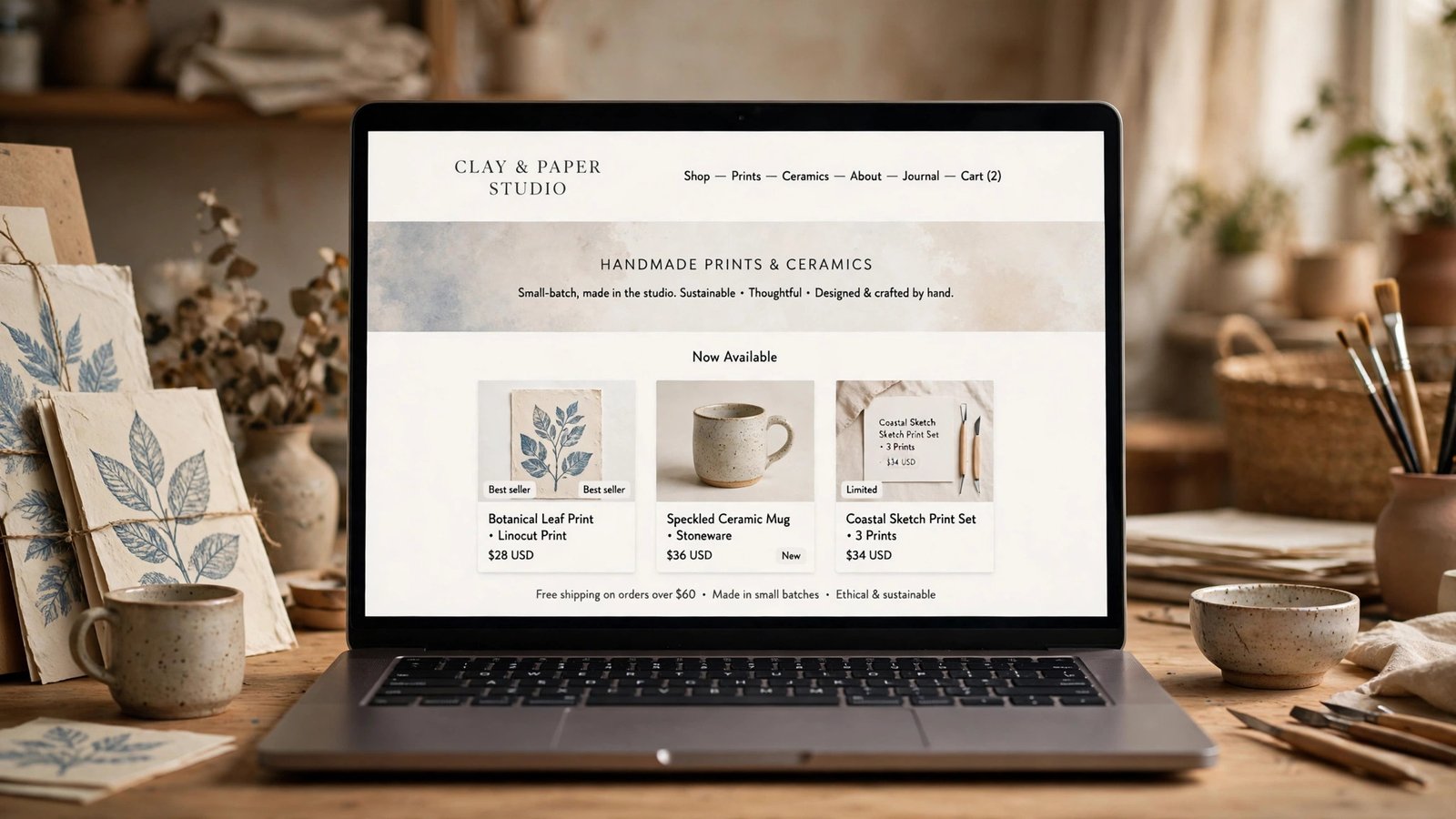
Big Cartel costs $0, $15, or $30 a month in 2026, and none of the three plans takes a cut of your sales. That’s the whole pitch, and it’s real: the only per-order cost is whatever Stripe or PayPal charges to process the card. The catch is just as real — Big Cartel gives you a store, not an audience. You bring every visitor yourself.
So the honest question isn’t whether Big Cartel is cheap. It is. The question is whether you’re at the point where paying a flat $15 a month beats paying Etsy roughly 11% of every sale — and whether Etsy’s new AI-training terms, which take effect December 16, 2026, tip the balance for you. I ran the numbers at several sales levels, checked every price on Big Cartel’s own pricing page on November 26, 2026, and the crossover point is lower than most sellers guess.
Big Cartel Pricing in 2026: The Three Plans
Big Cartel has sold to artists, makers, and bands since 2005, and its pricing still reads like a company that remembers who its customers are. Three plans, no commission, no setup fee.
| Plan | Monthly price | Annual price | Products | Images per product |
|---|---|---|---|---|
| Gold | $0 | $0 | 5 | 1 |
| Platinum | $15 | $144/year ($12/month) | 50 | 5 |
| Diamond | $30 | $288/year ($24/month) | 500 | 25 |
Annual billing saves 20% on both paid plans. There is a 7-day free trial on Platinum if you want to test the paid features before committing.
Gold: free forever, with real limits
Gold is a genuine free plan, not a timed trial. You get a working shop on a bigcartel.com address, online payments, a free mobile-friendly template, and basic sales reporting. The limits are the point: five products, one image per product, no custom domain, no discount codes, no inventory tracking, and no digital products.
Five products sounds tiny until you think about who it’s for: a printmaker with four best-selling prints and a sticker pack fits, as does a ceramicist with a rotating shelf of five pieces. The moment you want a sixth listing, or a PDF pattern alongside the physical one, Gold stops working and Platinum starts.
Platinum: the plan most sellers land on
Platinum is $15 a month, or $12 a month if you pay annually, and it’s the plan Big Cartel itself calls its most popular. Everything in Gold, plus a custom domain, 50 products with five images each, discount codes, inventory tracking, shipping labels and order tracking, in-person selling, and — the one that matters for digital sellers — digital products.
Digital products on Platinum mean one file or link per product, with 25GB of total shop storage and uploads up to 1GB each — enough for ebooks, printable wall art, sewing patterns, and presets. If digital downloads are your main business, the storage and per-product file limit are the numbers to watch, not the price.
Diamond: for shops that are actually scaling
Diamond is $30 a month ($24 on annual billing) and raises the ceiling to 500 products with 25 images each. The features it adds are the ones a growing shop eventually needs: abandoned-cart recovery emails, scheduled product drops, password-protected products, Zapier connections to 7,000+ apps, and priority support from actual humans.
Digital storage jumps to 250GB with up to five files per product. If you sell a course with five video modules or a bundle of five printable packs as one product, Diamond is the first plan that handles it natively.
The One Fee That Matters: What You Actually Pay Per Sale
Big Cartel charges 0% commission on every plan. That sentence does a lot of work, so let’s be precise about what it leaves out: you still pay a payment processor on every order, because Big Cartel doesn’t process payments itself. Your choices are Stripe or PayPal, and their rates are the only per-sale cost on the platform.
| Payment method | Rate (US) | Fee on a $30 order |
|---|---|---|
| Stripe | 2.9% + $0.30 | $1.17 |
| PayPal Checkout / Venmo | 3.49% + $0.49 | $1.54 |
| PayPal standard card | 2.99% + $0.49 | $1.39 |
Stripe is the cheaper default for most US sellers, and the gap widens on small orders because PayPal’s $0.49 fixed fee bites harder: on a $10 order, Stripe takes $0.59 and PayPal Checkout takes $0.84 — 5.9% versus 8.4% of the sale. If your average order is under $15, the processor choice matters more than the plan choice.
Here’s the full stack on a single $30 print order, so you can see every line:
| Fee | Big Cartel + Stripe | Etsy |
|---|---|---|
| Listing fee | $0 | $0.20 |
| Platform transaction fee | $0 | $1.95 (6.5%) |
| Payment processing | $1.17 | $1.15 (3% + $0.25) |
| Monthly plan (per order, at 25 orders/mo) | $0.60 (Platinum) | $0 |
| Total cost on the order | $1.77 | $3.30 |
| You keep | $28.23 | $26.70 |
That $1.53 difference per order is the whole story. Etsy also charges the 6.5% transaction fee on the shipping you charge, not just the item price, and if the sale came through Etsy’s Offsite Ads, another 12% (or 15% for shops under $10,000 a year in sales) comes off on top — the Offsite Ads holiday trap catches sellers every Q4. A $30 order that arrived via an Offsite Ad costs $6.90 in Etsy fees. On Big Cartel, the same order costs $1.17 plus your share of the flat monthly plan.
Big Cartel vs Etsy: The Fee Math at $500, $1,000, and $5,000 a Month
Per-order math is useful; monthly math decides the switch. These tables assume a $25 average order, Stripe processing, no shipping in the fee base, and no Offsite Ads. (Etsy’s fees rise if you charge shipping — the 6.5% applies to shipping too.)
At $500 a month (20 orders)
| Big Cartel Gold | Big Cartel Platinum | Etsy | |
|---|---|---|---|
| Monthly plan | $0 | $15.00 | $0 |
| Listing fees | $0 | $0 | $4.00 |
| Transaction fees (6.5%) | $0 | $0 | $32.50 |
| Processing (Stripe / Etsy Payments) | $20.50 | $20.50 | $20.00 |
| Total fees | $20.50 | $35.50 | $56.50 |
| You keep | $479.50 | $464.50 | $443.50 |
At this level Gold is cheapest of all — but only if your whole catalog fits in five products. Platinum still beats Etsy by $21 a month.
At $1,000 a month (40 orders)
| Big Cartel Gold | Big Cartel Platinum | Etsy | |
|---|---|---|---|
| Monthly plan | $0 | $15.00 | $0 |
| Listing + transaction + processing | $41.00 | $41.00 | $113.00 |
| Total fees | $41.00 | $56.00 | $113.00 |
| You keep | $959.00 | $944.00 | $887.00 |
Platinum now saves you $57 a month over Etsy — $684 a year, more than three times the plan’s cost.
At $5,000 a month (200 orders)
| Big Cartel Platinum | Big Cartel Diamond | Etsy | |
|---|---|---|---|
| Monthly plan | $15.00 | $30.00 | $0 |
| Listing + transaction + processing | $205.00 | $205.00 | $565.00 |
| Total fees | $220.00 | $235.00 | $565.00 |
| You keep | $4,780.00 | $4,765.00 | $4,435.00 |
At $5,000 a month, Etsy costs $345 more than Platinum every month — over $4,100 a year, and the reason sellers with an existing audience leave marketplaces. The caveat: at this volume you’re almost certainly past 50 products, so the honest comparison is Diamond at $235, which still beats Etsy by $330 a month.
If even a quarter of those Etsy orders came through Offsite Ads at 12%, add another $150 a month to Etsy’s column.
The Break-Even Point: When Big Cartel Starts Winning
The flat monthly fee means Big Cartel loses at very low volume and wins everywhere above a small threshold. Here’s the crossover, worked out at $30 per order with Stripe:
| Orders per month | Big Cartel Platinum | Etsy | Winner |
|---|---|---|---|
| 5 | $20.85 | $16.50 | Etsy by $4.35 |
| 7 | $23.19 | $23.10 | Dead even |
| 8 | $24.36 | $26.40 | Big Cartel by $2.04 |
| 10 | $26.70 | $33.00 | Big Cartel by $6.30 |
| 15 | $32.55 | $49.50 | Big Cartel by $16.95 |
| 25 | $44.25 | $82.50 | Big Cartel by $38.25 |
The crossover sits at around seven or eight orders a month at a $30 average order value. Sell cheaper items and the threshold moves up slightly, since Etsy’s percentage fees shrink while Big Cartel’s flat $15 stays put; sell pricier work and it moves down. Pay annually and the effective plan cost drops to $12, pulling break-even down to about six orders a month.
The practical rule: if you reliably sell eight or more orders a month, Platinum costs less than Etsy. If you sell fewer than that, Etsy is still cheaper — and at that volume, Etsy’s built-in traffic is worth more to you than the fee savings anyway.
Why Sellers Are Looking Now: Etsy’s December 16 AI Terms
Fees alone have always favored Big Cartel past a handful of orders, yet most sellers stayed on Etsy. The thing that changed in the last few weeks is the contract, not the price.
Etsy published new Terms of Use on October 26, 2026, effective December 16, 2026. Section 5.C gives Etsy and its “third party partners and vendors” the right to use seller content — listing photos, descriptions, videos, reviews — to “develop, train, test and improve artificial intelligence and machine learning technologies.” Sellers keep their copyright, but the license Etsy takes is perpetual, irrevocable, and sub-licensable. Etsy’s November 23 revision added a written promise not to train copycat models — but the permission itself stayed in place.
The backlash was fast and public. Etsy VP of Customer Operations James Ossman posted in the community forum on November 16 saying Etsy does not train models “designed to copy your original work or replace your creativity,” and listing fraud detection, search, and seller tools as the actual uses. On November 20, national press reported longtime sellers closing their shops rather than accept the terms — including Cognitive Surplus, a stationery and home-goods shop that had sold on Etsy for 13 years. The November 23 revision moved the no-copycat promise from a forum post into the contract itself, but the training permission stayed, the December 16 date stayed, and the line referencing opt-out rights in the Privacy Policy was removed.
What that leaves, as of November 26:
- No toggle. There is no switch in Etsy account settings to opt out of AI training for US sellers.
- No named partners. The terms don’t say which vendors can train on your work, or how you’d complain if an AI output resembles your product.
- A promise, not a limit. Etsy’s written commitment is that it won’t train models designed to copy your work. The training permission itself is broad, and the promise is only as strong as Etsy’s word.
- A deadline. Sellers who keep their shops open after December 16 accept the new terms.
None of this means every seller should leave. It means the decision now has two parts — money and control — and for the first time, a lot of sellers are weighing both at once.
What Big Cartel’s terms actually say
Here’s the honest version, because the comparison going around online is sloppier than it should be. Big Cartel’s content license has no AI wording in it at all, and the company makes no no-AI promise either. What it does offer is a free feature called AI Shield, which blocks compliant AI training crawlers from your shop — off by default, and only effective against crawlers that respect robots.txt, which not all of them do.
So the real difference isn’t “Big Cartel promises never to train on your work.” It’s that Big Cartel’s license is purpose-limited to running your store, it doesn’t hand your content to unnamed third-party partners for AI development, and it gives you a crawler-blocking tool Etsy doesn’t offer. That’s meaningful, but it’s not a guarantee — and any guide that tells you otherwise is overselling it.
If the AI terms are your main reason for moving, read Big Cartel’s license yourself before you migrate, turn on AI Shield the day you launch, and remember your product photos may already be circulating from years on Etsy. Moving stops future use under the new terms; it doesn’t claw back anything already published.
What Big Cartel Can’t Do
A fair pricing guide has to say the quiet part out loud: Big Cartel is cheaper because it does less. Here’s what you’re giving up.
Traffic. Etsy reported 87.5 million active buyers in the 12 months ending September 30, 2026. Big Cartel has no marketplace and no search page. A new store starts at zero visitors, and every one has to come from your Instagram, TikTok, email list, craft-fair booth, or search rankings. If you don’t already have an audience, Etsy isn’t expensive — it’s your marketing department, and 11% is a fair price for it.
Catalog size. The 500-product ceiling on Diamond is a hard cap, and 50 on Platinum is tighter than it sounds once you count variants. Etsy has no product cap. Print-on-demand sellers with hundreds of designs will hit Big Cartel’s ceiling fast, and there’s no higher plan to upgrade to — at that point you’re migrating to Shopify, not upgrading.
Subscriptions and depth. There’s no native subscription billing, no built-in email marketing, and the analytics are basic. Each product gets up to three variant dropdowns — enough for size and color, not much more — and SEO tools are minimal next to Shopify’s. Abandoned-cart flows with real segmentation mean Zapier duct tape on Diamond, not a native feature.
Discovery for digital products. Big Cartel sells digital goods fine once a buyer arrives, but nobody browses Big Cartel looking for a printable — Etsy’s search is where digital sellers get found. If most of your sales come from Etsy search, moving to Big Cartel means moving into a room nobody walks into.
Big Cartel vs Shopify: The $15 vs $39 Question
If you’re already thinking about leaving Etsy, the next question is usually whether to skip Big Cartel and go straight to Shopify. The plan prices tell most of the story: Shopify Basic is $39 a month ($29 on annual billing) against Platinum’s $15 ($12 annual). That’s $14 to $24 a month more before a single sale, plus Shopify’s own card processing on top.
What the extra money buys is scale and tools: no product cap, a massive app store, native subscriptions, far stronger SEO controls, and multi-channel selling built in. Shopify also has its own AI shopping channels, which you can switch off — worth doing on day one if the AI terms pushed you off Etsy.
The decision is simple. If your catalog fits in 50 products and your audience already follows you somewhere, Big Cartel saves you $168 to $288 a year over Shopify Basic and does everything you need. If your catalog is growing past 500 products, or you need subscriptions, or you want to sell on five channels at once, pay for Shopify and skip the intermediate move. Moving platforms twice costs more than the price difference ever will.
For the full Shopify fee breakdown, see our Shopify fees guide for 2026.
Who Should Switch, Who Should Stay
Switch to Big Cartel if:
- You sell 8+ orders a month and most buyers already find you through your own channels
- Your catalog fits in 50 products (or 500, on Diamond)
- You sell digital products and want 0% commission without a separate download app
- Etsy’s December 16 AI terms are a genuine dealbreaker for you, not just an annoyance
- You want your own domain and customer list, so no platform can change the rules under you
Stay on Etsy if:
- You sell fewer than 7 orders a month — Etsy is still cheaper, and its traffic is worth more than the savings
- Most of your sales come from Etsy search, not your own audience
- Your catalog is hundreds of listings deep, especially print-on-demand
- You rely on Etsy’s buyer trust, reviews, and dispute handling to close sales
- You don’t have time to drive your own traffic yet — an empty storefront doesn’t pay rent
Run both if:
- This is the move I’d recommend for most sellers reading this in late November. Keep Etsy open through the holidays — Cyber Week is the worst moment to disappear from search — and open the Big Cartel store now, while the AI-terms conversation is driving curious buyers to your links. Put your bestsellers on both, price them the same, and watch where the orders come from for a month. The data will tell you which platform earns its keep, and you’ll have a finished store ready if you go all-in after December 16.
How to Move From Etsy to Big Cartel Without Losing Sales
If you decide to move, do it in order. The sellers who lose money in a migration are the ones who close Etsy first and build second.
1. Open Big Cartel and build before you announce anything. Pick your plan by catalog size, not optimism — count your live listings, including variants you actually sell. Set your custom domain on Platinum or Diamond before you share a single link; changing domains later breaks every link you’ve posted.
2. Move your five best sellers first, not your whole catalog. Photograph and describe them properly — Gold gives you one image per product, so this is the moment to upgrade to Platinum for the five-image limit. Test checkout yourself with a real card, and turn on AI Shield in your shop settings.
3. Keep Etsy open and link out. Add your own site’s link to your shop banner and listing descriptions where the rules allow. Every buyer who finds you on Etsy and buys on Big Cartel next time is a customer you now own.
4. Email your own list. Your Etsy customer list belongs to Etsy, but emails you’ve collected at craft fairs or through a newsletter signup are yours. Send a short note about the new shop and a first-order discount code, which Platinum supports natively.
5. Watch the numbers for 30 days, then decide. If Big Cartel brings 8+ orders a month, pause the Etsy listings you’re duplicating and keep Etsy only for discovery. If it doesn’t, you’ve spent $15 learning your audience still lives on Etsy — and the store is ready for the next time Etsy changes its terms.
The Bottom Line
Big Cartel’s pricing hasn’t changed, and that’s the point. Gold is free for five products, Platinum is $15 a month for fifty, Diamond is $30 for five hundred, and none of them takes a percentage of your sales. At $30 an order, Platinum pays for itself at your eighth sale of the month; at $1,000 in monthly sales it saves you $57 a month over Etsy, and at $5,000 the gap is $345.
Whether that math matters depends on where your buyers come from. If Etsy search feeds your shop, the fees are the price of the traffic, and Big Cartel’s empty storefront will cost you more than it saves. If your audience already follows you, you’re paying Etsy 11% for traffic you brought yourself — and with its AI-training terms taking effect December 16, you’re also handing over a license to your work that you can’t opt out of.
Either way, the decision is cheaper to make now than in January. Open the store, run both for a month, and let your own order numbers settle it.
Prices verified November 26, 2026 on bigcartel.com and paypal.com. Platform fees change — check the vendor’s pricing page before you decide. This article is general information, not financial or legal advice.
Frequently Asked Questions
Is Big Cartel really free?
Yes — the Gold plan is free forever, with no trial period and no credit card required. You can list up to five products and take payments through Stripe or PayPal. The limits are five products, one image per product, no custom domain, and no digital products. You still pay Stripe or PayPal processing fees on every order, which is the only per-sale cost on any Big Cartel plan.
How much does Big Cartel charge per sale?
Big Cartel itself charges 0% commission on all three plans. The only per-sale cost is payment processing: Stripe at 2.9% + $0.30, or PayPal Checkout at 3.49% + $0.49 for US sellers. On a $30 order through Stripe, that’s $1.17. Compare that with Etsy’s $3.30 on the same order ($0.20 listing + 6.5% transaction fee + 3% + $0.25 processing).
How many products can you sell on Big Cartel?
Five on the free Gold plan, 50 on Platinum ($15/month), and 500 on Diamond ($30/month). There is no higher plan and no way to raise the cap, so sellers with catalogs over 500 products need a different platform. Each product also has an image limit — 1 on Gold, 5 on Platinum, 25 on Diamond — and up to three variant dropdowns.
Is Big Cartel better than Etsy?
It depends on where your buyers come from. Big Cartel is cheaper once you sell about eight orders a month, gives you your own domain and customer list, and its content license has no AI-training clause. Etsy is better if you need its 87.5 million active buyers, if your catalog is hundreds of listings deep, or if you sell fewer than seven orders a month. Many sellers run both: Etsy for discovery, Big Cartel for repeat buyers.
Does Big Cartel let you sell digital products?
Yes, on the paid plans. Platinum ($15/month) supports digital products with one file or link per product and 25GB of total storage; Diamond ($30/month) raises that to five files per product and 250GB, with uploads up to 1GB each. The free Gold plan is physical products only. Big Cartel charges no commission on digital sales either — just the Stripe or PayPal processing fee.
What is Etsy’s AI training clause, and when does it take effect?
Etsy’s new Terms of Use, published October 26, 2026, take effect December 16, 2026. Section 5.C lets Etsy and its third-party partners and vendors use seller content to develop, train, test, and improve AI and machine-learning technologies. On November 23, Etsy added a written promise not to train models designed to copy sellers’ work, but the training permission and the December 16 date stayed, and there is no opt-out toggle in account settings for US sellers. Big Cartel’s license contains no AI-training wording, and its free AI Shield feature blocks compliant AI training crawlers — though that only stops crawlers that respect it.