
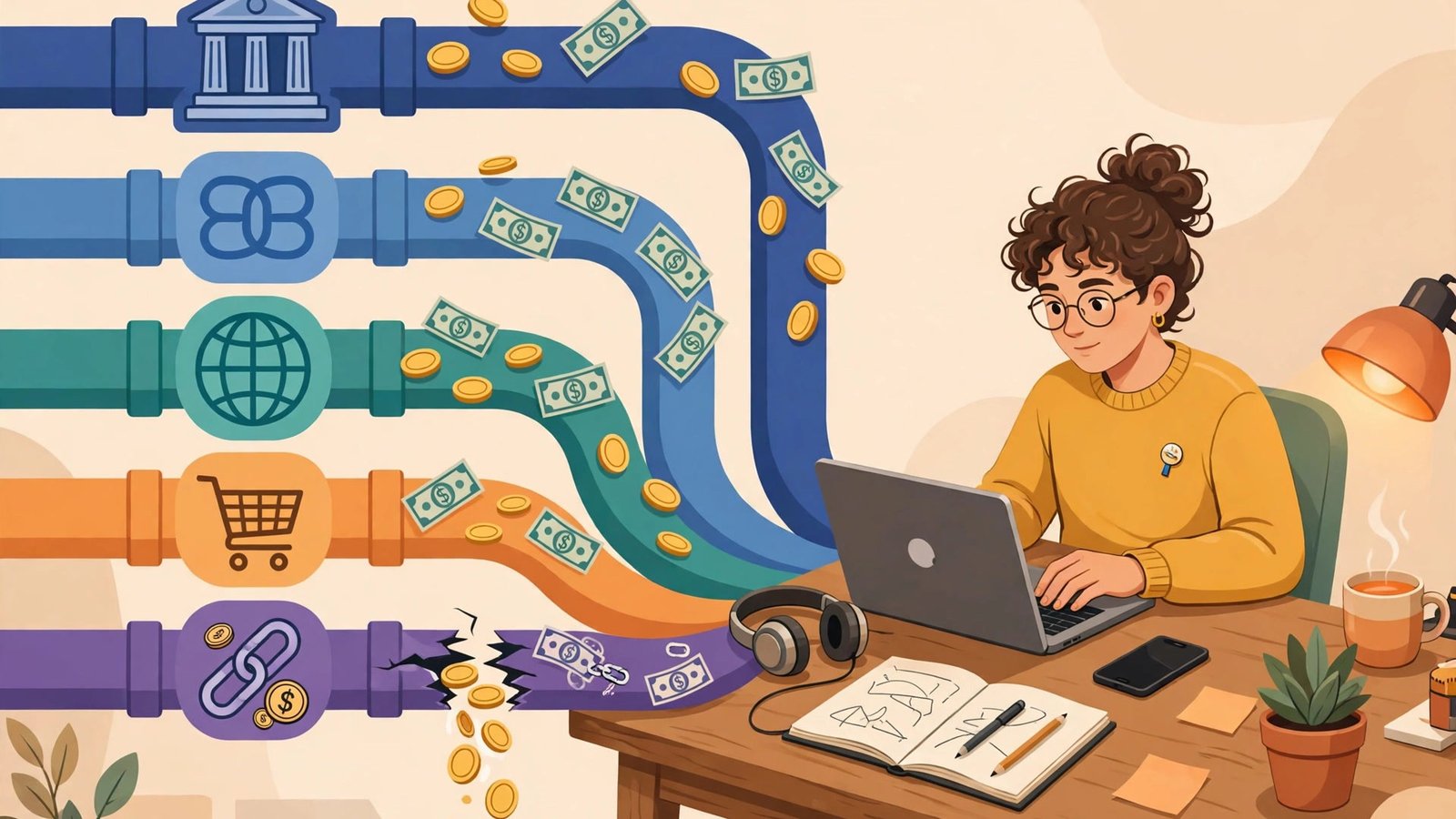
A brand offers you $500 for a video. You say yes, you deliver, and then the money arrives — but it’s not $500. It’s $480, or $494, or the full $500 minus a fee you never saw coming. Which number you get depends almost entirely on which payment rail the brand uses, whether you’re in the US or abroad, and one contract detail most creators never think to negotiate: who pays the transfer fee.
This is the part of the creator economy nobody puts in the rate card. Brands quote a gross number. Payout platforms take their cut in different places — some charge the sender, some skim the conversion, some charge both sides — and the difference between the cheapest and most expensive way to move $500 is big enough to matter. Run the same $500 through five common rails and the spread is roughly $20 on a single payment, and hundreds of dollars over a year of brand deals.
Here’s the honest breakdown, worked from published fee schedules as of October 2026, plus the tax-paperwork side that trips creators up every January.
The short answer: the rail matters more than the rate
If you’re a US creator being paid by a US brand, the cheapest rails cost almost nothing. PayPal Payouts charges the sender 2% capped at $1 per transaction on its website flow, or a flat $0.25 per transaction through the Payouts API — and you, the recipient, get the full amount. Wise Business prices transfers from 0.23% at the mid-market exchange rate, which on a same-currency USD transfer is close to nothing.
The fees bite when money crosses a border or changes currency. That’s where a $500 payout turns into $480. PayPal’s currency conversion spread runs around 4% in third-party comparisons, Wise charges a small transparent percentage instead of a spread, and a traditional bank wire can cost $5 on the sender’s side plus an undisclosed exchange spread and possibly an incoming wire fee on your side. The same $500, five rails, five different landings.
The single most important question to ask before you accept a deal isn’t “what’s the rate?” — it’s “is the $500 gross or net of transfer fees, and who pays them?” If the brand covers fees, you keep the full $500 on most rails. If the fee comes out of your pay — common when a brand quotes a flat “all-in” amount — the rail decides your real rate. Get that answer in writing before you film anything.
The $500 test: five rails, one payment
The table below assumes the realistic case for most US-based creators working with US brands but getting paid across borders or converting currency: a creator outside the US receiving $500 and converting it to local currency. Sender-side fees and creator-side conversion losses are shown separately, because they hit different people — and because your contract decides which ones hit you.
| Rail | Sender pays | Creator loses on conversion | Creator nets (approx.) | Total cost of the $500 |
|---|---|---|---|---|
| PayPal Payouts | 2% = $10 (capped at $20 internationally) | ~4% conversion spread = ~$20 | ~$480 | ~$30 |
| Wise Business | From 0.23% = ~$1.15 | $0 (mid-market rate) | ~$499 | ~$1 |
| Trolley | $4 local transfer + 2% FX = $14 | $0 (paid locally) | ~$486–$490 | ~$14 + platform fee |
| Chase bank wire | $5 wire in creator’s currency | Undisclosed FX spread (often 2–4%) | ~$480–$490 | ~$15–$25 |
| USDC on Base | Network fee (cents) | Cash-out cost varies | ~$500 before cash-out | Under $1 + cash-out |
A few things to note about this table, because fee tables that hide their assumptions are how creators get misled. First, these are estimates built from published fee schedules and an October 2026 third-party comparison (creator-payouts.com), not a promise — your exact numbers depend on the currency pair and the day’s rate. Second, Trolley’s per-transfer price looks competitive until you add its $2,399-a-year platform fee; at 100 payouts a year that’s another ~$24 per payout, and its tax-filing plan costs another $2,399 a year on top. Third, USDC looks nearly free until you convert it to spendable money, and that cash-out step — exchange fees, spreads, sometimes a bank withdrawal fee — is where the cost hides. If you can’t convert cheaply, the “free” rail isn’t free.
The headline for most solo creators: on a single $500 payment, Wise is the cheapest rail by a wide margin, PayPal is the most expensive mainstream option once currency conversion enters the picture, and wires sit in the middle with the worst transparency, because the exchange spread is never quoted upfront.
The same math at $100 and $2,000
Flat fees and percentage fees behave very differently as the payment size changes, and that’s why a rail that’s cheap at $500 can be terrible at $100. Here’s the same comparison scaled, assuming fees come out of the gross amount and the creator converts currency:
| Rail | Creator nets on $100 | Creator nets on $500 | Creator nets on $2,000 |
|---|---|---|---|
| PayPal Payouts | ~$94 (2% + 4% conversion) | ~$480 | ~$1,920 (2% capped at $20 + 4% conversion) |
| Wise Business | ~$99.77 (0.23%) | ~$499 | ~$1,995 |
| Trolley | ~$94 ($4 + 2% FX) | ~$486–$490 | ~$1,956 ($4 + 2% FX) |
| Chase wire | ~$91–$93 ($5 + spread) | ~$480–$490 | ~$1,915–$1,955 |
| USDC on Base | ~$100 before cash-out | ~$500 before cash-out | ~$2,000 before cash-out |
Two patterns jump out. First, flat fees punish small payments: Trolley’s $4 and Chase’s $5 are 4–5% of a $100 payout but rounding errors at $2,000. If you’re doing small UGC jobs at $16–$25 a video, the rail matters proportionally more, not less — a $5 wire fee on a $25 clip is 20%. Second, percentage fees punish big payments unless they’re capped: PayPal’s 2% sender fee caps at $20 internationally, which is why its $2,000 number ($1,920) isn’t as bad as a straight 6% would suggest. The cap is the one genuinely creator-friendly feature in PayPal’s payout pricing, and most creators don’t know it exists.
The practical rule: under $200, avoid flat-fee rails and wires. Over $1,000, avoid percentage-with-spread rails like PayPal conversion, and check whether your rail caps its fee.
Why PayPal still wins deals despite costing more
If Wise is so much cheaper, why does almost every brand still default to PayPal? Three reasons, and they’re all about the brand, not you. First, every brand already has a PayPal business account; asking them to set up Wise Business or Trolley for one creator is friction they won’t accept for a $500 deal. Second, PayPal Payouts lets a brand pay hundreds of creators in one upload, which matters when a campaign has 50 creators in it. Third, brands trust PayPal’s buyer protections and dispute process in a way they don’t trust a stablecoin transfer.
So the realistic play isn’t to demand Wise or walk away. It’s a two-track approach: accept PayPal for one-off brand deals where you have no leverage, and set up Wise (or Payoneer, if your work runs through Fiverr or Upwork, where Payoneer is deeply integrated and often the zero-fee withdrawal path) for repeat clients and direct invoices, where you control the payment instructions. Most established freelancers end up running two rails — PayPal because clients insist, Wise because the math insists — and that’s fine. The mistake is running only PayPal and eating a 4% conversion spread on every payment for years. On $30,000 of annual creator income, the difference between PayPal conversion and Wise’s mid-market pricing is roughly $1,000–$1,200 a year. That’s real money for a settings change.
The January surprise: W-9s, W-8BENs, and the new $2,000 line
Fees are the visible cost. Tax paperwork is the one that actually ruins a creator’s January, and 2026 changed the rules in a way most creators haven’t caught up with.
If you’re a US creator, hand every new client a completed Form W-9 before your first invoice. It gives them your legal name and taxpayer ID, and it prevents backup withholding — the 24% the payer must withhold if they don’t have your information on file. If you’re outside the US, the equivalent is Form W-8BEN, which certifies your foreign status and can reduce US withholding on your payments. Collect these before you get paid, not after; chasing a W-9 in January while a brand’s accounting team is closing its books is a miserable experience.
Here’s the 2026 change that matters: the One Big Beautiful Bill Act raised the 1099-NEC reporting threshold from $600 to $2,000 for payments made in 2026. A client that paid you $1,500 across the whole year now owes you no 1099-NEC — but you still owe tax on the $1,500. The threshold only decides whether the payer must file the form, not whether the income is taxable. The 2026 forms, filed in early 2027, are the first under the new line, with a filing deadline of February 1, 2027 (January 31, 2027 falls on a Sunday). And the threshold applies to your total payments from one payer across the entire year, not to each individual payment — four $500 deals from the same brand cross the line.
Two traps follow from this. First, don’t assume “no 1099” means “no income to report” — reconcile your bank deposits against your invoices at year-end, because the IRS doesn’t care that no form arrived. Second, don’t stop collecting W-9s from small clients: a client at $1,700 in October with one more invoice coming will cross $2,000 by Christmas, and collecting the form now costs an email while discovering the gap in January costs a late filing. Platforms like Trolley will collect W-9s and W-8s and handle 1099s for you, but only on their tax plan — that’s part of what the extra $2,399 a year buys, and for a brand paying dozens of creators it’s worth it. For you as an individual creator, a spreadsheet and a W-9 template are free.
One more note, because it comes up every year: this article is general information, not professional tax advice. If your situation involves multiple countries, an LLC election, or significant income, a short session with a tax professional pays for itself — and check the current IRS instructions before you file, since thresholds now adjust for inflation starting in 2027.
The decision guide: which rail for which client
Here’s how I’d choose, based on the math above and how much leverage you actually have:
- One-off brand deal, US brand, you have no leverage: Take PayPal Payouts. Don’t fight the brand’s system over a $500 deal. Just make sure the contract says the $500 is net of fees, so the 2% sender fee doesn’t quietly come out of your rate.
- Repeat client or retainer, direct invoice: Put Wise on your invoice. The mid-market rate and sub-1% fee save you the most over a year, and a repeat client will set it up once and reuse it.
- Marketplace work (Fiverr, Upwork): Use the platform’s built-in path — Payoneer for Fiverr, Wise’s direct-to-bank option for Upwork where available. Fighting the marketplace’s payout system rarely saves money once you count withdrawal fees. (Some platforms are improving this themselves — see how TikTok’s One Pay promises 30-day creator payouts with no fees.)
- Many small payments ($16–$50 UGC clips): Avoid wires and any flat-fee rail entirely. A $5 fee on a $25 clip is a 20% pay cut. Batch your withdrawals where the platform allows it.
- Brand paying 20+ creators: That’s the brand’s problem, not yours — but if they use Trolley, ask whether its tax plan covers your 1099, because that’s a genuine perk worth knowing about.
- Crypto-native brand offering USDC: Only accept if you already have a cheap cash-out path. If converting USDC to your bank account costs you 2–3% at an exchange, the “free” rail just became the expensive one.
And one negotiation line worth memorizing, because it costs nothing to ask: “Is the rate net of payment processing fees?” If the answer is no, add the rail’s cost to your rate before you agree. A $500 deal on PayPal conversion is really a $480 deal, and you should price it that way.
Frequently Asked Questions
Does PayPal charge the creator or the brand for Payouts?
The brand (the sender) pays the Payouts fee: 2% capped at $1 per domestic transaction on the website flow, or a flat $0.25 per transaction through the Payouts API. Internationally the 2% fee is capped per currency. The cost that hits you as the creator is the currency conversion spread — around 4% in third-party comparisons — when the payout arrives in a different currency than it was sent in.
Is Wise really cheaper than PayPal for creators?
For cross-currency payments, yes, by a wide margin. Wise converts at the mid-market rate and charges a transparent percentage fee starting from 0.23%, while PayPal adds a conversion spread of roughly 3–4% on top of its transfer fee. On a $500 cross-currency payout, that difference is roughly $19. For same-currency USD transfers, both are cheap and the difference is small.
What is the 1099-NEC threshold for 2026?
$2,000 in total payments from one payer during calendar year 2026, up from $600 in prior years under the One Big Beautiful Bill Act. The threshold applies to 2026 payments reported in early 2027, with a filing deadline of February 1, 2027. Income below the threshold is still taxable even though no form is required.
Should I accept USDC or stablecoin payouts?
Only if you have a cheap way to convert to your local currency. The on-chain transfer itself can cost cents, but exchange fees and spreads on cash-out can erase the advantage. Also confirm how the brand reports the payment for tax purposes, and keep records of the USD value on the date you received it.
Do I need a W-9 for every client, even small ones?
Yes, collect one before your first invoice. It prevents backup withholding, and a client who pays you $1,700 by October may cross the $2,000 reporting threshold with one more invoice before year-end. An unneeded W-9 in your files costs nothing; a missing one in January costs time and sometimes money.
What’s the cheapest way to receive a $100 creator payment?
For cross-currency payments, Wise’s percentage fee (from 0.23%) beats flat-fee rails — a $4 Trolley transfer or $5 wire is 4–5% of $100 before any conversion cost. For domestic US payments, PayPal Payouts costs you nothing as the recipient, since the sender pays the capped fee.