
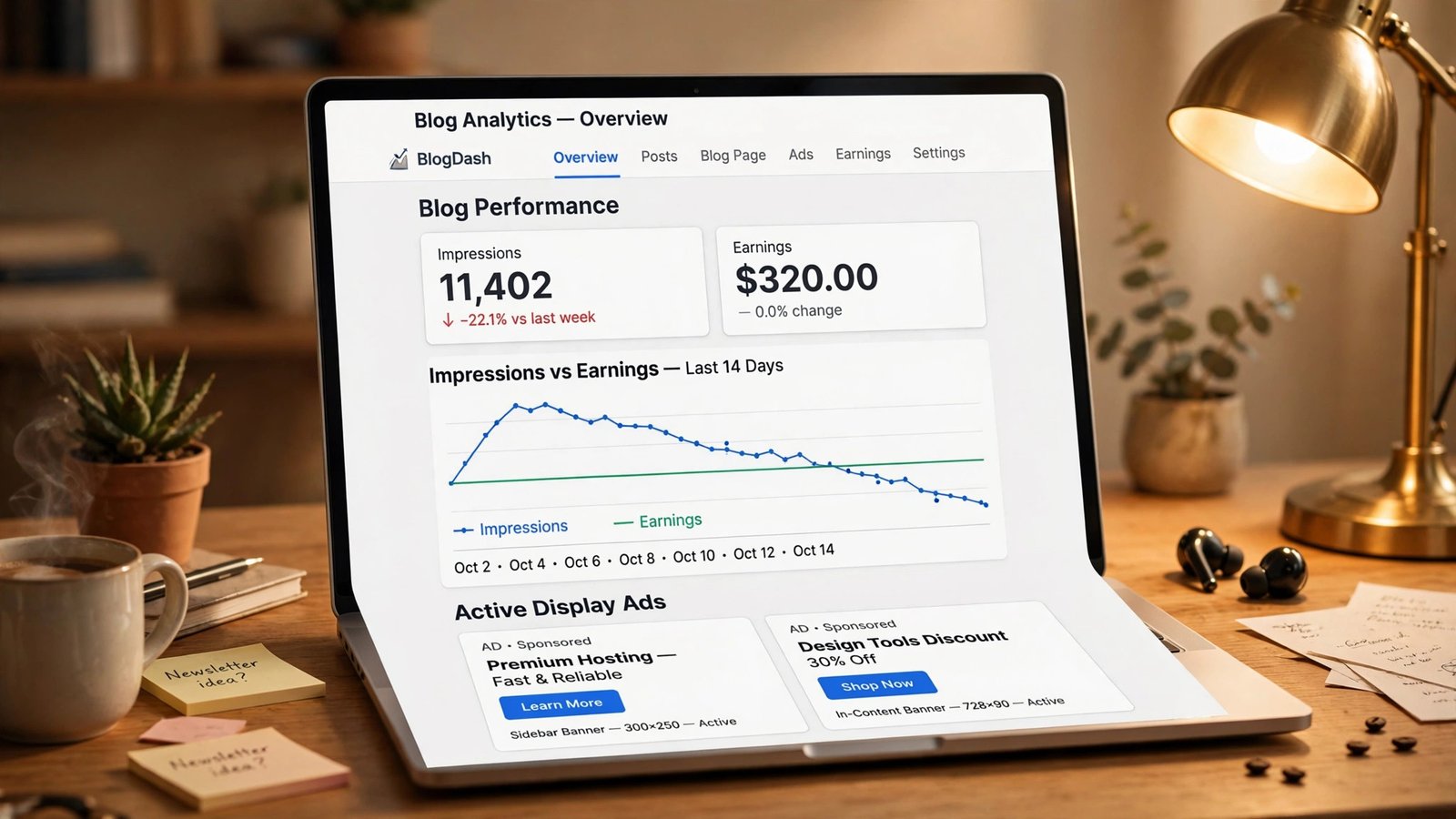
On February 17, 2027, Google AdSense will change what counts as a display ad impression. Instead of recording an impression the moment an ad starts downloading, AdSense will only count it once the ad has loaded and started rendering on the visitor’s device. Google calls the new method “begin-to-render,” and it says publishers “may notice a decrease in total display impressions” after the switch.
That sentence is doing a lot of work, so let me be plain about what it means and what it doesn’t. Your traffic won’t change. Your ads won’t stop serving. And a drop in reported impressions does not automatically mean a drop in earnings. But if you run AdSense on your site, you should understand the change now — because when February arrives and a familiar number in your dashboard suddenly looks smaller, you’ll want to know whether something broke or whether the ruler just changed.
The ruler changed. That’s the whole story, and it’s worth understanding in full before you panic, tweak your ad setup, or read a single scary headline about it.
What exactly is changing on February 17, 2027
Google emailed AdSense publishers on September 1, 2026, with the news: display impression counting in AdSense (and in Google Ad Manager, its bigger sibling for larger publishers) moves from “count-on-download” to “begin-to-render” on February 17, 2027. The change is automatic. Google says publishers don’t need to change anything on their sites or in their accounts — the transition happens on Google’s side. Search Engine Land confirmed the details from Google’s announcement, including Google’s own wording: an impression will only be counted “once the ad has successfully loaded and has started to render.”
Here’s the difference in plain English:
- Count-on-download (today’s method): AdSense counts an impression when an ad creative starts downloading to a visitor’s device. The ad doesn’t have to appear. It doesn’t even have to finish loading. If someone opens your page, the ad starts downloading, and the visitor hits the back button half a second later, that can still count as an impression.
- Begin-to-render (the new method): AdSense counts an impression only once the ad creative has successfully loaded and started rendering on the visitor’s device. The ad has to get far enough through the delivery process to actually begin appearing.
Think of it like a restaurant counting covers. The old method counted everyone who walked through the door, including the person who peeked at the menu and left. The new method counts people who actually sat down. The restaurant didn’t get less popular — it just stopped counting the walk-outs.
That gap between “started downloading” and “started rendering” is the whole change. Everything else about how AdSense works — auctions, ad selection, click counting, payments — stays the same.
Which ad formats are affected (and which aren’t)
This change covers display banner inventory on web, mobile web, and connected TV (CTV). Webview impressions, which are currently treated like mobile-web impressions, move to begin-to-render as well.
A lot of your inventory is untouched, because it already uses begin-to-render or an equivalent standard:
- Native ads — already begin-to-render compliant.
- Interstitial ads — already compliant.
- App inventory — counted under a one-pixel methodology that Google describes as compliant with begin-to-render.
- Video ads — counted at the first frame.
So if your site runs mostly native or in-feed units, you may barely notice the change. The publishers who’ll see the biggest difference are the ones with heavy banner placements, especially banners far down long pages, in slow-loading spots, or stacked in places where a visitor often leaves before the ad finishes loading.
That last point matters more than it sounds. The ads most likely to disappear from your impression totals are the ones that were never really seen — the below-the-fold banner on a page someone bounced from in two seconds, the ad slot that loaded after the visitor had already scrolled past it. Those impressions were, in a real sense, phantom inventory.
Will your AdSense earnings drop?
This is the question every publisher is actually asking, and the honest answer is: Google hasn’t said, and nobody can give you a number yet.
Google’s email and help documentation say publishers “may see a decrease in total display impressions” and offer no estimate of the size of that decrease or any earnings impact. That silence is frustrating, but it’s also informative. If Google expected a clear earnings hit, it would have a harder time framing this as a measurement improvement. And the mechanics genuinely point both ways.
Here’s the case for “earnings barely move”:
AdSense pays you for clicks and for viewable, auction-winning impressions — not for the raw count of downloads. An ad that downloaded but never rendered almost certainly never earned you anything anyway. Nobody clicked it. Nobody saw it. It was a number in a report, not money in your account. Removing those phantom impressions from the count changes the report, not the revenue. In fact, if the same earnings are now divided across fewer counted impressions, your impression RPM (revenue per thousand impressions) should rise — the same money spread over a smaller denominator looks like a higher rate.
There’s also precedent. In May 2018, AdSense switched impression counting from “served” to “downloaded” — a similar tightening. Google told publishers at the time that impression counts might fall while impression RPM, click-through rate, and other impression-based ratios improved, and that earnings would not be affected. The same logic applies here: a cleaner denominator makes the ratios look better, not worse.
Here’s the case for “earnings could dip a little”:
Not every unrendered impression is worthless in the auction economy. Some advertisers bid on a CPM (cost per thousand impressions) basis, and their bidding models were trained on the old, more generous counts. When the countable supply shrinks, the auction dynamics shift slightly. Google also says the buy side is changing at the same time: Display & Video 360 and Campaign Manager 360 move billed display impressions to begin-to-render in February 2027 as well, with Google describing the expected drop in billed volume only as “slight.” If advertisers are billed for fewer impressions, the total money flowing through the system could compress a touch — even if each counted impression is worth a bit more.
My read, after going through the coverage: expect your impression totals to drop visibly, expect your RPM to rise, and expect your actual earnings to land somewhere between “unchanged” and “slightly lower” — with the size of the effect depending on how much of your current impression count is phantom inventory. A fast site with engaged readers and ads near the top of the page has little phantom inventory to lose. A slow site with banners stacked at the bottom of 4,000-word posts has a lot.
And one more honest caveat: nobody outside Google has real data on this yet. Any article that gives you a precise percentage — “expect a 12% drop” or “earnings will fall 8%” — is guessing. I’ve seen no such number from Google, and I’m not going to invent one for you.
Why Google is making this change
Google’s stated reason is standardization. Begin-to-render is the measurement standard set by the Interactive Advertising Bureau (IAB) and the Media Rating Council (MRC), the industry bodies that define how digital ads get counted. Google already uses begin-to-render for native, app, and video inventory; display banners were the last holdout still on count-on-download. This change unifies the methodology across everything.
There’s a second, less-talked-about reason: MRC accreditation. Google aligns its measurement with MRC standards to keep its accreditation, and the advertiser side of the business is moving on the same schedule. When DV360 advertisers get billed on begin-to-render and AdSense publishers get counted on begin-to-render, both sides of a transaction inside Google’s stack rest on the same event. That reduces reconciliation arguments — the advertiser’s billed impression and your counted impression become the same thing instead of two numbers that never quite match.
From the advertiser’s perspective, the change is straightforwardly good: they stop paying for ads that never rendered. From your perspective, it’s a more honest report — but honesty has a price when the old numbers flattered your inventory.
What to do before February 17, 2027
Google says no changes are required, and that’s true in the narrow sense — your ads will keep serving. But “no changes required” isn’t the same as “nothing worth doing.” You have four months to make sure the impressions you earn are real ones, and the checklist below is the highest-value use of that time.
1. Establish your baseline now
Screenshot or export your current AdSense reports: total impressions, impression RPM, CTR, and earnings, broken out by ad unit if you can. Do it for a normal recent week. In February, when the numbers move, you’ll want to compare apples to apples — and you’ll want proof that your traffic didn’t fall off a cliff. The most common mistake publishers will make in February is confusing a measurement change with a traffic problem. A baseline kills that confusion.
2. Speed up your pages
This is the single biggest lever. Every millisecond between “visitor arrives” and “ad renders” is a window where the visitor can leave and the impression can vanish. Under count-on-download, a slow page still banked the impression. Under begin-to-render, it doesn’t. Run your top-earning pages through PageSpeed Insights, and fix the worst offenders: unoptimized images, render-blocking scripts, heavy ad stacks that delay each other. A page that renders its ads in under two seconds loses very few impressions to the new rule.
3. Move your best units where eyes actually go
Audit your ad placements with fresh eyes. A banner at the bottom of a 3,000-word article that 70% of readers never reach was always weak inventory — now it won’t even count. You don’t need to cram ads above the fold (Google’s own policies frown on that, and readers hate it), but make sure your in-article units sit at natural reading breakpoints where real readers pause, not in the footer where only the truly committed ever arrive.
4. Review your lazy-loading setup
Lazy loading — holding off on loading ads until they’re near the viewport — is generally good practice, and it pairs well with begin-to-render, since an ad that never approaches the viewport never loads. But check that your lazy-loading configuration isn’t so aggressive that ads load too late even when a reader is sitting right on top of them. The goal is ads that render promptly when a real reader reaches them, and never load for readers who never get there.
5. Cut ad weight and competition between units
If a page fires five ad requests at once, they compete for bandwidth, and the slowest ones may never render before the visitor leaves. Fewer, better-placed units often outperform a wall of banners — and under the new counting, that gap widens. Test removing your worst-performing unit per page and watch what happens to the others. You may find that total earnings hold steady while the page gets faster and cleaner.
6. Check your mobile experience specifically
Mobile traffic is where the phantom-impression problem is worst: slower connections, more bounces, more accidental visits. If your mobile pages are noticeably slower than desktop, the new rule will show up there first. Test your top pages on a mid-range phone over a regular mobile connection, not just on your fast office Wi-Fi.
7. Don’t chase the number by gaming placements
It will be tempting, after February, to move ads into aggressive positions to claw back the lost impressions. Resist it. Google’s policies on ad placement haven’t changed, and annoying your readers to inflate a metric that just got more honest is a losing trade. The publishers who come out ahead will be the ones who treat this as a quality signal, not a penalty to dodge.
How to read your reports after the change
When February 17 arrives, here’s how to interpret what you see:
- Impressions drop, RPM rises, earnings roughly flat: the expected outcome. The phantom inventory left the count, and the remaining impressions are worth more per thousand. Nothing is wrong.
- Impressions drop, RPM flat, earnings drop slightly: the pessimistic-but-plausible outcome, especially if a big share of your inventory was slow-rendering banners. Use the checklist above to recover real renderable impressions.
- Impressions drop off a cliff (say, more than a third): that’s bigger than a measurement change should cause on a healthy site. Check whether something else broke at the same time — a theme update, a plugin conflict, an ad-code error, a traffic drop. Compare against your Analytics traffic, not just AdSense.
- Clicks drop: pay attention. Clicks are counted independently of the impression change, so a real click drop means something changed in your actual traffic or ad relevance, not just the ruler.
One more reporting note: Ad Manager publishers get a tool to compare their existing impressions against begin-to-render metrics to estimate the impact in advance. AdSense publishers don’t get that tool, which is a genuine gap — you’ll be flying a little blind until the switch flips. Your baseline from step one is your substitute.
What this doesn’t change
A few things worth stating clearly, because confusion is already spreading:
- Your traffic is untouched. AdSense impression counts and Analytics pageviews measure different things. A drop in one doesn’t imply a drop in the other.
- Your account standing is untouched. This is a measurement change, not a policy change. It has nothing to do with invalid traffic, policy violations, or account suspensions. (If you’re still working toward approval, our guide to Google AdSense approval requirements for 2026 covers the policy side separately.)
- Your payment schedule is untouched. Same thresholds, same monthly cycle.
- Click counting is untouched. Clicks were always counted on actual clicks, and they still are.
- You don’t need to opt in or out. There is no setting to change, no form to fill out, no code to update. It happens automatically.
The bigger picture
Zoom out, and this change is one more step in a long, slow tightening of web advertising measurement. Search engines keep more traffic. AI answers compete with clicks. Google is even testing paying publishers when its AI answers draw on their content — a sign the old traffic-for-content bargain is being renegotiated. Advertisers demand proof their ads were actually seen. Every one of those trends squeezes independent publishers, and a stricter impression definition is part of that squeeze — even if, in this case, the stricter definition is also more honest.
But there’s a constructive way to read it: the publishers who survive these squeezes are the ones whose inventory is real. Fast pages, engaged readers, ads that render promptly where people actually look — that’s the inventory advertisers want to buy, and it’s exactly the inventory that begin-to-render rewards. The phantom impressions were never your business. The real ones are, and February’s change finally counts only those.
So don’t mourn the number that’s about to shrink. Fix the pages that earned it, bank your baseline, and let the new count tell the truth about your site. A smaller, honest number beats a big, inflated one — especially when advertisers, not just Google, start grading you on it.
Frequently Asked Questions
When exactly does the AdSense impression counting change take effect?
February 17, 2027. Google emailed AdSense publishers on September 1, 2026, announcing that display impression counting moves from count-on-download to begin-to-render on that date. The change applies automatically — no action is required on your part.
What is begin-to-render impression counting?
Begin-to-render (BTR) counts an ad impression only once the ad creative has successfully loaded and started rendering on the visitor’s device. Under the old count-on-download method, an impression was counted as soon as the ad started downloading, even if the visitor left before it ever appeared. BTR is the standard set by the IAB and Media Rating Council.
Will my AdSense earnings drop because of this change?
Google has given no earnings-impact estimate, and no publisher has real data yet. Impressions will likely fall, but impression RPM should rise because the remaining impressions are real ones. The most likely outcome is earnings roughly flat to slightly lower, with the effect depending on how much of your current impression count comes from ads that never render. Be skeptical of any article that gives you an exact percentage — it would be a guess.
Which ad formats does the change apply to?
Display banner inventory on web, mobile web, and connected TV, plus webview impressions. Native, interstitial, app, and video inventory already use begin-to-render or an equivalent standard, so they are not affected.
Do I need to change anything on my site before February 17, 2027?
No changes are required — the transition is automatic. But publishers can prepare by recording a baseline of their current reports, speeding up slow pages, reviewing ad placement and lazy-loading, and trimming weak ad units so more of their ads render promptly for real readers.
Why is Google changing how it counts impressions?
Google says the change aligns display measurement with IAB and Media Rating Council standards and unifies counting across all inventory types, since native, app, and video already use begin-to-render. The buy side is moving too: Display & Video 360 and Campaign Manager 360 shift billed display impressions to begin-to-render in February 2027, so advertisers and publishers will be measured on the same event.