
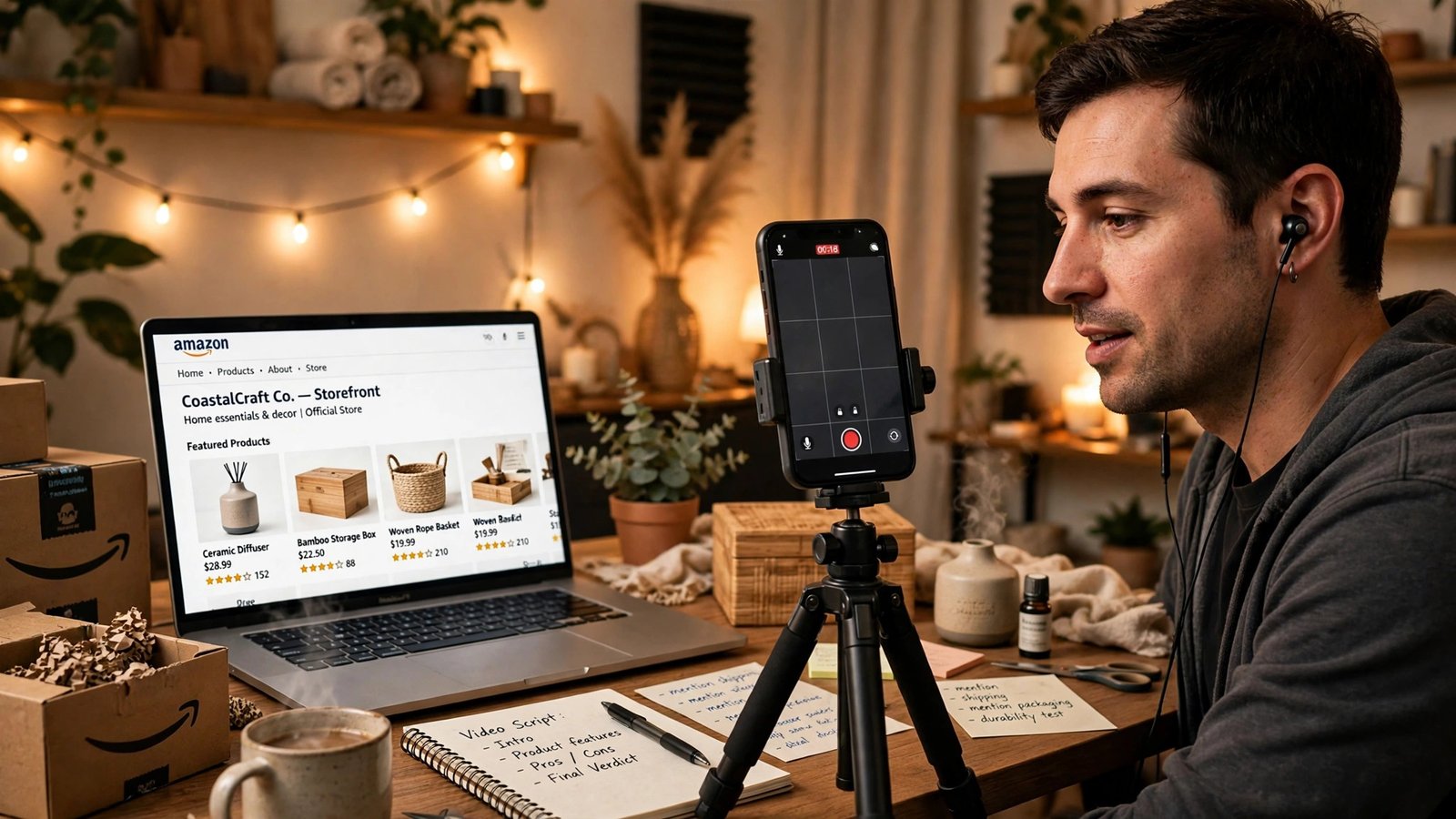
If you make shoppable videos for Amazon, your paycheck changed on April 14, 2026 — and most creators only noticed when the money stopped adding up. Amazon narrowed onsite commissions to purchases of the exact same product variant your content links to, and the rates on that table are far lower than the ones on your own links. A $40 kitchen gadget that used to earn you $1.80 through your storefront link now earns $0.50 when Amazon shows your video on the product page. Same video, same sale, less than a third of the money. The program behind those videos is Amazon’s Influencer Program, where creators apply and build the storefronts these videos link from.
That’s the short version. The longer version matters more, because Amazon actually runs three different pay tables, and which one applies depends on where the sale starts — not on what you made. Get the tables mixed up and every earnings estimate you build will be wrong.
The April 14, 2026 rule change, in plain English
Amazon’s Associates Program Operating Agreement was updated on April 14, 2026, and the change log spells out three things that reshaped creator earnings:
1. Same ASIN variant only. Onsite commission now applies only to “Direct Qualifying Purchases of the same ASIN variant as the linked Product detail page.” Before April 14, a shopper who watched your video for a navy medium hoodie and bought the black large still earned you commission — the sale was in the same product family. Now it doesn’t. The variant matters: size, color, configuration. If your video tags the variant most shoppers don’t buy, you earn nothing on the ones they do buy.
2. A 180-day window. The product must be shipped to, streamed or downloaded by, and paid for by the customer within 180 days to qualify. That’s generous on paper, but it means slow-shipping items and pre-orders that slip past the window quietly drop out of your earnings.
3. Paid-ad referrals are disqualified. Purchases by customers referred through any paid or boosted advertisement linking to Amazon no longer earn commission. If you boost a post that drives traffic to Amazon, those sales don’t pay you.
Creators felt it fast. Within days of the change, creators were reporting estimated income drops of roughly 25% — a figure that comes from creator reports, not from Amazon, which has published no earnings data of its own. Carrie Loranger, writing on her 9-to-Thrive Substack on April 18, 2026, four days after the change took effect, put it bluntly: “halo-sale commissions are dead,” describing the lost category as “passive income from products you never mentioned.”
The frustration spilled across affiliate communities. Reporting from May 2026 noted growing frustration in r/Affiliatemarketing and r/Amazon_Influencer, where creators said traffic stayed steady while earnings collapsed, and high-value sales vanished from dashboards, leaving smaller commissions from cheaper products. One recurring theme: the same videos, the same views, noticeably less money.
Three pay tables, not one
This is where most guides go wrong. Amazon pays influencers from two published rate tables — plus a third table for a specific ad product — and the rate you get depends on where the shopper came from.
Standard rates apply when you send the traffic: your storefront at amazon.com/shop/yourhandle, a product link you shared on social media, or an Idea List you posted. The shopper clicked your link. Amazon pays the standard category rate, and you also earn on other items in the same cart. Amazon has trimmed these standard category rates before — our breakdown of the 2026 Amazon Associates commission cuts shows which categories lost the most.
Onsite rates apply when Amazon shows your content to a shopper who was already on Amazon — your shoppable video on a product page, your photo in search results, your Idea List on the homepage, your Amazon Live stream. Amazon did the distribution, so Amazon pays less.
Creator Ads rates apply only to purchases referred through Amazon’s Creator Ads product. These rates sit between the other two in most categories.
Here’s the comparison that matters, using Amazon’s own commission income statements as checked in October 2026:
| Category | Your links / storefront (standard) | Onsite (Table A) | Creator Ads (Table B) |
|---|---|---|---|
| Luxury beauty | 10% | 4% | — |
| Kitchen, physical books, automotive | 4.5% | 1.25% | 2.25% (kitchen) |
| Apparel, shoes, jewelry, watches, luggage | 4% | 1% | — |
| Home, furniture, home improvement, lawn & garden, pets | 3% | 3% | 4% (home) |
| Beauty, musical instruments, business supplies | 3% | 2% | — |
| Toys | 3% | 0.5% | — |
| Televisions | 2% | 0.5% | — |
| Grocery, health & personal care | 1% | 0.5% (grocery) / 1.25% (health) | — |
| All other categories | 4% | 1% | — |
Two categories break the pattern, and they’re worth knowing. Home, furniture and pet products pay 3% on both tables — your video on a product page earns exactly what your link would. Health and personal care actually pays more onsite (1.25%) than through your own link (1%). Everywhere else, onsite pays less — often dramatically less. Books drop from 4.5% to 0.5%. Toys drop from 3% to 0.5%. Kitchen drops from 4.5% to 1.25%.
One more trap: many guides still quote the old onsite rates. Those old rates are now the Creator Ads rates. If a guide tells you kitchen pays 2.25% onsite, it’s reading the wrong table.
What the rates mean in real dollars
Percentages hide the damage. Worked examples make it visible.
Take a $40 kitchen gadget — a popular video category, and one of the worst-hit by the April change:
- Through your storefront link: $40 × 4.5% = $1.80
- Onsite, through your video on the product page: $40 × 1.25% = $0.50
- Through a Creator Ad: $40 × 2.25% = $0.90
Now apply the variant rule. Say your video features a blender with 20 color and size variants, and the variant you tagged accounts for only a quarter of sales. Before April 2026, all 40 sales in a month counted. Now only the 10 that match your exact variant count. Your monthly take from that video drops from 40 × $0.50 = $20.00 to 10 × $0.50 = $5.00 — and that’s after the rate cut already slashed each sale from $1.80 to $0.50. The two changes compound.
A $25 book is worse: $1.13 through your link, $0.13 onsite. A $60 toy: $1.80 through your link, $0.30 onsite. A $120 home item is the exception that proves the rule: $3.60 either way, because home pays 3% on both tables.
This is why creators who built their whole strategy on shoppable videos placed on product pages saw the steepest drops, while creators who drive traffic to their storefront from TikTok, Instagram, or YouTube felt it less. The traffic you control pays the standard rate. The traffic Amazon controls pays the onsite rate — and only on exact-variant matches.
How and when you actually get paid
The payout mechanics are straightforward, but the timing catches new creators off guard:
- Minimums: $10 for direct deposit or Amazon gift card, $100 for a paper check. If you earn less than $10 in a month, the balance rolls over.
- Timing: Amazon pays onsite commissions about 60 days after the end of the month in which they were earned. January’s earnings land around the end of March. That two-month lag is the single most common surprise for new influencers, and it means the April 14 rule change didn’t show up in payouts until June.
- Separate tracking: Amazon assigns approved influencers an Onsite Store ID automatically, separate from the regular Associates Store ID. Your onsite earnings and your link earnings are tracked — and reported — separately, which is useful: you can see exactly how much of your income comes from each table.
- No video-count shortcut: Older Amazon FAQ pages said you could qualify after 3 videos, or after 10 approved ones. Amazon’s newest video guide gives no count — videos have to pass moderation before they can earn from onsite placements. Don’t plan around a number Amazon no longer publishes.
The August 10 change most creators missed
On August 10, 2026, Amazon auto-enrolled every active Sponsored Products campaign into Influencer Program creator-content placements. In practice, that means brands advertising on Amazon can now have creator content — your videos — placed in their sponsored product ads by default.
That’s not automatically bad. More placements can mean more views on your content. But it blurs the line between your organic onsite earnings and paid-ad placements, and remember the April rule: purchases referred through paid or boosted ads are disqualified from commission. If your video is running inside a Sponsored Products placement, the sales it drives may not pay you at all. Check your account settings and your Creator Ads reporting to see which of your videos are enrolled, and whether the exposure is worth the trade-off.
The reported private rate cuts
Separate from the public tables, there were reports in May 2026 that Amazon had cut commission rates for some publishers by up to 50%, with premium rates in certain categories falling from around 10% to 4% or 5%, and bonus tiers for top publishers largely disappearing. Shopifreaks’ Paul Drecksler reported the cuts reached publishers one-on-one from their account managers, starting in Asia-Pacific late last year and reaching the U.S. around March 9, with no public Amazon announcement at any point.
Treat this carefully: Amazon has not confirmed private rate cuts, and the public rate tables are the only rates any creator can verify. But if your own Commission Income Statement shows rates below the published table, you’re not misreading it — some accounts genuinely pay less than the public schedule. The only reliable source for your rates is your own statement. Check it against the published tables, and if there’s a gap, that’s a question for your account manager, not a guide.
Bounties: the flat fees most creators forget
Not everything pays a percentage. Amazon also pays flat “bounty” fees for specific sign-ups that aren’t tied to a product price: roughly $3–$30 across Prime sign-up and membership types, and $5–$25 across Audible trial and membership types, on top of any product commission. A video that convinces someone to start a Prime trial can pay more than the product it features. Bounties are a small share of most creators’ income, but they’re the one part of the program where a single conversion beats a cart full of low-commission items.
What smart creators are doing now
The April 2026 change didn’t kill the Amazon Influencer Program. It killed one specific strategy: uploading videos and hoping Amazon’s placement engine turns them into passive income. The creators still earning well have adjusted in a few consistent ways:
Tag the variant that actually sells. Since only exact-variant purchases pay onsite, check which size and color of each product moves most — your Amazon reports show this — and tag that variant in your video. A video tagged to the best-selling variant can recover most of what the rule change took.
Drive traffic yourself. Your storefront link pays the standard rate, and you earn on the whole cart, not just the tagged item. A link in your TikTok bio, a YouTube description, or an Instagram story that sends shoppers to your storefront pays 4.5% on kitchen where the same sale onsite pays 1.25%. The work is harder — you have to bring the audience — but the rate is three to four times higher in most categories.
Prioritize home, furniture, and pet products. These pay 3% on both tables, so the onsite penalty doesn’t exist. If your content niche fits — home organization, pet gear, furniture — your onsite videos earn exactly what your links would.
Treat Creator Ads as a separate decision. The Table B rates are better than onsite in most categories, but enrollment means your content runs as advertising. Decide deliberately; don’t let auto-enrollment decide for you.
Diversify off Amazon. The creators hit hardest in 2026 were the ones whose entire income ran through onsite video. The same audience that buys through your Amazon storefront will buy through brand deals, affiliate programs on other platforms, and your own digital products. Platform payout rules change — April 14 proved it — and the only income that can’t be re-priced by a platform is the income you own outright. If you’re comparing platforms, our breakdown of Facebook’s payout thresholds and the 6-month forfeiture rule shows how differently another platform handles the same problem — and how easily earnings can vanish there too.
Read your own statements monthly. Amazon’s public tables are the starting point, not the final word on your account. Pull your Commission Income Statement every month, compare your actual rates to the published tables, and track what share of your income comes from onsite versus your own links. If onsite is most of your income and your rates are below the table, that’s the first thing to fix.
The bottom line
The Amazon Influencer Program still pays in 2026, but the easy version of it — upload videos, let Amazon place them, collect passive commissions on anything the shopper buys — ended on April 14. What remains is a program with three pay tables, a strict exact-variant rule, a 60-day payout lag, and a $10 minimum. Creators who understand which table applies to each sale, tag the right variants, and drive their own traffic to their storefront are still earning real money. Creators running on autopilot are wondering where the money went. The difference is knowing the rules — and now you do.
Frequently Asked Questions
What is the Amazon Influencer Program commission rate in 2026?
There is no single rate. Amazon pays from two published tables: standard rates for traffic you send (1% to 10% by category — luxury beauty 10%, kitchen 4.5%, apparel 4%, home 3%, grocery 1%) and lower onsite rates when Amazon shows your content to shoppers already on Amazon (luxury beauty 4%, kitchen 1.25%, apparel 1%, home 3%, toys 0.5%). A third table, Creator Ads, pays in between for ad-referred purchases. Which table applies depends on where the sale starts.
What changed on April 14, 2026?
Amazon updated its Associates Operating Agreement so onsite commission only counts purchases of the exact same ASIN variant as the product page your content links to. It also added a 180-day window for the purchase to ship and be paid for, and disqualified purchases referred through paid or boosted ads. Creators reported income drops of roughly 25% after the change, though Amazon has published no official figure.
How much do Amazon influencers actually make per video?
Amazon publishes no per-video earnings data, and any figure you see online is anecdotal. Creator blogs have cited around $1 to $5 per video per month as common, with $5 closer to the old average before earnings dropped. A 2024 Reddit thread in r/Amazon_Influencer suggested about $300 a month for a typical creator who posts. Treat all of these as rough anecdotes, not benchmarks — your earnings depend on your category, your variants, and how much traffic you drive yourself.
When does Amazon pay influencers?
Onsite commissions are paid about 60 days after the end of the month in which they were earned, with a $10 minimum for direct deposit or Amazon gift card and a $100 minimum for a paper check. Balances below the minimum roll over to the next month.
Do I earn commission if a shopper buys a different color or size than the one in my video?
Not onsite, not since April 14, 2026. Only purchases of the exact same ASIN variant earn onsite commission. Through your own storefront link or a link you shared, you still earn the standard rate on the item — and on other items in the same cart.
Is the Amazon Influencer Program still worth joining in 2026?
It depends on your strategy. If you plan to upload videos and rely on Amazon’s placement engine, expect low onsite rates and exact-variant limits — that passive-income model is largely gone. If you have an audience on TikTok, Instagram, or YouTube and can drive traffic to your storefront, the standard rates (up to 10%) and full-cart commissions still make it one of the better-paying affiliate programs available. Apply with a real content library and an audience you can send to Amazon, not just a hope that Amazon sends shoppers to you.