
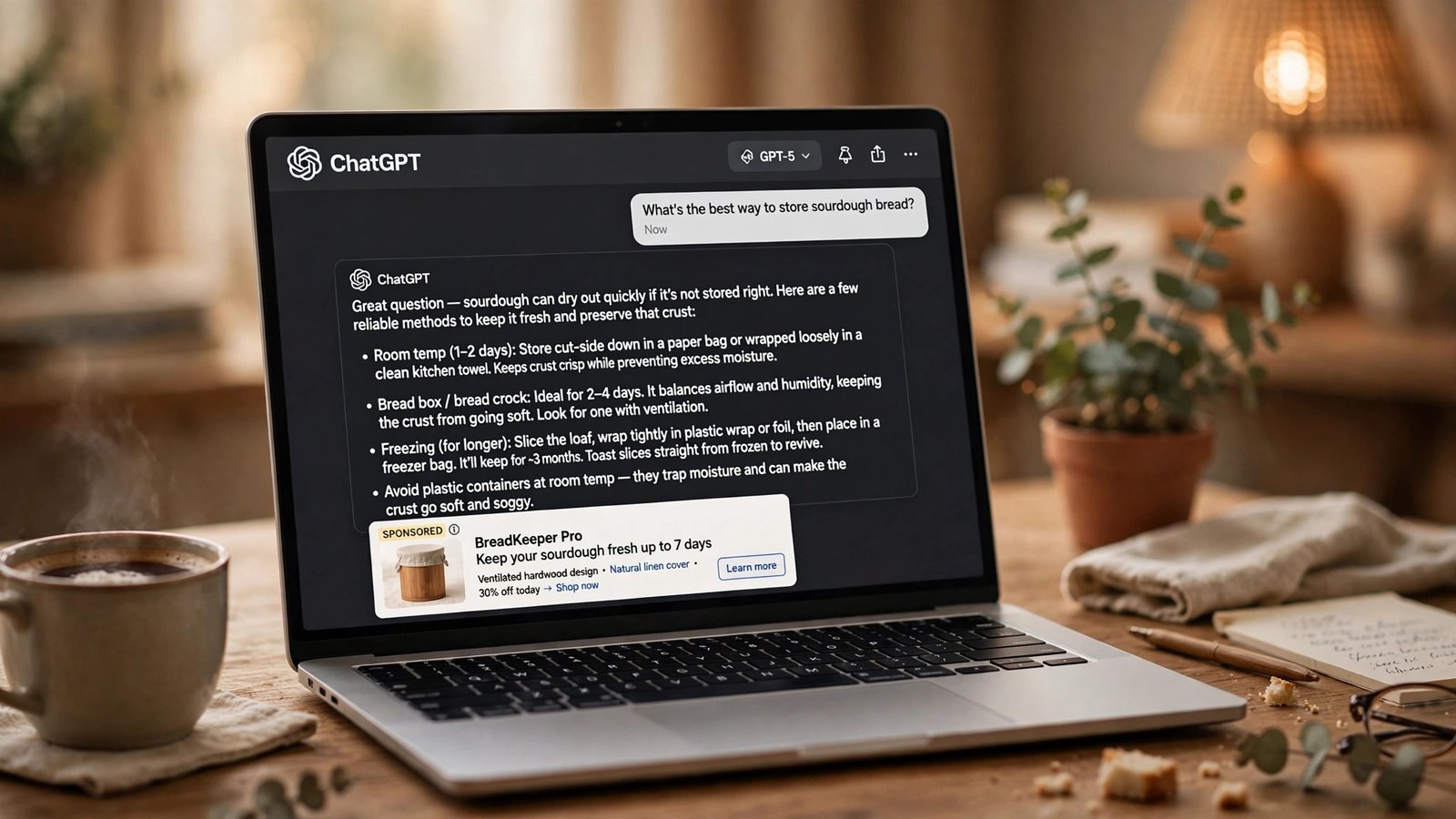
ChatGPT now shows ads in 89 countries, more than 100,000 advertisers have run campaigns, and this week Amazon started buying Black Friday placements inside its answers. If you run a blog, that matters twice: your readers are getting their answers — plus a sponsored link — inside a chat window instead of clicking out to your site, and the ad platform is now a real option for promoting your own work. The clicks are cheap. The conversions, so far, are not impressive.
Google expanded ads inside AI Mode to ten more countries on October 28 and launched multiturn ads in the US — I covered that rollout in our guide to Google’s AI Mode ads going global. ChatGPT is the other half of the same shift: the answer is becoming the destination, and the sponsored link now sits inside it.
What actually happened: the nine-month sprint to 89 countries
ChatGPT ads went from a closed US test to a global ad platform in nine months. The timeline below is drawn from OpenAI’s announcements as tracked in Contexthints’ ChatGPT ads news timeline, updated November 25, 2026. OpenAI’s own post on the October expansion — ChatGPT Ads expands to 26 new countries — confirms the 89-country total and the 100,000+ advertiser figure.
| Date (2026) | What changed |
|---|---|
| Jan 16 | OpenAI publishes its ad principles and plans a test for logged-in adults on the Free and Go plans |
| Feb 9 | US ad test begins — $60 per 1,000 impressions (CPM) launch price, $200,000 minimum buy |
| Mar | Canada, Australia, and New Zealand added |
| Apr | Minimum buy drops to $50,000; OpenAI loosens placement rules so medical, legal, and financial advice contexts are no longer categorically blocked |
| May 5 | Self-serve Ads Manager opens to every US business — CPC and CPM bidding, Conversions API and pixel measurement, $25-a-day minimum; observed CPM has fallen to roughly $25 |
| Jun–Aug | UK, Mexico, Brazil, Japan, and South Korea go live; ads reach 31 European markets on Aug 24 |
| Aug 31 | Ad revenue passes a $1 billion annual run rate; self-serve buying opens in Europe, India, the Middle East, and North Africa; the EU designates ChatGPT a Very Large Online Search Engine |
| Sep | Sponsored Agents, an Ads Manager plugin, and Shopify/HubSpot integrations arrive |
| Oct 21 | 26 more countries — 89 in total, including Ukraine, Argentina, Nigeria, South Africa, and Pakistan; 100,000+ advertisers to date |
| Oct 29–30 | OpenAI starts rewriting ads by default — headlines, translation, image resizing — unless the advertiser opts out; a wider desktop ad card rolls out |
| Nov 9 | Target CPA and Target CPC bidding arrive; Max Bid and Max CPC retire Jan 1, 2027; product-feed region targeting and product sets launch |
| Nov 10 | Visual ads during image generation are seen live in the US |
| Nov 17 | Aleph becomes OpenAI’s exclusive ad reseller in 44 markets across Latin America, Europe, Central Asia, the Middle East, Africa, and Asia-Pacific |
| Nov 24 | Amazon runs Black Friday ads inside ChatGPT (seen by Digiday); Adthena data: 52% of 30 brands struggled to recover their spend |
| Nov 25 | Similarweb data shows the top 10 advertisers hold about 14.7% of ChatGPT ad impressions; about one in three eligible users saw at least one ad in the Oct 26–Nov 8 window |
Three things in that table deserve a closer look. First, the buy-side barrier collapsed in three steps: $200,000 minimum at launch, $50,000 in April, then no minimum at all when the self-serve Ads Manager opened on May 5 — just a $25-a-day minimum. That is why the advertiser count went from a handful of big brands (WPP, Omnicom, Adobe, Ford, Target) to more than 100,000 in nine months.
Second, the price of attention fell as supply grew. The launch CPM of about $60 — three to five times standard display — had fallen to roughly $25 by May, and published tests since then report costs from under $3 a click to $13 a click. There is no stable “ChatGPT ads cost” yet — the auction is nine months old.
Third, the November changes are about control, not reach. Target CPA and Target CPC bidding arrived November 9, which lets a performance advertiser tell the system what a conversion is worth instead of just bidding for clicks. And OpenAI turning creative rewriting on by default on October 29–30 — it can now rewrite your headlines, translate your copy, and resize your images unless you switch it off — is the quiet default that catches small advertisers out. Check it before anything else.
Who sees the ads, and what they actually look like
The audience split is the most important fact for both sides of this market. Ads appear only to logged-in adults on the Free and Go plans (Go costs $8 a month). Everyone on Plus ($20 a month), Pro ($200 a month), Business, Enterprise, and Education sees no ads at all.
That split cuts two ways. If you are a blogger hoping to be discovered through ChatGPT, the people seeing ads — and your cited links — are the free users. If you are an advertiser, the paid tiers, which almost certainly hold a large share of the most valuable users (the people who pay for an AI assistant use it hardest), are simply not in the audience. Barn2, a software company that tested the platform, made exactly this point: the excluded paid plans likely hold its most valuable customers. Nobody outside OpenAI knows what share of business decision-makers use paid plans — treat any claim about the audience’s quality as a guess.
ChatGPT writes its normal answer first, and a labeled sponsored block appears below it when the conversation has commercial intent. The formats live now are:
- Standard card: favicon, advertiser name, headline, short description, square image, and a link — with a wider desktop version since October 30.
- Product-feed card: product, price, and star rating from a feed of up to one million items, live since June 2, with region targeting and product sets added November 9.
- Visual ads during image generation: a visual ad shown while ChatGPT draws an image, seen live in the US on November 10.
OpenAI matches ads to the topic of the conversation, past chats, and past ad interactions. A recipe question might bring a meal-kit ad. Advertisers see aggregate views and clicks only — in OpenAI’s words, they “do not have access to your chats, chat history, memories, or personal details.”
Two guardrails matter for bloggers writing about sensitive topics. Ads are not shown in Temporary Chats or in OpenAI’s Atlas browser, and they are not shown to users OpenAI knows or predicts are under 18. Conversations about self-harm, weapons, politics, and mental or personal health stay off-limits for ads. But note the April 2026 loosening: medical, legal, and financial advice contexts are no longer categorically blocked from ads by default. If you write in finance or health, your readers may now see ads next to those answers.
What early advertisers are actually getting
This is where the honest box belongs: the gap between the hype and the published results is wide, and the results that exist are all small.
Start with the marketers talking to each other. A roundup of 20 Reddit threads from r/PPC and r/ChatGPT, captured September 13, 2026, found the same pattern throughout: clicks are cheap, conversion evidence is thin, and the tooling is bare. The most-upvoted setup walkthrough, from May 21, describes about 15 days from application to approval, Reach/Clicks/Conversions objectives, targeting capped to the US, Canada, Australia, and New Zealand, and a context-hints box that is plain free text with no suggestions.
The clearest numbers come from small tests. In one r/PPC thread from May 15, an advertiser ran three ad groups totaling 228 impressions and saw click-through rates of 0%, 1.15%, and 2.4% — roughly two to three times Google Display and well below Search, with no conversions yet. Another agency account reported CPCs under $6 and rising, one conversion from France on US-only targeting, and spend that then stalled.
The published single-advertiser tests tell the same story:
| Advertiser | Spend | Impressions | Clicks | Cost per click | Conversions |
|---|---|---|---|---|---|
| Barn2 (software, 6 weeks) | $477 | 19,154 | 370 | ~$1.29 | 0 sales |
| AdLibrary (ad research, 2 weeks) | $200 | ~5,000 | ~40 | ~$5.00 | 0 |
| B2B agency test | ~$1,200 | — | 92 | ~$13 | 0 |
| Canadian client | CA$4,459 | 170,000 | 1,592 | ~CA$2.80 | not reported |
| Austin real-estate agent | ~$1,300 | — | 13 seller leads | ~$7.63 | 13 leads |
Barn2’s result is the one to sit with. At its usual organic conversion rate, the 210 ad sessions its clicks produced should have yielded about five sales. It got zero. The author gave the fair caveat — one advertiser over six weeks is not a rigorous study — but the pattern repeats across every published test: the click is cheap and the sale is missing.
A second November datapoint describes the market. Similarweb’s ad data for October 26 to November 8, shared by OpenAI president Greg Brockman on November 25, put the top 10 advertisers at about 14.7% of ChatGPT ad impressions worldwide, and found about one in three eligible users saw at least one ad in those two weeks. The inventory is not dominated by a few giants, and ad exposure is now routine for free users — only nine months after launch.
The first broader dataset arrived November 24: Adthena data on 30 brands found 52% struggled to recover their spend, 26% matched or beat Google Ads, and 22% saw mixed results. Thirty brands is a small sample, skewed toward larger advertisers — but it is the first number that is not a single anecdote, and it says more than half of early advertisers are not making their money back yet. In short: the clicks cost $3 to $9 in most published tests, click-through rates run around 1% to 2.4%, and conversions lag well behind Google Search. Some of that is immaturity — launch targeting was only location, platform, context hints, and custom audiences, and conversion optimization, the OpenAI Pixel, the Conversions API, and third-party measurement only arrived through August. But some of it is structural: the ad appears after the answer, to a user who may already have what they came for, on a free plan, with no way to see which conversation showed your ad.
What this means for your blog’s traffic
If you run a blog, the advertiser results are only half the story. The other half is what happens to your traffic when a second giant answer engine monetizes the space below its answers.
The direction of travel is now unmistakable. Google is putting ads inside AI Mode answers and in follow-up turns, and OpenAI is putting ads below ChatGPT answers, inside image generation, and, through Sponsored Agents, inside agent workflows. The answer is becoming the destination on both platforms, and the sponsored link sits inside the destination. Your blog is competing for a click that now has to beat both a complete answer and a paid listing.
That sounds bleak. The honest version is more mixed — three facts cut in your favor.
First, the answer still cites sources, and citations are the traffic that remains. ChatGPT search links out to the pages it draws on, and the pages that keep winning those clicks have two things in common: the answer leans on them visibly, and they give the reader a clear reason to click through — a calculator, a price list, original data, or a detailed walk-through the summary cannot reproduce. That is the same lesson as our guide to getting cited in Google’s AI search results: write the thing the answer cannot replace, not the thing it can summarize in three sentences.
Second, the traffic that does click through from AI answers appears to be unusually valuable. One synthesis of six independent datasets (Ahrefs, Semrush, Seer, Microsoft Clarity, Opollo, Visibility Labs) puts AI referral traffic at under 2% of website volume but converting at 4.4 to 23 times the rate of standard organic. That is a wide range and a synthesis, not a measurement of ChatGPT specifically — treat it as direction, not a promise. But the logic is sound: a reader who clicks out of a complete answer has a specific problem the answer did not solve, and that reader is further along than a casual searcher.
There is one more number worth knowing, with a caveat attached. An index synthesizing 680 million citations from six published studies puts Reddit at roughly 40% of all AI citations across the major platforms. That is a synthesis across platforms, not an OpenAI figure, and the studies behind it run from August 2024 to April 2026 — but it matches what AI-visibility researchers keep finding: AI engines lean heavily on real discussion, real experiences, and real arguments. If your blog reads like a person who has actually done the thing, that is now a ranking signal in a way it was not three years ago. If it reads like a summary of other summaries, the answer engine has no reason to cite it — it can write that itself.
The practical version is simple: the pages that keep earning clicks from AI answers are the ones with something the answer cannot contain — your own test results, your own math, a tool, a template, a price table you verified this week.
Should you advertise on ChatGPT?
For a small business or a blogger with something to sell, the answer right now is: test small, measure honestly, and do not confuse cheap clicks with a working channel.
The case for a test is real. The minimum is $25 a day, so a two-week test costs $350. Clicks at $3 to $9 are cheaper than Google Search, the audience is 1.2 billion weekly users, and the tooling is improving: Target CPA and Target CPC bidding arrived November 9, conversion tracking exists, and product-feed cards with prices and star ratings are live.
If you do test, do it this way:
- Set a kill rule before you spend. Decide in advance: $350 over two weeks, and the test ends unless it produces a defined result — a sale, a qualified lead, an email signup at a cost you can live with. Do not let a cheap cost-per-click talk you into a third week.
- Switch off creative rewriting first. In Ads Manager settings, turn off the default that lets OpenAI rewrite your headlines, translate your copy, and resize your images. Approve every headline yourself until you have a baseline.
- Use Target CPC, not Max Bid. Target CPA and Target CPC bidding arrived November 9; Max Bid and Max CPC retire January 1, 2027. OpenAI’s help page recommends starting click bids at $3 to $5.
- Send traffic to a page that can close. The click arrives after the answer, so the visitor may already be half-satisfied. A product page with a price, a clear offer, and a single action beats a homepage or a blog post.
- Measure in your own analytics, not just Ads Manager. Impressions, clicks, and CTR refresh about every 15 minutes in Ads Manager, but spend can lag 7 to 8 hours. Set up the OpenAI Pixel and the Conversions API, and check your own analytics for sessions and conversions. If the two do not roughly agree, believe your own numbers.
- Do not target what you cannot serve. Context hints are free text with no suggestions, and targeting is still coarse — location, platform, context hints, custom audiences. A broad hint will spend your budget on conversations you never meant to enter.
One more thing to watch: Sponsored Agents, added in September — an agent working on your behalf can surface a sponsored option inside the workflow. Nobody has published results yet, and they are the format most likely to matter in 2027. Treat them as a watch item, not a budget line.
What to do this week
Black Friday week is the worst week to make a permanent decision and the best week to gather data: Amazon’s Black Friday ads inside ChatGPT, seen November 24, are the first big-brand holiday test of the format.
- Check your own referral traffic. Open your analytics and look for ChatGPT traffic (usually a chatgpt.com referrer). If it is growing, find which pages it lands on — those are your citable assets. Protect them, update them, and link them to your money pages.
- Watch the Amazon experiment, don’t copy it. Amazon can afford to lose money learning a channel — you cannot. Let the big brands pay for the learning this week; read their results in December.
- Audit one thing: your citable pages. Pick your five best posts and ask of each one: does this contain something an AI answer cannot reproduce — original data, a worked calculation, a price I verified? If not, that post is the one to improve. If so, make sure it is current: a stale price or a dead link is the fastest way to lose a citation.
- If you advertise, run the $350 test — and only the $350 test. Two weeks, $25 a day, kill rule written down, creative rewriting off, Target CPC bidding, pixel installed. Then judge it on conversions, not clicks.
- Do not rebuild your content strategy around ChatGPT ads. You cannot target the placement or see which conversations showed your ad, and the format is nine months old. Make your existing content more citable instead: original numbers, clear entities in the first paragraph, prices and dates verified this week, and a reason to click that the answer cannot satisfy.
In February, ChatGPT ads were a $200,000-minimum experiment for Fortune 500 brands. By October they were in 89 countries with 100,000 advertisers. By November, Amazon was buying Black Friday placements inside them. The ad-supported AI answer is no longer a test — it is the environment your blog now competes in. The blogs that survive it will be the ones with something worth clicking through for.
Frequently Asked Questions
Does ChatGPT show ads to everyone?
No. Ads appear only to logged-in adults on the Free and Go plans. Plus ($20 a month), Pro ($200 a month), Business, Enterprise, and Education accounts are ad-free, and ads are not shown in Temporary Chats, in the Atlas browser, or to users under 18.
How much does it cost to advertise on ChatGPT?
The self-serve Ads Manager has a $25-a-day minimum, and you buy by impressions (CPM) or by clicks (CPC). OpenAI’s help page recommends starting click bids at $3 to $5. Published tests report CPCs mostly between $3 and $13; launch CPM was about $60 per 1,000 impressions, falling to about $25 by May. Target CPA and Target CPC bidding arrived November 9, and Max Bid and Max CPC retire January 1, 2027.
Do ChatGPT ads influence the answers ChatGPT gives?
OpenAI says no. Its stated principle, published January 16, 2026, is that “ads do not influence the answers ChatGPT gives you.” Ads are kept separate and clearly labeled as sponsored. You cannot pay to be inside the answer itself — only to appear below it.
How do I get my blog cited in ChatGPT’s answers?
Nobody outside OpenAI knows the exact mechanism, and any guide that claims otherwise is guessing. What the evidence supports: ChatGPT search links to pages it draws on, and the pages that win citations give readers a reason to click — original data, verified prices, worked calculations, tools, templates, or a walk-through the summary cannot reproduce. Keep those pages current and name entities plainly in the first paragraph. Our guide to getting cited in Google’s AI search results covers the same principles for Google.
Are ChatGPT ads worth it for a small business?
Not yet proven. More than half of the 30 brands in Adthena’s November 2026 data struggled to recover their spend, and published small tests repeatedly show cheap clicks with zero conversions — Barn2 spent $477 for 370 clicks and no sales. The disciplined move is a capped test: $25 a day for two weeks, a kill rule written down in advance, creative rewriting switched off, and judgment on conversions, not clicks.
Will ChatGPT ads come to paid plans?
OpenAI has said Plus, Pro, Business, and Enterprise stay ad-free, and there is no announcement of a change. The ad-free experience is part of what those subscriptions sell, so a reversal would be a major policy shift — watch OpenAI’s own announcements rather than rumors.