
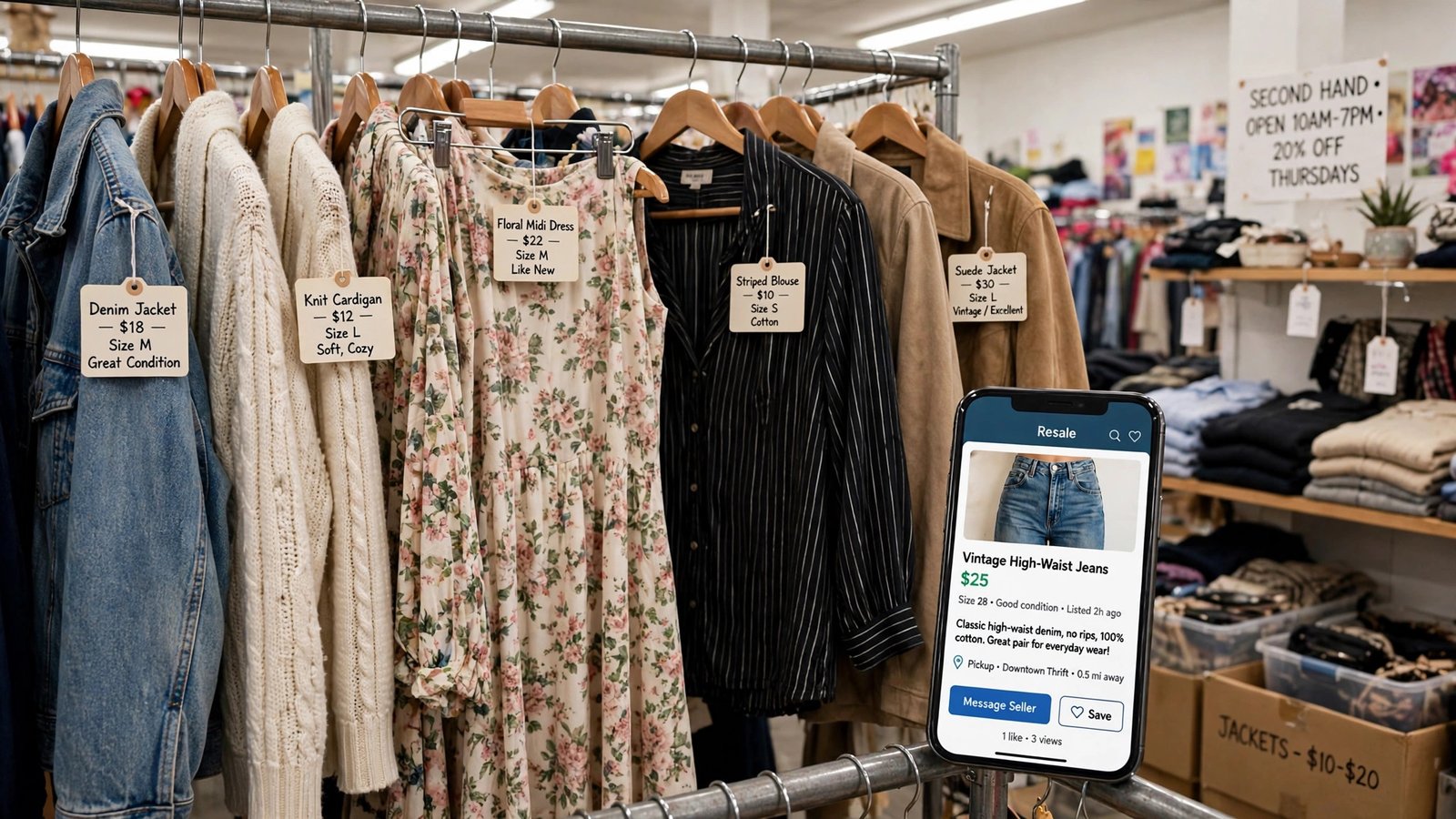
Poshmark seller fees in 2026 are $2.95 on sales under $15, and 20% on sales of $15 or more. You keep 80% of the sale price on the bigger sales, and there is no listing fee, no payment-processing fee, and no subscription to sell.
That is the short answer. The longer answer is where the money goes, because the fee is calculated on the price after discounts and offers, shipping and sales tax never enter the fee calculation, and a few price points behave very differently than sellers expect. A $10 sale does not cost you 20%. It costs you 29.5%. A $5 sale costs you 59% in fees alone. And marking a $30 item down to $12 to dodge the 20% fee does not save you money. It costs you almost $15 in payout.
How Poshmark Seller Fees Work in 2026
Poshmark changed its fee structure on October 24, 2024, and that structure is still in effect in 2026. There are two tiers, and only two: a flat $2.95 on a sale under $15, and 20% on a sale of $15 or more, with you keeping 80%. Poshmark’s own fee page states the same two tiers, and notes the Texas Seller Fee Tax added October 1, 2025.
The fee is computed on the price after discounts and offers. If you list a jacket at $40 and accept a $30 offer, the 20% fee is calculated on $30, not $40. Your fee is $6.00, and you take home $24.00. The same rule applies to bundle discounts and closet clear-out sales: the fee follows the final sale price, not the original listing price.
Shipping and sales tax are not part of the fee base. The buyer pays for shipping separately, and sales tax is collected from the buyer where applicable. Neither amount touches your payout, and neither increases the fee. That is a real difference from some other marketplaces, where the fee can apply to the total including shipping. On Poshmark, the fee is on the item price alone.
The $14.75 Crossover Most Sellers Miss
The flat $2.95 fee and the 20% fee meet at exactly $14.75, because $14.75 multiplied by 20% is $2.95. At that price, both fee structures cost the same.
Below $14.75, the flat fee costs you more than 20% would. At $10, the $2.95 fee is 29.5% of the sale. At $8, it is 36.9%. At $5, it is 59%. You are not paying a small fee on a small sale. You are paying a large percentage of a small sale.
Above $14.75, the 20% fee takes over, and the percentage stays flat at 20% no matter how high the price goes. A $25 sale costs $5.00 in fees. A $100 sale costs $20.00. A $250 sale costs $50.00.
The flat fee is only genuinely cheaper than 20% in one narrow band: $14.75 to $14.99. At $14.99, 20% would be about $3.00, so the flat fee saves you about five cents. That is the only place the flat fee beats the percentage.
The worst place to price an item is just below $15. A $14 item costs you $2.95 and leaves you $11.05. A $15 item costs you $3.00 and leaves you $12.00. You charged one dollar more and took home 95 cents more. The $14 price looks like a bargain for the buyer, but it is a worse deal for you than pricing at $15.
The $15 Boundary Is Genuinely Unclear — Do Not Price on the Line
Poshmark’s own announcement of the fee change is ambiguous at the boundary. The body of the announcement describes the flat fee as applying to sales of “$15 and under,” while the FAQ in the same announcement describes it as applying to sales “under $15.” Those two wordings point to different results at exactly $15.
Fee trackers that read Poshmark’s Fee Policy put the line at under $15 for the $2.95 fee, and $15 or more for the 20% fee. Under that reading, a $15 sale costs $3.00, and you keep $12.00. See the tracker breakdown at Poshmark fees explained: flat fee vs 20 percent.
I am going with the fee-policy reading in this guide, but I want to be straight with you: Poshmark’s own announcement leaves room for doubt. The difference at exactly $15 is only five cents. The real lesson is a pricing one. Do not price exactly on the line. Price at $14 or $16, or wherever the item’s value actually sits. If you want to check the current treatment for your own sale, the fee shown in the app at checkout is the one that applies.
Poshmark Seller Fees: The Take-Home Table
This is the table to keep. It shows the fee and what you actually take home at seven common sale prices: $2.95 under $15, and 20% at $15 or more.
| Sale price | Poshmark fee | You keep | Fee as % of sale |
|---|---|---|---|
| $5 | $2.95 | $2.05 | 59.0% |
| $10 | $2.95 | $7.05 | 29.5% |
| $15 | $3.00 | $12.00 | 20.0% |
| $25 | $5.00 | $20.00 | 20.0% |
| $50 | $10.00 | $40.00 | 20.0% |
| $100 | $20.00 | $80.00 | 20.0% |
| $250 | $50.00 | $200.00 | 20.0% |
Read that $5 row twice. You sell something for five dollars, Poshmark takes $2.95, and you keep $2.05 — before you pay for the item itself, before packaging, before your time. Sometimes clearing a closet is the goal, and $2.05 is better than $0 for something you were going to donate. But if you are buying inventory to resell, a $5 sale price is almost never a business. You would need to source the item for well under $2 to make anything at all.
The $10 row is the one that surprises most new sellers. Ten dollars feels like a real sale. After the fee, it is $7.05. If you paid $4 for the item at a thrift store, you made $3.05 before packaging and time. If you paid $6, you made $1.05. The fee is not the only cost, and on small sales it is not even the largest cost. Your sourcing cost is.
Offer Math: What Happens When You Accept a Lower Offer
Offers are where Poshmark sellers make or lose real money, because the fee follows the discounted price. A lower price means a lower fee in dollars, but your take-home drops faster than many sellers expect, because you lose 80 cents of every dollar you give away in a discount.
The formula to use every time: take-home equals the accepted offer price multiplied by 0.8, for sales of $15 or more. For sales under $15, take-home equals the offer price minus $2.95.
You list a dress at $40. A buyer offers $32, which is 20% off. You accept. The fee is 20% of $32, which is $6.40. You keep $25.60. You gave away $8 in price, and you lost $6.40 of take-home compared with selling at full price.
Now the case that catches people out: an offer that drops the price below $15. You list a top at $18. A buyer offers $14. You accept. The sale is now under $15, so the fee is the flat $2.95, not 20%. You keep $11.05. At full price you would have kept $14.40. The $4 discount cost you $3.35 in take-home, because the flat fee is a bigger percentage at the lower price.
The lesson is not to never accept offers. Offers are how Poshmark works, and a sale today is often worth more than a listing that sits for three months. The lesson is to do the multiplication before you tap accept. Multiply the offer by 0.8. That is your payout. Then subtract what you paid for the item. If the result is still worth it, accept. If it is not, counter. If a buyer offered $45 on a $60 item, counter at $52. At $52, you keep $41.60 instead of $36.00, and the buyer still gets a real discount.
The Markdown Trap: Why Cutting the Price to Dodge the Fee Backfires
This is the most expensive misunderstanding in Poshmark selling. The idea goes like this: if I mark my $30 item down to $12, I will pay the $2.95 flat fee instead of the 20% fee, and I will save money. It sounds clever. It is wrong.
Start with the $30 sale at full price. The fee is 20% of $30, which is $6.00. You keep $24.00. Now mark it down to $12. The sale is under $15, so the fee is the flat $2.95. You keep $9.05. You “saved” $3.05 in fees. You lost $18 in sale price. Your take-home fell from $24.00 to $9.05 — a loss of $14.95. You traded $14.95 of payout for $3.05 of fee savings.
It gets worse at higher prices. Take a $75 item and mark it down to $14. At full price, the fee is $15.00 and you keep $60.00. At $14, the fee is $2.95 and you keep $11.05. You saved $12.05 in fees and lost $48.95 in take-home.
The mistake is thinking about the fee in isolation. Cutting the price always cuts your take-home, because you keep 80% of whatever price you set above $15, and the price minus $2.95 below $15. There is no price cut that increases your take-home. A lower price can increase the chance of a sale, and that can be a good trade when an item has sat unsold for weeks. But it never increases the payout on that sale.
Use markdowns gradually: drop the price by 10% or 15%, wait a week, and see if interest picks up. Poshmark also lets you send offers to likers, which is smarter than a public price cut — you offer a discount to people who already liked the item without lowering the public price for everyone else. Use that first. For more worked numbers on this trap, see the Marginglass guide to the Poshmark markdown trap.
Shipping and Payouts
The buyer pays a flat $6.49 for the prepaid USPS Ground Advantage label, for packages up to 5 pounds. That rate has been in effect since September 12, 2025, when it came down from $8.27. The buyer pays it at checkout, on top of the item price and any sales tax.
Shipping does not come out of your payout, and it does not increase your fee, because the fee is calculated on the item price only. Do not use the older $7.97 shipping figure if you see it in older guides or videos. That figure is outdated. The current buyer shipping rate is $6.49.
Overweight Label Upgrades
Since October 26, 2026, packages over 5 pounds need a label upgrade, and the upgrade cost is deducted from the seller’s earnings. Poshmark’s own announcement says the upgrade fee varies by weight, without publishing a fixed schedule in the announcement itself. Two fee trackers report the figures as $5 for packages from 5.01 to 10 pounds, and $10 for packages from 10.01 to 15 pounds.
Those are the trackers’ reported figures, not Poshmark’s own published schedule. Before you ship a heavy package, check the upgrade price shown in the app for that specific order. A bundle that weighs 6 pounds will cost you $5 from your payout if the reported figure holds — manageable on a $60 bundle, a real bite on a $20 bundle. A cheap kitchen scale pays for itself quickly.
When You Get Paid
Poshmark releases your earnings when the buyer accepts the delivery, or automatically three days after delivery if the buyer does not act. Once the funds are released, you can withdraw them by direct deposit, which is free and typically takes two to three business days to reach your bank account. In practice, most sellers see the money about a week after the sale, sometimes sooner if the buyer accepts quickly.
The Texas Seller Fee Tax
Sellers in Texas have one extra deduction. Since October 1, 2025, a Texas Seller Fee Tax is deducted from Texas sellers’ earnings. The tax is Texas state sales tax at 6.25%, plus any applicable local sales tax, applied to 80% of Poshmark’s fee.
An example: you sell an item for $50 in Texas. Poshmark’s fee is $10.00. Eighty percent of that fee is $8.00. Texas state tax at 6.25% on $8.00 is $0.50. If your local sales tax adds another 2%, that is another $0.16 on the same $8.00 base. Your total Texas fee tax on that sale would be about $0.66, and your payout would be $40.00 minus $0.66, or $39.34. On a $25 sale, the fee is $5.00, 80% of the fee is $4.00, and the state tax at 6.25% is $0.25, plus local tax.
This is a small deduction on most sales, but it is real, and Texas sellers should factor it in rather than discovering it on the payout screen. If you do not sell from Texas, this section does not apply to you.
Poshmark vs eBay: Where Each One Wins
eBay’s final value fee is about 13.6% in 2026, after rising from 13.25% on February 14, 2025. That is lower than Poshmark’s 20% on sales of $15 or more. On a $100 sale, eBay’s fee is about $13.60 and Poshmark’s is $20.00 — a $6.40 difference in eBay’s favor.
But the straight percentage is not the whole comparison. On eBay, the final value fee can apply to the total including shipping and sales tax in some cases, depending on the category and the sale. On Poshmark, the fee is on the item price only, and shipping and tax never enter the calculation. That narrows the gap more than the headline percentages suggest.
The practical crossover, once shipping and tax treatment are counted, is around $30. Below about $20, Poshmark usually wins, because the flat $2.95 fee on a sale under $15 can be competitive and the prepaid label keeps things simple. Above about $30, eBay’s lower percentage usually wins, and the gap grows as the price rises. Between $20 and $30, the two are close enough that other factors should decide it: where your buyers are, how fast the item sells on each platform, and how much work each listing takes.
For a detailed breakdown of eBay’s current fees, see our eBay seller fees 2026 guide. Etsy is a different case: its transaction fee is about 6.5%, plus about 3% plus $0.25 for payment processing, but Etsy is built for handmade, vintage, and craft supplies, not reselling secondhand fashion at scale. Our Etsy seller fees 2026 guide covers it. Mercari and Depop also work differently from Poshmark’s model — see our Mercari seller fees guide and our Depop fees guide and compare them on the same item before committing a listing to one platform.
A video worth watching if you sell on both Poshmark and eBay is “Flip It for Profit? The Real Math on eBay and Poshmark Fees” on YouTube: https://www.youtube.com/watch?v=CwkXc9sTS6I
A Realistic Part-Time Month on Poshmark
The fee is not what decides whether a part-time Poshmark side hustle makes money. Sourcing cost and sell-through speed matter more. Here is an illustrative model — not a survey and not a promise — using round figures you can adjust to your own situation.
Suppose you sell 30 items in a month at an average sale price of $32. That is $960 in gross sales. Poshmark’s 20% commission on $960 is $192. Your payout, before any other costs, is $768. Suppose you paid an average of $6 per item sourcing at thrift stores or clearance racks: 30 items at $6 is $180, leaving $588. Subtract packaging at about $1 per item, or $30, leaving $558. Subtract a small allowance for unsold inventory, about $33, leaving about $525 net for the month before you count your time.
The fee is fixed at 20% above $15. You cannot negotiate it. You can negotiate your sourcing cost by choosing better thrift stores, buying in season, and passing on items with thin margins. You can improve sell-through by photographing well, writing clear titles, pricing realistically, and sharing your closet regularly. Those two levers are where the money is.
How to Price on Poshmark Without Leaving Money Behind
First, price with the take-home in mind, not the list price. Multiply the price by 0.8. That is your payout on a sale of $15 or more. If it does not cover your sourcing cost plus a margin you are happy with, the price is too low or the item is not worth listing.
Second, avoid the $10 to $14 zone for items you bought to resell. Either price at $15 or above if the item supports it, or bundle the item with something else so the combined sale clears $15 comfortably. A $12 top and a $10 scarf sold separately leave you $9.05 and $7.05, or $16.10 combined. Sold as a $22 bundle, the fee is $4.40 and you keep $17.60. Same two items, $1.50 more in your pocket, and one shipment instead of two.
Third, use offers to likers before you cut the public price. That is a targeted discount to warm buyers, and it does not lower the price for everyone else. Fourth, do not chase the flat fee — a lower price never increases your take-home on that sale. Fifth, weigh heavy items before you list them, so an overweight upgrade never surprises you. Sixth, compare platforms on the same item: a $150 handbag keeps $120 on Poshmark and about $129.60 on eBay before shipping and tax treatment, so if it will sell equally fast on both, eBay’s lower fee wins.
Frequently Asked Questions
How much does Poshmark take from sellers in 2026?
Poshmark takes a flat $2.95 on sales under $15, and 20% on sales of $15 or more. You keep 80% of the sale price on sales of $15 or more. There is no listing fee, no payment-processing fee, and no subscription. The fee is calculated on the price after discounts and offers, and shipping and sales tax are not included in the fee calculation.
What is the $14.75 crossover on Poshmark?
At $14.75, the $2.95 flat fee and the 20% fee cost exactly the same, because $14.75 multiplied by 20% is $2.95. Below $14.75, the flat fee costs more than 20% would. At $10, the fee is 29.5% of the sale. At $5, it is 59%. The flat fee is only cheaper than 20% in the narrow band from $14.75 to $14.99, where it saves about five cents.
How much do you keep on a $50 sale on Poshmark?
On a $50 sale, Poshmark takes 20%, which is $10.00, and you keep $40.00. That is before your sourcing cost, packaging, and any Texas Seller Fee Tax if you sell from Texas. On a $25 sale you keep $20.00, on a $100 sale you keep $80.00, and on a $250 sale you keep $200.00.
Does the buyer or seller pay for shipping on Poshmark?
The buyer pays for shipping: a flat $6.49 for the prepaid USPS Ground Advantage label for packages up to 5 pounds, a rate in effect since September 12, 2025. Shipping is not deducted from your payout and does not increase your fee. For packages over 5 pounds, an overweight label upgrade is deducted from the seller’s earnings, with reported figures of $5 for 5.01 to 10 pounds and $10 for 10.01 to 15 pounds. Check the upgrade price in the app before shipping a heavy package.
When does Poshmark pay sellers?
Poshmark releases your earnings when the buyer accepts the delivery, or automatically three days after delivery if the buyer does not act. You can then withdraw by direct deposit, which is free and typically takes two to three business days to reach your bank account. In practice, most sellers receive the money about a week after the sale.
Is Poshmark or eBay cheaper for sellers?
It depends on the price. eBay’s final value fee is about 13.6%, which is lower than Poshmark’s 20% on sales of $15 or more. Above about $30, eBay usually wins once shipping and tax treatment are counted. Below about $20, Poshmark usually wins. Between $20 and $30, the two are close, and speed of sale and audience should decide. For the full eBay breakdown, see our eBay seller fees 2026 guide.