
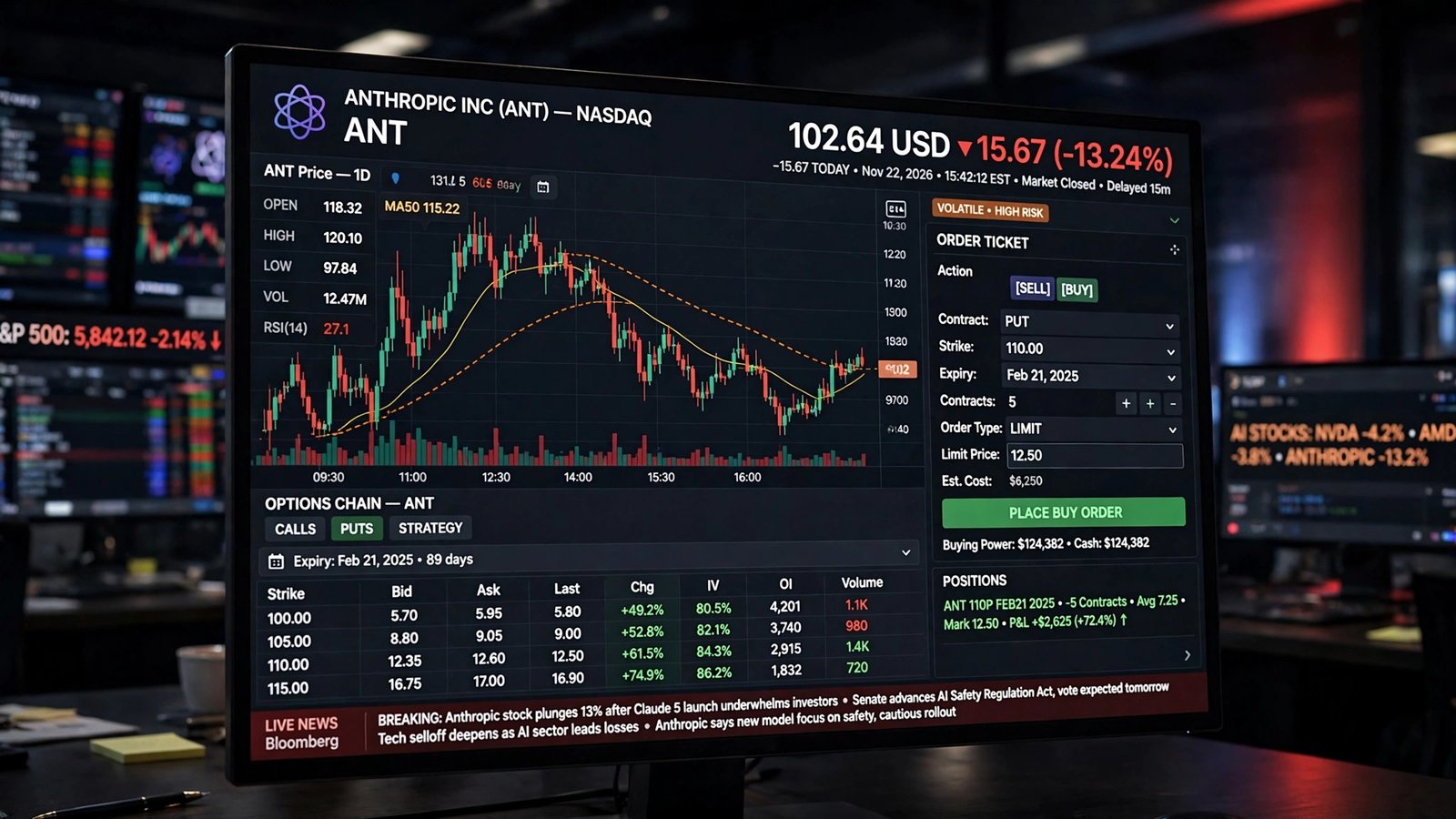
Anthropic options are expected to start trading on Monday, November 23, 2026, with implied volatility of 100% to 150% expected and several 2x leveraged Anthropic ETFs also expected to launch the same day. That would make the first trades among the most expensive and most active single-stock options ever listed, just two sessions after one of the wildest IPO debuts in recent memory.
Monday is not a normal options launch. ANT swung about 20% inside a single session, the first options week is cut short by Thanksgiving, and the leveraged ETFs reset every day and can lose money even when the stock ends up roughly where it started. If you own ANT, Monday gives you a way to hedge for the first time. If you do not own it, the options market will start putting a public price on just how far traders think this stock can move. This is not investment advice. Options and leveraged ETFs can lose money fast, and the dollar examples below are illustrative, not live quotes.
Anthropic’s first two days, in one table
The day-one and day-two stories already cover the IPO in full, so this table is only here so Monday makes sense in context.
| What happened | The number |
|---|---|
| IPO price, November 18, 2026 | $83 per share, above the $70–$78 range |
| Shares sold | 1.127 billion Class A shares |
| Initial offering size | About $81.3 billion |
| Gross proceeds after the greenshoe | About $93.5 billion, after underwriters fully exercised the 147-million-share greenshoe |
| Debut open, November 19, Nasdaq | $111.50 |
| Debut close, November 19 | $97.17, up 17% from the IPO price |
| November 20 open | $89.86 |
| November 20 intraday low | $83.05, just 5 cents above the IPO price |
| November 20 close | $88.91, down 8.5% on the day |
| Shares traded November 20 | About 400 million, versus about 857 million on debut |
| Market value at the November 20 close | About $1.19 trillion, on 13.37 billion shares outstanding |
For the full day-by-day account, see the second-day slide and the first-day close at $97.17.
Two points deserve a second look. First, Friday’s low touched $83.05, 5 cents above the IPO price — the stock nearly traded below its IPO price on only its second day. Second, Friday was not an Anthropic-only selloff. The Nasdaq fell about 5.3% on November 20, and the Nasdaq 100 fell 10.4% for the week, its worst week since 2020. ANT fell with the market, then fell further on its own momentum. The filing adds context: Anthropic’s S-1 showed third-quarter 2026 revenue of $16.96 billion, up from $11.56 billion in the second quarter, and nine-month revenue of $33.24 billion, plus a concurrent sale of 313,253,007 Class N shares at $83 to AMD, Broadcom, Google, Micron, Microsoft, NVIDIA and TSMC Partners for about $26.0 billion.
What Monday actually changes
Until now, if you owned ANT, you had two choices: hold it, or sell it. There was no listed options market, so there was no straightforward way to buy a put to limit a drop or sell a covered call against shares you already held. Monday is expected to change that, with one important caution.
Under Cboe Rule 4.3, the earliest possible date for options on a company worth $3 billion or more at its IPO price is the second business day after the IPO — Monday, November 23, for Anthropic. Cboe’s preview, published November 20 and written by Henry Schwartz, says listed options will begin trading that day. You can read it here: Anthropic options preview.
That is the expectation, not a done deal. Cboe’s options symbol directory did not include ANT on the evening of November 20, and Reuters reported on November 18 that the listing was “pending industry readiness.” Check Cboe’s directory and your broker’s platform on Monday morning. If a symbol is not there at the open, it does not mean the launch has failed — the final readiness step may simply not have cleared by Friday evening.
Tom Sosnoff, co-founder of ThinkOrSwim and TastyTrade, put the expected demand plainly in CNBC reporting: “I expect ANT options to be super active. I expect heavy options volume.”
Strikes, increments, and weeklies
Cboe says strikes are set roughly 50% above and below spot at listing. With ANT near $87, monthly and longer-dated options are expected in $5 increments — 80, 85, 90, 95, and so on. Exchanges may add $2.50 strikes below $100, such as 85.50 and 87.50, and weeklies may list in $0.50 increments below $100 and $1 between $100 and $150.
Quote increments are nickels under $3, and dimes at $3 and above, with penny increments possible through auctions and price improvement. Monday and Wednesday weeklies are unlikely at launch, because of quarterly eligibility rules — standard expirations should come first.
FLEX options are eligible at launch — custom expiry, strike, and style, physically settled, often used in stock-loan trades and option-strategy ETFs. MIAX Options and MIAX Emerald have also widened their quote-width requirements for ANT, effective Monday, November 23, through December 31. Expect wider bid-ask spreads in the first days, especially in less active strikes.
What 100–150% implied volatility means in dollars
Implied volatility, or IV, is the market’s guess about how much a stock will move, expressed as an annualised percentage. A higher IV means traders expect bigger moves, and it means options cost more. Cboe floor single-stock market makers estimate ANT options will open at 100% to 150% IV, according to CNBC reporting on November 20, based on intraday moves of about 20%.
For context, pre-IPO perpetual futures on ANT showed realised volatility as high as 140% earlier in November and 41% over the past week, per the Cboe preview. The VIX closed at 28.44 on November 19, and S&P 500 volatility sits around 30, versus 17.3 when SpaceX debuted.
The numbers below are illustrative, worked from the 100–150% IV range. They are not live quotes. Actual premiums will depend on the stock price, strike, expiry, and where market makers set IV on Monday morning. Divide annualised IV by the square root of about 252 trading days: at 100% IV, that implies a typical daily move of about 6.3%; at 150% IV, about 9.5% a day. Stretch that to a month — the square root of one-twelfth of a year is about 0.29 — and a one-month move of about 29% at 100% IV, or about 43% at 150% IV, is within one standard deviation. That does not mean the stock will move that far. It means the options market is pricing in the possibility, and charging accordingly.
A worked example: a $90 call, one month out
Take a hypothetical $90 strike call, expiring in about a month, with ANT trading near $87 to $89. A very rough, back-of-the-envelope estimate for an at-the-money call premium is about 0.4 times IV times the square root of time to expiry times the stock price. Using that rough formula — illustrative only, not a pricing model your broker will use:
- At 100% IV: 0.4 × 1.00 × 0.29 × $88 = about $10.20 per share, or about $1,020 per standard 100-share contract.
- At 150% IV: 0.4 × 1.50 × 0.29 × $88 = about $15.30 per share, or about $1,530 per contract.
A calm large-cap stock at 20% IV would price a similar call at roughly $2.00 to $2.50 per share. ANT’s expected premium is four to six times that. You pay for the possibility of a big move whether or not it happens.
Now look at what a 20% daily move does. Suppose you bought that illustrative $90 call for about $10 to $15, and ANT jumps 20% in a day, from about $88 to about $105 or $106. Your call is now deep in the money, and its value would rise sharply — roughly toward its intrinsic value of $15 to $16 plus whatever time value remains, a gain of 50% or more on the option in a day. Flip it: ANT falls 20% to about $70, and your $90 call is far out of the money. Its value could fall by half or more in that single session. High IV makes options expensive, and expensive options can lose value quickly even if you get the direction right but the timing wrong.
What about hedging?
If you own 100 shares, a put gives you the right to sell at a set price. At 100–150% IV, a one-month put near the money could cost roughly $10 to $15 per share on an illustrative basis, or $1,000 to $1,500 per contract — about 11% to 17% of the shares’ value, for one month of protection. A cheaper put further out of the money only helps if the stock falls a long way, and a covered call offsets cost but caps upside. Hedging is expensive this week: compare the put’s cost to the drop you fear, and decide with the actual Monday quotes in front of you.
The 2x ETFs launching the same day
Options are not the only new ANT product expected on Monday. Leveraged and inverse ETFs are lining up too, and they work very differently from owning the stock. Leverage Shares said on November 21 that three of its ETFs will launch on Cboe on Monday, November 23, per the company’s release, summarised here: How to go 2x long Anthropic (ANT) — Leverage Shares explains ANUU, the 2x leveraged Anthropic ETF launching Monday.
| Ticker | Issuer | What it seeks | Expense ratio |
|---|---|---|---|
| ANUU | Leverage Shares | 2x long ANT, daily | 0.75% |
| ANDD | Leverage Shares | 2x short ANT, daily | Not stated in the verified release excerpt |
| ANSS | Leverage Shares | 1x short ANT, daily | 0.99% |
| ANTT | Tradr | 2x long ANT, daily | Not stated in the verified reports |
| ANTZ | Tradr | 2x short ANT, daily | Not stated in the verified reports |
| AIL | GraniteShares | 2x long ANT, daily (expected/planned) | Not stated in the verified reports |
| ANS | GraniteShares | 2x short ANT, daily (expected/planned) | Not stated in the verified reports |
| ANTO | Direxion | Bull 2x ANT, daily (expected/planned) | Not stated in the verified reports |
| ANTD | Direxion | Bear 2x ANT, daily (expected/planned) | Not stated in the verified reports |
At least eight fund companies have effective prospectuses for leveraged or inverse ANT ETFs, so this is not the full universe — only the set publicly tied to a Monday launch or a near-term plan. Three warnings from the Leverage Shares release deserve to be stated plainly. First, these ETFs do not hold Anthropic shares, and they do not take part in the IPO. They seek 200% — or, for the short products, -200% or -100% — of ANT’s daily performance, before fees and expenses, using derivatives. You are not buying ANT when you buy ANUU. You are buying a daily bet on ANT’s next session. Second, they are designed for knowledgeable investors who monitor their positions daily — the issuer’s own description, not a buy-and-hold product. Third, an investor could lose their entire principal in ANUU if ANT falls more than 50% in one day — a real risk for a stock that has already moved about 20% in a day.
The daily-reset decay example
Leveraged ETFs reset every day. They aim to deliver twice the daily return, and compounding over multiple days can pull them away from twice the stock’s return over that longer period — often called volatility decay. The example below uses a clean hypothetical $100 starting price for both stock and ETF. It is illustrative, not a prediction about ANT.
- Day 1: ANT falls 10%, from $100 to $90. A 2x long ETF falls twice as far, 20%, from $100 to $80.
- Day 2: ANT rises 11%, from $90 to $99.90. ANT is almost back to where it started — down just 0.10% over the two days.
- The 2x ETF on Day 2 rises twice the daily return, 22%, from $80 to $97.60.
After two days, the stock is down 0.10%. The 2x ETF is down 2.40%. The stock nearly recovered. The ETF did not, because it lost 20% on Day 1, then gained 22% on a smaller base on Day 2. The same pattern holds in reverse: rise 10% one day, fall 9% the next, and the stock ends close to flat while the 2x ETF lags. Choppy movement hurts a daily-reset product even when the stock goes nowhere. Hold a 2x ETF for a week or longer and you are not holding “twice ANT” — you are holding a product whose return depends on the path ANT took, day by day, not just where it ended up.
The SpaceX precedent — and why it may mislead
SpaceX is the closest recent comparison, and Cboe itself draws the parallel. SpaceX options started at 116% IV, with about 1.7 million contracts traded on day one, representing about $2.5 billion in premium; short-dated options opened at 187% IV, per GraniteShares and BML Tech. SpaceX had priced at $135 on June 11, closed its first session at $161.11, and hit $225.64 intraday on June 16, the day its options listed. Cboe says opening-day ANT volume near 2 million contracts would set a record, second only to NVDA among single-stock option classes.
Be careful with the parallel, for three reasons. First, SpaceX short-dated options opened at 187% IV; ANT is expected at 100% to 150% — still very high, but not the same level. Second, SpaceX debuted when S&P 500 volatility was around 17.3; ANT debuts with S&P 500 volatility around 30, the VIX at 28.44 on November 19, and the Nasdaq 100 fresh from its worst week since 2020. The options market may be pricing in broad market risk as well as ANT-specific risk. Third, SpaceX options listed on a normal week; ANT faces a Thanksgiving-shortened week, so a weekly option has only three full sessions to work with. The SpaceX numbers are a guide to scale, not a promise ANT will repeat them.
The Thanksgiving short week and what to watch
US markets are closed Thursday, November 26, for Thanksgiving, and close at 1 p.m. ET Friday, November 27. The first options week has only three full sessions — Monday, Tuesday, and Wednesday — plus a half session Friday. A weekly option bought Monday has less time than you think.
Watch box: Monday, November 23, through Friday, November 27
- Does ANT hold above $83 on Monday? Friday’s low was $83.05. If it breaks below $83, traders will notice; if it holds, that is a different signal. Watch the open, not just the close.
- Put/call mix on day one. Heavy call buying suggests upside bets; heavy put buying suggests hedging or downside bets; heavy selling of both suggests traders think 100–150% IV is too high.
- First-day options volume versus the SpaceX record. Does ANT get close to the 1.7 million contracts SpaceX traded on day one, and how fast?
- Where IV actually opens. The 100–150% range is an estimate. At the low end, options will be cheaper than feared; at the high end, more expensive.
- The leveraged ETFs’ first prints. Do ANUU, ANDD, ANSS, ANTT, and ANTZ actually begin trading Monday? Watch their opening prices and volume — and remember they do not hold ANT shares.
- The Nasdaq backdrop. If the Nasdaq stabilises Monday, ANT may trade on its own news. If it falls again, that will show up in put prices first.
Beyond Thanksgiving week, MSCI has confirmed ANT’s addition to its Global Standard indexes at the close of November 30. Index additions can bring buying from tracking funds, but do not guarantee a price rise — do not let November 30 distract you from this week’s three full sessions.
If you own ANT, and if you just watch
If you own ANT, Monday gives you tools you did not have on Friday: buy a put to limit a further fall, sell a covered call to bring in premium, or do both in a collar to set a floor and a ceiling. All three will be expensive at 100–150% IV, and all involve trade-offs — a put can expire worthless, a covered call caps your gain, a collar limits both. You do not have to do any of them. Monday gives you the option to hedge, not an obligation to hedge, and if you do, do it with the actual Monday quotes in front of you.
If you just watch, you do not need to trade to learn from Monday. IV, put/call ratios, and volume by strike will give you a daily read on what traders expect: IV staying at 100–150% means big moves are still expected; IV falling quickly means the wildest moves may be behind it. ETF volume gives a second read — heavy long-product volume suggests speculative demand is still strong; heavy short-product volume suggests positioning for a further fall. Volume alone does not tell you who is right. It tells you where the money is going.
Frequently Asked Questions
When do Anthropic options start trading?
Monday, November 23, 2026, is the expected start — the earliest date allowed under Cboe Rule 4.3. Cboe’s November 20 preview says trading will begin that Monday, but ANT had not yet appeared in Cboe’s options symbol directory on the evening of November 20, and Reuters had reported the listing was pending industry readiness. Check Cboe’s directory and your broker’s platform on Monday morning before assuming a contract is live.
What implied volatility is expected for ANT options?
Cboe floor market makers estimate 100% to 150%, according to CNBC reporting on November 20, based on intraday moves of about 20%. SpaceX options started at 116% IV, with short-dated options opening at 187% IV. Pre-IPO perpetual futures on ANT showed realised volatility as high as 140% earlier in November and 41% over the past week. The VIX closed at 28.44 on November 19, so ANT’s expected IV is far above the broad market’s level.
What are the 2x Anthropic ETFs launching on Monday?
Leverage Shares plans to launch ANUU (2x long, 0.75%), ANDD (2x short), and ANSS (1x short, 0.99%) on Cboe on Monday, November 23. Tradr’s ANTT (2x long) and ANTZ (2x short) are also expected that day. GraniteShares’ AIL and ANS, and Direxion’s ANTO and ANTD, are expected or planned. These ETFs do not hold Anthropic shares and do not take part in the IPO. They seek 200%, -200%, or -100% of ANT’s daily performance, before fees and expenses.
Can a 2x leveraged ETF lose money if Anthropic stock ends up flat?
Yes. Leveraged ETFs reset daily, so their return depends on the path the stock takes, not just where it ends up. In this article’s example, ANT falls 10% then rises 11%, ending down just 0.10% over two days, while a 2x long ETF ends down 2.40%. An investor could also lose their entire principal in ANUU if ANT falls more than 50% in a single day.
How does the Thanksgiving holiday affect the first options week?
US markets are closed Thursday, November 26, and close at 1 p.m. ET Friday, November 27. That leaves only three full sessions — Monday, Tuesday, and Wednesday — plus a half session on Friday. A weekly option bought on Monday has less time to work than in a normal five-day week.
Should I buy Anthropic options or a 2x ETF if I think ANT will go up?
That is a personal decision, and this article is not investment advice. Options at 100–150% IV are expensive and can lose value quickly if the stock does not move far enough or fast enough. Leveraged ETFs reset daily, can lose money even if the stock ends up flat, and are designed for knowledgeable investors who monitor daily. If you own ANT, Monday gives you a way to hedge for the first time, but hedging will be expensive.
Disclaimer: This article is for information only and is not investment advice. Options trading involves substantial risk and is not suitable for all investors. Leveraged and inverse ETFs seek daily results, reset every day, and can lose money fast — including the entire principal in ANUU if Anthropic falls more than 50% in a single day. Do your own research, check live quotes on Monday morning, and consider speaking to a licensed financial adviser before you trade.