
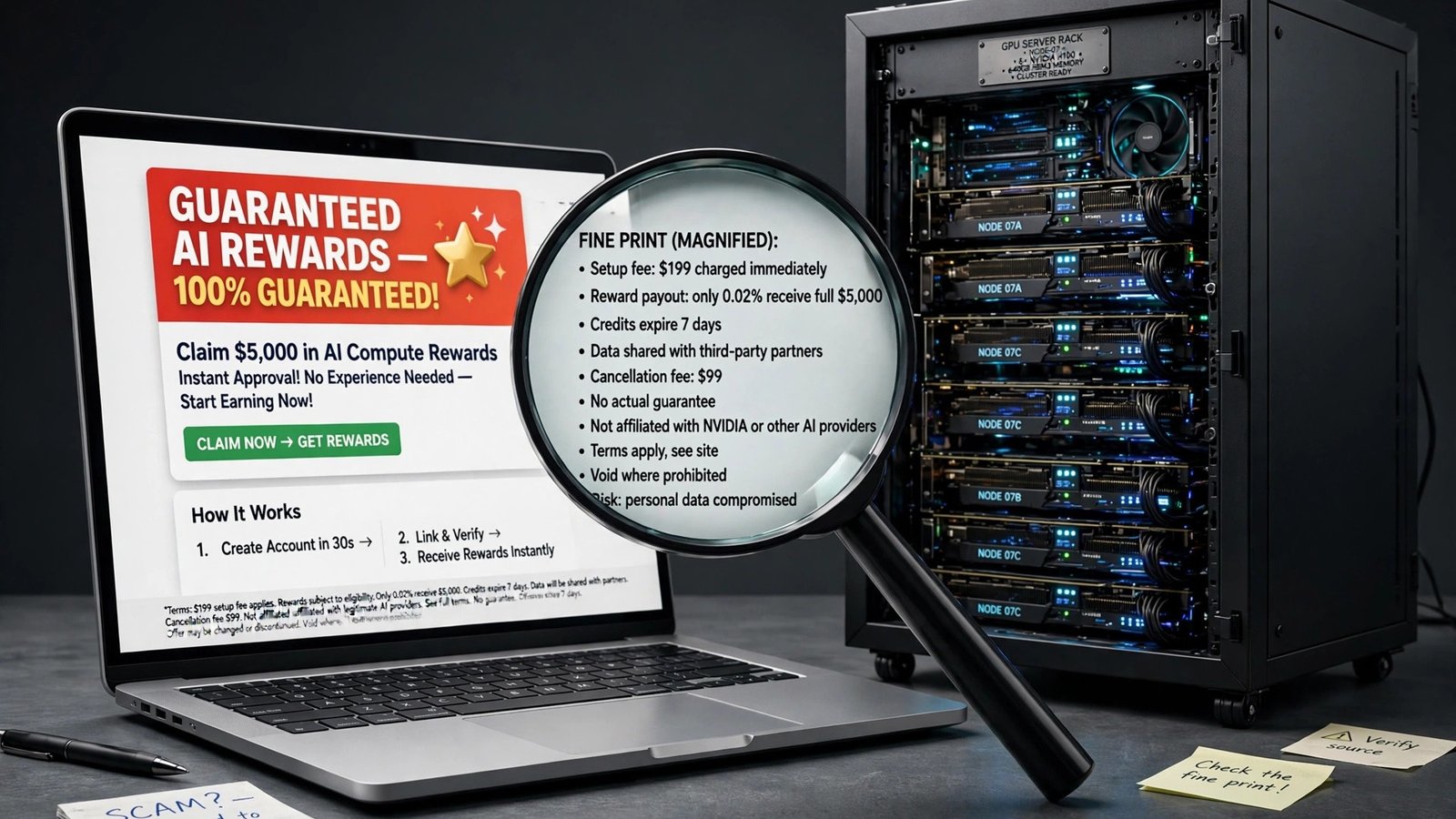
If someone promises you steady rewards for paying into “AI infrastructure” or “AI computing power” plans, stop before you send money. Most of these offers are not investments in real computing hardware. They are pay-in, get-paid-later arrangements where your “rewards” depend entirely on the platform’s own terms, and your ability to withdraw depends on conditions the platform controls. This ai infrastructure participation plans scam check walks you through how the genre works, the seven questions that separate a real opportunity from a risky one, and what legitimate AI earning options actually look like.
You don’t need to be cynical about every AI side hustle to protect yourself. You just need one habit: if you can’t explain where the money comes from in one plain sentence, don’t put money in. Real GPU rentals earn money because someone pays to use computing power. A plan that pays earlier buyers with later buyers’ money follows the pattern the SEC warns about again and again.
What “AI Infrastructure Participation” Actually Means
The phrase sounds technical, and that’s part of the appeal. “Infrastructure” sounds solid. “Participation” sounds like getting in early on something big. But the phrase means nothing specific in finance or computing. It isn’t a regulated product category, a stock, a bond, or a registered fund. It’s marketing language that different platforms use to describe very different things.
In the offers flooding creator feeds right now, the genre usually looks like this: you buy one or more “plans” tied to AI computing power, and the platform credits you with “rewards” based on the plan’s terms. Some dangle a free starter plan to get you in the door. Others tier the plans, so bigger payments promise bigger rewards. Withdrawals are typically subject to minimums, waiting periods, fees, or other conditions buried in the fine print.
Here’s the question that cuts through all of it: are you buying a real, verifiable claim on computing capacity that real customers pay to use, or a promise from a website that it will pay you later? If you can’t verify the first part, assume you’re dealing with the second.
How the Genre Usually Works
The typical playbook has four stages, and it looks similar even when the branding changes.
The hook
You see the offer in a side-hustle roundup, a short-form video, a comment thread, or a message from someone who says they’re earning from it. The pitch leans on AI hype: AI is booming, computing power is scarce, and ordinary people can now “participate” in the infrastructure behind it. The entry point is often framed as low-risk or even free — a starter plan, a signup bonus, or a limited number of free purchases. That low-friction entry is deliberate. It gets you to create an account, see a dashboard balance move, and feel like you’re already earning.
The dashboard
Once you’re inside, you get a dashboard showing your plans, daily rewards, and total balance. Dashboards are cheap to build, and a rising number on a screen is not proof of real revenue. The SEC warns that depictions of accounts rapidly increasing in value are often fake. What matters is whether money from real outside customers is flowing in, and whether you can take your money out.
The upsell
The free or small starter plan pays a little. To earn “more,” you buy bigger plans. This is where the real money changes hands. The platform may also reward you for referring others, which brings in fresh deposits. Referral bonuses aren’t automatically fraud — plenty of legitimate businesses have them — but when referrals become the main way new money enters the system, that’s a serious warning sign.
The withdrawal test
Sooner or later you try to withdraw. This is the moment of truth. Common friction includes moving minimum thresholds, “verification” delays, fees that eat most of your balance, requirements to buy another plan before you can cash out, or sudden “system maintenance” that lasts weeks. Legitimate businesses can have processing times and reasonable fees. What they don’t do is invent new conditions after you’ve paid, or make withdrawing practically impossible while deposits stay instant.
The Math That Gives It Away
You don’t need a finance degree to stress-test one of these offers. You need a calculator and about sixty seconds.
Imagine a plan that costs $100 and pays $3 per day for 60 days — $180 back, an 80% gain in two months, with no mention of risk. Where does that $80 of profit come from? For it to come from real GPU rentals, the platform would need to earn more than $3 per day from your $100 share of computing capacity, after covering electricity, hardware, maintenance, staff, and its own profit. Real rental rates are public and modest: third-party trackers from September and October 2026 put an RTX 4090 at roughly $0.34 to $0.74 per hour and an H100 SXM at roughly $1.73 to $3.49 per hour. Those are gross rates for the whole GPU, before costs — not profits handed to passive plan buyers. And utilization is never 100%: real hardware sits idle and needs maintenance.
Now scale it up. If a platform pays hundreds or thousands of users these returns, the real computing revenue required gets enormous fast. Either it owns a staggering amount of hardware with a staggering number of paying customers — in which case it should show audited evidence of both — or payouts come from new buyers’ deposits. When the pitch can’t survive basic arithmetic, believe the arithmetic.
The 7-Question Vetting Checklist
Run every offer through these seven questions before you spend a dollar. One weak answer is a reason to pause. Two or three mean you should walk away.
1. Who is behind this, and can you verify them?
A real company has real, verifiable people: named founders or executives with traceable professional histories, a real business address (not just a P.O. box or a vague city), and a legal entity you can look up in a business registry. If the “About” page has no names or the company provides no registration details, that’s a fail. The SEC’s advice is blunt: check out the company before you invest, and be extra cautious with firms you’ve never heard of.
2. Is the investment registered, and is the seller licensed?
In the U.S., most investment professionals and firms must be registered with the SEC or state securities regulators. The SEC’s investor alert tells you to verify the license and registration status of anyone offering you an investment in securities using the search tool on Investor.gov. If the platform offers something that functions like an investment — you put money in, you expect profits from someone else’s efforts — but nobody involved is registered, that’s a major red flag. “We’re a tech platform, not an investment” is not a magic shield. What matters is how the arrangement works, not what the marketing calls it.
3. Can you explain, in one sentence, where the returns come from?
Try it out loud: “I earn money because [specific outside customers] pay [this company] for [this specific service], and I own a verifiable share of that revenue.” If your sentence instead sounds like “I earn money because I bought a plan and the platform rewards me,” you haven’t found a revenue source. You’ve found a promise. Vague phrases like “proprietary AI algorithm” or “advanced arbitrage” are not explanations. Legitimate operators can explain their model in plain language.
4. Can you verify the underlying assets?
If the platform claims to own GPUs, data centers, or computing clusters, ask for proof that would hold up outside its own marketing: audited financial statements, independent verification of hardware, verifiable customer contracts, or evidence in public filings. Screenshots of server racks and a live “compute” counter on a dashboard are not verification. Real infrastructure businesses have paperwork — contracts, audits, filings, and customers willing to be named.
5. What are the exact withdrawal terms, in writing, before you pay?
Read the withdrawal terms before you deposit, not after. Look for minimums, holding periods, fees, withdrawal limits, and any requirement to reinvest or buy another plan to unlock withdrawals. Then ask: if this business really earns money from real customers, why would it make it hard to take your own money out? Delays and excuses around withdrawals are one of the SEC’s classic Ponzi warning signs.
6. Does the offer promise guaranteed or unusually consistent returns?
The SEC’s warning is direct: promises of high investment returns with little or no risk are a classic warning sign of fraud, and “guaranteed returns” aren’t real. Every genuine investment carries risk, and higher potential returns come with higher risk. Real computing revenue fluctuates: demand rises and falls, hardware breaks, prices change. A dashboard showing smooth, identical daily profits isn’t evidence of a brilliant system. It’s evidence that the operator sets the numbers, not the market.
7. How much of the growth depends on recruiting new buyers?
Ask where the platform’s growth comes from. If the loudest selling point is the referral program — earn more by bringing in friends, unlock tiers by building a team — the model may depend on new deposits rather than real revenue. Referral marketing alone doesn’t prove fraud, but combined with guaranteed returns, unverifiable assets, and withdrawal friction, it completes a pattern experienced investors run from.
If an offer fails even two of these seven questions, don’t try to talk yourself into it. The next offer will come along, and the checklist will still be here.
Red-Flag Phrases, Translated
Scam-adjacent offers reuse the same language. Here’s what the most common phrases mean in an AI infrastructure pitch.
“Guaranteed rewards” or “guaranteed returns.” No honest investment can guarantee returns. The SEC says this flatly: every investment carries risk, and “guaranteed returns” aren’t real. When you see this phrase, treat it as a warning label, not a selling point.
“Free starter purchases” or “free plans that pay you.” Free is a customer-acquisition cost. Ask what the free plan is acquiring customers for. If the answer is “buying bigger plans,” the free plan is bait. Legitimate free trials let you test a real product. They don’t pay you cash for existing.
“Rewards per plan terms” or “rewards based on platform terms.” Read that phrasing carefully. It means the platform decides what you earn, and it can change the terms. You aren’t earning a share of a market rate. If the terms can change at any time, your “guaranteed” rewards are only as solid as the next terms update.
“Withdrawals subject to platform conditions.” This is the clause that turns a good-looking dashboard into trapped money. Before you deposit, demand the full list of conditions. If the list is vague, assume the conditions will get stricter the moment you try to withdraw.
How Real GPU Rental Marketplaces Actually Work
Here’s the good news: you genuinely can earn money connected to GPU computing without owning GPUs — but it looks nothing like a “participation plan.” It looks like a marketplace, a rental, or a service business, with real customers and real work.
In a real GPU rental marketplace, owners list their hardware and renters pay by the hour to use it. Two of the best-known examples are RunPod and Vast.ai. On RunPod, you rent a “pod” — a container running on a specific GPU — at an hourly rate set by GPU model and tier. On Vast.ai, individual owners list GPUs and renters book capacity at market prices. In both cases the economics are transparent: you see the GPU, the hourly price, storage and network costs, and the terms. Nobody promises you a return for passively holding a “plan.”
The prices tell the real story. Third-party trackers from September and October 2026 show an RTX 4090 renting for roughly $0.34 to $0.74 per hour, an A100 80GB for roughly $0.47 to $1.89 per hour, and an H100 SXM for roughly $1.73 to $3.49 per hour. Those are what renters pay for the whole GPU. After the marketplace cut and the owner’s electricity, internet, and wear-and-tear costs, the net margin is a fraction of the headline rate — and a GPU that sits unrented earns nothing. If someone promises a fixed daily profit from a small “share” of a GPU, compare it to these rates.
There’s a second honest way to participate in GPU economics: provide a service on top of rented compute. Rent GPU time to fine-tune a model for a client, run inference for an app, render video, or train a small model for a business use case — and charge the client for the finished work. You’re a freelancer who rents tools by the hour, like a photographer renting a studio. Your profit comes from the value you deliver, not from the GPU itself.
How Real Listed AI and Infrastructure Exposure Actually Works
If what you want is investment exposure to AI and computing infrastructure, there’s a regulated way to get it: buy shares of publicly traded companies or funds through a licensed brokerage. You own a security that trades on a public exchange, whose price you can check any time the market is open. The companies file audited financial statements with the SEC. You can sell your shares, and the cash settles under rules that are public and standardized.
That’s the whole difference. With a listed security, you can verify the company, verify the price, and exit. With an unregistered “participation plan,” you can verify almost none of that, and your exit depends on the platform’s goodwill.
A few honest expectations: listed exposure is not passive income in the side-hustle sense. Stock prices are volatile, and you can lose a large share of what you put in. Diversified funds spread risk, but they still fall when markets fall. And nobody — not a broker, not a fund manager, not a YouTuber — can guarantee your returns. If someone selling a plan calls listed investing “too slow” while their plan is “guaranteed,” they’re comparing a real, regulated product with an unverifiable promise.
Legit Ways to Earn From AI Without Owning GPUs
If the participation-plan route is off the table, you still have real options for earning from AI. Each involves doing actual work or building something real — which is why they pay.
Sell AI-assisted services. Businesses will pay for AI help right now: setting up chatbots, writing product descriptions, creating social media content, building automations, or cleaning up data. You don’t need infrastructure. You need a skill, a portfolio, and clients. If you’re starting from zero, our guide to the best AI side hustles for beginners in 2026 maps out which services fit your skills.
Build and sell digital products. AI tools can speed up templates, planners, guides, and courses — but the product still has to be genuinely useful. The winning formula is the same one behind any best side hustles for beginners in 2026: find a real problem, solve it, and sell on a platform with real buyers.
Learn in-demand AI skills and freelance them. Prompt engineering, AI workflow setup, niche fine-tuning, and AI-powered video production are all billable skills. They take weeks or months to learn well, which is precisely why clients pay for them. Anyone promising the income without the learning is selling a shortcut — and shortcuts here almost always end at someone else’s wallet.
What to Do If You Already Put Money In
If you already paid into one of these platforms, don’t panic — and don’t throw more money at it to “unlock” your withdrawal. That’s one of the most common ways people turn a small loss into a big one.
1. Stop depositing. Do not buy another plan, pay a “withdrawal fee,” or pay a “tax” or “verification charge” to release your funds. Legitimate platforms don’t hold your money hostage for an extra payment. Every additional dollar you send is a dollar you’re unlikely to see again.
2. Try to withdraw what you can, and document everything. Attempt a withdrawal through the normal process. Screenshot your balance, plan details, withdrawal terms, error messages, and support messages. Save emails and chat transcripts, and note dates and amounts. That paper trail is your evidence if this becomes a report or a dispute.
3. Contact your payment provider. If you paid by card or a payment service, contact the issuer or provider and ask about dispute options — dispute windows are often time-limited, so don’t wait. If you paid with cryptocurrency, recovery is much harder, because crypto transfers generally can’t be reversed. That doesn’t mean you shouldn’t report it, but set your expectations honestly.
4. Report it. In the U.S., report suspected investment fraud to the SEC through Investor.gov and to your state securities regulator. Reporting helps regulators spot patterns and warn others, even if it doesn’t get your money back. Include the platform’s name, website, amounts involved, and your documentation.
5. Tell people you know, and don’t pay a “recovery” service. If friends or family joined through your referral link, tell them what happened. And watch out for a second wave of scammers who target people who already lost money, promising to recover it for an upfront fee. Real regulators don’t charge you to file a report.
The Bottom Line
AI infrastructure is a real industry, and real people earn real money in it — by owning hardware, renting compute, building services, or investing through regulated markets. What doesn’t exist is a free-money machine where you buy a “plan” and collect guaranteed rewards while the platform handles everything behind a curtain. Every time an offer promises that, run the seven-question checklist, do the basic math, and trust the SEC’s simplest rule: if it sounds too good to be true, it probably is.
The AI boom will keep producing new offers, and some will be legitimate. Make sure the ones you put money into can survive a few boring questions: who runs it, where does the money come from, can I verify it, and can I get my money out? If the answers aren’t clear and checkable, keeping your money in your pocket is the smartest AI side hustle of all.
Disclaimer: This article is general education, not professional financial, legal, or investment advice. If you’re considering an investment, do your own research and consider speaking with a licensed financial professional.
Frequently Asked Questions
Are all AI infrastructure participation plans scams?
Not every offer using AI or infrastructure language is a scam, but the genre is high-risk because the phrase is unregulated marketing, not a verified product category. Judge each offer on evidence: verified operators, registered status, a plain-language revenue source, verifiable assets, and clean withdrawal terms. If several are missing, treat it as risky no matter how polished the website looks.
What is the biggest red flag in an AI participation plan?
A promise of guaranteed or unusually consistent returns with little or no risk. The SEC warns this is a classic sign of fraud, because every real investment carries risk and real revenue fluctuates. Combine it with withdrawal friction or pressure to recruit new buyers, and you have a pattern that should make you walk away.
Can I really earn money from GPUs without owning any?
Yes, but through real work or real rentals — not passive plan payouts. You can rent GPU time by the hour on marketplaces like RunPod or Vast.ai to do client work, or rent out hardware you already own. In each case your earnings come from a real customer paying for real computing, and you can see the rates, costs, and terms upfront.
How do I check whether an investment seller is legitimate?
In the U.S., use the SEC’s search tool on Investor.gov to check the license and registration status of the people and firms offering an investment, and check with your state securities regulator for more information. Be cautious with unlicensed sellers and unregistered investments — the SEC notes they commit much of the securities fraud targeting retail investors.
I already paid into a plan and can’t withdraw. What should I do first?
Stop sending money — don’t pay extra fees or buy another plan to “unlock” your withdrawal. Document everything, try the normal withdrawal process once, and contact your payment provider about dispute options. Then report the platform to the SEC through Investor.gov and to your state securities regulator.
What is a safer way to get exposure to AI growth?
The regulated route is buying shares of publicly traded companies or funds through a licensed brokerage, where you can verify the company, see the market price, and sell your shares. Expect volatility and possible losses — no honest investment guarantees returns. For income, consider AI freelancing, digital products, or content creation, where you get paid for real work rather than for holding a plan.